Best Aquarium Filters 2026: 5 Canister & HOB Picks by Tank Size
There is no single best aquarium filter for every tank. For a 20–45 gallon setup where canister media capacity and below-tank plumbing fit your maintenance routine, the Fluval 207 is our top research pick; for easy rim-top service on 40–70 gallon aquariums, the Fluval AC70 is the HOB alternative; for larger systems within a published up-to-200-gallon range, the Penn-Plax Cascade 1500 is the large-system canister option. PetGearReport has not physically tested these filters, so we compare documented tank fit, media architecture, flow-label context, maintenance requirements and manufacturer support rather than treating unlike GPH figures as head-to-head performance measurements.
| Rank | Product | Score | Best for | Link |
|---|---|---|---|---|
| #1 | Fluval 207 Performance Canister FilterTop pick | 9 | 20–45 gallon setups that want documented canister media capacity and a below-tank filter layout | Check price → |
| #2 | Fluval AC70 Power FilterBest HOB for 40–70 gal | 9 | 40–70 gallon aquariums where easy top-access media service and adjustable HOB flow are priorities | Check price → |
| #3 | MarineLand Penguin PRO 275 Power FilterBest Bio-Wheel option | 8 | Aquariums up to 50 gallons where a HOB with adjustable flow and Marineland BIO-Wheel architecture is specifically wanted | Check price → |
| #4 | Marineland Penguin Bio-Wheel 200 Power FilterSimple HOB pick | 8 | Aquariums up to 40 gallons that fit a straightforward cartridge-and-BIO-Wheel HOB workflow | Check price → |
| #5 | Penn-Plax Cascade CCF5UL Canister FilterLarge-system canister | 8 | Larger aquariums within the manufacturer's up-to-200-gallon envelope where a five-basket canister layout is useful | Check price → |
Specifications compared
| Spec | Fluval 207 Performance Canister Filter | Fluval AC70 Power Filter | MarineLand Penguin PRO 275 Power Filter | Marineland Penguin Bio-Wheel 200 Power Filter | Penn-Plax Cascade CCF5UL Canister Filter |
|---|---|---|---|---|---|
| Flow rate (GPH) | 206 | — | 275 | — | 350 |
| Max tank size (gal) | 45 | 70 | 50 | — | 200 |
| Filter type | — | — | Three-stage: mechanical, chemical, biological | Three-stage: mechanical, chemical, biological | Canister |
#1 · Our PickTop pick
Fluval 207 Performance Canister Filter
Best for: 20–45 gallon setups that want documented canister media capacity and a below-tank filter layout
What we like
- Manufacturer-rated for 20–45 US gal aquariums
- Separately documents 206 GPH pump output and 121 GPH filter circulation
- Vertical pre-filter plus multiple media stages
- Canister layout keeps intake and return hardware at the aquarium rather than a filter box on the rim
What we don't
- Requires hose routing and space below the aquarium
- More involved to disconnect and service than a typical HOB
- 45-gallon upper manufacturer rating means larger aquariums need a different model

Fluval specifies the 207 for 20–45 US gal / 60–220 L aquariums. Its documentation lists 206 GPH pump output and, separately, 121 GPH filter circulation. That distinction matters: the pump figure and the complete-filter circulation figure describe different conditions and should not be substituted for one another.
The 07 Series routes water through a vertical pre-filter before the media trays, giving the 207 a clearly documented mechanical-to-media flow path. That architecture is useful when you want separate mechanical, biological or optional chemical media stages rather than a simple replaceable-cartridge workflow. The trade-off is the normal canister-filter footprint: the unit sits below the aquarium and uses intake/return hoses, so setup and servicing involve more hardware than a rim-mounted HOB.
Choose the 207 because the manufacturer's 20–45 gallon envelope fits your tank and the canister architecture fits your maintenance preferences—not because its 206 GPH pump-output number looks larger than another brand's differently defined flow specification.
Our top research pick because Fluval documents the 207's sizing envelope, hydraulic figures and media system unusually clearly, making fit easier to assess before purchase.
Check price on Amazon →#2Best HOB for 40–70 gal
Fluval AC70 Power Filter
Best for: 40–70 gallon aquariums where easy top-access media service and adjustable HOB flow are priorities
What we like
- Manufacturer-rated for 40–70 US gal aquariums
- 300 GPH maximum flow rate
- Adjustable flow control
- Open media-basket design supports staged foam, carbon and BioMax media
What we don't
- Filter body remains visible on the aquarium rim
- 300 GPH is published as maximum flow rate, not the same metric as Fluval 207 filter circulation
- Requires clearance behind the tank for the HOB body and intake
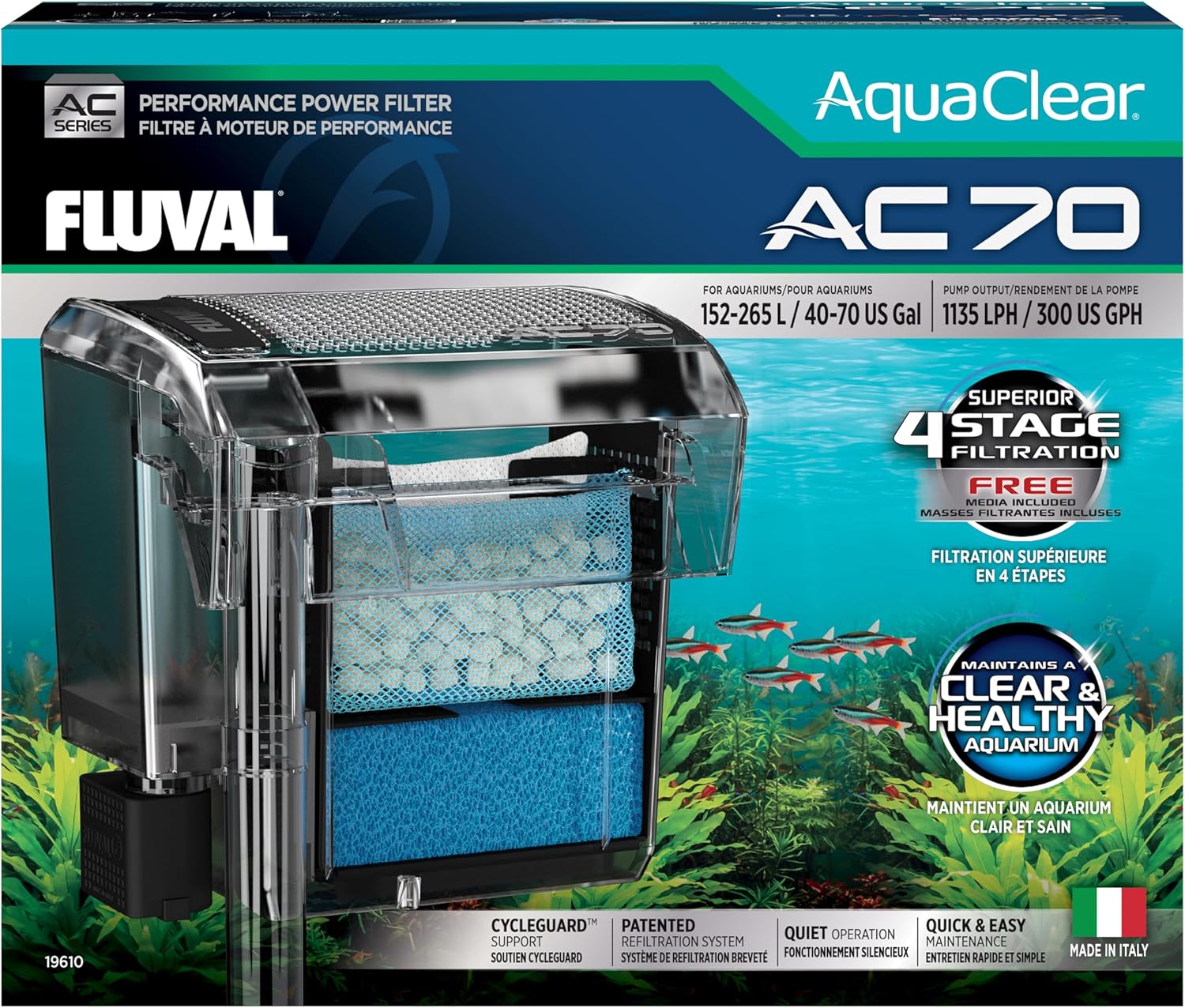
Fluval's current AC Series documentation specifies the AC70 for 40–70 US gal / 152–265 L aquariums and lists a 300 GPH maximum flow rate. The model also provides flow adjustment and an open media basket rather than a sealed cartridge-only path.
That makes the AC70 attractive when you want to reach media from the top of the aquarium instead of disconnecting a canister. It also lets you work with separate foam, activated carbon and BioMax stages. The main compatibility questions are physical: the HOB body needs room behind the aquarium, the intake has to fit the tank, and the resulting current still needs to suit the livestock.
Do not compare the AC70's 300 GPH maximum flow rate directly with the Fluval 207's 121 GPH filter-circulation figure as if they were the same measurement. Start with the manufacturer tank range and architecture, then use the published hydraulic label only in its documented context.
The strongest HOB fit in this shortlist when the 40–70 gallon manufacturer range, adjustable flow and open media basket match the aquarium.
Check price on Amazon →#3Best Bio-Wheel option
MarineLand Penguin PRO 275 Power Filter
Best for: Aquariums up to 50 gallons where a HOB with adjustable flow and Marineland BIO-Wheel architecture is specifically wanted
What we like
- 275 GPH manufacturer flow rate
- Rated for aquariums up to 50 gallons
- Adjustable flow via the Vortex pump
- Three-stage mechanical, chemical and BIO-Wheel biological filtration
What we don't
- Uses Marineland Rite-Size filter cartridges in the documented chemical/mechanical workflow
- 50-gallon upper rating limits its role in larger systems
- BIO-Wheel adds a moving biological component that needs to remain unobstructed

Marineland documents the Penguin PRO 275 at 275 GPH for aquariums up to 50 gallons. The PRO line combines mechanical, chemical and biological stages, with the BIO-Wheel providing a wet/dry surface for nitrifying bacteria and the Vortex pump providing flow control.
Its design choice is also its main trade-off. The documented workflow uses Marineland Rite-Size cartridges alongside the BIO-Wheel, so it is less open-ended than the AquaClear media basket if your priority is freely configuring every media stage. The wheel should also stay able to rotate as part of the intended biological stage.
The PRO 275 earns its place for a specific architecture and tank envelope—not because a 275 GPH label proves it outperforms a canister with a differently defined circulation specification.
A well-documented HOB choice for buyers who want the Penguin PRO's adjustable-flow and BIO-Wheel system rather than an open media basket.
Check price on Amazon →#4Simple HOB pick
Marineland Penguin Bio-Wheel 200 Power Filter
Best for: Aquariums up to 40 gallons that fit a straightforward cartridge-and-BIO-Wheel HOB workflow
What we like
- Exact current listing identifies 200 GPH output
- Current exact variant is listed for aquariums up to 40 gallons
- Three-stage filtration with BIO-Wheel biological stage
- Straightforward HOB form factor
What we don't
- Current exact variant tops out at 40 gallons rather than the older 30–50 gallon wording
- Cartridge-based media workflow is less configurable than an open basket
- Published 200 GPH figure should be interpreted within this model's own documentation

The exact B0009IODZG variant is currently identified as the Marineland Penguin 200 GPH power filter for aquariums up to 40 gallons. That corrects the older 30–50 gallon wording previously attached to this product on PetGearReport.
The classic Penguin uses a three-stage HOB architecture with mechanical/chemical cartridge filtration and a BIO-Wheel biological stage. It is a more prescriptive media workflow than the AquaClear basket, which can be a limitation if you want to customize each stage extensively.
Treat 200 GPH as this model's published flow figure, not as a universal performance score. Tank fit, media architecture, livestock current tolerance and maintenance access remain separate decision inputs.
A simpler Penguin option whose current exact-variant 200 GPH / up-to-40-gallon identity is clearer than the stale 30–50 gallon wording previously on this page.
Check price on Amazon →#5Large-system canister
Penn-Plax Cascade CCF5UL Canister Filter
Best for: Larger aquariums within the manufacturer's up-to-200-gallon envelope where a five-basket canister layout is useful
What we like
- Cascade 1500 / CCF5UL is documented at 350 GPH
- Recommended for aquariums up to 200 gallons
- Five media baskets provide configurable filtration stages
- Canister layout includes separate intake and return plumbing
What we don't
- Large canister and hose system needs suitable below-tank space
- 350 GPH is the model's published flow figure; Penn-Plax does not label it as the same filter-circulation metric Fluval publishes for the 207
- Five baskets create more media to inspect and service than a small HOB

Penn-Plax identifies the CCF5UL as the Cascade 1500. Current model documentation and exact-variant listing data specify 350 GPH, use for aquariums up to 200 gallons, and five media baskets. That gives it the broadest documented tank-capacity envelope in this shortlist.
The five-basket canister layout is useful when you want to separate media stages, but it also means a physically larger filter with intake/return hoses and more media to inspect during service. Those are workflow differences, not evidence that the design is automatically better for every large aquarium.
As with the other products, the 350 GPH label is kept in its manufacturer context. Penn-Plax does not present it as the same filter-circulation measurement Fluval publishes for the 207, so we do not use the two numbers as a direct head-to-head performance test.
The large-system option in this set, selected for its documented 350 GPH, up-to-200-gallon envelope and five-basket architecture rather than price positioning.
Check price on Amazon →If you already have a specific model in mind, use the aquarium filter sizing & flow calculator to compare your actual water-volume estimate with the manufacturer range and keep unlike flow labels separate before using any GPH/LPH ratio.
If the tank size itself is the shopping constraint, use the dedicated 5-gallon, 10-gallon, 20-gallon, 29/30-gallon, 40-gallon, 55-gallon, 75-gallon, 90-gallon, or 125-gallon filter guide for exact current-model fit and architecture trade-offs rather than treating this broad roundup as a gallon-by-gallon sizing table.
If the livestock itself is the main constraint, the goldfish filter guide compares current HOB and canister options by manufacturer tank range, mechanical/biological media, flow control and maintenance access, with separate gentle-current guidance for fancy goldfish. For calm-water Siamese fighting fish, the betta filter guide compares sponge, adjustable HOB and powered-internal options while keeping filter product ratings separate from welfare tank sizing. For freshwater shrimp, the shrimp filter guide prioritizes shrimplet intake safety, gentle flow and guarded powered-filter intakes. For amphibian-specific low-flow filtration, the axolotl filter guide compares sponge, canister and conditional HOB options using veterinary flow guidance and manufacturer-specific hydraulic labels.
Which aquarium filter type fits your tank?
The five ranked products on this page are powered HOB and canister filters. Sponge filters are not part of this five-product powered-filter ranking, because they solve a different set of problems: gentle current, intake safety, air-driven biological filtration and simple service. Use the architecture shortcut below before comparing individual models.
| Filter type | Strong fit when you prioritize | Main trade-offs to check | Next guide |
|---|---|---|---|
| Sponge filter | Shrimp, fry, breeding, quarantine and calm-flow setups; intake safety and simple biological media | Requires an air pump; coarse debris capture and whole-tank circulation depend on sponge size, air delivery and placement | Best aquarium sponge filters |
| Hang-on-back (HOB) | Rim-mounted access and simpler routine service; quick access to media without cabinet plumbing | Needs rear/rim clearance; return current and intake exposure still have to suit the livestock | Best aquarium HOB filters |
| Canister filter | More configurable external media and flexible intake/return placement; larger below-tank media systems | Requires hose routing, cabinet/floor space and a more involved disconnect/service workflow | Best aquarium canister filters |
This is an architecture decision, not a universal hierarchy. A well-matched sponge filter can be the better choice for shrimp or fry even though it does not appear in the powered-filter top five below; a HOB can be the better operational choice when easy media access matters; and a canister can be the better fit when external media capacity and return placement justify the extra plumbing.
For direct architecture comparisons, use sponge filter vs HOB, sponge filter vs canister, or canister vs HOB.
How we researched and scored
PetGearReport has not physically tested these filters. This is a research-based comparison built from current manufacturer documentation, exact-product identity checks and documented specifications. The scores below are PetGearReport research scores—editorial assessments of documented features and use-case fit, not hands-on measurements, laboratory results, customer ratings or Amazon ratings.
We applied the same five weighted categories to every filter:
- Tank fit & hydraulic documentation — 30% — clarity of the manufacturer aquarium range and of what each published flow figure represents.
- Media architecture — 25% — documented mechanical/biological/chemical media path, usable staging and configuration options.
- Flow control & livestock fit — 15% — documented adjustment options plus how clearly the design can be matched to livestock current needs.
- Maintenance/serviceability — 15% — documented access, disconnect or media-service workflow.
- Documentation/parts support — 15% — quality of current manufacturer specifications, instructions and replacement-media/parts support.
| Filter | Tank fit / hydraulics (30%) | Media architecture (25%) | Flow / livestock fit (15%) | Maintenance (15%) | Documentation / parts (15%) | Weighted result | Published score |
|---|---|---|---|---|---|---|---|
| Fluval 207 | 10 | 9 | 8 | 9 | 9 | 9.15 | 9/10 |
| AquaClear 70 | 9 | 9 | 9 | 9 | 9 | 9.00 | 9/10 |
| Penguin PRO 275 | 9 | 8 | 9 | 8 | 8 | 8.45 | 8/10 |
| Penguin 200 | 8 | 7 | 7 | 8 | 8 | 7.65 | 8/10 |
| Penn-Plax Cascade 1500 | 9 | 9 | 8 | 8 | 7 | 8.35 | 8/10 |
The weighted decimals make the editorial method auditable; they do not imply real-world measurement precision. Published scores are rounded to whole numbers. Current price and availability are excluded because they change, and customer/Amazon ratings are not converted into PetGearReport scores. Rank order also reflects the intended use case: a filter built for a 200-gallon system is not automatically a better recommendation for a 40-gallon aquarium simply because its capacity number is larger.
Read the hydraulic label before comparing GPH
Manufacturer flow labels such as pump output, filter circulation, and maximum flow rate are not interchangeable.
Fluval, for example, publishes both 206 GPH pump output and 121 GPH filter circulation for the 207. Its AC70 page instead publishes 300 GPH as maximum flow rate. Marineland lists model flow rates for the Penguin line, while Penn-Plax publishes the Cascade 1500 at 350 GPH. Those numbers are useful inside each manufacturer’s documented context, but a higher number under one label is not proof of greater complete-filter performance than a lower number under another label.
Use our aquarium filter size guide when adjacent model ranges overlap. It explains how to combine manufacturer capacity, hydraulics, media volume, livestock flow tolerance and maintenance constraints without inventing one universal turnover target.
Choose media architecture, not just motor size
A filter is also a media-management system. The Fluval 207 uses a vertical pre-filter and media trays; AquaClear uses an accessible HOB basket; Marineland’s Penguin designs combine cartridges with BIO-Wheel biological media; and the Cascade 1500 provides five media baskets. Our aquarium filter media guide explains mechanical, biological and optional chemical media by function and why the exact intake-to-output water path matters. The aquarium filter maintenance guide covers cleaning those stages, impeller/housing service and restart checks without wholesale bio-media replacement. If an installed filter has stopped, lost flow, become noisy or started leaking, use the aquarium filter not working guide before replacing it. If you need cut-to-fit mechanical material for a compatible basket or chamber, our aquarium filter pads & floss guide compares reusable foam, dual-density rolls and fine polishing media. If optional chemical filtration is the specific need, our activated carbon guide compares current loose and pre-bagged carbon options.
If gentle current and intake safety are more important than a high-capacity powered HOB or canister, compare the best aquarium sponge filters. If the powered filter itself is appropriate but its bare intake needs protection for fry or small shrimp, our pre-filter sponge guide covers intake measurement, fit and maintenance. For a direct HOB product decision, our Tidal 55 vs AquaClear 70 comparison compares two current open-media designs. If you are deciding specifically between air-driven sponge filtration and a powered rim filter, use our sponge filter vs HOB comparison; if the powered alternative is a canister, use the sponge filter vs canister comparison. For the broader powered-filter architecture decision, our canister filter vs HOB filter guide separates setup, media access and plumbing differences without declaring one type universally superior. If you already know you want a rim-mounted powered filter, our best aquarium HOB filters guide compares dedicated HOB models; if you want a below-tank canister, our best aquarium canister filters guide compares dedicated canister models, Fluval 107 vs 207 covers the smallest 07 Series overlap, Fluval 207 vs 307 covers the smaller 07 Series overlap, the Fluval 307 vs 407 comparison covers the next 07 Series sizing decision, and Fluval FX2 vs FX4 covers the first larger FX step, while Fluval FX4 vs FX6 compares the two full-size FX models by canister/media volume, filter circulation, cabinet height, head pressure and power draw. For the rest of the setup and care context, browse our aquarium guides.
Size for the aquarium you actually run
Manufacturer tank range is the first boundary, not the whole decision. Tank shape, hardscape, stocking, feeding, livestock current tolerance and where the intake/return can physically sit all affect whether a model is a good fit. Moving to the next model up can be reasonable near the upper end of a published range, but stronger flow and larger hardware can also be the wrong trade-off for calm-water livestock or a cramped aquarium.
Watch water clarity, ammonia, nitrite and the rest of the water-parameter trend, and observed flow instead of assuming every cloudy-water or water-quality problem needs a larger filter. A filter can only perform consistently if its media and plumbing are maintained, so use the aquarium maintenance schedule as an adaptive framework rather than a rigid replacement calendar. If the problem is specifically free-floating green water and UV is already a justified tool, see our best aquarium UV sterilizers & clarifiers guide; UV does not replace the main mechanical or biological filter.
A new filter also does not make a new aquarium instantly cycled. Use our fishless cycling guide to verify biofilter establishment with water testing instead of a fixed elapsed-time promise.
For aquascapes where plant mass, return geometry and service access are the main constraints, use our planted-tank filter guide. It compares canister, HOB and sponge options without treating one GPH label as a universal planted-tank target.
For aquatic turtles, use the turtle-tank filter guide, which applies veterinary flow guidance to actual habitat water volume and compares canister media/service trade-offs without flattening unlike manufacturer GPH labels. For warm-water discus, the discus filter guide adds gentle-current constraints, serviceability and species-specific water-quality context. For medium and large cichlid systems, the cichlid filter guide prioritizes debris handling, media capacity and maintenance without turning unlike GPH labels into one rule.
Sources and verification notes
Specifications were checked against current manufacturer documentation before this update. Where an exact current standalone manufacturer product page was not readily available, we kept claims narrow and used exact-variant identity checks rather than extrapolating from a similar model.
- Fluval 207: Fluval 207 manufacturer page — 20–45 US gal, 206 GPH pump output, 121 GPH filter circulation and current media-system specifications.
- AquaClear 70: Fluval AC Series manufacturer page — 40–70 US gal and 300 GPH maximum flow rate, plus current AC Series architecture.
- Marineland Penguin PRO 275: Marineland Penguin PRO manufacturer page — 275 GPH, up to 50 gallons, three-stage filtration, BIO-Wheel and flow-control documentation.
- Marineland Penguin 200: Marineland Penguin family documentation plus exact Amazon variant
https://www.amazon.com/dp/B0009IODZG— exact current variant identity checked as 200 GPH / up to 40 gallons. We do not carry forward the page’s previous 30–50 gallon wording. - Penn-Plax Cascade CCF5UL / Cascade 1500: Penn-Plax manufacturer site plus exact Amazon variant
https://www.amazon.com/dp/B0002DJ9PW— exact identity and current model documentation support 350 GPH, up to 200 gallons and five media baskets. Claims are limited to documented model attributes rather than inferred noise, durability or priming performance.
Frequently asked questions
What is the best aquarium filter?
There is no universal winner because tank volume, livestock flow tolerance, media needs, available space and maintenance access change the fit. In this researched shortlist, the Fluval 207 is our top canister pick for its documented 20–45 gallon range and media architecture, the Fluval AC70 is the HOB alternative for 40–70 gallons, and the Penn-Plax Cascade 1500 is the large-system canister option within its published up-to-200-gallon range.
What size filter do I need for my aquarium?
Start with the exact manufacturer's published aquarium range and keep your tank within it. Then compare the model's hydraulic specification in its stated context, media capacity, livestock flow tolerance, bioload, tank layout and maintenance access. Our aquarium filter size guide explains why a turnover ratio is useful context but not a universal sizing rule.
Canister or hang-on-back filter, which is better?
Neither architecture is universally better. HOB filters generally make the filter body and media easier to reach from the tank rim, while canisters can provide more configurable media space and flexible intake/return placement. The better choice is the architecture that fits the exact tank, livestock flow needs, available space and maintenance routine.
How often should I clean my aquarium filter?
Use observed flow, visible debris or media loading, water-quality trends and the exact manufacturer's service guidance rather than one universal calendar. Mechanical media may need attention sooner in a heavily loaded system. When established biological media needs a gentle rinse, removed aquarium water or suitably dechlorinated water avoids exposing it to untreated disinfectants. Replace or regenerate chemical media according to the exact media product and its intended use rather than assuming a fixed monthly schedule.
Will a new filter cycle my tank instantly?
No. A new filter provides surfaces where nitrifying microorganisms can establish, but elapsed time alone does not confirm cycling. Follow ammonia and nitrite test results and the wider water-quality trend before treating the biofilter as established. Mature seeded media can change the process, but testing remains the verification step; see our cycling guide and aquarium water parameters guide for the decision workflow.