Best Bird Cages 2026: 5 Picks by Size & Bar Spacing
Bird-cage fit starts with species-specific enclosure dimensions and bar spacing, not a generic small/medium-bird label. For this refresh PetGearReport screened current cage specifications against Merck Veterinary Manual minimums and Association of Avian Veterinarians enclosure-safety guidance, then compared usable interior space, access, cleaning design and documentation. PetGearReport has not assembled, used, measured or durability-tested these cages. The five picks below are research-based options with unusually complete current manufacturer documentation; all five happen to be Prevue models, which reflects documentation quality and fit evidence rather than sponsorship or a paid brand preference.
| Rank | Product | Score | Best for | Link |
|---|---|---|---|---|
| #1 | Prevue F050 Large Flight Bird CageBest overall flight cage | 9 | Small-bird setups where the 1/2-inch spacing and large documented interior meet the species-specific veterinary screening baseline | Check price → |
| #2 | Prevue F037 Charming Aviary Flight Cage JumboBest large aviary | 9 | Owners prioritizing the largest documented interior in this shortlist for small-to-medium birds after confirming species-specific spacing and wire strength | Check price → |
| #3 | Prevue F040 Flight Bird CageBest compact rolling flight cage | 9 | Budgerigar/cockatiel/lovebird/parrotlet-class screening where a smaller rolling footprint is preferable to the F050 | Check price → |
| #4 | Prevue F085 Playtop Flight Cage with StandBest playtop option | 8 | Small-bird homes that want a documented playtop design without treating the external play area as extra cage volume | Check price → |
| #5 | Prevue F035 Charming Aviary LargeBest smaller-footprint aviary | 8 | Small-bird setups needing a narrower floor footprint while still clearing the Merck small-bird dimensional baseline | Check price → |
#1 · Our PickBest overall flight cage
Prevue F050 Large Flight Bird Cage
Best for: Small-bird setups where the 1/2-inch spacing and large documented interior meet the species-specific veterinary screening baseline
What we like
- 36 1/8 × 22 1/8 × 47 in documented interior living space
- 1/2 in wire spacing matches the Merck reference spacing for budgerigar, cockatiel, lovebird and parrotlet class birds
- Two front doors plus six side access doors
- Pull-out grille and tray with rolling casters
- Current manufacturer page publishes dimensions, materials, cleaning and inspection guidance
What we don't
- Its 22 1/8 in interior depth is below Merck's 24 in conure-class minimum width
- Large floor footprint compared with compact cages
- Species fit still depends on the individual bird, bar strength, furnishings and veterinary guidance
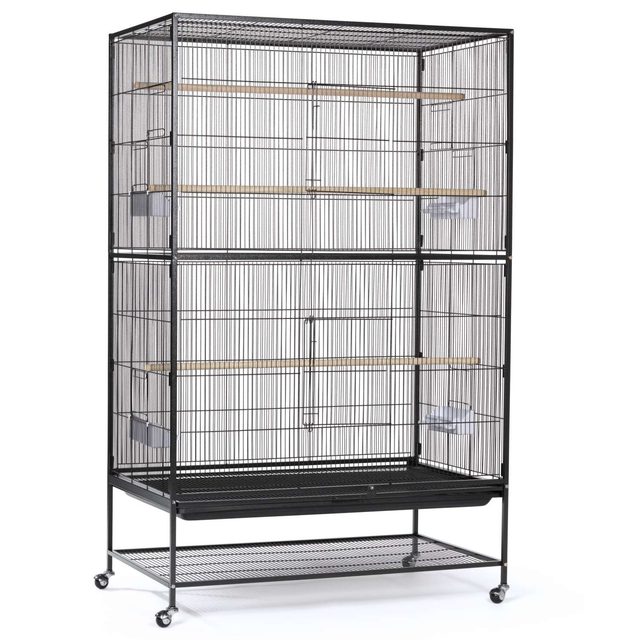
Prevue publishes the F050 at 37 × 23 × 60 inches overall, with 36 1/8 × 22 1/8 × 47 inches of interior space and 1/2-inch wire spacing. That combination clears the Merck Veterinary Manual minimum dimensions of 20 × 20 × 30 inches and matches its 0.5-inch reference spacing for budgerigars, cockatiels, lovebirds and parrotlets. That is a screening comparison, not a guarantee that every individual bird or multi-bird setup is appropriate.
The manufacturer documents two front doors, six side doors, a pull-out grille and tray, rolling casters, powder-coated steel mesh and routine inspection/removal-from-use guidance when worn or damaged. Those documented access and maintenance features are why the F050 ranks first here; PetGearReport has not timed cleaning, tested coating durability or assembled the cage.
The F050 should not be treated as a conure recommendation simply because Prevue labels it for small-to-medium birds. Its 22 1/8-inch interior depth falls short of Merck's 36 × 24 × 48-inch minimum reference for the conure/Poicephalus/caique/miniature-macaw group.
Our strongest research pick because its 1/2-inch spacing, large interior and current manufacturer documentation make species-fit screening unusually transparent before purchase.
Check price on Amazon →#2Best large aviary
Prevue F037 Charming Aviary Flight Cage Jumbo
Best for: Owners prioritizing the largest documented interior in this shortlist for small-to-medium birds after confirming species-specific spacing and wire strength
What we like
- 36 × 27 × 53 3/4 in documented interior
- 7/16 in wire spacing
- Two large front doors plus side cup access
- Pull-out floor grille and debris tray
- Current manufacturer page publishes exact model, UPC, interior dimensions and wire gauge
What we don't
- Substantially larger footprint than the other picks
- 7/16 in spacing is narrower than Merck's 0.75 in conure-class reference, so bar gauge and species-specific suitability still need confirmation
- Peaked roof increases overall footprint beyond the core cage dimensions
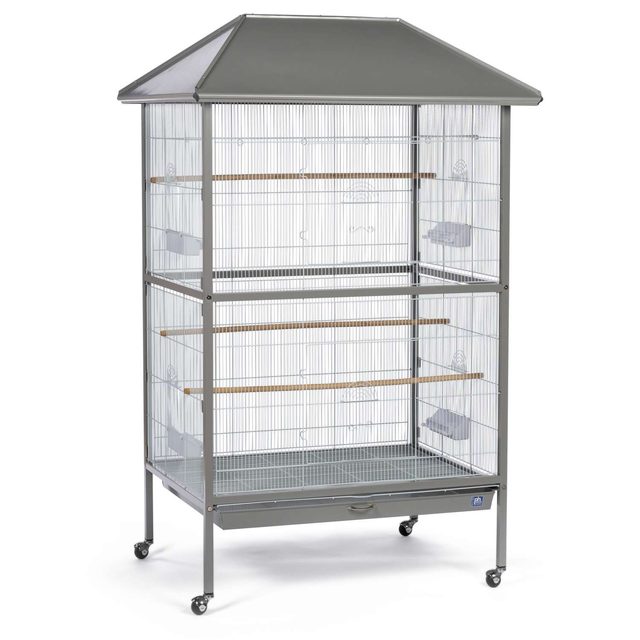
Prevue lists the F037 interior at 36 × 27 × 53 3/4 inches with 7/16-inch wire spacing. Its dimensions meet or exceed the Merck 36 × 24 × 48-inch dimensional minimum for the conure-class row, while the spacing is considerably narrower than Merck's 0.75-inch reference. Narrower spacing can reduce head-entrapment opportunity, but spacing alone does not establish suitability for a stronger-billed bird; wire gauge, individual bird behavior and avian-veterinary guidance still matter.
The manufacturer documents two large front doors, inset slide-up doors, side cup access, a pull-out grille and tray, casters and a cage-wide toy bar. PetGearReport has not measured door security, assembly quality or long-term coating wear.
Choose the F037 when maximizing documented interior space is the priority and you can verify the exact species against the enclosure and wire construction. For multiple birds, Merck advises more space than the single-bird minimum, so the larger footprint should not be converted into a fixed bird-count claim.
The largest documented living space here, with unusually complete first-party dimensions and access details; use the veterinary table as a screening baseline, not a universal species label.
Check price on Amazon →#3Best compact rolling flight cage
Prevue F040 Flight Bird Cage
Best for: Budgerigar/cockatiel/lovebird/parrotlet-class screening where a smaller rolling footprint is preferable to the F050
What we like
- 30 1/4 × 20 1/4 × 40 in documented interior
- 1/2 in wire spacing
- Pull-out grille and debris tray
- Rolling casters and multiple access doors
- Manufacturer publishes assembly, cleaning and inspection guidance
What we don't
- Less interior width than F050 and F037
- Not dimensionally appropriate for the Merck conure-class minimum
- Supplied dowel perches should not replace a varied perch setup suited to the bird
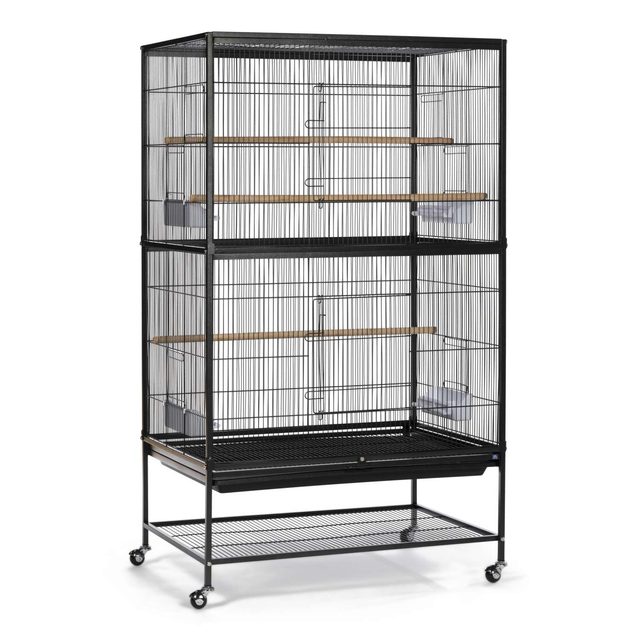
Prevue documents the F040 at 31 × 20 1/2 × 53 inches overall, with 30 1/4 × 20 1/4 × 40 inches of interior living space and 1/2-inch wire spacing. Those figures exceed Merck's 20 × 20 × 30-inch dimensional minimum and match the 0.5-inch reference spacing for budgerigars, cockatiels, lovebirds and parrotlets.
The F040 includes a floor grille, debris tray, casters, cups and wood dowels, and the manufacturer tells owners to inspect the cage during routine cleaning and remove it from use when worn or damaged. Those are useful documented ownership details, but they are not evidence that PetGearReport has tested service time or durability.
Compared with F050, the F040 trades away interior length for a smaller footprint. That can be practical where room space is limited, provided the exact bird still has adequate movement space after perches, toys and feeding stations are installed.
A compact alternative whose 1/2-inch spacing and 30 1/4 × 20 1/4 × 40-inch interior remain easy to compare against the veterinary small-bird baseline.
Check price on Amazon →#4Best playtop option
Prevue F085 Playtop Flight Cage with Stand
Best for: Small-bird homes that want a documented playtop design without treating the external play area as extra cage volume
What we like
- 35 1/2 × 22 × 46 in documented living space
- 7/16 in wire spacing
- Closeable playtop plus storage shelf
- Removable grille and tray with rolling casters
- Exact model/UPC and current manufacturer dimensions are documented
What we don't
- Falls slightly below the Merck 36 × 24 × 48 in conure-class dimensional minimum
- Playtop adds height but does not substitute for interior living space
- Manufacturer small/medium label still needs species-specific veterinary screening
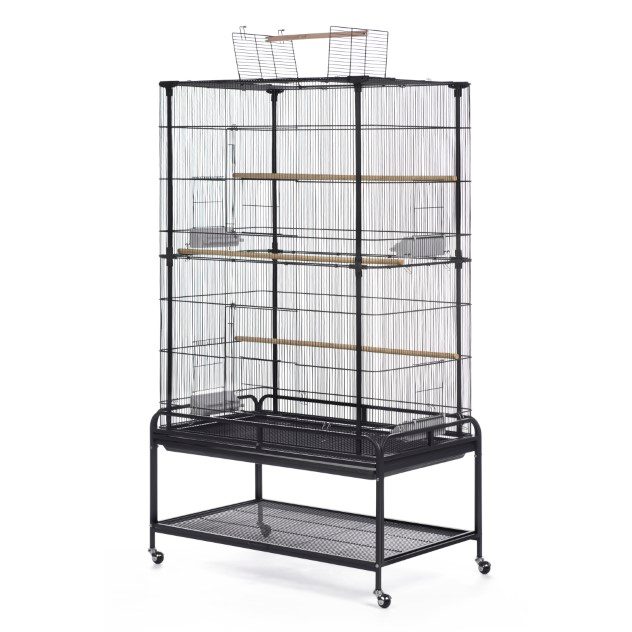
Prevue lists the F085 living space at 35 1/2 × 22 × 46 inches with 7/16-inch wire spacing. That is generous relative to Merck's 20 × 20 × 30-inch small-bird minimum, but it is below all three dimensions of the 36 × 24 × 48-inch conure-class reference. For that reason, PetGearReport does not present it as a generic 'medium bird' or conure cage just because a manufacturer category uses broad size labels.
The playtop can be securely closed, and the cage includes front access, a storage shelf, removable grille/tray, perches, cups and casters. The playtop can add supervised out-of-cage utility, but it should not be counted as interior living volume.
Use this model when the playtop workflow is genuinely useful and the exact bird fits the enclosure after a species-specific check.
A well-documented playtop choice, but we keep the recommendation narrow because its 35 1/2 × 22 × 46-inch living space does not meet Merck's conure-class dimensional baseline.
Check price on Amazon →#5Best smaller-footprint aviary
Prevue F035 Charming Aviary Large
Best for: Small-bird setups needing a narrower floor footprint while still clearing the Merck small-bird dimensional baseline
What we like
- About 23 5/8 × 23 × 53 3/4 in documented interior
- 7/16 in wire spacing
- Two large front doors plus side access doors
- Pull-out grille and debris tray with casters
- Manufacturer publishes exact model/UPC, material and cleaning details
What we don't
- Much narrower interior length than F037 and F050
- Does not meet Merck's 36 × 24 × 48 in conure-class dimensional minimum
- Tall shape should not be mistaken for equivalent horizontal flight room
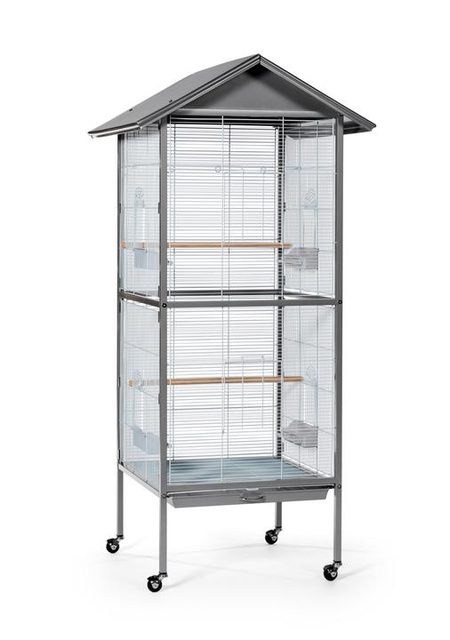
Prevue lists the F035 at roughly 23 5/8 × 23 × 53 3/4 inches of interior space with 7/16-inch wire spacing. Those dimensions clear the Merck 20 × 20 × 30-inch small-bird minimum, but they are well below the 36-inch interior length in the conure-class reference.
The current manufacturer page documents powder-coated steel components, two large front doors, side access doors, a pull-out grille and tray, casters, cups, perches and a toy bar. PetGearReport has not tested how quickly the cage cleans or how the coating ages in a particular home.
Choose the F035 when floor-space width is a real constraint and the exact bird fits the smaller-bird screening envelope. Do not use the tall overall profile as a substitute for checking interior length, width, spacing and the bird's ability to move normally around installed furnishings.
A narrower aviary-format option with strong current documentation; its height does not erase the trade-off in horizontal interior length.
Check price on Amazon →Bird cage fit at a glance
The table below is a screening matrix, not a promise that a cage fits every bird within a broad manufacturer size label. Merck’s current companion-bird table lists 20 × 20 × 30 in with 0.5 in spacing for budgerigars, cockatiels, lovebirds and parrotlets, and 36 × 24 × 48 in with 0.75 in spacing for conures, Poicephalus parrots, caiques and miniature macaws. The Association of Avian Veterinarians adds that spacing should be such that the individual bird cannot fit its head through the cage bars.
| Cage | Manufacturer interior / living space | Bar spacing | Veterinary screening note |
|---|---|---|---|
| Prevue F050 | 36 1/8 × 22 1/8 × 47 in | 1/2 in | Clears Merck’s small-bird dimensional minimum and matches its 0.5 in spacing reference; interior depth is below the conure-class 24 in minimum |
| Prevue F037 | 36 × 27 × 53 3/4 in | 7/16 in | Meets the conure-class dimensional minimum, but exact species fit still depends on wire gauge/strength and individual bird factors rather than dimensions alone |
| Prevue F040 | 30 1/4 × 20 1/4 × 40 in | 1/2 in | Clears the Merck small-bird dimensional minimum and matches its 0.5 in spacing reference |
| Prevue F085 | 35 1/2 × 22 × 46 in | 7/16 in | Clears the Merck small-bird dimensional minimum but falls below the conure-class dimensional minimum |
| Prevue F035 | about 23 5/8 × 23 × 53 3/4 in | 7/16 in | Clears the Merck small-bird dimensional minimum but does not meet the conure-class dimensional minimum |
Why all five are Prevue: this refresh required a current first-party page with exact model identity, interior/living dimensions, spacing and enough safety/maintenance documentation to support the comparison, plus a defensible exact Amazon.com identity. Prevue currently met that evidence bar consistently across the shortlisted models. PetGearReport has no sponsorship or paid placement from Prevue.
For enclosure setup after choosing the cage, use our healthy bird cage setup guide. The bird perches guide covers perch variation and placement without turning supplied dowels into the entire perch plan, and the birds hub links the rest of the care cluster.
How we researched and scored
PetGearReport has not physically tested, assembled, measured or durability-tested these cages. We compared current manufacturer documentation, exact Amazon.com model identities, avian-veterinary enclosure guidance and the practical ownership information the manufacturers publish. The displayed numbers are PetGearReport research scores, not hands-on ratings or customer-review averages.
We applied the same five categories to each cage:
- Species-fit & bar-spacing documentation — 35% — how clearly the exact interior dimensions and spacing can be screened against veterinary guidance.
- Usable interior space — 25% — documented interior/living dimensions, with horizontal space kept visible rather than relying on overall height.
- Cleaning & access design — 15% — documented doors, grille, tray and service access; not an assumed cleaning-time claim.
- Materials & inspection guidance — 10% — documented material/safety information and instructions to inspect/remove worn equipment.
- Documentation & exact-product identity — 15% — quality of current manufacturer evidence and exact marketplace model/UPC/ASIN match.
| Cage | Species fit / spacing 35% | Interior space 25% | Cleaning / access 15% | Materials / inspection 10% | Documentation / identity 15% | Weighted result | Published score |
|---|---|---|---|---|---|---|---|
| Prevue F050 | 10 | 9 | 9 | 8 | 10 | 9.40 | 9/10 |
| Prevue F037 | 9 | 10 | 9 | 8 | 10 | 9.30 | 9/10 |
| Prevue F040 | 10 | 8 | 9 | 8 | 10 | 9.15 | 9/10 |
| Prevue F085 | 8 | 8 | 9 | 8 | 9 | 8.30 | 8/10 |
| Prevue F035 | 9 | 7 | 8 | 8 | 10 | 8.40 | 8/10 |
The decimals make the method auditable; they do not imply laboratory precision. Product order also reflects different use cases, so a larger aviary is not automatically the universal winner.
Veterinary baseline: dimensions and bar spacing
Merck Veterinary Manual currently publishes both minimum dimensions and bar spacing by bird group. For budgerigars, cockatiels, lovebirds and parrotlets it lists 20 × 20 × 30 in and 0.5 in spacing. For conures, Poicephalus parrots, caiques and miniature macaws it lists 36 × 24 × 48 in and 0.75 in spacing.
Those numbers are a minimum screen, not a reason to buy the smallest cage that technically passes. Merck’s owner guidance recommends the largest appropriate cage practical, states that birds need room for natural movement and exercise, and notes that multiple birds require more space.
The Association of Avian Veterinarians adds a simple individual-bird check: the bar spacing should be such that the bird cannot fit its head through the bars. That matters because a broad product label such as “small/medium birds” cannot replace the dimensions, spacing, wire construction and the actual bird in front of you.
Why generic manufacturer size labels are not enough
Manufacturer size categories are useful for catalog browsing, but they are too broad to act as veterinary clearance. The same “medium” tag can cover birds with different body proportions, bill strength, activity and enclosure needs.
This refresh therefore removed several old recommendations whose species claims did not survive a current evidence check. The previous Yaheetech 52-inch listing publishes 5/8-inch spacing, while the old VIVOHOME 30-inch page publishes 0.8-inch spacing; neither supports the old PetGearReport claim that they were straightforward budgie/lovebird picks against Merck’s 0.5-inch reference for that group. The former Prevue 3151C also has a documented 17.5 × 17.5 × 32 1/8-inch interior and 3/4-inch spacing, so the old “best for cockatiels” positioning was not defensible against the current Merck small-bird minimum.
Removing those products from this shortlist is a safety/editorial correction, not a claim that every excluded cage is unsafe for every possible bird or use. It means the old specific species recommendations were not sufficiently supported.
Interior size: use living dimensions, not the stand or roof
Overall height can include casters, stands, shelves or decorative roofs. For species-fit screening, interior or living-space dimensions are the relevant starting numbers.
That is why F037’s 67-inch overall height is not presented as 67 inches of living space; Prevue documents 53 3/4 inches of interior height. Likewise, F085’s external playtop does not become extra cage volume when the bird is inside the enclosure.
Once perches, toys and bowls are installed, the usable path through the cage shrinks further. Arrange furnishings so the bird can move normally rather than filling every open area with accessories.
Cleaning and access: document the hardware, not a stopwatch
All five shortlisted Prevue models document pull-out grille/tray systems and multiple access points. Those features can make routine care more practical, but PetGearReport has not timed a full clean or compared cleaning effort experimentally.
Use the manufacturer’s instructions for the exact cage. Prevue’s current pages generally specify mild/no-fragrance soap, warm water and thorough drying. The Association of Avian Veterinarians recommends a clean enclosure and daily cage-paper changes, partly so droppings can be monitored.
Materials, coating and routine inspection
A bird may climb or chew the enclosure, so material and condition matter. The Association of Avian Veterinarians says enclosure materials should be nontoxic and resistant to damage/eating by the bird. Prevue documents powder-coated steel on the relevant models and tells owners to inspect cages and remove worn or damaged equipment from use.
That is more defensible than calling a latch “escape-proof” or a coating “durable for years” without testing it. Inspect bars, welds, fasteners, doors and coating condition as part of routine care, especially for birds that chew aggressively.
Sources
Veterinary references:
- Merck Veterinary Manual — Minimum and Bar Spacing Recommendations
- Merck Veterinary Manual — Providing a Home for a Bird
- Association of Avian Veterinarians — Basic Care for Companion Birds
Current manufacturer pages checked October 1, 2026:
- Prevue F050 Large Flight Bird Cage
- Prevue F037 Charming Aviary Flight Cage Jumbo
- Prevue F040 Flight Bird Cage
- Prevue F085 Playtop Flight Cage with Stand
- Prevue F035 Charming Aviary Large
Exact Amazon.com identities revalidated for this refresh: F050 B0002AQ228, F037 B0CZP3SJMZ, F040 B00176F5L0, F085 B07JPHQCYV, F035 B07D5XTFGG.
Frequently asked questions
What bar spacing does my bird need?
Use species-specific veterinary guidance rather than one generic small/medium-bird label. Merck lists 0.5 inch for budgerigars, cockatiels, lovebirds and parrotlets, and 0.75 inch for the conure/Poicephalus/caique/miniature-macaw group. The Association of Avian Veterinarians adds the practical safety principle that spacing should be narrow enough that the individual bird cannot fit its head through the bars. Ask an avian veterinarian when the species, age, size or wire strength makes the fit uncertain.
Is the minimum cage size the ideal cage size?
No. A veterinary minimum is a screening floor, not a target maximum. Merck advises buying the largest appropriate cage practical while preserving safe construction and spacing, and says multiple birds need more room. Interior space also has to remain usable after perches, toys and feeding stations are added.
Can two birds share one cage?
Sometimes, but cage dimensions alone do not determine compatibility. Merck notes that not all birds get along and that multiple birds require a larger enclosure. Species, individual behavior, introductions, resource access and veterinary guidance all matter, so this guide does not convert cage size into a fixed bird-count rule.
How should I clean and inspect a bird cage?
Follow the cage manufacturer's cleaning instructions and keep food, droppings and soiled liner material from building up. The Association of Avian Veterinarians recommends a clean enclosure and daily cage-paper changes so droppings can be monitored. Inspect bars, fasteners, coating, doors and trays regularly, and remove damaged equipment from use according to the manufacturer's safety guidance.