Best Dog Boots and Paw Protection 2026
Winter pavements are not just cold, they are chemically hostile. Rock salt and the calcium chloride blends spread on paths draw moisture out of the pads and work into the cracks that result, which is why a dog that was fine in November is limping and licking its feet by January. Boots are the obvious answer and they are also the product most often bought once, fought with in the hallway, and abandoned, because the fit was wrong. Sizing is genuinely the whole story here: measure the paw bearing weight, because a paw spreads when the dog stands on it, and buy to that. For plenty of dogs a wax barrier and a proper rinse after every walk works better than footwear ever will. These five cover both approaches.
| Rank | Product | Score | Best for | Link |
|---|---|---|---|---|
| #1 | QUMY Dog Boots with Reflective Straps (Set of 4)Top pick | 10 | Most dogs facing salted winter pavements | Check price → |
| #2 | Musher's Secret All-Natural Dog Paw Balm (60g)Best value | 9 | Dogs that will not tolerate boots, and most owners' actual winter problem | Check price → |
| #3 | Ruffwear Grip Trex Dog Boots (Set of 4) | 9 | Hiking, trail running and rough ground where grip and durability matter most | Check price → |
| #4 | Kurgo Blaze Cross Dog Shoes (Set of 4) | 9 | Dogs that shrug other boots off, thanks to two independent closures | Check price → |
| #5 | Dexas MudBuster Portable Dog Paw Cleaner (Medium)Budget pick | 8 | Every winter dog, alongside whichever protection you choose | Check price → |
#1 · Our PickTop pick
QUMY Dog Boots with Reflective Straps (Set of 4)
Best for: Most dogs facing salted winter pavements
What we like
- Wide split-seam opening makes them genuinely possible to get on
- Rugged anti-slip sole handles ice, grit and hot pavement alike
- Water-repellent upper keeps salt slush off the pads
- Two reflective straps hold them on and add visibility
- Comes as a set of four rather than pairs
What we don't
- Sizing runs small, so measure rather than guessing by breed
- Bulky sole feels awkward to some dogs for the first few walks
- Hand wash and air dry only
The QUMY boots earn the top spot on the least glamorous quality a boot can have: they go on. The upper has a wide split seam that opens right out, so you can get a splayed, uncooperative paw into the boot in one movement rather than forcing toes through a narrow tube while a dog pulls its leg back. Almost every abandoned set of dog boots was abandoned in the hallway, and this is the design that prevents that.
Once on, they do the job properly. The sole is a rugged rubber with real tread rather than a thin printed pattern, which grips on ice and takes the abrasion of grit-strewn pavement, and it works equally well against hot tarmac in summer, so the set does not sit in a cupboard for eight months. The upper repels water well enough to keep salt slush off the pads, which is the actual mechanism of winter paw damage, and the two adjustable straps are the part that determines whether boots stay on: one around the ankle, one higher, both reflective, which is worth having on a dark evening walk.
Two honest notes. The sizing runs small, so measure the paw while the dog is standing on it and buy against QUMY's chart rather than assuming your breed's usual size. The chunky sole also changes how the ground feels, and most dogs need a few short indoor sessions before they stop high-stepping. Get past that and it is the most practical winter boot here.
The boot we rank first. The wide split opening solves the problem that makes owners give up on boots, and the sole is tough enough for salt, ice and summer tarmac.
Check price on Amazon →#2Best value
Musher's Secret All-Natural Dog Paw Balm (60g)
Best for: Dogs that will not tolerate boots, and most owners' actual winter problem
What we like
- Creates a breathable barrier against salt and de-icer without footwear
- Food-safe waxes, so licking it is harmless
- Works for hot pavement and cracked pads too, not just winter
- Nothing to fit, so no sizing problem at all
- A 60g tin lasts a normal winter for one dog
What we don't
- Needs reapplying before every walk
- Leaves waxy marks on hard floors for the first few minutes
- No protection at all against sharp objects or cold itself
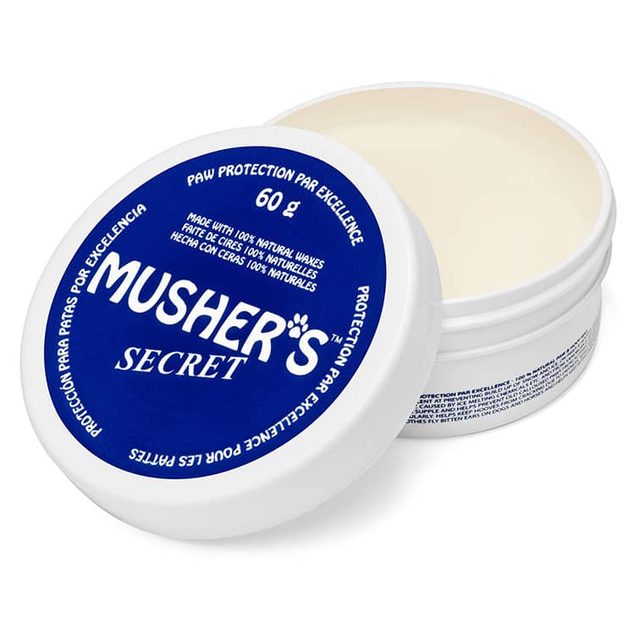
Most owners buying winter paw protection do not have a puncture problem or a snow-depth problem, they have a salt problem. Musher's Secret addresses that directly: a dense wax rubbed into the pads and between the toes forms a breathable barrier that keeps chloride-laden slush off the skin, which is the actual mechanism behind the dry, cracked, licked-raw paws that appear in January. For the dog that fights boots, and there are many, this is not a compromise, it is the better tool.
It is also the least fussy product on this page. There is no sizing, nothing to fasten, and nothing to lose in a snowdrift. The waxes are food-safe, so the inevitable licking is harmless, and it doubles as a treatment: rubbed into already cracked pads it moisturises rather than just shielding. The same tin protects against hot tarmac in summer, where it stops the pads drying and splitting, so it is a year-round purchase rather than a seasonal one. A 60g tin sees a single dog through a normal winter.
The limits are real and worth stating. It has to go on before every walk, which is a thirty-second habit you must actually keep, and for the first few minutes it transfers slightly onto hard flooring. It does nothing against glass, thorns or genuinely extreme cold, where a boot's physical barrier is irreplaceable. As the everyday answer to salted pavements, though, it is the best money here by a wide margin.
The value pick, and the honest answer for most dogs. A wax barrier stops salt reaching the pads at a fraction of the cost and none of the fitting struggle.
Check price on Amazon →#3
Ruffwear Grip Trex Dog Boots (Set of 4)
Best for: Hiking, trail running and rough ground where grip and durability matter most
What we like
- Vibram outsole with genuine grip on wet rock and ice
- Breathable mesh upper drains and dries fast
- Cinching closure sits on the narrowest part of the leg so boots stay on
- Sold in pairs so you can mix sizes front and rear
- Built to survive serious mileage
What we don't
- The most expensive option here
- Mesh upper is not waterproof, so slush soaks through
- Sizing in quarter-inch increments takes real measuring
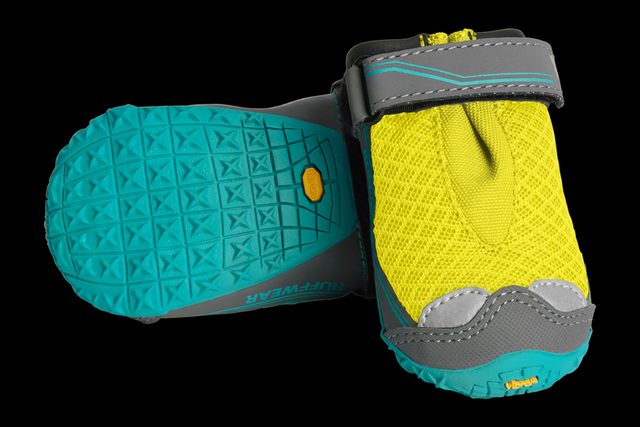
Grip Trex are the boots for dogs that work rather than walk. The outsole is Vibram, the same rubber compound used on hiking boots, and the difference is obvious on wet rock, frozen ruts and loose scree where cheaper soles skid. Combined with a genuinely durable upper, this is the set that survives a season of trail miles instead of shredding after a fortnight.
The cleverest thing about them is the fit system. The closure cinches around the narrowest part of the dog's leg above the joint, which is the only place a boot can be held reliably, and it is why these stay on through mud and water when others get pulled off in the first bog. Ruffwear also sells them in pairs rather than fours, which sounds like an upsell until you remember that most dogs have wider front paws than rear ones, so buying two different sizes is how you get all four boots fitting properly.
The caveats are price and water. These are the dearest boots here by a clear margin, and the mesh upper is breathable rather than waterproof, so it drains and dries quickly but does not keep slush out, which makes them a better trail boot than a winter pavement boot. Sizing in quarter-inch steps also demands actual measuring. For a dog doing real distance on rough ground, they are worth every penny.
The performance pick. A Vibram sole and a closure that actually stays put, for dogs covering real distance over rough terrain.
Check price on Amazon →#4
Kurgo Blaze Cross Dog Shoes (Set of 4)
Best for: Dogs that shrug other boots off, thanks to two independent closures
What we like
- Dual ankle closures allow a precise fit on awkward legs
- Water-resistant woven upper with breathability retained
- Ergonomic sole shaped to the natural paw rather than a flat pad
- Reflective accents for dark morning walks
- Genuine all-season boot for both snow and hot tarmac
What we don't
- Two closures mean more time per paw in a cold hallway
- Narrower opening than the QUMY boots
- Fit is fussy on dogs with slim legs
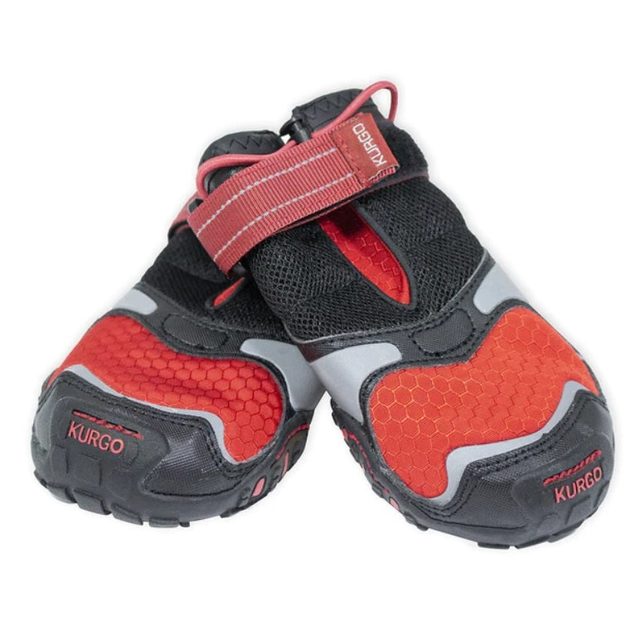
The recurring complaint about dog boots is not that they wear out but that they come off, usually the back two, usually in the first field. The Blaze Cross tackles that with two independent ankle closures instead of one, so you can tighten the boot at two points on the leg and stop it rotating or sliding down. On a dog with a leg shape that defeats single-strap boots, that is the difference between four boots home and two.
It is a properly designed all-season shoe otherwise. The upper is a tightly woven, water-resistant fabric that still breathes, so it holds off slush without cooking the paw on a milder day, and the sole is shaped to the natural contour of a dog's paw rather than being a flat slab, which most dogs adapt to faster. Reflective accents help on the dark walks that make up most of a British winter, and the same boots handle summer pavement heat.
The cost of two closures is time: fitting four boots with two straps each in a cold hallway with an impatient dog is a slower business than the QUMY single-wrap design. The opening is also narrower, which makes getting the paw in fiddlier, and on very slim legs the fit can be hard to dial in. For the dog that loses other boots, though, this is the one that stays on.
The fit specialist. Two ankle closures let you tune the grip on a leg shape that defeats single-strap boots.
Check price on Amazon →#5Budget pick
Dexas MudBuster Portable Dog Paw Cleaner (Medium)
Best for: Every winter dog, alongside whichever protection you choose
What we like
- Removes salt and de-icer from the pads in seconds
- Soft BPA-free silicone bristles reach between the toes
- Contained cup design keeps the mess off your floor
- Needs only water, no additives
- Cheap, and the piece of kit you will use most often
What we don't
- Cleans rather than protects, so it is not a boot substitute
- Sizing is by paw width, and the wrong size is ineffective
- A dog has to learn to tolerate having a paw dunked
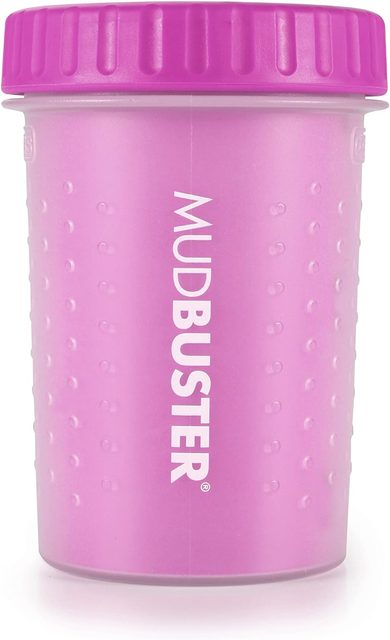
The most effective thing you can do for a dog's paws in winter is get the salt off them the moment you are home, before it has hours to draw moisture out of the pads and before the dog licks it off and swallows it. The problem has always been that doing it properly means a bowl of water, a towel and a wet floor, so most owners do it badly or not at all. The MudBuster turns it into a ten-second job.
It is a cup lined with soft silicone bristles: add a little water, insert the paw, twist. The bristles are long enough to work between the toes and around the pads where grit and salt actually lodge, and they are soft enough not to bother a sore paw. Because the whole operation happens inside a contained cup, the mess stays in the cup rather than on the hall floor, which is what makes it a habit you keep rather than a chore you skip.
Understand what it is not. It cleans, it does not protect, so it belongs alongside wax or boots rather than instead of them. Getting the size right matters: it comes in three, matched to paw width, and a cup that is too large simply lets the paw waggle without contacting the bristles. Most dogs also need a few sessions to accept having a foot dunked. As the cheapest genuinely useful thing on this page, it is the one we would not skip.
The budget essential. Rinsing salt off the pads immediately after a walk prevents more damage than any single product here, and this makes it a ten-second job.
Check price on Amazon →Salt is a chemical problem, not a cold problem
The damage that shows up in January is mostly not frostbite. Rock salt and the calcium chloride blends used on paths are hygroscopic: they draw moisture out of the pads, leaving them dry and split, then settle into those splits and sting. That produces the limping and the obsessive licking, and the licking creates a second problem, because de-icer swallowed off the feet after every walk irritates the gut and in quantity does real harm. Understanding the mechanism tells you what actually helps. A physical barrier before the walk stops contact, and a rinse straight afterwards removes what got through. Cold-proofing is a separate question that only matters at genuinely low temperatures.
Measure the paw while the dog is standing on it
A paw spreads under load, so a boot sized against a lifted foot will be too tight the moment the dog puts weight on it. Stand the dog on a piece of paper, mark either side of the paw, and measure the width. Do the front and rear separately, because most dogs are wider in front, which is why the brands that sell boots in pairs rather than sets of four are doing you a favour rather than upselling. Then look at where the boot fastens: the only place a closure holds is cinched around the narrowest part of the leg above the joint. A boot strapped over the widest part will rotate and walk itself off, and a set of rear boots that keeps vanishing is nearly always a size too big.
The wax and the rinse do most of the work
For the average dog on salted pavements, a wax barrier before the walk and a paw cleaner after it deals with the actual problem better than boots, costs a fraction as much, and involves no hallway wrestling. Boots earn their place where the ground itself is the hazard: deep snow, sharp frozen ruts, thorns, glass, abrasive grit, sustained hard cold, or summer tarmac hot enough to burn. Plenty of households want both, using wax for the daily walk and boots for the long one. Whichever way you go, buy the paw cleaner, because getting the salt off within a minute of walking through the door prevents more damage than anything else on this page.
Winter paws come home wet as well as salted, and damp fur is its own problem. Pair this with our pet grooming and deshedding kits guide to get a dog dry and sorted after a cold walk.
Frequently asked questions
Do dogs really need boots, or is that overkill?
Most dogs do not need boots for an ordinary winter walk on a salted pavement; they need the salt kept off their pads and rinsed away afterwards, which a wax barrier and a paw cleaner achieve more cheaply and with no fitting struggle. Boots become genuinely necessary when the ground is the hazard rather than the chemistry: deep snow on long walks, ice with sharp frozen ruts, trails with thorns or glass, gritted surfaces that abrade, and sustained sub-zero cold where a physical barrier is the only thing that keeps a pad warm. They also earn their place in summer on tarmac hot enough to burn.
How do I stop the boots falling off?
Fit and closure position, in that order. Measure the weight-bearing paw and size to it, since a boot that is slightly too big will rotate and work its way off no matter how tightly you strap it. Then check where the closure sits: the only place a boot can be held reliably is cinched around the narrowest part of the leg above the joint, which is what the Ruffwear design does. On dogs that keep losing boots, a set with two independent ankle closures gives you a second point of grip. If the rear boots are the ones going missing, they are almost certainly a size too large, as rear paws are usually narrower than front ones.
Is rock salt actually dangerous, or just uncomfortable?
Both. On the pads it is hygroscopic, meaning it pulls moisture out of the skin, which leaves the pads dry and cracked and then works into those cracks and stings, hence the limping and frantic licking. Ingested, it is the more serious problem: a dog that licks salt and de-icer off its feet after every walk can take in enough to cause vomiting and, in quantity, worse. That is why rinsing the paws when you get home matters as much as protecting them on the way out, and why it is the step not to skip.
How do I get a dog used to wearing boots?
Indoors, in short sessions, and never for the first time on a walk. Put one boot on, reward, take it off after a minute. Build up over several days to all four, still indoors, with something the dog enjoys happening while they are on. Expect exaggerated high-stepping at first, which is normal and passes as the dog recalibrates to the changed feel of the ground. Only once the dog moves normally around the house should you head outside, and keep the first outdoor trips short. Skipping this and going straight to a cold pavement is how boots end up in a drawer.