Best Dog Ramps and Steps for Senior Dogs 2026
The jump into the boot is the moment an ageing dog's joints get asked to absorb the most, and it is also the moment owners hurt their own backs lifting a dog that can no longer manage it. A ramp fixes both, but only if it is long enough. This is the specification almost every buyer gets wrong: a short ramp propped against an SUV tailgate makes a slope so steep that a stiff dog refuses it outright, and a refused ramp is worse than none because you are back to lifting. The working rule is that the ramp wants to be at least two and a half to three times the height it has to climb, which keeps the incline under about eighteen degrees. Grip, weight rating and how it stores come after that. These five cover the car, the sofa and the bed.
| Rank | Product | Score | Best for | Link |
|---|---|---|---|---|
| #1 | PetSafe Happy Ride Extra Long Telescoping Dog RampTop pick | 10 | Tall vehicles and any large or genuinely arthritic dog | Check price → |
| #2 | PetSafe Happy Ride Folding Dog RampBest value | 9 | Cars and crossovers with a medium-sized dog | Check price → |
| #3 | PetSafe Happy Ride Side Door Dog Stairs | 9 | Back-seat access, and dogs that will not commit to a sloped ramp | Check price → |
| #4 | Pet Gear Easy Step II Pet Stairs | 9 | Small and medium dogs and cats getting onto a sofa or a low bed | Check price → |
| #5 | Best Pet Supplies Foldable Foam Pet Steps (4-Step)Budget pick | 8 | Small dogs and cats needing to reach a tall bed on a budget | Check price → |
#1 · Our PickTop pick
PetSafe Happy Ride Extra Long Telescoping Dog Ramp
Best for: Tall vehicles and any large or genuinely arthritic dog
What we like
- Extends from 47 to 87 inches, long enough for a tall SUV or truck bed
- Supports dogs up to 300 lb on an aluminium frame
- Weighs only 18 lb despite the length
- High-traction surface and side rails keep a wobbly dog on track
- Safety latch locks it closed so it cannot open while driving
What we don't
- 87 inches is a long object to store in a small car
- Telescoping sections need keeping clear of grit to slide smoothly
- Dearer than the fixed folding ramps
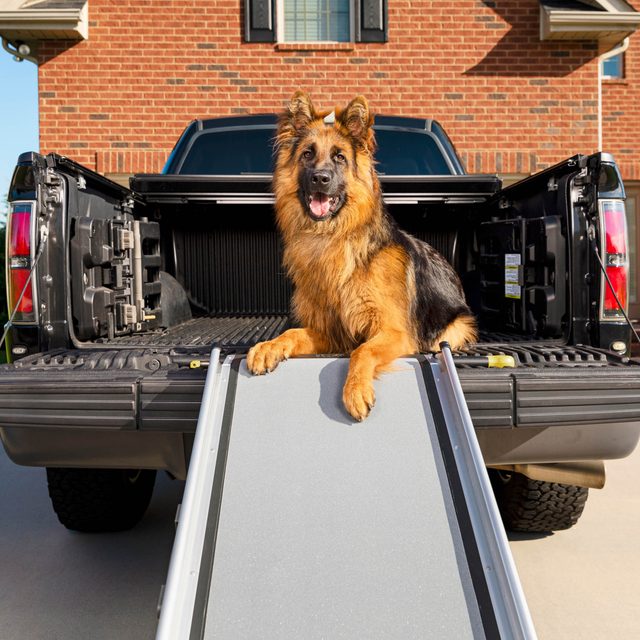
This is the ramp that solves the actual problem. Extended to its full 87 inches it reaches a truck bed or a tall SUV tailgate while keeping the slope inside the range a stiff dog will walk up voluntarily, and that is the whole game. Shorter ramps are cheaper and easier to store, but against a high vehicle they produce an incline that an arthritic dog looks at once and declines, which leaves you lifting the dog anyway.
It manages that length without becoming unmanageable. The aluminium frame carries dogs up to 300 lb, so it takes the giant breeds that need it most, yet the whole thing weighs 18 lb, which is light enough to pull out and set up single-handed several times a day. The walking surface is high-traction rather than smooth plastic, side rails give a dog with poor proprioception something to feel for, and rubber feet stop it creeping on tarmac. A safety latch holds it collapsed, which matters because an unlatched telescoping ramp will extend itself over a speed bump.
The trade-offs are storage and maintenance. Collapsed it is still a long item that dominates a small boot, and the telescoping sections want brushing clear of road grit occasionally or they stop sliding sweetly. It also costs more than the folding ramps below. For a large dog and a tall vehicle, though, it is the one that actually gets used, and that makes it the best value on the page.
The ramp we rank first. At 87 inches it is the only one here that gets a shallow enough slope for a high tailgate, and it carries 300 lb doing it.
Check price on Amazon →#2Best value
PetSafe Happy Ride Folding Dog Ramp
Best for: Cars and crossovers with a medium-sized dog
What we like
- Only 10 lb, the easiest here to lift in and out daily
- Folds in half and locks with a safety latch
- High-traction treads, side rails and rubber feet as standard
- Fits most cars, estates and mid-height SUVs
- Substantially cheaper than the telescoping models
What we don't
- Supports up to 150 lb, so not for giant breeds
- Fixed length is marginal against a tall tailgate
- Fabric treads eventually wear and need replacing
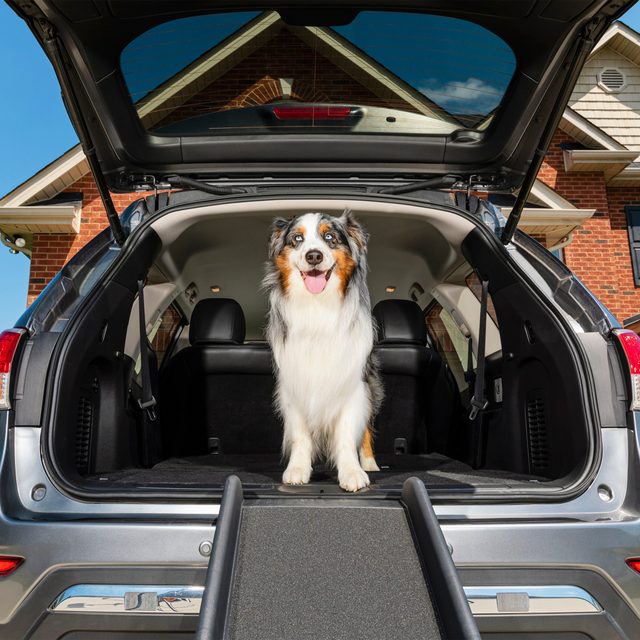
For a saloon, an estate or a crossover with a medium dog, this is the sensible buy. At 10 lb it is the lightest ramp here by a clear margin, and that number decides more than it looks like it should: a ramp you can lift out one-handed while holding a lead gets deployed every time, and a heavy one gets left at home on the days you are in a hurry.
It does not skimp on the things that keep a dog confident. The walking surface has high-traction treads rather than bare plastic, there are side rails to guide a dog that drifts, and rubber feet stop the bottom end skating away at the moment a dog commits its weight, which is the failure that teaches a dog to distrust ramps permanently. It folds in half and latches shut for storage, so it slides down the side of a boot rather than lying across it.
The limits are load and length. It is rated to 150 lb, which covers most retrievers and collies but rules out the giant breeds, and its fixed length is on the short side against a tall SUV, where the slope gets steeper than an arthritic dog will accept. The fabric treads also wear through eventually, though PetSafe sells replacements. Matched to a normal car and a normal-sized dog, it is the best money here.
The value pick. Light enough that you will genuinely use it every day, at half the outlay of a telescoping ramp.
Check price on Amazon →#3
PetSafe Happy Ride Side Door Dog Stairs
Best for: Back-seat access, and dogs that will not commit to a sloped ramp
What we like
- Adjusts to three heights for different vehicles
- Steps suit dogs that refuse a ramp's continuous slope
- Supports dogs up to 200 lb
- Textured non-slip treads on each step
- Folds flat for storage behind a seat
What we don't
- Steps ask more of the joints than a shallow ramp does
- Aimed at side-door access rather than a boot
- Small dogs may still find the step rise tall
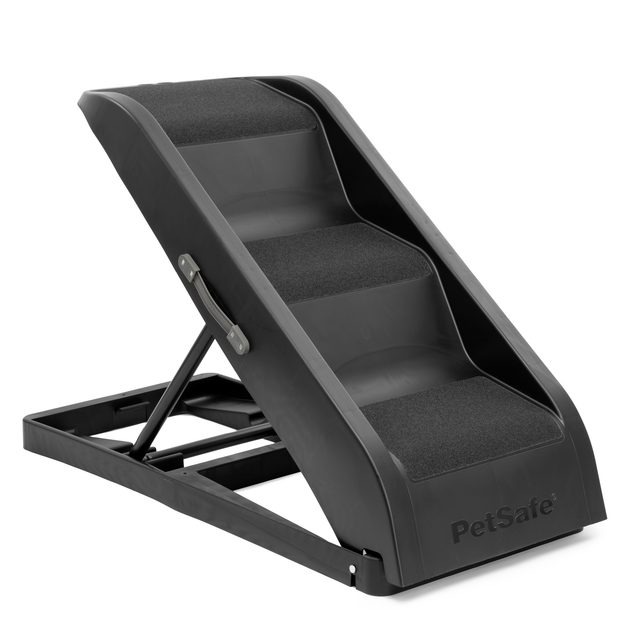
Some dogs simply will not walk a ramp. A continuous slope with nothing to aim for unsettles dogs with poor eyesight or poor hind-end awareness, and no amount of treats fixes it. Stairs give those dogs a series of defined targets instead, and a surprising number that refused a ramp will climb steps on the first attempt. This set is built for the back seat, which is also where many owners actually want their dog rather than the boot.
It adjusts to three heights, so it works across a car, an estate and a mid-height SUV instead of being sized for one vehicle, and it takes dogs up to 200 lb. Each step has a textured non-slip tread, which matters far more on stairs than on a ramp because a paw placed half on and half off a step is how dogs fall. It folds flat enough to live behind a seat.
Be clear about the biomechanics, though. A step asks a dog to lift and load one joint at a time, which is more demanding than distributing the climb along a shallow ramp, so for a genuinely arthritic dog a long ramp remains the gentler option. This is the answer for a dog that refuses ramps or an owner who needs side-door access, not the default choice for the stiffest dogs.
The alternative for ramp refusers. Discrete steps suit dogs that balk at a continuous incline, and it adjusts to three vehicle heights.
Check price on Amazon →#4
Pet Gear Easy Step II Pet Stairs
Best for: Small and medium dogs and cats getting onto a sofa or a low bed
What we like
- Wide, deep steps a small dog can get all four feet onto
- Snaps together in minutes with no tools
- Removable carpet tread that machine washes
- Light enough to move between rooms
- Supports cats and dogs up to 75 lb
What we don't
- Two steps only, so it suits a sofa rather than a tall bed
- 75 lb limit rules out larger dogs
- Carpet tread holds shed hair until vacuumed
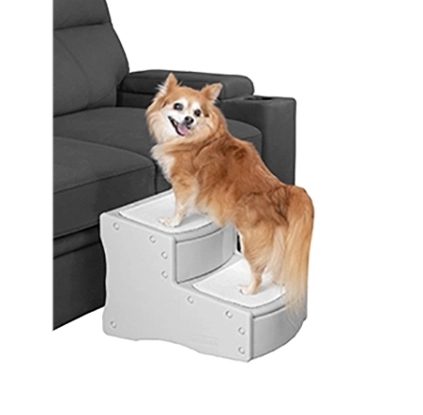
The daily wear on an older small dog's joints usually comes from the sofa rather than the car, repeated a dozen times a day. The Easy Step II is built for that, and its advantage over the cheap alternatives is tread depth: the steps are wide and deep enough for a small dog to get its whole body onto each platform rather than perching, which is what makes a nervous or stiff dog willing to use them unsupervised.
It is easy to live with. The parts snap together without tools in a couple of minutes, it is light enough to shift between the sofa in the day and the bedroom at night, and the carpet tread pulls off and goes in the washing machine, which is the feature that decides whether indoor pet steps stay in the living room or get quietly retired. The carpeted surface also gives better grip than moulded plastic for a dog with worn claws.
The limits are height and weight. Two steps gets a dog onto a sofa or a low bed but not onto a tall divan, where you want a taller set, and the 75 lb rating means this is for small and medium dogs and cats rather than a labrador. The carpet also collects shed hair until you run a vacuum over it. For the job it is sized for it is the most useful indoor option here.
The indoor pick. Wide, deep steps and a washable tread make it the sensible way to keep a small senior dog off the floor without jumping.
Check price on Amazon →#5Budget pick
Best Pet Supplies Foldable Foam Pet Steps (4-Step)
Best for: Small dogs and cats needing to reach a tall bed on a budget
What we like
- Four steps reach 22 inches, tall enough for most beds
- CertiPUR-US certified foam with no sharp edges to bump into
- Folds in half for storage
- Non-slip base keeps it against the bed frame
- Removable machine-washable cover
What we don't
- Foam compresses under a heavier dog and feels unstable
- Really suited to small dogs and cats only
- Cover slackens after repeated washing
Getting a small senior dog onto a tall bed is a specific problem, and foam steps are the cheap answer. At four steps this set reaches around 22 inches, which covers most bed heights, and it does it without the hard edges of a rigid plastic frame, so the inevitable midnight collision with a shin is harmless in both directions.
The practical details are better than the price suggests. The foam is CertiPUR-US certified, the base is non-slip so the steps stay pressed against the bed frame rather than walking away as a dog climbs, and the cover unzips for a machine wash, which any set of steps beside a bed will need. It folds in half, so it can be put away when guests come.
The honest limitation is foam itself. Under anything heavier than a small dog the steps compress noticeably underfoot, and that softness reads as instability to exactly the wobbly senior you bought them for, so this is a small-dog and cat solution rather than a general one. The cover also goes slack after a number of washes. Within those limits, it is the cheapest way to keep a little dog from launching itself off a tall bed.
The budget pick. Four foam steps that reach bed height for the least outlay, provided the dog using them is genuinely small.
Check price on Amazon →Slope is the specification that matters
Almost every unhappy ramp purchase is a ramp that was too short. Take the height your dog has to climb, multiply by two and a half to three, and that is your minimum length; it keeps the incline near eighteen degrees, which is roughly where a stiff dog stops treating the ramp as a cliff. A 30-inch tailgate therefore wants something around 80 inches, which is telescoping territory, not a folding ramp. The reason this matters so much is that a refusal is not a setback you train out of. The dog has assessed the slope, decided against it, and you are back to lifting a heavy animal into a car, which is the situation the ramp was bought to prevent.
Grip, and a bottom end that stays put
The two things that frighten a dog off ramps are a surface its claws slide on and a ramp that moves. Smooth moulded plastic is treacherous for an older dog with worn claws, so look for high-traction treads or carpet. More important still are the rubber feet: at the moment a dog transfers its weight onto the ramp, any tendency for the lower end to skate away registers as the whole structure collapsing, and one experience of that can end a dog’s willingness to try for good. Side rails help any dog with failing eyesight or poor awareness of where its back feet are, which describes most seniors.
Do not overlook the sofa
Car trips happen twice a week. Jumping on and off the sofa happens a dozen times a day, usually onto hard flooring, and the cumulative loading on an older dog’s joints is far greater. A set of steps at the sofa and another at the bed often does more for a senior dog’s comfort than the car ramp does, and for the long-backed breeds prone to disc trouble it removes one of the genuinely risky movements in their day. Look for treads deep enough that the dog can get its whole body onto each step rather than perching on the edge, and a washable cover, because anything living beside a bed will need cleaning.
A ramp keeps the joints from taking a hammering; the bed at the end of the trip does the rest. Pair this with our orthopedic dog beds guide to look after an older dog at both ends of the day.
Frequently asked questions
How long does the ramp actually need to be?
Measure the height your dog must climb, then multiply by two and a half to three. That keeps the slope at or below roughly eighteen degrees, which is the practical threshold where a stiff or arthritic dog will use a ramp willingly rather than refusing it. A car boot at around 24 inches wants a ramp of about 60 to 72 inches; an SUV or truck bed at 30 inches or more needs something in the 80 inch class, which in practice means a telescoping model. Undersizing is the single commonest mistake, and it is not recoverable, because a ramp your dog will not walk up leaves you lifting the dog.
Ramp or steps for an arthritic dog?
A long ramp is gentler, because it spreads the climb into continuous, low-effort movement instead of asking each joint to lift and load the dog's weight one step at a time. That makes it the better default for genuine arthritis or post-operative recovery. The exception is the dog that will not use one: dogs with poor eyesight or poor hind-end awareness are often unsettled by an unbroken slope and do much better with the defined targets steps provide. Watch which your dog will actually commit to, since the gentler option is worthless if it goes unused.
My dog refuses to walk up the ramp. What now?
Check the slope first, because refusal is usually a physics problem rather than a training one; if the ramp is too short for the height, no amount of coaxing fixes it. Then take the ramp off the car entirely, lay it flat on the ground, and reward the dog for walking across it until that is boring. Raise one end gradually over several sessions, keep the ramp braced so it cannot wobble or slide, and use something the dog genuinely wants at the top. Never lure a dog partway and then lift it, as that teaches the ramp predicts being grabbed.
Do ramps help with anything besides the car?
Yes, and indoors is often where the greater cumulative benefit is. A dog jumping on and off a sofa or bed a dozen times a day does far more total loading of its joints than the two car trips a week, and it happens on slippery flooring where the landing is worse. Indoor steps or a short ramp at the sofa and the bed removes that repetition. For dogs prone to spinal problems, particularly the long-backed breeds, keeping them from launching off furniture is worth as much as any car ramp.