Best Dog Talking Buttons 2026
Recordable buttons went from a speech therapist's experiment with her dog to one of the most-shared pet products on the internet, and the videos have set expectations that no plastic button can meet. What the hardware genuinely does is give a dog a deliberate, repeatable way to ask for something, which turns vague pawing and barking into a signal you can actually answer. That is worth having, and it is a real training win for a bored or frustrated dog. What decides whether a set works is unglamorous: how much pressure a paw needs, whether the recording is loud and clear enough for the dog to recognise its own cue from across a room, and whether the buttons stay put on the floor instead of skidding under the sofa. These five are the sets worth starting with.
| Rank | Product | Score | Best for | Link |
|---|---|---|---|---|
| #1 | FluentPet Speak Up! Get Started Kit (6 Buttons, 3 HexTiles)Top pick | 10 | Anyone serious about teaching a real vocabulary rather than trying one word | Check price → |
| #2 | Hunger for Words Talking Pet Starter SetBest value | 9 | Testing whether your dog takes to buttons before spending more | Check price → |
| #3 | FluentPet Speak Up! Key Vocab Kit (12 Buttons, 6 HexTiles) | 9 | Dogs already using a starter board and asking for more words | Check price → |
| #4 | Hunger for Words Talking Pet Doorbell | 9 | Teaching a dog to ask to go outside, and nothing more | Check price → |
| #5 | FluentPet Tester Kit (2 Buttons and HexTiles)Budget pick | 8 | Trying button training cheaply, with a clean upgrade path | Check price → |
#1 · Our PickTop pick
FluentPet Speak Up! Get Started Kit (6 Buttons, 3 HexTiles)
Best for: Anyone serious about teaching a real vocabulary rather than trying one word
What we like
- Upward-facing speaker is far clearer for a dog at floor level
- Six buttons is the right size for a genuine starting vocabulary
- HexTiles lock buttons in place and cluster them by meaning
- Only about half a pound of pressure needed, so cats and small dogs manage
- Batteries pre-installed and a structured teaching guide included
What we don't
- Costs more than the four-button rival sets
- Growing the board means buying more tiles and buttons
- Six words is still a small vocabulary once a dog takes to it
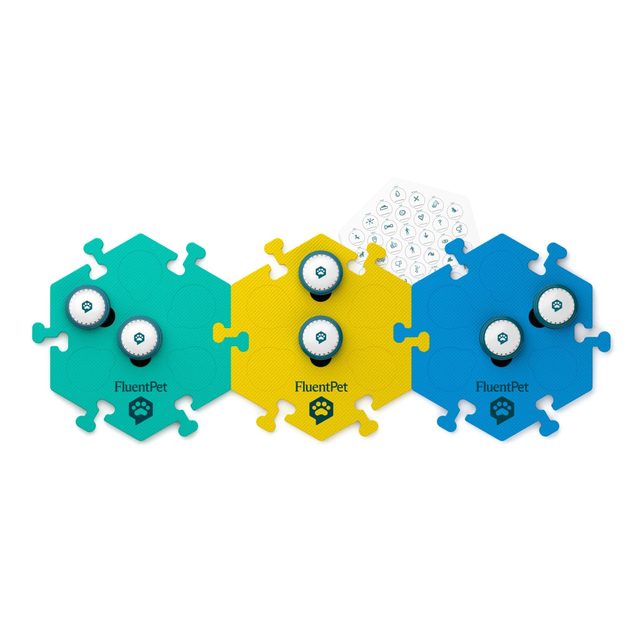
The Speak Up! Get Started Kit is the set to buy if you intend to actually do this rather than test the idea. The upward-facing speaker is the reason. Earlier buttons fired their sound sideways or down into carpet, which muffled it at exactly the height a dog's ears are, and a cue a dog cannot cleanly hear is a cue it cannot learn. Pointing the sound up at the room makes the word distinct from a few metres away, and that single change does more for training progress than anything else in the box.
The HexTiles are the other half of the design. Loose buttons skid across hard floors, get nudged under furniture and end up in a different arrangement every day, which destroys the spatial consistency a dog relies on to remember which button means what. The tiles hold each button firmly and snap together, so you can group words by category and keep the layout stable, then extend the board outward as the vocabulary grows. Six buttons is genuinely the right starting number, enough for a useful set of requests without overwhelming a dog in week one, and the included guide gives you a sensible order to introduce them in.
The trade-offs are cost and the upgrade path. It is dearer than the four-button starter sets, and once a dog is fluent with six words you will be buying more tiles and buttons rather than finding them in the box. Both are reasonable prices to pay for the set that gets the fundamentals right, and it is the one we recommend on the floor first.
The set we recommend first. Clear upward-facing sound, buttons that stay put, and a tile system that scales as the dog's vocabulary grows.
Check price on Amazon →#2Best value
Hunger for Words Talking Pet Starter Set
Best for: Testing whether your dog takes to buttons before spending more
What we like
- Four large buttons that an unsure paw finds easily
- Step-by-step guide from the trainer who started the movement
- Cheapest genuine way into button training
- Big colour-coded tops help you keep words straight
- Durable plastic that survives being trodden on
What we don't
- Sound fires outward rather than upward, so it is less clear at floor level
- No mat included, so buttons slide on hard floors
- Needs two AAA batteries per button, not supplied
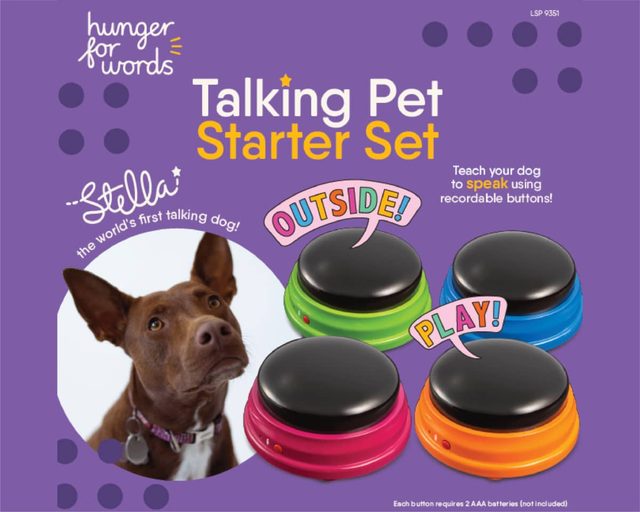
This is the set that popularised the whole category, and it remains the sensible way to find out whether your dog is interested before committing to a larger system. The four buttons are physically big, with wide colour-coded tops that an uncertain paw connects with easily, which matters more than it sounds in the first fortnight when a dog is still working out that pressing the thing causes the word.
What you are really buying is the teaching material. The guide is written by the speech therapist whose work started the talking-dog movement, and it lays out the actual method: model the word yourself as you do the thing, keep the button in a fixed, meaningful place, and wait rather than prompting. Plenty of owners fail at button training because they treat the buttons as a toy and never model consistently, and this guide is the best correction for that in any box here.
The hardware shows its age in two ways. The speaker fires outward rather than up, so the word is noticeably less crisp to a dog standing a few feet away on carpet, and there is no mat, so on a wood or tile floor the buttons travel and the layout you carefully arranged is gone by the weekend. You will also need your own AAA batteries. Accept those and it is the most affordable honest way in.
The value pick. The original system, a genuinely good teaching guide, and four big easy targets for the lowest outlay.
Check price on Amazon →#3
FluentPet Speak Up! Key Vocab Kit (12 Buttons, 6 HexTiles)
Best for: Dogs already using a starter board and asking for more words
What we like
- Twelve buttons is enough for a genuinely expressive board
- Six tiles let you group words into meaningful categories
- Same clear upward-facing speaker as the starter kit
- Works out cheaper per button than buying add-ons later
- Pre-installed batteries across the whole set
What we don't
- Too many words to introduce to a beginner dog at once
- Needs real floor space set aside permanently
- The most expensive set here
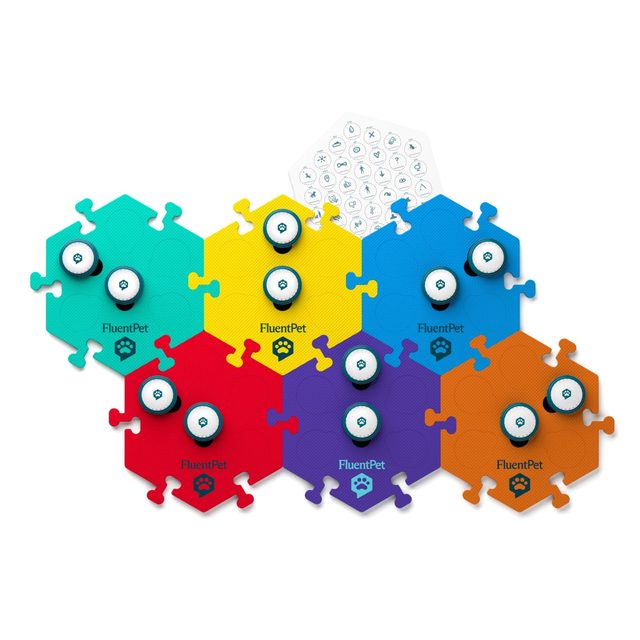
The Key Vocab Kit is what you buy second, or first if you already know your dog will take to this. Twelve buttons is the point at which a board stops being a party trick and starts being expressive: you have room for the requests, the places and the few social words that let a dog string two presses together, which is where the genuinely interesting behaviour appears.
The six HexTiles are what make that many buttons usable. Spatial grouping is how dogs keep a large board straight, so putting the outdoor words on one tile and the food words on another gives a physical structure that a dog navigates far better than twelve buttons in a row. It uses the same upward-facing speaker as the starter kit, so clarity holds up as the board grows, and buying this set costs less per button than starting small and adding pieces later.
The reasons not to start here are practical. Twelve words dropped on a beginner dog at once is a good way to teach nothing at all, so you would be introducing them a couple at a time regardless. A board this size also needs a permanent patch of floor you are willing to give up, which is a real constraint in a small flat. And it is the dearest option on this page. For a dog that has outgrown four or six words, it is the right purchase.
The step-up pick. Twelve buttons and six tiles at a better price per button than adding to a starter set piecemeal.
Check price on Amazon →#4
Hunger for Words Talking Pet Doorbell
Best for: Teaching a dog to ask to go outside, and nothing more
What we like
- Single dedicated button removes any ambiguity about meaning
- Excellent for the one request most owners actually want
- Mounts by the door where the behaviour happens
- Cheap enough to buy alongside a full set
- Simple enough that a dog often gets it in days
What we don't
- One word only, so it is an accessory rather than a system
- Placement by the door means it gets knocked in passing
- Does nothing to build a broader vocabulary
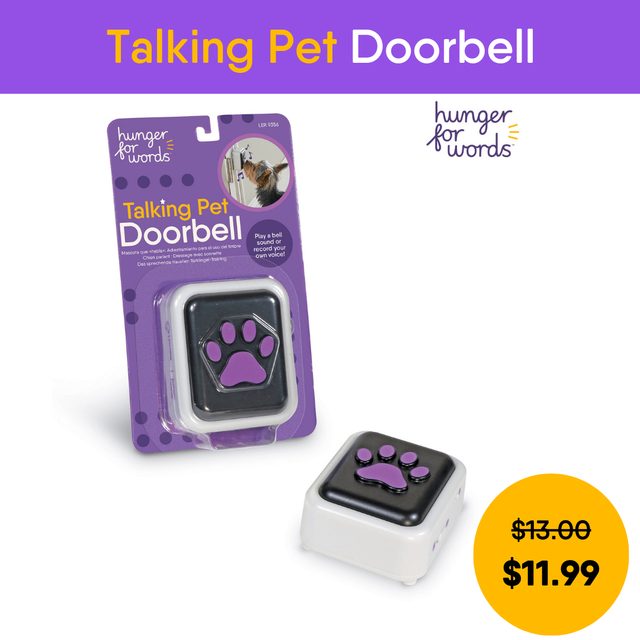
Most owners who buy talking buttons want one specific thing: to stop guessing whether the dog needs the garden. This solves exactly that, and it solves it better than a general board does, because a single button by the door carries no risk of confusion with the other words and sits precisely where the behaviour needs to happen.
That focus makes it the fastest thing here to teach. A dog that already goes to the door has most of the chain learned, and you are only adding one deliberate press to a routine it performs several times a day with an immediate, obvious reward on the other side. Plenty of dogs have it within a week, which is a very different timescale from building a vocabulary. It is also cheap enough to add to a proper set without much thought, and pairing it with an outdoor word on the main board works well.
The limitation is inherent: it is one word. It will not lead anywhere, it does not teach the modelling habit that broader button work depends on, and sitting by the door it takes the occasional knock from feet and coats. Bought for the job it is for rather than as a way into the category, it earns its place.
The single-purpose pick. If the only thing you want is a reliable way for the dog to ask to go out, this does that job better than a board does.
Check price on Amazon →#5Budget pick
FluentPet Tester Kit (2 Buttons and HexTiles)
Best for: Trying button training cheaply, with a clean upgrade path
What we like
- Cheapest way to find out if your dog engages at all
- Same button and tile system as the full kits, so it extends cleanly
- Two words is the correct number to start any dog on
- Batteries included and ready to record out of the box
- Small enough to leave down permanently without losing floor space
What we don't
- Two words runs out fast with a dog that takes to it
- Per-button cost is the highest here
- Not enough to judge the system's real potential
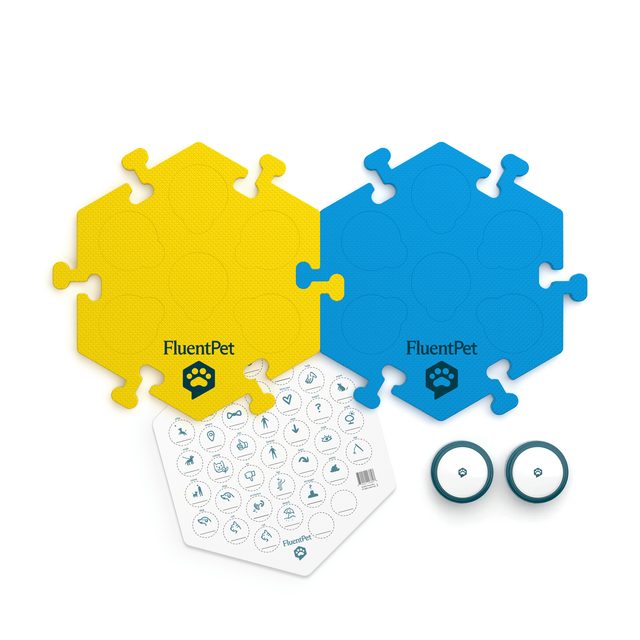
The Tester Kit exists for a good reason: two words is where trainers tell you to start anyway. Introducing a beginner dog to six buttons at once tends to produce random pressing rather than meaning, whereas two clearly distinct, high-value words modelled consistently is how the concept actually lands. Buying only what you need for the first few weeks is a defensible plan rather than a compromise.
Its real advantage over the cheap four-button rival is that it is the same system as the full kits. The buttons, the sound and the HexTiles are identical, so nothing you teach has to be relearned and nothing gets thrown away when you expand. Add a tile and four more buttons and you have the Get Started Kit. Batteries come installed, and the whole thing takes up so little floor that leaving it down permanently, which consistency demands, costs you nothing.
The arithmetic is the catch. Per button it is the most expensive option here, so if you already suspect your dog will take to this you should buy the six-button kit and save money. And two words genuinely does run out quickly with an engaged dog, often within a month. As a low-risk way to test the idea on a system you can grow into, though, it is the sensible smallest step.
The budget entry point. Two buttons is genuinely where every dog should start, and this is the cheapest way to do it without buying into a dead end.
Check price on Amazon →The hardware details that decide whether training works
Three unglamorous specifications separate a set that teaches something from a set that ends up in a drawer. Where the speaker points matters because a dog’s ears are at floor level, and a word fired sideways into carpet is muffled at exactly the distance the dog is standing; upward-facing sound is clearly distinguishable across a room. Activation force decides who can use the board at all, and around half a pound is light enough for a cat or a small dog while stiffer buttons quietly exclude them. And the buttons have to stay put, because a dog navigates a board by position as much as by sound. Buttons that skid on wood and get rearranged every week are being reset faster than the dog can learn them.
Start with two words, and model them yourself
The commonest reason button training fails has nothing to do with the buttons. Owners set out six words on day one, wait for the dog to say something, and conclude it is not interested. What actually builds the association is modelling: you press the button yourself, every single time, as you open the door or pick up the toy, so the word reliably precedes the thing. Two words, chosen because the dog genuinely wants them and you can deliver them immediately, then weeks of consistency before adding a third. A dog that presses a button and gets the promised outcome nine times out of ten learns fast. A dog whose requests are honoured only when convenient learns that the board is noise.
What to expect, honestly
A dog with a working board asks for things deliberately instead of barking, pawing or pacing, and for a bored or frustrated dog that alone is worth the outlay. Sequences that read as sentences in a fifteen-second clip are usually a dog pressing several favourite buttons in a row, and treating the buttons as evidence of language will only lead to disappointment. Treated as an enrichment tool and a clearer request channel, they are one of the more genuinely useful things you can put on the floor for an intelligent dog with time on its paws.
Button work is enrichment as much as communication, and a dog with a full day behind it presses with more purpose. Pair this with our dog puzzle toys guide to keep the rest of the day occupied.
Frequently asked questions
Do talking buttons actually work, or is it just clever editing?
They work in a narrower sense than the viral videos imply. Dogs reliably learn that pressing a particular button produces a particular outcome, and many learn several such associations, which genuinely gives them a deliberate way to make requests instead of barking or pawing. What is not established is that they are composing sentences or using words the way a person does; the sequences that look like sentences are usually better explained by a dog pressing several high-value buttons in a row. Set your expectation at clearer requests and a mentally engaged dog, and the buttons deliver reliably.
Which words should I start with?
Two, and both things your dog urgently wants and you can produce instantly every single time. 'Outside' and 'play' work well for most dogs; 'food' is tempting but ties the button to a fixed mealtime schedule you probably will not honour on demand. Avoid abstract words at the start, and avoid two words that sound similar. Model the word yourself by pressing the button as you open the door or pick up the toy, then wait rather than guiding the paw. Add a third word only once the first two are clearly being used with intent, which usually takes several weeks.
Can cats use them too?
Yes, and some take to it well, but activation force is the deciding factor. A cat presses with far less weight than a dog, so buttons needing around half a pound of pressure, as the FluentPet sets do, are workable while stiffer buttons are not. Cats also tend to investigate with a nose or a swipe rather than a deliberate press, so expect a slower start and more accidental activations. Keeping the board somewhere the cat already asks for things, near the door or the feeding spot, helps considerably.
How long before a dog learns its first button?
For a single high-value word modelled consistently, commonly one to three weeks; the doorbell-style single button is often faster because the surrounding routine is already learned. Building a genuine multi-word vocabulary is a matter of months, not weeks. The single biggest factor is your consistency rather than the dog's intelligence: pressing the button yourself every time you do the thing, keeping the button in a fixed place, and honouring the request whenever the dog gets it right. Owners who model inconsistently usually conclude their dog is not interested, when the pattern was never there to learn.