Best Elevated Dog Bowls 2026: 4 Researched Feeders + Safety Guide
Elevated dog bowls are a use-case product, not a universal health upgrade. AAHA notes that senior-dog home modifications may include elevation of food and water bowls for some individuals, while current Merck Veterinary Manual guidance for dogs at elevated gastric dilatation-volvulus (GDV) risk includes avoiding elevated feed bowls. PetGearReport has not physically tested these feeders; we compare documented feeder design, adjustability, spill/cleaning features, exact product identity and the veterinary context that determines whether elevation is appropriate for the individual dog.
| Rank | Product | Score | Best for | Link |
|---|---|---|---|---|
| #1 | Neater Feeder Deluxe Elevated Dog Bowls (Medium, with Mess-Catching Reservoir)Top pick | 9 | Homes prioritizing spill containment in a raised feeder when elevation is appropriate for the dog | Check price → |
| #2 | COMESOON Elevated Dog Bowls with Adjustable StandAdjustable pick | 8 | Owners who specifically need an adjustable raised platform and want removable bowls | Check price → |
| #3 | IRIS USA Elevated Dog Feeder with Airtight Food Storage | 8 | Homes that want feeding and sealed dry-food storage combined in one unit, when bowl elevation is appropriate | Check price → |
| #4 | Pet Zone Designer Diner Adjustable Elevated Dog Feeder (3 Heights) | 8 | Owners who need a three-position feeder and want current catalog-backed dimensions | Check price → |
#1 · Our PickTop pick
Neater Feeder Deluxe Elevated Dog Bowls (Medium, with Mess-Catching Reservoir)
Best for: Homes prioritizing spill containment in a raised feeder when elevation is appropriate for the dog
What we like
- Two-level design routes spilled water and food toward a lower catch basin
- Two removable stainless steel bowls
- Current manufacturer line offers size-specific leg/feeding-height configurations
- Dishwasher cleaning is documented for feeder parts other than the leg extensions
- Optional leg extensions are available for compatible sizes
What we don't
- Bulkier footprint than a plain stand
- Fixed height for its size, not adjustable
- The reservoir needs occasional emptying and rinsing
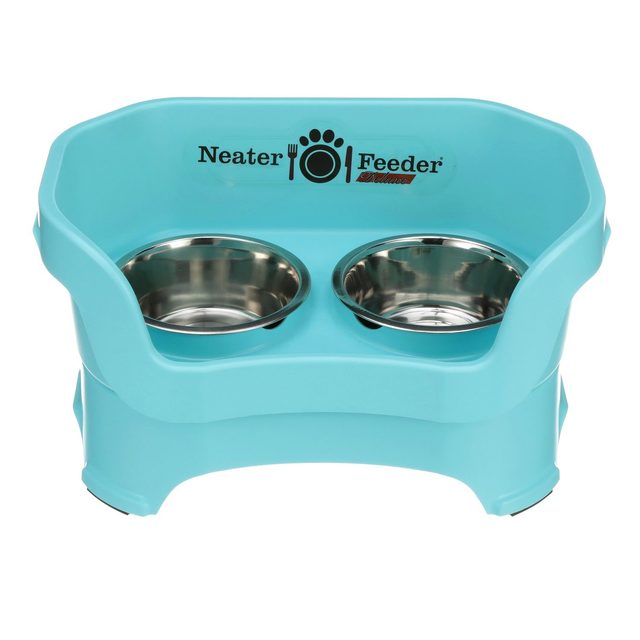
Neater Pets currently describes the Deluxe Neater Feeder as a two-level raised feeder in which spilled food is retained on the upper level while spilled water drains to a lower basin. The current product family uses removable stainless-steel bowls and size-specific leg/feeding-height configurations. Those are manufacturer design claims; PetGearReport has not measured spill capture, stability or long-term durability.
That makes the Neater Feeder easiest to justify when the problem you are solving is feeding-area mess and an elevated setup is already appropriate for the individual dog. The lower catch basin is a concrete design difference from a plain stand, while removable bowls simplify routine cleaning.
Do not choose it based on generic digestive, joint-health or GDV-prevention marketing claims. Current veterinary guidance does not support treating elevation as a universal health upgrade, and dogs at increased GDV risk need veterinary context before a raised feeder is used.
Our top research pick for spill management: the current two-level design separates the feeding deck from a lower catch basin without implying that elevation is medically beneficial for every dog.
Check price on Amazon →#2Adjustable pick
COMESOON Elevated Dog Bowls with Adjustable Stand
Best for: Owners who specifically need an adjustable raised platform and want removable bowls
What we like
- Adjustable stand offers multiple height positions
- Two removable stainless-steel bowls
- Non-slip feet are part of the current listing design
- Height can be changed as the setup changes
- Exact Amazon.com product identity remains live in the repository manifest
What we don't
- Raised twin-bowl footprint is larger than a single floor bowl
- Requires assembly
- Current exact listing lacks a first-party manufacturer specification page for deeper verification
The current exact COMESOON listing is an adjustable elevated feeder with two removable stainless-steel bowls and non-slip feet. PetGearReport keeps the claim set narrow because we do not have a current first-party manufacturer specification page for this exact ASIN, and we have not physically tested the stand.
Its defensible use case is adjustability: if a veterinarian, rehabilitation professional or the dog’s individual setup gives you a reason to elevate the bowls, an adjustable platform lets you change the height rather than committing to one fixed stand.
We do not claim a neck/spine, digestive or general health benefit from raising the bowls for a growing dog. Those are medical/ergonomic conclusions that depend on the individual animal and should not be inferred from the feeder’s adjustability alone.
The adjustable pick when being able to change platform height solves a real fit or mobility need; the page does not treat one height as universally correct.
Check price on Amazon →#3
IRIS USA Elevated Dog Feeder with Airtight Food Storage
Best for: Homes that want feeding and sealed dry-food storage combined in one unit, when bowl elevation is appropriate
What we like
- Feeding platform is integrated with a sealed food-storage container
- Two removable stainless-steel bowls
- Current IRIS family documentation lists airtight seals
- Combines feeding and storage in one footprint
- Plastic body is designed for wipe-clean maintenance
What we don't
- Fixed platform height rather than an adjustable stand
- Plastic body rather than a metal frame
- Storage-first footprint may be unnecessary if food is already stored elsewhere
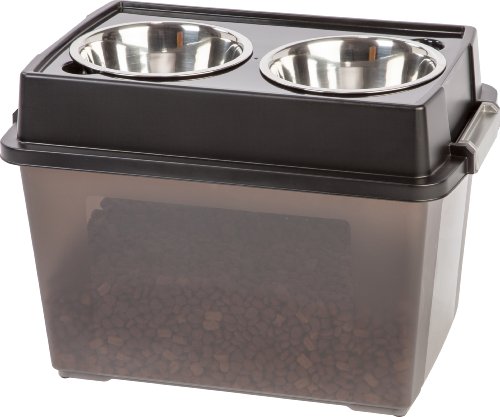
IRIS currently sells elevated-feeder/storage products built around a sealed dry-food container with two removable stainless-steel bowls on the top platform. The storage architecture is the useful differentiator: it consolidates feeding hardware and dry-food storage without requiring a separate bin beside the bowls.
The current manufacturer family page emphasizes airtight seals and a wipe-clean plastic container. PetGearReport has not independently tested seal performance, food-storage duration, structural rigidity or spill resistance.
Choose this architecture for space/storage workflow only if an elevated bowl position makes sense for the individual dog. The storage design is not evidence of a digestive, posture or joint-health benefit from elevation.
The storage-integrated option: its main differentiator is the feeder-plus-sealed-container layout, not a claimed medical benefit from bowl height.
Check price on Amazon →#4
Pet Zone Designer Diner Adjustable Elevated Dog Feeder (3 Heights)
Best for: Owners who need a three-position feeder and want current catalog-backed dimensions
What we like
- Current Pet Zone catalog lists three positions: 2.75, 8 and 12 inches
- Two stainless-steel bowls are included
- Frame can be configured to different platform heights
- Current catalog lists 2.95-cup bowl capacity
- Multiple positions make fit testing easier than a fixed-height stand
What we don't
- Three-position design is less granular than a continuously adjustable stand
- Fixed published positions may not match every individual dog
- Plastic-frame construction rather than a metal stand
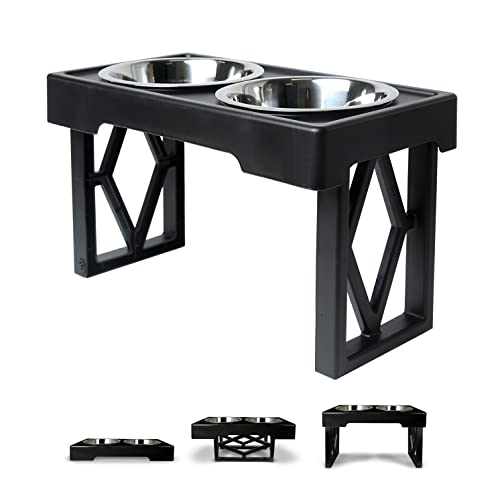
Pet Zone’s current catalog lists the Designer Diner with three platform positions—2.75, 8 and 12 inches—and two stainless-steel bowls with 2.95-cup capacity each. Those specifications make it easier to compare the stand against the individual dog and feeding setup than a fixed-height product with vague sizing language.
The useful feature is adjustability, not an assumed ideal posture. If a veterinarian or rehabilitation plan calls for elevation, or if you are trialing a practical home modification for a senior dog, multiple positions let you make a controlled change and observe the dog’s access rather than treating one generic chest/elbow formula as medical guidance.
PetGearReport has not tested the stand’s stability, hinge durability or long-term wear. We rank it for the clarity of the current catalog dimensions and the flexibility those positions provide.
The best-documented adjustable option here, with three current catalog-listed platform heights rather than a claimed universal ergonomic target.
Check price on Amazon →Quick answer
Elevated bowls are not a universal health upgrade. Use one because it solves a specific feeding-access, spill-control, storage or mobility problem—not because raising food is assumed to improve digestion or prevent disease.
For dogs at increased risk of gastric dilatation-volvulus (GDV), current Merck Veterinary Manual guidance includes avoiding elevated feed bowls. GDV is seen especially in large- and giant-breed dogs and dogs with a deep-chested conformation. If your dog is in a high-risk group, the feeding setup belongs in the veterinary discussion rather than in a generic product rule.
For senior or mobility-limited dogs, the decision can be different. The AAHA Senior Care Guidelines say environmental modifications may include elevation of food and water bowls. That is an individualized accommodation, not a recommendation for every senior dog.
How we researched and scored
PetGearReport has not physically tested these feeders. We reviewed current manufacturer/catalog documentation, exact affiliate-product identity and veterinary guidance relevant to bowl elevation. Current price, Amazon star ratings and unsupported owner-experience claims are not scoring inputs.
The displayed numbers are PetGearReport research scores using the same decision categories for all four products:
- Documented feeder design & sizing — 30%
- Cleaning and spill management — 25%
- Adjustability / use-case fit — 20%
- Physical footprint / storage workflow — 15%
- Documentation & exact-product confidence — 10%
| Feeder | Design/sizing | Cleaning/spill | Adjustability/use case | Footprint/workflow | Evidence | Published score |
|---|---|---|---|---|---|---|
| Neater Feeder Deluxe | 9 | 10 | 8 | 8 | 9 | 9/10 |
| COMESOON Adjustable | 8 | 8 | 9 | 7 | 7 | 8/10 |
| IRIS Elevated Storage Feeder | 8 | 8 | 6 | 10 | 8 | 8/10 |
| Pet Zone Designer Diner | 9 | 8 | 10 | 8 | 9 | 8/10 |
The scores compare documented feeder features and evidence quality; they are not veterinary outcome scores.
Elevated bowls are not a universal health upgrade
There are at least three different reasons an owner might look at an elevated feeder, and they should not be conflated:
- Mobility/access modification. AAHA notes that senior-pet environmental changes may include raising food and water bowls for some individuals.
- Mess or storage management. A catch basin, removable bowls or integrated dry-food container can solve household workflow problems regardless of any health claim.
- Medical feeding plan. Some conditions require veterinary-directed feeding posture. For example, megaesophagus management can involve feeding with the upper body elevated at a much steeper angle and maintaining that posture after eating. An ordinary raised bowl is not equivalent to that treatment plan.
The right question is therefore not “Are elevated bowls healthier?” but “What specific problem am I solving for this individual dog?”
GDV/bloat: high-risk dogs need veterinary context
GDV is an emergency in which the stomach dilates and can rotate. Current Merck Veterinary Manual guidance lists avoiding elevated feed bowls among recommendations for owners of high-risk dogs. The American College of Veterinary Surgeons describes GDV as multifactorial and notes associations with factors including large/giant body size, deep-chested conformation and elevated feeding.
That does not mean a raised feeder causes GDV in every dog, but it is enough to reject the old internet claim that elevation is automatically safer or healthier. For an at-risk dog, ask the veterinarian about feeding routine and preventive gastropexy rather than using feeder height as a do-it-yourself prevention strategy.
Senior and mobility use: individualize the setup
The AAHA Senior Care Guidelines discuss home modifications for senior pets and state that they may include elevation of food and water bowls. That can make elevation a reasonable option for an individual dog whose mobility or posture is being managed, but it does not create a universal height formula.
If elevation is being used because of arthritis, neck/back disease, neurologic limitations, post-operative recovery or another medical reason, use the dog’s veterinarian or rehabilitation professional to define the goal. An adjustable stand can then be useful because it allows the physical setup to follow that plan.
Product decisions that are actually comparable
- Neater Feeder Deluxe: choose for its two-level spill-management architecture and removable bowls when an elevated setup is appropriate.
- COMESOON Adjustable: choose when multiple platform positions are the primary requirement and the exact listing’s form factor fits the feeding area.
- IRIS Elevated Storage Feeder: choose when integrated dry-food storage is more useful than a stand-only design.
- Pet Zone Designer Diner: choose when you want current catalog-backed positions of 2.75, 8 and 12 inches rather than one fixed platform.
Do not select among them by assuming the tallest position is the healthiest.
Sources
Veterinary and manufacturer references rechecked October 1, 2026:
- Merck Veterinary Manual — Gastric Dilation and Volvulus in Small Animals
- American College of Veterinary Surgeons — Gastric Dilatation-Volvulus
- AAHA — 2023 Senior Care Guidelines: Pain Management
- Merck Veterinary Manual — Dilatation of the Esophagus in Small Animals
- Neater Pets — Deluxe Neater Feeder for Dogs
- IRIS USA — Elevated Feeder with Airtight Storage
- Pet Zone — current product catalog
For dogs that eat too quickly, see our slow feeder dog bowls guide. A slow-feeding strategy and an elevated stand solve different problems and should not be treated as interchangeable.
Frequently asked questions
What height should an elevated dog bowl be?
There is no single veterinary bowl-height formula that fits every dog. If elevation is appropriate for the individual dog, start with the feeder manufacturer’s documented height options and any veterinarian or rehabilitation guidance for that dog’s mobility, body shape and medical history. An adjustable stand can make it easier to trial a lower or higher position without assuming taller is healthier.
Are raised bowls better for older dogs?
Sometimes, but this should be individualized. The AAHA Senior Care Guidelines say home modifications may include elevation of food and water bowls for some senior pets. That is not a recommendation that every older dog should eat from a raised feeder, especially when GDV risk or another medical condition changes the decision. Ask the dog’s veterinarian or rehabilitation professional when elevation is being used for a mobility problem.
Do elevated bowls cause bloat?
GDV is a life-threatening emergency seen especially in large- and giant-breed and deep-chested dogs. Current Merck Veterinary Manual guidance for owners of high-risk dogs includes avoiding elevated feed bowls, and the American College of Veterinary Surgeons also lists elevated bowls among suggested risk factors. If your dog is in a high-risk group, discuss feeding setup and preventive options with your veterinarian rather than assuming elevation is protective.
Stainless steel or plastic bowls on an elevated feeder?
Choose a bowl material and finish that can be cleaned thoroughly and often, and follow the feeder manufacturer’s cleaning instructions. Removable stainless-steel bowls are convenient because several products in this shortlist specify dishwasher cleaning, but cleanliness and intact surfaces matter more than declaring one material universally safest.