Best Aquarium Filter Pads & Floss: 4 Cut-to-Fit Picks for Mechanical Filtration
The best aquarium filter pad is the one that fits the filter's actual water path and traps the particle size you are trying to remove without becoming a neglected flow restriction. We researched four current cut-to-fit media options by documented density or pore structure, dimensions, mechanical role, maintenance guidance and exact Amazon.com identity. PetGearReport has not physically tested these pads, measured debris capture, clarity improvement, pressure drop, flow loss or long-term durability.
| Rank | Product | Score | Best for | Link |
|---|---|---|---|---|
| #1 | Aquatic Experts FilterFirst Filter Floss (12 Inch x 12 Feet)Best overall cut-to-fit roll | 9 | Owners who want one documented cut-to-fit roll for routine mechanical capture plus a finer downstream layer | Check price → |
| #2 | AQUANEAT Open-Cell Foam Sheet (40 PPI, 9 x 9 x 0.5 Inch, 2 Pack)Best reusable foam sheet | 8 | Reusable cut-to-fit foam where a defined 40-PPI open-cell structure is more useful than disposable fine floss | Check price → |
| #3 | Aquatic Experts Polishing Filter Pad (100 Micron, 24 x 36 Inch)Best fine polishing stage | 9 | A downstream polishing stage after coarser mechanical media has already intercepted larger debris | Check price → |
| #4 | AQUANEAT Dual-Density Filter Media Pad (72 x 12 Inch)Best long dual-density roll | 8 | Larger custom media chambers where a long dual-density roll is more convenient than buying smaller sheets repeatedly | Check price → |
#1 · Our PickBest overall cut-to-fit roll
Aquatic Experts FilterFirst Filter Floss (12 Inch x 12 Feet)
Best for: Owners who want one documented cut-to-fit roll for routine mechanical capture plus a finer downstream layer
What we like
- Dual-density construction gives larger and finer particles separate stages
- Manufacturer specifies the open or looser fiber side should receive water first
- 12-inch-wide by 12-foot exact Amazon.com roll provides substantial cut-to-fit material
- Polyester pad can be rinsed and reused several times according to the manufacturer
- Strong manufacturer documentation plus exact Amazon.com identity
What we don't
- A thick dual-density pad can still restrict flow when overloaded with debris
- Cutting requires knowing the filter chamber dimensions and water path
- A long roll is unnecessary for owners who only need one small replacement piece
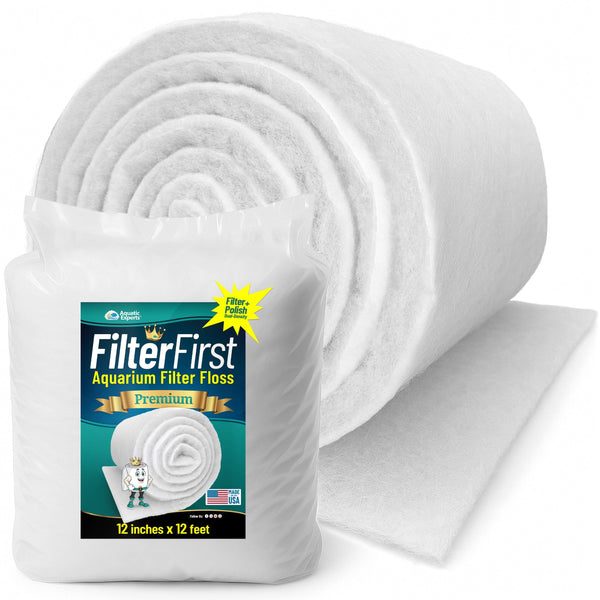
Aquatic Experts describes FilterFirst as a dual-layer polyester pad: an open or looser fiber section catches larger debris before water reaches the denser section. The exact B01AHHN4VW Amazon.com child we checked is the 12-inch-wide, 12-foot roll.
That staged construction is more useful than treating every white floss sheet as interchangeable. The manufacturer also recommends cutting from a cardboard template when replacing an existing filter pad and says the material can be rinsed and reused several times.
Choose it when the filter has enough chamber space for the pad without forcing water around it or compressing it excessively. PetGearReport has not measured installed pressure drop or debris capacity, so normal return flow remains the practical check after fitting and during service.
Our strongest all-round research pick because its two-layer water path, cut-to-fit format and reuse guidance are unusually explicit rather than leaving density and orientation to guesswork.
Check price on Amazon →#2Best reusable foam sheet
AQUANEAT Open-Cell Foam Sheet (40 PPI, 9 x 9 x 0.5 Inch, 2 Pack)
Best for: Reusable cut-to-fit foam where a defined 40-PPI open-cell structure is more useful than disposable fine floss
What we like
- Exact variant specifies two 9 x 9 x 0.5-inch open-cell foam sheets
- Published 40 PPI gives a concrete pore-density reference
- Cut-to-fit foam can be shaped for sump, canister, power-filter or DIY media chambers
- Reticulated foam is intended to preserve water pathways better than tightly packed loose floss
- Exact Amazon.com child was independently verified live
What we don't
- Product-specific documentation is marketplace-led rather than a detailed manufacturer manual
- 40 PPI is a pore-density label, not a PetGearReport measurement of particle-removal efficiency
- Half-inch thickness may need layering or a different format in deeper media chambers
The exact B0BZNNH2B7 listing identifies two black open-cell foam sheets measuring 9 by 9 by 0.5 inches and specifies 40 PPI. Current product data describes the material as cut-to-size media for sumps, wet/dry filters, canisters, power filters and DIY projects.
The important distinction is material architecture. This is reticulated foam rather than a bonded floss roll, so it is a better fit when you want a reusable sponge-like mechanical layer that can also remain wetted in the filter. That does not make a 40-PPI label a universal performance score or prove how much biological capacity the sheet will provide in a particular aquarium.
Choose it when the chamber benefits from a defined half-inch foam layer. Avoid stacking so much material that the filter's normal output falls; inspect loading and reduced flow as maintenance signals.
The reusable foam specialist: its 40-PPI open-cell structure, half-inch thickness and two-sheet format solve a different mechanical-media job from bonded floss rolls.
Check price on Amazon →#3Best fine polishing stage
Aquatic Experts Polishing Filter Pad (100 Micron, 24 x 36 Inch)
Best for: A downstream polishing stage after coarser mechanical media has already intercepted larger debris
What we like
- Manufacturer identifies this variant as a 100-micron polishing pad
- 24 x 36-inch sheet is cut-to-fit
- Dense interwoven polyester targets finer suspended particles
- Manufacturer explicitly recommends coarser media upstream to extend service life
- Detailed cleaning and media-order guidance is available
What we don't
- Fine media can clog much faster than a coarse first stage
- Not the best first layer for heavy debris loads
- 100 microns describes the product's nominal media specification, not a PetGearReport clarity test
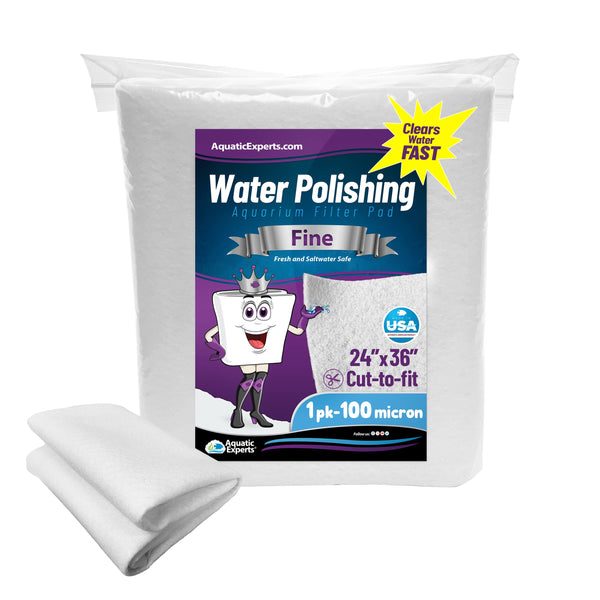
Aquatic Experts specifies the B014G7WTRY family as a 100-micron polishing pad, with the exact Amazon.com child represented here sized at 24 by 36 inches. The manufacturer describes dense interwoven polyester fibers intended for fine-particle capture.
The maintenance trade-off is equally important. Aquatic Experts says its polishing pads can clog quickly because they collect very fine debris and recommends sending water through a regular pad such as FilterFirst or ClassicBlue first. That is why this product ranks as a polishing specialist rather than our universal first mechanical stage.
Use it when the filter has an upstream coarse stage and you are deliberately adding fine mechanical polishing. Watch normal flow and clean the pad when loading or reduced output indicates that the fine layer is becoming restrictive.
The specialist fine-media pick: unusually clear 100-micron documentation and explicit coarse-before-fine guidance make its role easy to understand before cutting it into a filter.
Check price on Amazon →#4Best long dual-density roll
AQUANEAT Dual-Density Filter Media Pad (72 x 12 Inch)
Best for: Larger custom media chambers where a long dual-density roll is more convenient than buying smaller sheets repeatedly
What we like
- Exact variant is a 72 x 12-inch bonded roll
- White open-fiber side and denser green side provide two documented mechanical stages
- Cut-to-fit format suits custom filter chambers and larger media areas
- Published 3/4-1 inch dry thickness provides a useful fit reference
- Exact Amazon.com child was independently verified live
What we don't
- Documentation is primarily marketplace-led
- Long roll overlaps with FilterFirst's general-purpose role
- Published thickness can vary by batch and still needs confirmation against the actual chamber
The exact B089CQ18FT variant is a 72 by 12-inch AQUANEAT bonded pad roll, with dry thickness listed around 3/4 to 1 inch. Product documentation describes a white open-fiber side for larger particles and a denser green side for finer debris.
That makes it a direct alternative to FilterFirst for owners who value a long bulk roll, but the evidence quality is not identical. We could verify the exact Amazon.com child and current dimensional/product details; we did not find an equally detailed first-party manufacturer guide for orientation, cleaning or service intervals.
Choose it when the dimensions and bulk-roll format fit your filter project. Cut it closely enough to prevent obvious bypass while avoiding excessive compression that could become another source of reduced flow.
The long-roll alternative: 72 inches of dual-density bonded media gives useful cut-to-fit flexibility, but its documentation trail is weaker than FilterFirst's.
Check price on Amazon →How we researched and scored
PetGearReport has not physically tested these aquarium filter pads, measured particle capture, water-clarity improvement, pressure drop, installed flow loss, reuse cycles or long-term durability. We compared current manufacturer documentation where available, exact Amazon.com product identity, published dimensions, density or micron/PPI information, intended mechanical role and maintenance guidance. Current price, Amazon customer stars, review counts and popularity are not scoring inputs.
The four exact Amazon.com variants represented on this page were directly checked on September 13, 2026. The displayed 1-10 number is a PetGearReport research score, rounded from the same weighted categories for every product:
- Mechanical role & density documentation — 30%: clarity about dual-density layers, PPI, micron specification and intended coarse/fine job.
- Fit & cut-to-size flexibility — 25%: documented dimensions, thickness and usefulness across custom media chambers.
- Flow & clogging guidance — 20%: evidence that explains media order, loading or reduced-flow trade-offs without inventing measured performance.
- Maintenance & reuse guidance — 15%: cleaning, rinsing, reuse or replacement instructions for the exact product family.
- Documentation & exact-product identity — 10%: current first-party evidence where available plus independently checked Amazon.com child identity.
| Product | Mechanical role 30% | Fit 25% | Flow/clogging 20% | Maintenance 15% | Documentation 10% | Weighted result | Published score |
|---|---|---|---|---|---|---|---|
| FilterFirst 12 in x 12 ft | 9 | 10 | 9 | 9 | 10 | 9.25 | 9/10 |
| AQUANEAT 40 PPI foam | 8 | 9 | 8 | 9 | 6 | 8.15 | 8/10 |
| Aquatic Experts 100 micron | 10 | 9 | 9 | 9 | 10 | 9.40 | 9/10 |
| AQUANEAT dual-density roll | 9 | 10 | 8 | 7 | 6 | 8.35 | 8/10 |
The weighted decimals make the method auditable; they are not laboratory measurements. The 100-micron pad scores strongly because its specialist role is unusually well documented, but FilterFirst ranks first editorially because a dual-density general-purpose roll solves a broader mechanical-filtration job before a fine polishing stage is added.
Quick decision table
| Pick | Documented structure | Exact size | Best role | Main maintenance risk |
|---|---|---|---|---|
| FilterFirst | Dual-density polyester | 12 in x 12 ft | General coarse-to-finer mechanical stage | Debris loading can restrict flow |
| AQUANEAT 40 PPI foam | Open-cell reticulated foam, 40 PPI | Two 9 x 9 x 0.5 in sheets | Reusable foam layer | Needs rinsing when pores load with debris |
| Aquatic Experts 100 micron | Dense polyester polishing pad | 24 x 36 in | Fine downstream polishing | Fine media can clog quickly |
| AQUANEAT dual-density | Open white + denser green bonded layers | 72 x 12 in, about 3/4-1 in dry | Large custom cut-to-fit roll | Layer order and loading still need flow checks |
Start with the mechanical job, not tank gallons
Filter pads do not become more or less appropriate because an aquarium crosses an arbitrary gallon number. The useful questions are what particles you are trying to intercept, where the pad sits in the water path, how much chamber space is available and how quickly the medium will load with debris.
Our aquarium filter media guide separates mechanical, biological and chemical media by function. Use that framework first. A cut-to-fit pad is a mechanical-media choice; it should protect downstream stages and preserve useful flow rather than simply fill every empty space in a basket.
If the goal is specifically to protect a powered intake before water reaches the main filter, a fitted aquarium pre-filter sponge solves a different problem. Intake foam sits outside or directly over the intake; the pads on this page are primarily intended for media chambers, baskets, sumps or custom internal stages.
Coarse before fine when the filter design allows it
A fine polishing layer catches smaller suspended particles, but that same density can make it load faster. Aquatic Experts explicitly recommends sending water through a regular pad before its polishing pad so larger debris is removed upstream. FilterFirst uses the same principle inside one product: water enters the open/looser layer before reaching the denser section.
That does not create one universal stack order for every HOB, canister or sump. Trace the actual water path and follow the filter manual. The practical rule is to avoid forcing the finest material to handle the entire debris load when a coarser mechanical stage can protect it first.
Cut to fit without creating bypass or over-compression
A useful cut-to-fit pad should cover the intended flow opening closely enough that water does not simply take a large gap around the media. At the same time, stuffing oversized material into a chamber can compress the fibers or foam and make the flow path unnecessarily restrictive.
Use the original cartridge or pad as a template when possible. Aquatic Experts specifically recommends making a reusable cardboard template for FilterFirst. For custom chambers, measure the usable width, length and depth before cutting, then confirm that the filter closes normally and returns water at its expected operating rate.
The material thickness matters here. A half-inch foam sheet behaves differently from a thick bonded roll, and neither should be chosen from tank gallons alone.
Watch loading and reduced flow
Mechanical media gets dirty because it is doing its job. The maintenance question is not whether debris will collect, but whether the pad can keep intercepting solids without becoming a neglected restriction.
Fine media needs the closest attention. Aquatic Experts notes that polishing pads can clog quickly under a heavy fine-particle load. Coarser/open-cell foam generally leaves larger flow paths, but it can still become packed with waste. Check the filter’s normal output and the media itself during routine service; a meaningful drop in flow, visible matting or bypass around the pad is a reason to inspect it sooner.
Our aquarium maintenance schedule uses the same performance-triggered approach: inspect filters routinely, then clean the mechanical stage when condition and output show that service is actually needed.
Mechanical filtration does not replace biological filtration
Filter floss, bonded pads and foam can remove suspended solids. Reusable foam also provides wetted surface that can support biofilm while it remains in service. But fresh mechanical media does not replace biological filtration or instantly establish the nitrogen cycle.
If ammonia or nitrite is detectable in an established aquarium, do not solve the problem by packing in more floss. Verify the water, check the biological stage, review recent filter work and identify the source of the disruption. Likewise, visually clear water is not proof that water chemistry is safe.
If the main problem is visible particles or haze, our aquarium water clarity guide helps distinguish suspended debris from biological cloudiness, algae and water-quality problems before you add more polishing media.
Which one should you choose?
Choose FilterFirst when you want one broadly useful dual-density roll and value the strongest manufacturer instructions for orientation, cutting and reuse. Choose the AQUANEAT 40-PPI foam sheets when reusable open-cell foam is the material you actually need. Choose the 100-micron Aquatic Experts pad when a coarse stage already exists and the goal is fine polishing. Choose the AQUANEAT dual-density roll when a long 72-inch cut-to-fit roll is the practical requirement and you are comfortable with a more marketplace-led documentation trail.
None of these choices changes the filter’s underlying capacity, livestock requirements or biological maturity. Treat the pad as one serviceable mechanical stage inside the larger filtration system.
Sources
PetGearReport researched current manufacturer documentation where available and independently checked the exact Amazon.com variants on September 13, 2026. We did not use current Amazon prices, customer ratings or popularity as recommendation evidence.
- Aquatic Experts — FilterFirst Aquarium Filter Floss
- Aquatic Experts — Aquarium Polishing Pad
- Aquatic Experts — Filter Pad FAQ
For the two AQUANEAT products, exact dimensions, density/structure and variant identity were evaluated from the current exact Amazon.com listings because we did not find an equally detailed current first-party product manual. That weaker primary-documentation trail is reflected in their research scores.
Frequently asked questions
What is the difference between aquarium filter floss and a polishing pad?
The terms overlap, but products can differ substantially in density and intended particle size. A general bonded or dual-density pad can serve as routine mechanical media, while a documented fine-micron pad is better treated as a downstream polishing stage. Compare the exact product specification rather than the marketing name alone.
Should coarse or fine filter media go first?
When the filter's documented water path allows staged mechanical media, coarser material usually makes sense upstream so it intercepts larger debris before a fine polishing layer. Follow the exact filter and media instructions because chamber flow paths differ. Aquatic Experts explicitly recommends regular media before its fine polishing pad.
Can filter floss reduce aquarium filter flow?
Yes, any mechanical medium can become restrictive as debris loads into it, especially fine polishing material. PetGearReport has not measured the pressure drop of these products. Use the filter's normal return flow, visible loading and product instructions as service signals rather than continually adding more layers.
Can mechanical filter pads replace biological media?
No. Mechanical filtration physically captures suspended solids; it does not replace biological filtration. Reusable foam can also support biofilm while it remains in service, but installing fresh floss or foam does not instantly create an established nitrogen-cycle biofilter.
How often should I replace aquarium filter floss?
There is no single interval that fits every aquarium and every medium. Fine pads can load much faster than coarse foam. Inspect debris loading and filter output, follow the exact product guidance, and clean or replace the mechanical stage when its condition or reduced flow shows that service is needed.