Best Aquarium TDS Meters: 5 Picks for EC, Freshwater & RO/DI
A TDS meter is most useful when you know whether it shows raw conductivity, a fixed EC-to-TDS conversion, or a selectable scale. We researched five exact marketplace variants spanning a configurable EC/TDS handheld, a multiparameter tester, an inline RO/DI monitor and two simpler handheld meters. PetGearReport has not physically tested these instruments, compared them with laboratory gravimetric TDS, measured calibration drift, verified manufacturer accuracy claims or established a universal TDS target for any aquarium.
| Rank | Product | Score | Best for | Link |
|---|---|---|---|---|
| #1 | HM Digital COM-100 Waterproof EC/TDS/Temp MeterBest documented EC/TDS handheld | 10 | freshwater, RO/DI and aquaculture users who want a serviceable waterproof handheld with direct EC plus selectable TDS scales | Check price → |
| #2 | Apera Instruments PC60 Premium 5-in-1Best multiparameter upgrade | 9 | advanced freshwater, planted or aquaculture users who want pH and conductivity/TDS in one serviceable instrument and will maintain the calibration workflow | Check price → |
| #3 | HM Digital DM-1 In-Line Dual TDS MonitorBest inline RO/DI monitor | 8 | RO/DI owners who want permanent feed-versus-product monitoring and do not need one handheld meter for multiple tanks or water sources | Check price → |
| #4 | HM Digital TDS-4TM Aquarium TDS MeterBest aquarium-focused simple pen | 8 | freshwater keepers who want a compact aquarium-specific TDS-and-temperature pen and value a simple repeatable fixed-scale workflow | Check price → |
| #5 | HM Digital TDS-3 Handheld TDS MeterBest simple handheld with case | 8 | users who want a straightforward portable TDS/temperature meter with a protective case for source-water, tank and filter spot checks | Check price → |
#1 · Our PickBest documented EC/TDS handheld
HM Digital COM-100 Waterproof EC/TDS/Temp Meter
Best for: freshwater, RO/DI and aquaculture users who want a serviceable waterproof handheld with direct EC plus selectable TDS scales
What we like
- Measures EC directly in µS/mS as well as TDS rather than exposing only a fixed ppm display
- Current HM Digital documentation provides selectable 0.5 NaCl and 0.7 442 TDS scales
- Digital calibration, automatic temperature compensation and ±2% published accuracy
- IP67 waterproof housing and replaceable conductivity sensor
- Exact COM-100 / UPC 891144000007 identity maps to Amazon.com ASIN B0045LQFTK
What we don't
- More scale and calibration choices mean the user must record the mode before comparing readings
- Published ±2% accuracy should not be confused with the finer 0.1-unit display resolution at the low end
- It measures EC/TDS/temperature only, so specific ammonia, nitrate, GH or KH questions still require separate methods
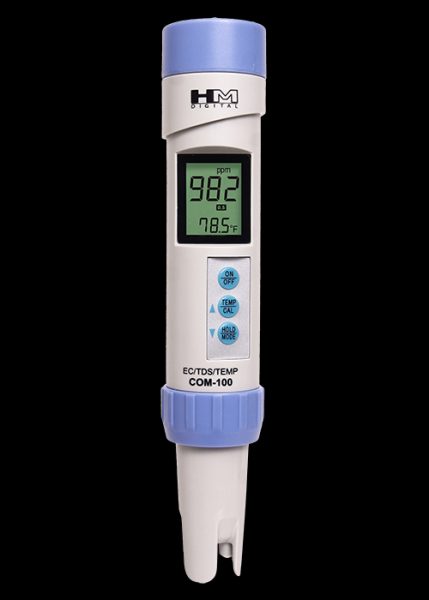
HM Digital's current COM-100 documentation lists four display scales: µS, mS, ppm 0.5 (NaCl) and ppm 0.7 (442). EC range is 0–9990 µS / 0–9.99 mS, published accuracy is ±2%, and the unit uses automatic temperature compensation. The current product is digitally calibrated and ships factory-calibrated at 1413 µS; its sensor is replaceable and the housing is IP67 waterproof.
Those features make the COM-100 more auditable than a fixed-factor ppm pen: you can log conductivity directly or choose the TDS scale that matches the comparison method. The added flexibility also creates responsibility — readings from different scales should not be mixed in one trend. Exact model COM-100 and UPC 891144000007 reconcile to Amazon.com ASIN B0045LQFTK.
The strongest research pick because it combines direct EC, selectable TDS scales, digital calibration, IP67 construction, replaceable sensing and unusually complete current manufacturer documentation.
Check price on Amazon →#2Best multiparameter upgrade
Apera Instruments PC60 Premium 5-in-1
Best for: advanced freshwater, planted or aquaculture users who want pH and conductivity/TDS in one serviceable instrument and will maintain the calibration workflow
What we like
- Measures pH, conductivity, TDS, salinity and temperature in one IP67 pocket tester
- Apera publishes ±1% F.S. conductivity accuracy and automatic 1–3 point conductivity calibration
- User-selectable TDS factor from 0.40 to 1.00
- Kit includes 1413 µS/cm and 12.88 mS/cm conductivity standards
- Exact PC60 / SKU AI316 / UPC 858718006094 identity maps to ASIN B01ENFOIKA
What we don't
- More sensors and calibration routines are unnecessary if the only job is a simple TDS trend
- The pH/conductivity combo probe is replaceable but creates a broader maintenance workflow than a dedicated TDS pen
- TDS remains an EC-derived calculation even though the meter measures several parameters
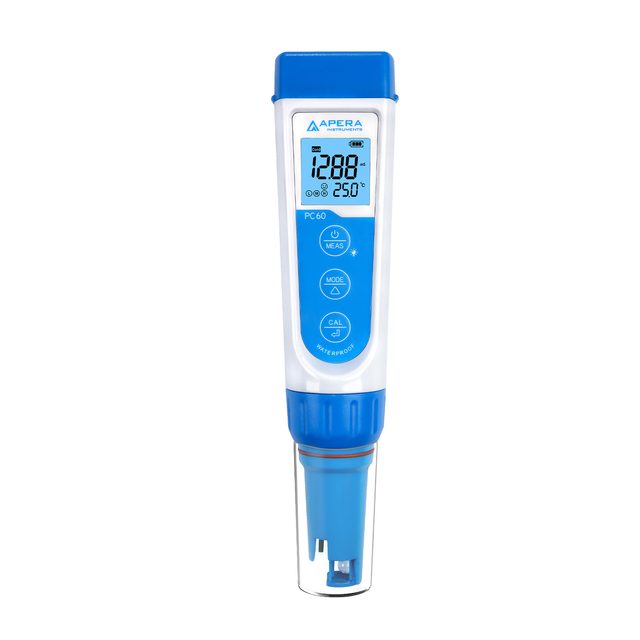
Apera identifies the current PC60 as SKU AI316. The meter measures pH, conductivity, TDS, salinity and temperature, with conductivity from 0 to 20 mS/cm and manufacturer-published ±1% F.S. conductivity accuracy. Apera documents automatic 1–3 point conductivity calibration, automatic temperature compensation from 0 to 50°C and an adjustable TDS factor from 0.40 to 1.00. The kit includes both 1413 µS/cm and 12.88 mS/cm conductivity standards.
The advantage is not that five displayed parameters make it universally more accurate; it is that one waterproof, replaceable-probe instrument can cover several measurement jobs. For a user who only wants an occasional TDS spot check, that added complexity may be unnecessary. Exact PC60 / AI316 / UPC 858718006094 reconciles to Amazon.com ASIN B01ENFOIKA.
The multiparameter pick: unusually strong conductivity documentation and adjustable TDS factor, ranked below COM-100 because buyers who only need EC/TDS pay for a broader sensor/calibration workflow.
Check price on Amazon →#3Best inline RO/DI monitor
HM Digital DM-1 In-Line Dual TDS Monitor
Best for: RO/DI owners who want permanent feed-versus-product monitoring and do not need one handheld meter for multiple tanks or water sources
What we like
- Two permanently installed probes show feed/input and product/output water without repeated handheld sampling
- HM Digital specifically positions the DM-1 for RO and DI filtration including aquarium applications
- Published ±2% accuracy with a fixed NaCl-average 0.5 conversion factor
- Includes dual 1/4-inch quick-connect probe fittings
- Exact DM-1 / UPC 891144000052 identity maps to Amazon.com ASIN B001EHAZGW
What we don't
- Displays TDS rather than direct EC, so the fixed conversion scale is part of every result
- Two probes are ideal for one before/after comparison but cannot independently monitor every stage of a complex multi-DI train
- Analog calibration is less convenient than the push-button calibration on the top handheld picks
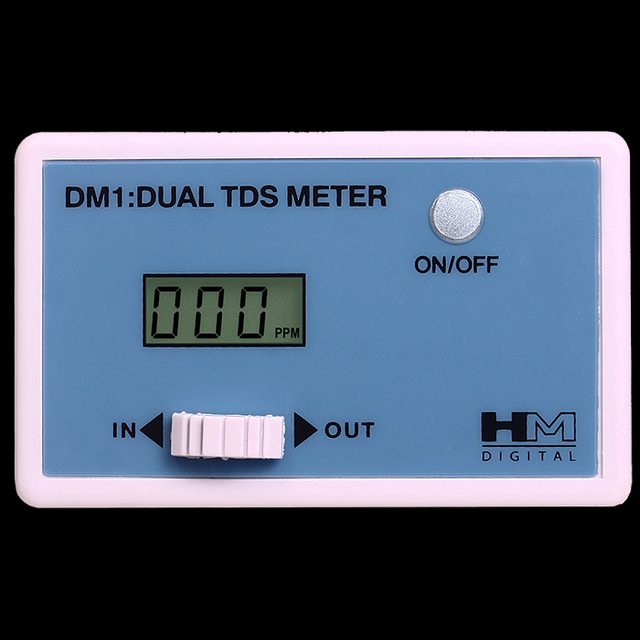
HM Digital's DM-1 is a dual in-line TDS monitor intended to compare feed/input water with product/output water from filtration systems. The current manufacturer page specifies two probes, standard 1/4-inch fittings, ±2% accuracy, a fixed NaCl-average 0.5 conversion factor and analog calibration.
That permanent two-point layout is useful around an RO membrane or final filtration boundary because the same installed sensors can be read repeatedly without dipping a pen. It is not a general aquarium chemistry analyzer and does not identify what caused a TDS change. Exact DM-1 marketplace metadata cross-keys UPC 891144000052 to Amazon.com ASIN B001EHAZGW.
The inline specialist: the best fit for continuous two-point RO/DI comparison, deliberately scored below the leading handhelds because it uses a fixed TDS scale and a narrower measurement job.
Check price on Amazon →#4Best aquarium-focused simple pen
HM Digital TDS-4TM Aquarium TDS Meter
Best for: freshwater keepers who want a compact aquarium-specific TDS-and-temperature pen and value a simple repeatable fixed-scale workflow
What we like
- HM Digital explicitly positions TDS-4TM for freshwater aquariums, ponds, RO and DI checks
- 0–9990 ppm range with ±2% published accuracy and built-in temperature display
- Automatic Temperature Compensation from 1 to 50°C
- Simple fixed NaCl-average 0.5 conversion makes one-meter trend logging straightforward
- Exact TDS-4TM / UPC 891144000199 identity maps to Amazon.com ASIN B001RK38LU
What we don't
- Fixed NaCl-average TDS scale cannot show the alternative 0.7-style result available on configurable meters
- Does not display direct EC, so cross-meter ppm comparisons require knowing the conversion scale
- HM Digital's maintenance guidance does not treat this pen as watertight like the COM-100, so it should not be used as a submersible instrument
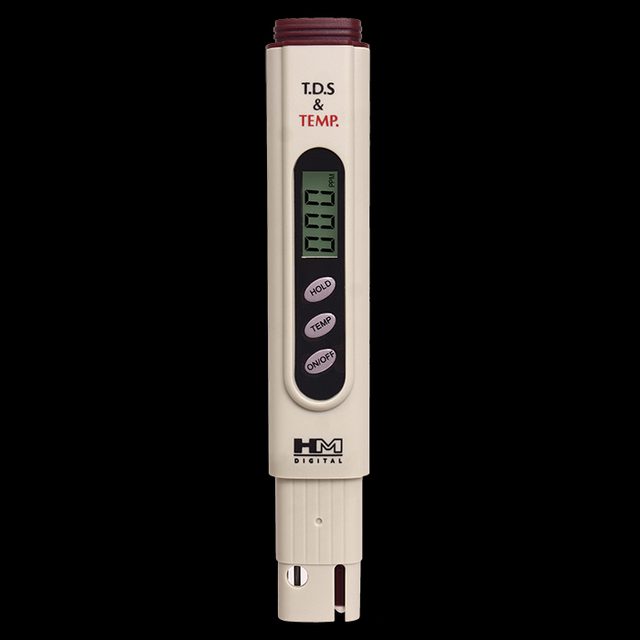
HM Digital explicitly names the TDS-4TM an aquarium TDS meter with digital thermometer. Current specifications are 0–9990 ppm, ±2% accuracy, automatic temperature compensation from 1 to 50°C, and a fixed NaCl-average 0.5 EC-to-TDS factor. It is factory calibrated with 342 ppm NaCl solution.
That fixed scale is a limitation for cross-meter comparison but a convenience for one-meter trend logging because the user cannot accidentally switch between 0.5 and 0.7 modes. HM Digital's maintenance guidance distinguishes the waterproof COM-100 from its standard handheld pens, so do not infer full submersion resistance. Exact TDS-4TM / UPC 891144000199 reconciles to Amazon.com ASIN B001RK38LU.
The simplest aquarium-specific research pick: clear manufacturer positioning and exact identity, with fewer scale/calibration controls than the higher-ranked instruments.
Check price on Amazon →#5Best simple handheld with case
HM Digital TDS-3 Handheld TDS Meter
Best for: users who want a straightforward portable TDS/temperature meter with a protective case for source-water, tank and filter spot checks
What we like
- 0–9990 ppm TDS range with built-in digital thermometer and included carrying case
- HM Digital publishes ±2% accuracy and automatic temperature compensation
- Factory calibration uses 342 ppm NaCl solution and the meter can be recalibrated
- Fixed NaCl-average 0.5 scale makes its trend method easy to document
- Exact TDS-3 model maps consistently to Amazon.com ASIN B000VTQM70
What we don't
- TDS-only display uses a fixed scale rather than exposing direct conductivity
- No selectable EC-to-TDS factor for comparing different ppm conventions
- Standard handheld housing is not documented as waterproof like COM-100
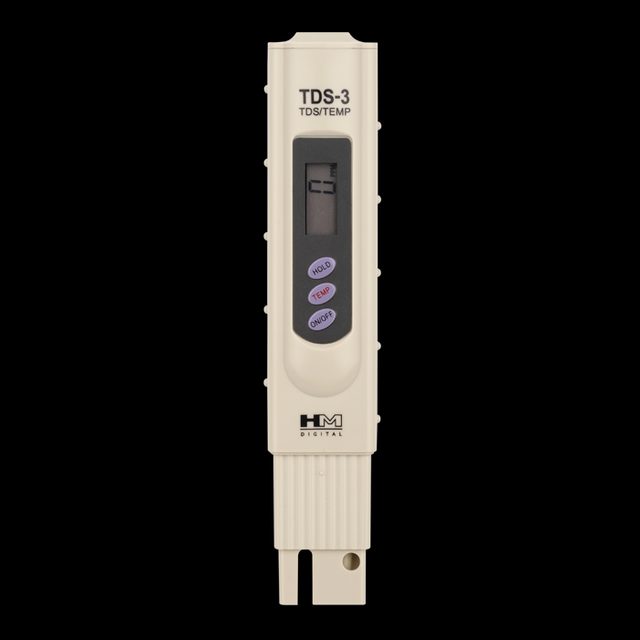
HM Digital's current TDS-3 page documents a 0–9990 ppm range, built-in thermometer, ±2% accuracy, automatic temperature compensation from 1 to 50°C and a fixed NaCl-average 0.5 conversion factor. It is factory calibrated with 342 ppm NaCl solution and can be recalibrated manually.
The included case and simple hold/temperature workflow fit portable spot checks. The trade-off is that it does not expose direct EC or selectable TDS scales, so comparisons should stay within the same meter/method. Current manufacturer model TDS-3 reconciles consistently to Amazon.com ASIN B000VTQM70.
The no-frills portable pick: solid current manufacturer documentation and a widely reconciled exact identity, but fewer measurement and calibration controls than the leaders.
Check price on Amazon →A TDS meter can be useful for aquariums, but buying one by the largest ppm range or cheapest display misses the important differences.
The key questions are:
- does it show electrical conductivity (EC) directly or only a derived TDS value?
- is the EC-to-TDS factor fixed or selectable?
- what accuracy does the manufacturer actually publish?
- how is the instrument calibrated?
- how is temperature handled?
- is the real job handheld aquarium/source-water testing or permanent RO/DI monitoring?
For the measurement theory behind those questions, read the aquarium TDS guide. It explains why most hobby TDS meters estimate ppm from conductivity and why no universal TDS target fits every aquarium.
Use the aquarium RO/DI systems guide when the meter is part of a water-purification workflow, the aquarium water test kit guide for ammonia/nitrite/nitrate and other specific chemistry, the aquarium GH guide for calcium/magnesium hardness, and the aquarium KH guide for carbonate/bicarbonate buffering.
How we researched and scored
PetGearReport has not physically tested these TDS meters, checked them against a laboratory conductivity or gravimetric-TDS reference, measured calibration drift, tested waterproofing, measured battery life or independently verified manufacturer accuracy claims.
The displayed number is a PetGearReport research score, not a hands-on result, Amazon/customer rating or laboratory measurement.
- Measurement capability & published accuracy — 30% — direct EC availability, TDS range/factor behavior and explicit manufacturer accuracy evidence.
- Calibration, scale & temperature handling — 25% — calibration method/standards, selectable versus fixed conversion scale, ATC and temperature documentation.
- Aquarium / RO/DI use-case fit — 20% — how clearly the exact instrument fits aquarium, source-water or inline filtration monitoring without pretending it measures parameters it does not.
- Usability & serviceability — 15% — waterproofing, replaceable sensors, installed-versus-portable workflow and maintenance clarity.
- Exact identity & documentation — 10% — exact model/SKU/UPC evidence reconciled to the marketplace variant.
| TDS meter | Capability/accuracy 30% | Calibration/scale/temp 25% | Use-case fit 20% | Usability/service 15% | Identity 10% | Weighted | Score |
|---|---|---|---|---|---|---|---|
| HM Digital COM-100 | 10 | 10 | 9 | 9 | 10 | 9.65 | 10/10 |
| Apera PC60 / AI316 | 10 | 9 | 9 | 8 | 10 | 9.25 | 9/10 |
| HM Digital DM-1 | 7 | 7 | 10 | 9 | 10 | 8.20 | 8/10 |
| HM Digital TDS-4TM | 7 | 7 | 9 | 8 | 10 | 7.85 | 8/10 |
| HM Digital TDS-3 | 7 | 7 | 8 | 8 | 10 | 7.65 | 8/10 |
The weighted order follows the evidence categories. The decimals make the method auditable; they do not imply laboratory precision.
Resolution is not accuracy
A meter can show more digits than its published accuracy supports.
The COM-100, for example, can display 0.1-unit resolution in its low range while HM Digital publishes ±2% accuracy. A finer display therefore helps show small changes but does not turn the instrument into a ±0.1% reference.
Apera publishes ±1% F.S. conductivity accuracy for PC60. That is a manufacturer specification for its conductivity system, not a statement that every calculated TDS ppm value is accurate to one displayed unit.
Compare resolution is not accuracy as a rule across all five products.
Fixed versus selectable EC-to-TDS scales
Most hobby TDS displays are calculated from EC.
Current manufacturer documentation shows three different approaches in this shortlist:
- COM-100 — selectable 0.5 (NaCl) and 0.7 (442™) TDS scales, plus direct µS/mS EC display;
- PC60 — configurable TDS factor from 0.40 to 1.00, plus direct EC;
- DM-1, TDS-4TM and TDS-3 — fixed NaCl average 0.5 conversion.
That means two meters can show different ppm in the same water without either sensor necessarily being defective.
For repeatable trends, record the meter and scale and do not mix values from different conversion modes as though they are one continuous series.
Calibration and temperature handling
Calibration and Automatic Temperature Compensation are part of the measurement method.
HM Digital factory-calibrates COM-100 at 1413 µS. TDS-4TM, TDS-3 and DM-1 use 342 ppm NaCl factory calibration references in current documentation. COM-100 uses digital calibration; DM-1 uses analog calibration; the standard HM handhelds can be manually recalibrated according to their instructions.
Apera PC60 supports automatic 1–3 point conductivity calibration and its current kit includes 1413 µS/cm and 12.88 mS/cm standards.
ATC improves comparability as temperature changes. It does not identify what is dissolved and it does not create a universal aquarium TDS target.
Handheld versus inline RO/DI monitoring
A handheld meter can move among:
- tap or well feed water;
- RO permeate;
- DI product water;
- prepared replacement water;
- the aquarium itself.
That flexibility is useful if you have several measurement points.
An inline DM-1 stays plumbed into two fixed points. That makes repeated feed-versus-product comparison fast, but the installed probes cannot be carried to another tank or container.
For an RO/DI system with more than two diagnostic points, decide whether two permanent readings are enough or whether a handheld/multi-probe layout better matches the system.
A TDS meter is not a general water-quality meter
TDS does not identify the dissolved composition.
A meter cannot tell you from the TDS number alone whether a change came from calcium, magnesium, sodium, bicarbonate, nitrate, fertilizer, salt or another dissolved ion.
It does not replace:
- ammonia testing;
- nitrite testing;
- nitrate testing;
- GH testing;
- KH testing;
- pH testing where relevant.
The aquarium TDS guide covers those interpretation limits in detail.
Product-by-product fit
HM Digital COM-100
Exact Amazon.com identity: COM-100, UPC 891144000007 → ASIN B0045LQFTK.
This is the best-documented dedicated EC/TDS handheld in the shortlist. Direct EC display, selectable TDS scales, digital calibration, IP67 waterproofing and a replaceable sensor make it suitable when you want to preserve the underlying conductivity measurement rather than only a fixed ppm conversion.
Avoid if you want a one-button fixed-scale pen and do not intend to record calibration/scale choices.
Apera Instruments PC60 Premium 5-in-1
Exact Amazon.com identity: PC60 / SKU AI316, UPC 858718006094 → ASIN B01ENFOIKA.
PC60 is the broadest instrument here: pH, EC, TDS, salinity and temperature. Apera’s current documentation includes adjustable TDS factor 0.40 to 1.00, ±1% F.S. conductivity accuracy, automatic conductivity calibration and a replaceable combination probe.
Avoid if TDS/EC is the only measurement you need; the extra pH sensor and calibration/storage workflow add complexity.
HM Digital DM-1
Exact Amazon.com identity: DM-1, indexed UPC 891144000052 → ASIN B001EHAZGW.
DM-1 is the specialist for two-point inline RO/DI monitoring. It is designed to show input/feed versus output/product TDS through permanently installed probes and standard quick-connect fittings.
Avoid if you need to spot-check several tanks, buckets or more than two locations with one instrument.
HM Digital TDS-4TM
Exact Amazon.com identity: TDS-4TM, UPC 891144000199 → ASIN B001RK38LU.
TDS-4TM has the clearest aquarium-specific positioning from HM Digital. It combines a fixed 0.5-scale TDS reading with temperature, ±2% published accuracy and ATC in a compact pen.
Avoid if you need direct EC or selectable conversion scales.
HM Digital TDS-3
Exact Amazon.com identity: TDS-3 → ASIN B000VTQM70.
TDS-3 is a straightforward portable meter with temperature, ATC, hold function and a carrying case. Its fixed NaCl-average 0.5 factor is easy to keep consistent if you use the same meter for every trend reading.
Avoid if waterproof housing, direct EC or selectable TDS factors matter.
Which one should you buy?
Choose by workflow:
| Need | Research fit | Why |
|---|---|---|
| Direct EC + configurable TDS in a waterproof handheld | COM-100 | Direct EC, selectable scales, digital calibration, replaceable sensor |
| pH + EC/TDS + salinity in one serviceable meter | PC60 | Five parameters, adjustable TDS factor, calibration kit |
| Permanent RO/DI feed vs product monitoring | DM-1 | Two inline probes, fixed installation |
| Simple freshwater/aquarium TDS + temperature | TDS-4TM | Aquarium-specific HM positioning, compact fixed-scale workflow |
| Portable basic TDS meter with case | TDS-3 | Simple fixed-scale spot checks and protective case |
A meter is useful only when its reading can drive a defined decision. If the real question is ammonia, nitrate, GH, KH or livestock health, buy or use the specific method for that parameter instead of treating TDS as a shortcut.
For a repeatable logging cadence, use the aquarium maintenance schedule.
Sources and methodology
Product specifications were checked against current manufacturer documentation. Exact Amazon.com identity was reconciled using exact model/SKU/UPC evidence and indexed marketplace metadata rather than relying on live Amazon product-page probing.
- HM Digital — COM-100 — current EC/TDS scales, range, ±2% accuracy, ATC, digital calibration, IP67 rating, replaceable sensor and UPC 891144000007.
- Apera Instruments — PC60 Premium / AI316 — pH/EC/TDS/salinity/temp coverage, ±1% F.S. conductivity accuracy, calibration standards, TDS factor 0.40–1.00, IP67 and replaceable probe.
- HM Digital — DM-1 — dual inline feed/product architecture, range, ±2% accuracy, fixed 0.5 conversion, calibration and fittings.
- HM Digital — TDS-4TM — aquarium positioning, 0–9990 ppm range, ±2% accuracy, fixed 0.5 factor, ATC and UPC 891144000199.
- HM Digital — TDS-3 — range, ±2% accuracy, temperature, ATC, fixed 0.5 factor and carrying case.
- HM Digital — Product Maintenance — calibration solutions and waterproofing/immersion boundary for standard handhelds versus COM-100.
No Amazon price, stock or availability claim is made here. Those are dynamic and are not part of the research score.
Frequently asked questions
What is the best TDS meter for an aquarium?
The best fit depends on the job. COM-100 is our strongest documentation-based EC/TDS handheld because it exposes direct conductivity plus selectable TDS scales. TDS-4TM is a simpler aquarium-focused fixed-scale pen, while DM-1 is purpose-built for inline RO/DI feed-versus-product monitoring. These are PetGearReport research conclusions, not hands-on test results.
Why can two TDS meters show different ppm in the same water?
Most hobby TDS meters derive ppm from electrical conductivity. Different instruments can use different EC-to-TDS conversion factors. COM-100 offers 0.5 NaCl and 0.7 442 scales, PC60 allows a 0.40–1.00 factor, while TDS-4TM, TDS-3 and DM-1 use a fixed NaCl-average 0.5 factor.
Is finer TDS resolution the same as better accuracy?
No. Resolution is the smallest displayed increment; accuracy describes closeness to the reference under the manufacturer's specified conditions. COM-100 can display 0.1-unit resolution at its low range while HM Digital still publishes ±2% accuracy. Resolution is not accuracy.
Should I use a handheld or inline TDS meter for RO/DI?
A handheld is more flexible because it can check feed water, RO permeate, DI output and aquarium samples manually. An inline dual monitor is more convenient for repeated before/after readings at two fixed points. Choose based on how many locations you need to measure and whether portability or permanent monitoring matters more.
Can a TDS meter replace an aquarium test kit?
No. A conductivity-derived TDS reading does not identify the dissolved ions and does not measure ammonia, nitrite or nitrate specifically. GH and KH also answer different mineral-hardness and buffering questions. Use TDS as a trend or source-water/RO/DI tool, then use specific tests for the parameter you need.