Best Aquarium RO/DI Systems: 5 Picks by Source Water, GPD & DI Stage
An aquarium RO/DI system should be chosen around the source water and operating conditions, not by counting filter stages or comparing headline GPD alone. We researched five exact marketplace variants using current manufacturer documentation for chlorine/chloramine pretreatment, membrane capacity, pressure and temperature limits, DI architecture, monitoring, wastewater behavior, serviceability and exact product identity. PetGearReport has not physically tested these systems, measured TDS rejection, production rate, wastewater ratio, pressure loss, cartridge life or long-term reliability.
| Rank | Product | Score | Best for | Link |
|---|---|---|---|---|
| #1 | Bulk Reef Supply 4 Stage Value Plus 75 GPD RO/DIBest documented low-chlorine source-water system | 9 | reef, saltwater or freshwater preparation where the verified source water contains low chlorine rather than chloramine and the user wants built-in TDS and pressure monitoring | Check price → |
| #2 | Max Water 6 Stage 100 GPD RO/DI (101047)Best higher-output documented system | 8 | reef and saltwater users who need a documented 100 GPD option, can operate within the 45–75 PSI pressure envelope and want a refillable DI stage | Check price → |
| #3 | Aquatic Life Twist-In 75 GPD 4-Stage RO/DIBest tool-free cartridge system | 8 | aquarium keepers who value compact tool-free cartridge changes and whose source-water disinfectant/pressure fit the documented configuration | Check price → |
| #4 | LiquaGen 5 Stage Elementary 75 GPD RO/DI (1-OT-75)Best portable conventional-canister option | 8 | first-time reef or freshwater users on relatively clean low-chlorine city water who prefer a portable conventional-canister system and are comfortable adding monitoring upgrades if needed | Check price → |
| #5 | Aquatic Life RO Buddie +DI 50 GPDBest compact lower-output option | 8 | smaller aquariums and lower-volume water preparation where compact size matters and the source-water disinfectant is verified before selecting pretreatment | Check price → |
#1 · Our PickBest documented low-chlorine source-water system
Bulk Reef Supply 4 Stage Value Plus 75 GPD RO/DI
Best for: reef, saltwater or freshwater preparation where the verified source water contains low chlorine rather than chloramine and the user wants built-in TDS and pressure monitoring
What we like
- BRS explicitly defines the ideal source-water boundary as low-chlorine city water or low-contaminant well water
- 75 GPD Dow Filmtec membrane with documented 50–90 PSI operating range and 77°F ideal temperature
- Dual inline TDS meter and pressure gauge make membrane/DI performance easier to monitor
- Manual flush restrictor and automatic shut-off hardware are included
- Exact SKU 210773 / UPC 850048740891 maps to indexed Amazon.com ASIN B0DQLSCW8P
What we don't
- BRS does not position this 4-stage configuration for chloramine-treated city water
- Approximate 3:1 waste:product ratio is less efficient than some higher-recovery designs
- Rated 75 GPD depends on source-water pressure, temperature and quality rather than being guaranteed in every home
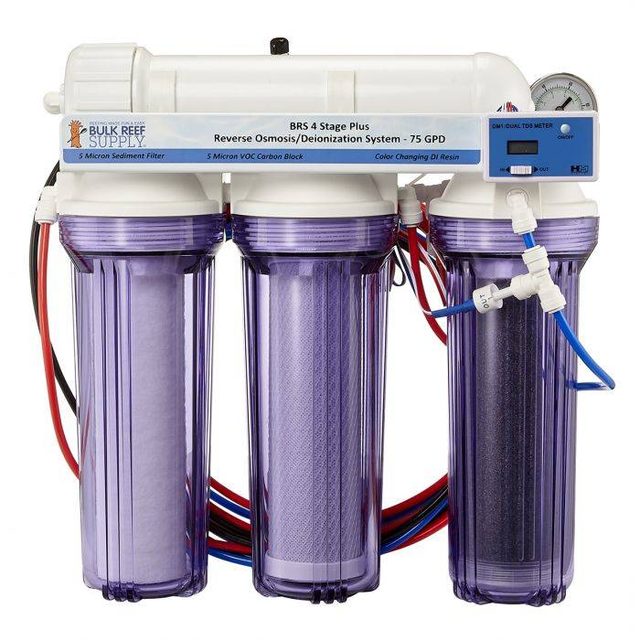
Bulk Reef Supply identifies the exact 4 Stage Value Plus 75 GPD system as SKU 210773 and UPC 850048740891. BRS specifies a 75 GPD Dow Filmtec membrane, 50 PSI minimum and 90 PSI maximum pressure, 77°F ideal water temperature and an approximate 3:1 waste:product ratio. The Plus configuration includes a pressure gauge, dual inline TDS meter and manual flush flow restrictor.
The source-water boundary matters more than the stage count. BRS says this system is best for city water with low levels of chlorine and low-contaminant well water; its current comparison does not recommend this four-stage configuration for chloramine-treated city water. Exact SKU/UPC evidence reconciles to Amazon.com ASIN B0DQLSCW8P.
The strongest documented pick when its source-water boundary is respected: unusually clear pressure, waste-ratio, monitoring and exact-identity evidence without pretending the four-stage layout fits chloramine-treated water.
Check price on Amazon →#2Best higher-output documented system
Max Water 6 Stage 100 GPD RO/DI (101047)
Best for: reef and saltwater users who need a documented 100 GPD option, can operate within the 45–75 PSI pressure envelope and want a refillable DI stage
What we like
- Exact system part 101047 can be configured with 100 GPD membrane part 104094
- Manufacturer publishes 45–75 PSI recommended pressure and 40–104°F operating-water range
- Approximate 1:2 product-to-drain ratio is documented for the current configuration
- Refillable mixed-bed DI cartridge supports resin replacement rather than a sealed disposable DI stage
- Exact 101047 marketplace identity maps to ASIN B07CN7B1K8
What we don't
- Final T33 post-carbon is aimed at taste/freshness; manufacturer notes aquarium-only users may collect directly after DI instead
- Pressure gauge, TDS meter, booster pump and other accessories are not automatically included unless selected
- Manufacturer says approximately 0 ppm is condition-dependent rather than guaranteed under every feed-water condition
Max Water identifies the aquarium system as part number 101047 and the selected 100 GPD TFC membrane as part 104094. Its current documentation lists a six-stage path with sediment filtration, GAC and carbon-block pretreatment, the RO membrane, a refillable mixed-bed DI cartridge and a final T33 carbon post-filter. Recommended pressure is 45–75 PSI and the current 100 GPD configuration lists an approximate 1:2 product-to-drain ratio.
For aquarium-only use, Max Water notes that users may bypass the final taste-oriented post-carbon and collect directly after the DI stage. That distinction prevents us from treating a sixth stage as automatically purer aquarium water. Exact part 101047 maps to indexed Amazon.com ASIN B07CN7B1K8.
A strong high-output research choice because Max Water publishes unusually detailed pressure, waste-ratio, DI and exact component evidence for part 101047.
Check price on Amazon →#3Best tool-free cartridge system
Aquatic Life Twist-In 75 GPD 4-Stage RO/DI
Best for: aquarium keepers who value compact tool-free cartridge changes and whose source-water disinfectant/pressure fit the documented configuration
What we like
- Aquatic Life publishes an exact 30 PSI minimum, 65 PSI suggested and 80 PSI maximum pressure range
- 75 GPD membrane rating is paired with a documented 77°F optimal temperature
- Twist-In cartridges can be replaced without opening conventional canister housings
- Four-stage path includes sediment, solid carbon, RO and color-changing DI
- Exact SKU 540346 maps to indexed Amazon.com ASIN B083P4HZPD
What we don't
- Current product page documents chlorine reduction through the carbon stage but does not claim this exact configuration is a chloramine-focused system
- No built-in pressure gauge or inline TDS meter is documented as part of the standard system
- Proprietary Twist-In cartridges trade universal 10-inch cartridge flexibility for easier servicing
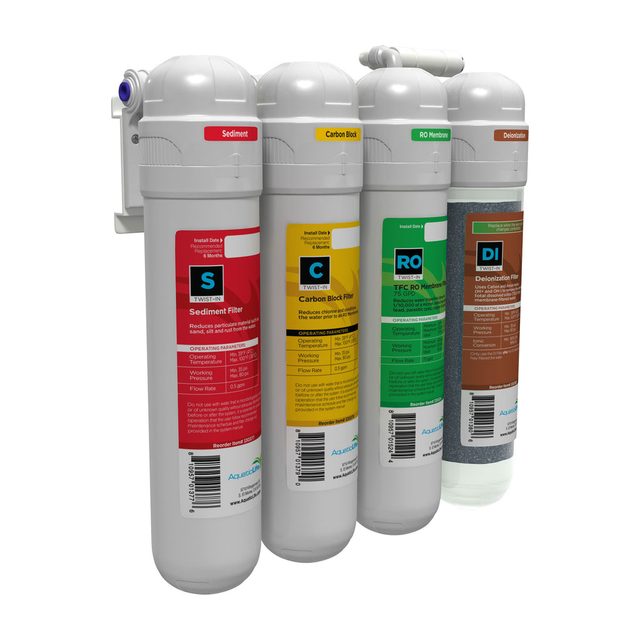
Aquatic Life identifies this Twist-In four-stage system as SKU 540346. The manufacturer lists a 75 GPD RO membrane, 30 PSI minimum, 65 PSI suggested and 80 PSI maximum pressure, with 77°F / 25°C as the optimal water temperature. The filtration path is a 5-micron sediment filter, 5-micron solid carbon filter, 75 GPD RO membrane and color-changing DI cartridge.
The current product page supports chlorine reduction but does not give this exact four-stage system the same explicit chloramine positioning that BRS gives its dual-carbon five-stage system. Marketplace records for the exact Twist-In 75 GPD product map to ASIN B083P4HZPD; indexed marketplace coding also uses 810957013714, while Aquatic Life's own product SKU remains 540346.
The serviceability pick: a clearly specified 75 GPD system with unusually broad 30–80 PSI operating pressure and straightforward Twist-In maintenance.
Check price on Amazon →#4Best portable conventional-canister option
LiquaGen 5 Stage Elementary 75 GPD RO/DI (1-OT-75)
Best for: first-time reef or freshwater users on relatively clean low-chlorine city water who prefer a portable conventional-canister system and are comfortable adding monitoring upgrades if needed
What we like
- Current 1-OT-75 page is explicitly 75 GPD and designed primarily for aquarium/reef water preparation
- Single-frame system is documented as portable without permanent drilling
- Automatic shut-off and check valve are currently included
- Standard-style filtration architecture has clear replacement/upgrade paths
- Indexed 1-OT series marketplace evidence maps the 75 GPD system to ASIN B01FNAPGPA
What we don't
- LiquaGen positions the current system for relatively clean city water with low chlorine levels rather than as a universal difficult-water configuration
- Pressure gauge and dual TDS meter are presented as upgrade options rather than assumed standard equipment
- Exact current manufacturer-to-marketplace reconciliation is less richly cross-keyed than BRS or Aquatic Life, so identity scoring is conservative
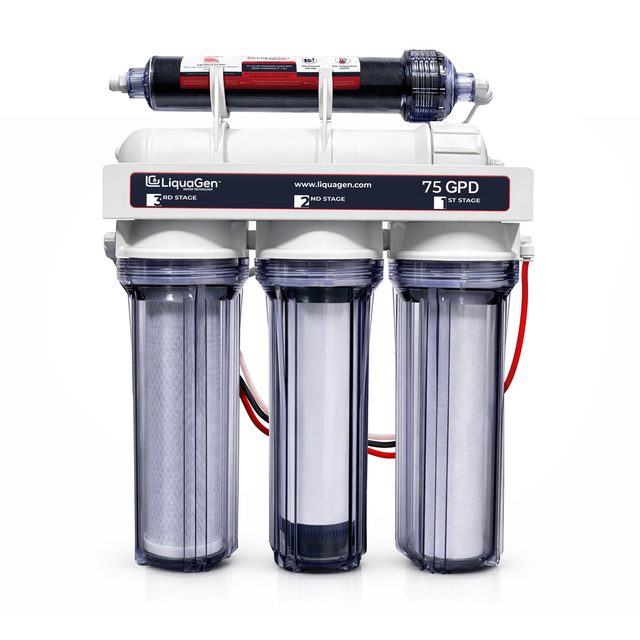
LiquaGen's current product page identifies the 5 Stage Elementary 75 GPD RO/DI system in the 1-OT-75 product path. It is positioned for relatively clean city water with low chlorine levels, uses a 75 GPD membrane and is built on one portable frame. The current page says an automatic shut-off and check valve are pre-installed.
LiquaGen describes pressure gauge, dual TDS monitoring and water-saver hardware as upgrade options, so this guide does not silently credit the base exact marketplace variant with those accessories. Current 1-OT-series evidence is reconciled to indexed Amazon.com ASIN B01FNAPGPA, but the mapping is less richly cross-keyed than the leading picks and receives a lower identity score.
A practical portable option, scored conservatively because the current product page is clear about low-chlorine source water while exact marketplace identity evidence is less richly cross-keyed.
Check price on Amazon →#5Best compact lower-output option
Aquatic Life RO Buddie +DI 50 GPD
Best for: smaller aquariums and lower-volume water preparation where compact size matters and the source-water disinfectant is verified before selecting pretreatment
What we like
- Exact item 540019 / UPC 810957010195 has strong manufacturer identity evidence
- Manufacturer rates up to 50 GPD at 65 PSI and 77°F rather than presenting output without test conditions
- Compact four-stage path includes sediment, carbon, RO membrane and color-changing mixed-bed DI
- Aquatic Life documents up to 98% RO-membrane TDS reduction before DI polishing
- Exact item 540019 maps to Amazon.com ASIN B00204CQF6
What we don't
- Lower 50 GPD rated output is slower for large mixing reservoirs than 75–100 GPD systems
- Aquatic Life documentation says chloramine-treated water requires a special chloramine filter rather than relying on the standard carbon cartridge
- No built-in pressure gauge or inline TDS monitor is part of the standard compact package
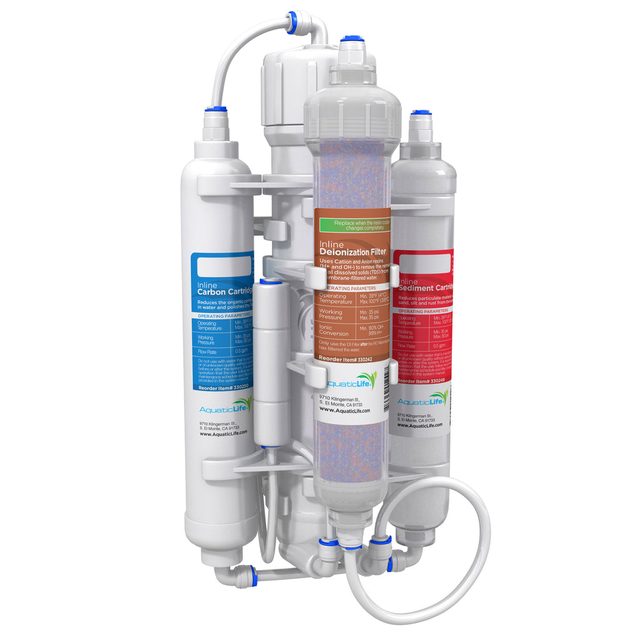
Aquatic Life identifies the exact RO Buddie +DI as item 540019 and UPC 810957010195. The manufacturer rates it for up to 50 gallons in 24 hours when incoming pressure is 65 PSI and water temperature is 77°F. Its four stages are sediment, carbon, RO membrane and mixed-bed DI resin; Aquatic Life states the RO membrane can remove up to 98% of TDS before the DI stage removes remaining dissolved solids.
The standard carbon cartridge should not be treated as a universal chloramine solution. Aquatic Life's documentation says a special chloramine filter is required when chloramines are present. Exact item 540019 / UPC 810957010195 maps to Amazon.com ASIN B00204CQF6.
The compact research pick with excellent exact identity evidence, deliberately ranked lower because the standard carbon path requires an additional chloramine-specific filter when chloramines are present.
Check price on Amazon →RO/DI is a water-preparation system, not a universal aquarium-water recipe.
For reef aquariums, purified RO/DI water is commonly used as the base for a salt mix and as freshwater for evaporation top-off. For freshwater and planted aquariums, raw RO/DI water is not a universal freshwater target: it may need to be remineralized or blended/prepared to species-appropriate GH, KH, conductivity and other parameters before livestock exposure.
That distinction matters because the best machine for producing low-TDS water is not automatically a prescription for the final aquarium chemistry. Use our aquarium water-parameters guide for the chemistry side, the aquarium TDS guide for EC-derived TDS interpretation and meter limitations, and the aquarium GH guide when freshwater RO/DI needs species-appropriate calcium/magnesium hardness and remineralization. Our reef salt mix guide covers the chemistry profile mixed into marine RO/DI base water, our aquarium salinity tester guide verifies finished marine saltwater, and our aquarium auto top-off guide covers evaporation replacement.
How we researched and scored
PetGearReport has not physically tested these RO/DI systems, measured real production rate, membrane rejection, final TDS, pressure drop, wastewater volume, chloramine breakthrough, cartridge life or leak reliability. We compared current manufacturer documentation, exact marketplace identity, source-water positioning, membrane/pressure specifications, DI architecture, monitoring, serviceability and documented wastewater behavior.
The displayed number is a PetGearReport research score, not a hands-on result, customer rating or laboratory measurement.
- Source-water & pretreatment fit — 30% — how clearly the manufacturer defines chlorine/chloramine, well-water or other feed-water boundaries.
- RO membrane, GPD & pressure evidence — 25% — membrane capacity plus the pressure/temperature context needed to interpret rated production.
- DI architecture & monitoring — 20% — DI cartridge/resin design, TDS monitoring and evidence for knowing when performance changes.
- Waste/product efficiency & serviceability — 15% — documented wastewater relationship, flushing, cartridge access, refillability and maintenance hardware.
- Exact identity & documentation — 10% — model/SKU/UPC evidence reconciled to the ranked marketplace variant.
| RO/DI system | Source water 30% | RO/GPD/pressure 25% | DI/monitoring 20% | Efficiency/service 15% | Identity 10% | Weighted | Score |
|---|---|---|---|---|---|---|---|
| BRS 4 Stage Value Plus 75 GPD | 9 | 10 | 10 | 8 | 10 | 9.40 | 9/10 |
| Max Water 101047 100 GPD | 8 | 9 | 8 | 9 | 10 | 8.60 | 8/10 |
| Aquatic Life Twist-In 75 GPD | 7 | 10 | 7 | 9 | 10 | 8.35 | 8/10 |
| LiquaGen 1-OT-75 | 8 | 8 | 7 | 9 | 7 | 7.85 | 8/10 |
| Aquatic Life RO Buddie 50 GPD | 7 | 9 | 7 | 7 | 10 | 7.80 | 8/10 |
The decimals make the weighting auditable; they do not imply laboratory precision. The weighted order and displayed ranks use the same evidence categories; products within the same rounded 8/10 band still differ in documentation depth and use-case fit.
Stage count is not a universal quality score
A six-stage system is not automatically better than a four-stage system.
The relevant question is what each stage does for the actual source water. Bulk Reef Supply provides a useful example:
- its 4 Stage Value Plus is positioned for city water with low chlorine and low-contaminant well water;
- its 5 Stage Premium Plus adds a second carbon block and is explicitly positioned for city water treated with chlorine or chloramines.
That is a functional reason for another stage. By contrast, Max Water’s sixth stage is a post-DI carbon filter intended for taste/freshness; Max Water says aquarium-only users may collect directly after the DI stage. Counting that stage as automatically “purer” aquarium water would be misleading.
Chlorine and chloramine: verify the source before choosing pretreatment
Municipal supplies can use free chlorine or chloramine. Carbon configuration should be chosen from the exact filter’s documented capability rather than from the number printed on the housing. The chlorine vs chloramine aquarium guide explains how to verify the utility disinfectant and why RO membrane performance should not be confused with chloramine-capable pretreatment.
The ranked BRS 4 Stage Value Plus is not intended for chloramine-treated city water according to BRS’s current system comparison; it is the low-chlorine source-water pick.
BRS documents its 5 Stage Premium Plus 75 GPD with dual Universal Carbon Blocks for chlorine/chloramine-treated city water. That model is a useful chloramine reference below even though it is not ranked because its exact current Amazon.com identity did not meet our evidence gate.
For the RO Buddie, Aquatic Life documentation says a special chloramine filter is required when chloramines are present. Do not assume the standard carbon cartridge covers every disinfectant simply because the unit has a carbon stage.
Our aquarium water-conditioner guide explains the same source-water-first principle for direct tap-water treatment. The tap-water source guide compares conditioned tap, household-softened water and RO/DI preparation before the product-selection step. A conditioner and an RO/DI system are different workflows; choose the one that matches how the replacement water will actually be prepared.
Rated GPD is a test-condition number, not guaranteed household output
Rated GPD means gallons per day under the membrane/system’s stated conditions. Real production changes with:
- feed pressure;
- water temperature;
- source-water TDS and chemistry;
- membrane and prefilter condition;
- flow restrictor and system configuration.
The documentation makes those differences concrete:
| System | Rated output | Documented pressure context | Temperature context |
|---|---|---|---|
| BRS 4 Stage Value Plus | 75 GPD | 50–90 PSI | 77°F ideal |
| Aquatic Life Twist-In | 75 GPD | 30 min / 65 suggested / 80 max PSI | 77°F optimal |
| Max Water 101047 | 100 GPD selected membrane | 45–75 PSI recommended | 40–104°F operating |
| Aquatic Life RO Buddie | 50 GPD | Rating stated at 65 PSI | Rating stated at 77°F |
| LiquaGen 1-OT-75 | 75 GPD | Monitoring/booster choices depend on configuration | Follow current system/membrane instructions |
Do not size production time by dividing a storage-container volume by headline GPD without margin. If source water is cold or pressure is low, the real filling time can be substantially different.
DI resin and TDS monitoring
The RO membrane rejects most dissolved material before the DI stage. The DI resin then removes remaining ions until the resin is exhausted.
Monitoring matters because a DI cartridge can look like a simple final polishing stage while its useful life depends heavily on how much TDS reaches it from the membrane.
The BRS Value Plus includes a dual inline TDS meter, giving direct pre/post-DI monitoring. Max Water uses a refillable mixed-bed DI cartridge and instructs users to monitor RO-water and final-water TDS; its TDS meter is an optional configuration item rather than something this guide assumes is included. Aquatic Life’s ranked systems use color-changing DI cartridges/resin; color is useful maintenance evidence but does not make a separate measurement instrument unnecessary when precise TDS verification matters. If your system needs a separate meter, the aquarium TDS meter buyer guide compares handheld EC/TDS instruments with a permanent dual-inline RO/DI monitor.
Do not translate a manufacturer’s “0 TDS” product-water claim into a universal livestock target. Product water and finished aquarium water are different decision layers.
Wastewater ratio and water-saver claims
Reverse osmosis produces product water and a reject/drain stream.
BRS lists an approximate 3:1 waste:product ratio for the 4 Stage Value Plus. Max Water lists an approximate 1:2 product-to-drain ratio for the selected 100 GPD 101047 configuration — equivalent wording should not be compared until the direction of the ratio is clear.
LiquaGen says conventional RO can waste roughly three to four gallons for every gallon purified and offers a water-saver upgrade that requires adequate pressure. That is an upgrade path, not a claim that the base marketplace variant includes the water saver.
Because pressure, restrictors, membranes and feed chemistry affect recovery, this guide does not invent one universal wastewater ratio for systems whose manufacturer does not publish the exact configured value.
Product-by-product fit
Bulk Reef Supply 4 Stage Value Plus 75 GPD
Exact identity: SKU 210773, UPC 850048740891, Amazon.com ASIN B0DQLSCW8P.
This is the monitoring-focused choice for verified low-chlorine source water. The current BRS configuration includes a pressure gauge, dual inline TDS meter, flush hardware, automatic shut-off valve, 75 GPD Dow Filmtec membrane and color-changing mixed-bed DI.
Use the source-water boundary literally. If the city water is chloramine-treated, move to pretreatment explicitly documented for chloramine rather than assuming the standard four-stage carbon block is enough.
Max Water 101047 — 100 GPD configuration
Exact system part: 101047. Selected 100 GPD membrane: 104094. Amazon.com ASIN B07CN7B1K8.
Max Water documents 45–75 PSI recommended pressure, 40–104°F operating-water temperature and an approximate 1:2 product-to-drain ratio. Its mixed-bed DI cartridge is refillable.
The sixth stage is an inline T33 post-carbon filter. For aquarium-only applications, Max Water says users may bypass that taste/freshness stage and collect water directly after DI. That is why stage count alone is a poor comparison metric.
Aquatic Life Twist-In 75 GPD 4-Stage
Exact manufacturer SKU: 540346. Indexed marketplace product code: 810957013714. Amazon.com ASIN B083P4HZPD.
The Twist-In system stands out for serviceability: sediment, carbon, RO and DI cartridges twist into the manifold without opening conventional housings. Aquatic Life documents 30 PSI minimum, 65 PSI suggested and 80 PSI maximum pressure with 77°F optimal water temperature.
The current exact product page documents a solid carbon stage and chlorine reduction but does not give us enough evidence to relabel it as a chloramine-focused system.
LiquaGen 5 Stage Elementary 75 GPD
Current product path: 1-OT-75. Amazon.com ASIN B01FNAPGPA.
LiquaGen positions this system for relatively clean city water with low chlorine. It uses a conventional multi-canister layout, is built on a portable single frame and currently includes auto shut-off and a check valve.
The manufacturer presents pressure gauge, dual TDS meter and water-saver hardware as selectable upgrades. Do not assume those upgrades are included with the exact marketplace variant unless the listing specifically says so.
Aquatic Life RO Buddie +DI 50 GPD
Exact item: 540019. UPC: 810957010195. Amazon.com ASIN B00204CQF6.
Aquatic Life states that the unit can produce up to 50 gallons in 24 hours at 65 PSI and 77°F. It uses sediment, carbon, RO and mixed-bed DI stages in a compact package.
When chloramines are present, Aquatic Life documents a separate chloramine-filter requirement. That source-water limitation matters more than the compact unit’s four-stage label.
Why BRS 5 Stage Premium Plus is not ranked
The BRS 5 Stage Premium Plus 75 GPD is technically important because BRS explicitly documents its dual-carbon configuration for chlorine/chloramine-treated city water. It is therefore the clearest reference in this guide for understanding why source-water pretreatment matters.
It is not ranked in this publication because we did not reconcile the exact current Amazon.com marketplace identity to the same standard as the five ranked variants. This is an identity-evidence exclusion, not a claim that the BRS 5-stage system is technically inferior.
RO/DI water still has to become aquarium water
For a reef:
- produce appropriate RO/DI base water;
- mix new saltwater with the exact marine salt product according to its instructions and the aquarium’s required salinity/chemistry; use the reef saltwater mixing guide for the preparation workflow;
- use appropriate freshwater RO/DI for normal evaporation top-off, because evaporation leaves dissolved salts behind.
For freshwater/planted systems, raw RO/DI is not a universal freshwater target. It can have very little mineral content and buffering. Remineralize, blend or otherwise prepare it to the requirements of the species, plants and system rather than chasing “0 TDS” in the display tank.
The aquarium maintenance schedule keeps actual water changes separate from top-off, while the water-parameters guide explains why final GH/KH/pH and other targets depend on livestock and system type.
Identity verification notes
- BRS 4 Stage Value Plus 75 GPD — SKU 210773, UPC 850048740891 → ASIN B0DQLSCW8P.
- Max Water 101047 / 100 GPD 104094 → ASIN B07CN7B1K8.
- Aquatic Life Twist-In 75 GPD — SKU 540346, indexed marketplace code 810957013714 → ASIN B083P4HZPD.
- LiquaGen 5 Stage Elementary 75 GPD — current 1-OT-75 series identity → indexed ASIN B01FNAPGPA, scored conservatively for identity evidence.
- Aquatic Life RO Buddie +DI 50 GPD — item 540019, UPC 810957010195 → ASIN B00204CQF6.
Direct Amazon product-page probing was not used as a release gate.
Sources and verification
- Bulk Reef Supply — 4 Stage Value Plus 75 GPD RO/DI — exact SKU/UPC, stages, pressure, 75 GPD membrane, 3:1 waste:product ratio, TDS/pressure monitoring and low-chlorine source-water boundary.
- Bulk Reef Supply — 5 Stage Premium Plus 75 GPD RO/DI — chlorine/chloramine source-water positioning and dual-carbon pretreatment reference.
- Aquatic Life — Twist-In 75 GPD 4-Stage RO/DI — exact SKU, stages, pressure and temperature boundaries, cartridge architecture.
- Aquatic Life — 50 GPD RO Buddie +DI — item/UPC identity, rated-output test conditions, RO/DI architecture and specifications.
- LiquaGen — 5 Stage Elementary 75 GPD RO/DI — current 1-OT-75 product, low-chlorine positioning, 75 GPD, portable frame and upgrade boundaries.
- Max Water — Aquarium RO/DI system part 101047 — exact system/membrane parts, 100 GPD configuration, pressure/temp range, DI architecture, post-carbon boundary and product:drain ratio.
No Amazon price, stock or availability claim is made here. Those are dynamic and are not part of the research score.
Frequently asked questions
How many RO/DI stages do I need for an aquarium?
There is no universal stage-count target. Match pretreatment to the source water first. A well-documented four-stage system can be appropriate for low-chlorine water, while chloramine-treated city water may need additional or chloramine-specific carbon pretreatment. DI configuration and monitoring also matter. Stage count is not a universal quality score.
Does a 75 GPD RO/DI system always make 75 gallons per day?
No. Rated GPD is tied to specified test conditions. Feed-water pressure, temperature, TDS, membrane condition and restrictor/system configuration can change real production. BRS, Aquatic Life and Max Water all publish operating-condition boundaries rather than guaranteeing the headline number in every home.
Can an aquarium RO/DI system remove chloramine?
Only when the exact pretreatment is documented for it. BRS positions its 4 Stage Value Plus for low-chlorine city water and its dual-carbon 5 Stage Premium Plus for chlorine/chloramine-treated city water. Aquatic Life states that the RO Buddie needs a special chloramine filter when chloramines are present. Verify the local water utility and the exact filter documentation.
Can I put pure RO/DI water directly into a freshwater aquarium?
Do not treat raw RO/DI water as a universal freshwater target. Many freshwater animals and planted systems require appropriate minerals, hardness and buffering. Prepare or remineralize the water to species- and system-appropriate parameters before livestock exposure, using qualified guidance for the animals you keep.
How is RO/DI water used in a reef aquarium?
RO/DI product water is commonly used as base water for a marine salt mix and as freshwater for normal evaporation top-off. The salt mix establishes the intended marine chemistry for new saltwater; routine evaporation leaves salt behind, so top-off normally replaces only the lost freshwater.