Best Aquarium Water Conditioners: 5 Picks by Chlorine, Chloramine & Dosing
The best aquarium water conditioner is the one whose exact label matches the disinfectant in your source water and whose dose you can measure accurately for the water being treated. We revalidated five current exact Amazon.com variants against manufacturer documentation for chlorine/chloramine coverage, dosing clarity, concentration, compatibility and limitations. PetGearReport has not physically tested these conditioners or independently validated manufacturer efficacy claims; the scores below are PetGearReport research scores, not hands-on results.
| Rank | Product | Score | Best for | Link |
|---|---|---|---|---|
| #1 | Seachem Prime Concentrated Water ConditionerTop pick | 9 | Freshwater or saltwater keepers who want a highly concentrated conditioner with broad manufacturer-documented treatment scope | Check price → |
| #2 | API Tap Water Conditioner (Concentrated)Best focused dechlorinator | 9 | Routine source-water treatment when a focused, concentrated dechlorinator matches the local water supply | Check price → |
| #3 | Tetra AquaSafe Plus Water Conditioner | 8 | Keepers who prefer a straightforward teaspoon-based dose and Tetra's documented BioExtract formulation | Check price → |
| #4 | Fluval Aqua Plus Water Conditioner | 8 | Freshwater or saltwater keepers who want Fluval's documented tap-water treatment plus its current herbal-extract formulation | Check price → |
| #5 | API Stress Coat Water Conditioner (with Aloe Vera, Budget)Aloe-formula pick | 8 | Keepers who specifically want API's aloe-containing conditioner and whose system matches the label limitations | Check price → |
#1 · Our PickTop pick
Seachem Prime Concentrated Water Conditioner
Best for: Freshwater or saltwater keepers who want a highly concentrated conditioner with broad manufacturer-documented treatment scope
What we like
- Seachem documents chlorine and chloramine removal
- Manufacturer states 5 mL treats 200 L / 50 US gallons
- Manufacturer documents use in both fresh and saltwater
- Seachem states the product binds/detoxifies ammonia, nitrite and nitrate
- 500 mL variant has clearly documented dosing and safety directions
What we don't
- Very small routine dose benefits from careful measurement
- Sulfur odor is normal according to Seachem
- Ammonia/nitrite/nitrate behavior is a manufacturer claim, not an independently validated PetGearReport finding

The exact ranked variant is Seachem Prime 500 mL. Seachem states that Prime is a complete conditioner for both fresh and saltwater, removes chlorine and chloramine, and uses a routine dose of 5 mL for 200 L / 50 US gallons of new water. That combination gives it the strongest documented treatment scope and dosing practicality in this shortlist.
Seachem also states that Prime binds or detoxifies ammonia, nitrite and nitrate while leaving those compounds available to biological filtration. We treat that as manufacturer documentation rather than an independently validated PetGearReport efficacy result. This distinction matters because a conditioner does not replace biological filtration, water testing, or correction of the underlying cause of elevated nitrogen compounds.
The practical caution is measurement. A 5 mL dose covers a large volume, so smaller aquariums require proportionally small amounts. Follow the label rather than improvising higher doses. Seachem also notes that a sulfur odor is normal and publishes additional dosing cautions for specific conditions.
Our highest-ranked research pick for documented breadth and concentration. Seachem states that Prime removes chlorine and chloramine and that 5 mL treats 200 L / 50 US gallons of new water.
Check price on Amazon →#2Best focused dechlorinator
API Tap Water Conditioner (Concentrated)
Best for: Routine source-water treatment when a focused, concentrated dechlorinator matches the local water supply
What we like
- API documents chlorine removal and chloramine neutralization
- Manufacturer documents heavy-metal detoxification
- Exact ranked variant is 16 fl oz
- API publishes separate dosing for chlorine/heavy metals and chloramines
- Manufacturer states it is suitable for fresh and salt water
What we don't
- Chloramine dosing differs from the chlorine/heavy-metal dose
- Does not carry the same manufacturer-documented nitrogen-compound binding scope as Prime
- Users need to select the dose that matches the disinfectant being treated

The ranked API Tap Water Conditioner is the 16 fl oz variant. API states that the product removes chlorine, neutralizes chloramines and detoxifies heavy metals. Its documentation is especially useful because it separates the dosing instructions: 1 mL per 10 US gallons for chlorine and heavy metals, and 5 mL per 30 US gallons for chloramines.
That makes source-water knowledge important. If the local utility uses chloramine, the chloramine-specific label dose is the relevant one rather than the lower chlorine dose. API also states that the conditioner can be used in both fresh and salt water.
We rank it just behind Prime because its documented purpose is more focused. That is not a disadvantage when straightforward dechlorination is the job; it simply means this product should be judged on its documented chlorine/chloramine/heavy-metal scope rather than credited with functions its manufacturer does not claim for this formula.
A focused concentrated option with unusually clear manufacturer dosing: API specifies one dose for chlorine/heavy metals and a different dose for chloramines.
Check price on Amazon →#3
Tetra AquaSafe Plus Water Conditioner
Best for: Keepers who prefer a straightforward teaspoon-based dose and Tetra's documented BioExtract formulation
What we like
- Tetra documents chlorine, chloramine and heavy-metal neutralization
- Exact ranked variant is 3.38 fl oz
- Tetra states one teaspoon (5 mL) treats 10 gallons
- BioExtract formula includes seaweed extracts described as natural biopolymers
- Manufacturer documents freshwater and marine use
What we don't
- Uses a larger routine dose per gallon than the two concentrates ranked above
- Additional BioExtract/slime-coat claims come from Tetra rather than PetGearReport testing
- Extra formulation features should not be treated as a substitute for water-quality management

The exact ranked AquaSafe Plus variant is 3.38 fl oz. Tetra states that the product works in seconds to neutralize chlorine, chloramines and heavy metals, and its directions use one teaspoon (5 mL) for every 10 gallons. That is a simple dosing workflow for keepers who prefer a larger, easier-to-measure routine dose.
Current Tetra documentation describes the PLUS BioExtract formula as containing seaweed extracts, specifically natural biopolymers, along with colloid ingredients intended to support protective surfaces. We report those as manufacturer claims. The current product page does not support the previously stated specific B-vitamin wording, so that claim has been removed.
Tetra states the conditioner is usable with freshwater and marine fish. Its additional-use claims are not the reason we rank it above products with clearer concentration or treatment advantages; the score mainly reflects its documented core treatment, understandable dose and broad water-type fit.
A clearly dosed all-purpose option. Tetra states that one teaspoon treats 10 gallons and documents chlorine, chloramine and heavy-metal treatment.
Check price on Amazon →#4
Fluval Aqua Plus Water Conditioner
Best for: Freshwater or saltwater keepers who want Fluval's documented tap-water treatment plus its current herbal-extract formulation
What we like
- Fluval documents chlorine, chloramine and undesirable-metal neutralization
- Exact ranked variant is 4 fl oz / 120 ml
- Manufacturer says the 120 ml bottle treats up to 240 US Gal
- Current formula is documented with herbal extracts
- Fluval states it can be used in freshwater and saltwater aquariums
What we don't
- Manufacturer treatment-capacity language is less dose-specific than API's separate disinfectant doses
- Herbal-extract and protective-surface claims are manufacturer claims
- No independent PetGearReport efficacy testing was performed

The ranked Fluval Aqua Plus is the 4 fl oz / 120 ml variant. Fluval states that the conditioner neutralizes chlorine, chloramine and undesirable metals in tap water, and that this bottle treats aquariums up to 240 US Gal / 908 L. The manufacturer also documents use in both freshwater and saltwater aquariums.
Current Fluval documentation describes pure herbal extracts and says the formula coats or protects scales and fins from minor abrasions. We present that as Fluval's claim rather than as a PetGearReport treatment recommendation. The previously stated electrolyte-addition wording is not supported by the current manufacturer page and has been removed.
This product scores well for broad compatibility and clearly documented treatment capacity. It ranks below the two concentrated leaders because its documentation gives us less reason to favor it on dosing practicality or additional treatment scope, not because of a hands-on performance difference.
A broad all-rounder with current manufacturer documentation for chlorine/chloramine treatment and a 4 fl oz / 120 ml bottle rated to treat up to 240 US Gal.
Check price on Amazon →#5Aloe-formula pick
API Stress Coat Water Conditioner (with Aloe Vera, Budget)
Best for: Keepers who specifically want API's aloe-containing conditioner and whose system matches the label limitations
What we like
- API documents chlorine and chloramine removal plus heavy-metal neutralization
- Exact ranked variant is 16 fl oz
- API states a 5 mL per 10 gallons dechlorination dose
- Manufacturer documents aloe vera as part of the formula
- API states freshwater and saltwater compatibility, with a protein-skimmer limitation
What we don't
- Additional skin/slime-coat claims are manufacturer claims rather than PetGearReport treatment advice
- API says the freshwater Stress Coat formula is not recommended with a protein skimmer
- Routine dose is less concentrated than Prime or API Tap Water Conditioner
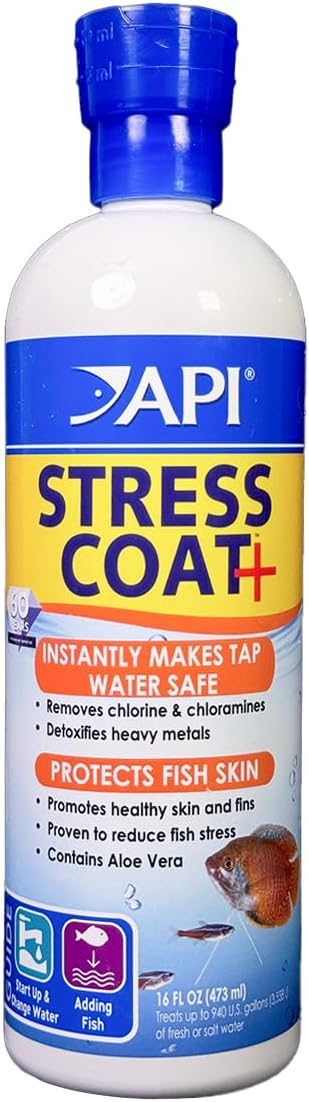
The exact ranked API Stress Coat variant is 16 fl oz. API states that Stress Coat removes chlorine and chloramines, neutralizes heavy metals and uses 5 mL per 10 gallons when used as a dechlorinator. The manufacturer also identifies aloe vera as part of the formulation.
API makes additional claims about protecting fish skin and reducing stress. Those claims belong to the manufacturer documentation; PetGearReport is not presenting Stress Coat as a treatment for injury or disease. If a fish has wounds, abnormal behavior or suspected illness, water quality and husbandry should be checked and veterinary guidance considered where appropriate.
API states that Stress Coat is suitable for freshwater and saltwater aquariums but is not recommended when a protein skimmer is in use. That concrete system limitation is more useful for selection than generic claims about which conditioner is universally best.
A documented chlorine/chloramine conditioner with aloe vera. We rank it on core treatment, dosing and compatibility rather than on unverified therapeutic claims.
Check price on Amazon →Start with the source water, not the bottle
Conditioner selection is easiest when you know what the source water contains. EPA explains that chloramines are commonly formed when ammonia is added to chlorine for drinking-water treatment. A local utility’s current water-quality report is therefore a better starting point than assuming every supply uses the same disinfectant. The chlorine vs chloramine aquarium guide covers source verification, the standing-water myth, ammonia-label boundaries and chloramine-specific RO/DI pretreatment before you choose a bottle. If your workflow instead uses reverse osmosis plus deionization, our aquarium RO/DI systems guide compares pretreatment against the same chlorine/chloramine source-water question before the membrane.
For direct checking, free and total chlorine measurements can help distinguish disinfectant residuals, but follow the method’s instructions and interpret results in the context of the local supply. Merck Veterinary Manual notes that chlorine and chloramine are important aquatic toxicants, so the objective is to select a conditioner whose label explicitly covers the disinfectant actually present.
Conditioner label-dose reference
Manufacturer pages checked September 23, 2026. There is no universal aquarium-water-conditioner dose. The relevant number is the current direction for the exact formula, the disinfectant being treated and the volume of water being treated.
Decision table: disinfectant, dose and system fit
The first table keeps each manufacturer’s wording intact. The second column is the published direction or capacity statement; the arithmetic column is only a normalization aid where an explicit liquid dose and water volume are both published.
| Product / treatment context | Current manufacturer direction | Arithmetic equivalent only | Practical note |
|---|---|---|---|
| Seachem Prime | 5 mL / 50 US gal of new water | 0.10 mL per US gal | Seachem says direct-to-tank dosing should instead be based on aquarium volume |
| API Tap Water Conditioner — chlorine/heavy metals | 1 mL / 10 US gal of tap water being added | 0.10 mL per US gal | API publishes a separate chloramine dose |
| API Tap Water Conditioner — chloramines | 5 mL / 30 US gal of tap water | 0.167 mL per US gal | Do not substitute the lower chlorine/heavy-metal dose when chloramine is the target |
| Tetra AquaSafe Plus | 5 mL / 10 US gal | 0.50 mL per US gal | Tetra also says replacement water should match aquarium temperature |
| Fluval Aqua Plus 4 fl oz / 120 mL | 120 mL bottle treats up to 240 US gal on the current U.S. product page | Not normalized here | The current U.S. page gives treatment capacity rather than one explicit per-gallon user direction, so we do not reverse-engineer that bottle-capacity statement into a per-gallon user dose |
| API Stress Coat | 5 mL / 10 US gal as a dechlorinator | 0.50 mL per US gal | API says dose for the amount of new water being added when using it as a dechlorinator |
These normalized values are simple arithmetic from the cited label directions. They are not substitute label instructions and they are not PetGearReport efficacy measurements. A value such as 0.167 mL per gallon can also be harder to measure accurately than the manufacturer’s original 5 mL / 30 US gal direction, so use an appropriate graduated measuring device rather than treating the normalized value as a new dosing recommendation.
The concentration comparison is useful because it shows why bottle size alone is misleading. Prime and API Tap Water Conditioner can use much smaller routine volumes than AquaSafe Plus or Stress Coat, while API Tap Water Conditioner itself changes dose depending on whether the target is chlorine/heavy metals or chloramine.
What 5 mL means for each explicit direction
This is another arithmetic view of the same current manufacturer directions, not a claim that the products are chemically equivalent.
| Product / treatment context | Water volume corresponding to 5 mL under the cited direction |
|---|---|
| Seachem Prime routine new-water dose | 50 US gal |
| API Tap Water Conditioner — chlorine/heavy metals | 50 US gal |
| API Tap Water Conditioner — chloramines | 30 US gal |
| Tetra AquaSafe Plus | 10 US gal |
| API Stress Coat as a dechlorinator | 10 US gal |
A larger treated volume per 5 mL means a more concentrated label dose, not automatically better chemistry, better livestock outcomes or better value. Price, local disinfectant concentration, measuring accuracy, compatibility and the exact treatment claim still matter.
Fluval Aqua Plus: keep capacity language separate from a user dose
Fluval’s current U.S. Aqua Plus page states that the 120 mL bottle treats up to 240 US gal, and its FAQ says to dose at minimum for the amount of replacement water changed and recommends treating replacement water before it enters the aquarium.
Those statements are useful, but they are not the same as an explicit U.S. per-10-gallon dosing instruction on the product page. PetGearReport therefore keeps the published bottle capacity as bottle capacity rather than dividing 120 mL by 240 gallons and presenting the result as if Fluval had printed that per-gallon direction.
This conservative treatment also avoids mixing regional label wording. If the bottle in hand or the current regional manufacturer page gives a more specific instruction, follow that exact current label.
Chlorine and chloramine can require different doses
Do not assume one dose fits every disinfectant. API, for example, states that its Tap Water Conditioner uses 1 mL per 10 US gallons for chlorine/heavy metals but 5 mL per 30 US gallons for chloramines. Seachem states that Prime uses 5 mL per 200 L / 50 US gallons of new water and separately publishes guidance for unusually high chloramine concentrations.
The practical rule is to identify the source-water disinfectant and follow the label for the exact product. The chlorine vs chloramine aquarium guide explains how to verify that source-water question before choosing a dose.
Do not assume that “more conditioner” is automatically safer. Manufacturer overdosing guidance is formula-specific. A higher-dose statement from one product should not be transferred to another conditioner.
Compare concentration as a dosing issue, not a price claim
A concentrated product can treat a large volume with a small dose, but that does not justify a fixed cost-per-gallon claim because retail prices change. Instead, compare the documented dose and decide whether you can measure it accurately for your aquarium.
For example, the Prime 500 mL variant uses a 5 mL routine dose for 50 US gallons, while Tetra AquaSafe Plus uses one teaspoon (5 mL) for 10 gallons. API Tap Water Conditioner uses yet another set of dose instructions depending on whether chlorine or chloramine is being treated.
For very small water changes, concentration can become a measurement problem. A mathematically proportional dose below 1 mL may be awkward to measure with a bottle cap. Use a clean graduated syringe or other appropriately marked tool if the product instructions permit proportional dosing, and never round down simply for convenience.
Replacement water versus direct-to-tank dosing
The volume basis can change with the product instructions, so “dose for tank size” is not a universal rule.
For a routine partial water change, start with the replacement water you are actually treating when that is what the label directs — not the aquarium’s advertised capacity. The aquarium water change guide covers the wider temperature-matching, treatment, equipment-shutdown/restart and refill workflow.
- API Tap Water Conditioner tells users to dose the tap water being added.
- API Stress Coat says that when it is used as a dechlorinator, dose enough for the amount of new water being added.
- Fluval says to dose at minimum for the amount of replacement water changed and recommends adding Aqua Plus to the replacement water before it enters the aquarium.
- Tetra’s AquaSafe Plus directions are written around water being conditioned during setup and water changes.
Seachem Prime makes an important distinction: its routine direction is 5 mL per 50 US gallons of new water, but Seachem says that when Prime is added directly to the aquarium, base dose on aquarium volume.
That is why this page does not provide one generic calculator across brands. Use the exact product direction, exact treatment context and exact water volume. Our aquarium volume and water-change calculator can help convert a water-change percentage into an estimated replacement-water volume; the tap-water source guide covers the wider source-water decision.
Match the formula to the system
Freshwater versus saltwater compatibility is only one compatibility check. Reef equipment and other system details can matter as well. API, for example, says the freshwater Stress Coat formula is not recommended with a protein skimmer, while Fluval states Aqua Plus is for freshwater and saltwater aquariums. Manufacturer-specific limitations should take priority over generic assumptions.
Additional claims such as slime-coat support, herbal extracts, natural biopolymers or nitrogen-compound binding are also product-specific. We report them as manufacturer documentation, not as PetGearReport laboratory findings or medical advice.
How we researched and scored
PetGearReport has not physically tested these conditioners. We verified the ranked product identities and compared current manufacturer documentation, dosing directions, documented compatibility, limitations and safety information. Category scores are editorial judgments about the quality and usefulness of the documented evidence for aquarium decision-making; they are not independent laboratory measurements of chemical performance or therapeutic efficacy.
The PetGearReport research score uses these weights:
- Disinfectant coverage — 30%
- Dosing clarity & measurability — 25%
- Compatibility & limitations — 20%
- Concentration & routine practicality — 15%
- Documentation & exact identity — 10%
Each category is scored on a 10-point editorial scale, multiplied by its weight, and summed. The published score is the weighted result rounded to the nearest whole point. The exact Amazon.com identity check is a publication gate; the evidence-quality category also rewards current primary documentation without turning marketplace ratings or popularity into PetGearReport scores.
| Product | Disinfectant 30% | Dosing 25% | Compatibility 20% | Concentration 15% | Documentation 10% | Weighted result | Published score |
|---|---|---|---|---|---|---|---|
| Seachem Prime | 9 | 10 | 9 | 10 | 9 | 9.40 | 9/10 |
| API Tap Water Conditioner | 9 | 10 | 9 | 9 | 9 | 9.25 | 9/10 |
| Tetra AquaSafe Plus | 9 | 8 | 9 | 6 | 9 | 8.30 | 8/10 |
| Fluval Aqua Plus | 9 | 7 | 9 | 7 | 9 | 8.20 | 8/10 |
| API Stress Coat | 9 | 8 | 8 | 7 | 9 | 8.25 | 8/10 |
A conditioner does not replace biological filtration, water testing, cycling, routine maintenance, or the temperature and chemistry requirements of the particular species and system. If the larger question is whether conditioned tap, household-softened water or RO/DI is the right source, use the tap-water source guide. For related decisions, see our aquarium water test kits guide, new aquarium cycling guide, and aquarium maintenance schedule.
Primary and authoritative sources
Product-specific statements above were checked against current manufacturer documentation. Additional water-quality context uses EPA and Merck Veterinary Manual rather than retailer copy.
- Seachem Prime — directions, sizes, treatment and compatibility
- API Tap Water Conditioner — current product scope and dosing
- Tetra AquaSafe Plus — BioExtract formula, sizes and directions
- Fluval Aqua Plus 4 fl oz / 120 ml — current formula and treatment capacity and Fluval Aqua Plus FAQ for replacement-water dosing guidance
- API Stress Coat — current product scope, dosing and compatibility
- US EPA — Chloramines in Drinking Water
- Merck Veterinary Manual — Environmental Diseases of Aquatic Animals
Frequently asked questions
Do I need a water conditioner for aquarium tap water?
If your source water contains chlorine or chloramine, it needs appropriate treatment before exposure to fish and the aquarium's biological community. Merck Veterinary Manual notes that chlorine and chloramine are toxic to fish, while EPA notes that water utilities may use either chlorine or chloramine. Check the local utility or test the source water rather than assuming which disinfectant is present, and follow the label for the exact conditioner you use.
What is the difference between chlorine and chloramine?
EPA explains that chloramines are most commonly formed when ammonia is added to chlorine to treat drinking water. That matters in aquariums because product directions can specify different treatment doses for chlorine and chloramine. If you verify source water yourself, methods that distinguish free and total chlorine can help identify whether a combined-chlorine residual is present; otherwise the water utility is the best starting point.
Can I use too much water conditioner?
Do not assume that more is better. Products differ in concentration and in their manufacturer instructions for routine, chloramine-specific and emergency dosing. Follow the label for the exact product and water volume. Seachem, for example, publishes specific conditions for higher Prime doses, while API publishes different Tap Water Conditioner doses for chlorine/heavy metals versus chloramines.
Does water conditioner remove ammonia?
It depends on the exact formula and what the manufacturer means by remove, bind or detoxify. Seachem states that Prime binds/detoxifies ammonia, nitrite and nitrate while leaving them available to biological filtration; we have not independently validated that claim. A conditioner does not replace biological filtration, water testing or correction of an ammonia source. If ammonia is detected, use an appropriate test method and address cycling, stocking, feeding, filtration and other system-specific causes.
Do goldfish need a special water conditioner?
Not simply because they are goldfish. Use the same source-water decision: identify chlorine or chloramine, choose an exact label that covers it, and dose the water being treated. Goldfish still have species-specific water parameters and husbandry needs, but those do not turn a generic dechlorinator into a goldfish-specific formula.
Do bettas need a special water conditioner?
Not simply because they are bettas. Use the same source-water decision for chlorine or chloramine and follow the exact product label for the treated water volume. Betta-specific temperature, flow and other water parameters remain separate husbandry decisions.
Do axolotls need a special water conditioner?
Do not choose by species branding alone. Use the same source-water decision, verify the disinfectant and follow an exact label that covers it. Axolotls have species-specific water parameters and husbandry constraints, so conditioner choice is only one part of preparing appropriate replacement water.