Best Bird Feeder Cameras 2026
A bird feeder camera is two products fused into one, and they fail independently. The feeder half has to hold seed dry, survive a squirrel, and mount somewhere birds will actually approach; the camera half has to wake fast enough to catch a chickadee that lands for two seconds, stay powered through a week of overcast December weather, and identify what it saw without inventing species that live two thousand miles away. Most of the disappointment in this category comes from buying on camera resolution alone and discovering that the trigger is slow, the solar panel cannot keep up in winter, or the good features sit behind a subscription that was not mentioned on the box. Winter is when these earn their keep, because that is when birds visit hardest and when you least want to be outside watching. These five cover the range from the polished expensive one to the cheap one that genuinely works.
| Rank | Product | Score | Best for | Link |
|---|---|---|---|---|
| #1 | Bird Buddy Pro Solar Smart Bird Feeder with CameraTop pick | 9 | Anyone who wants the version that simply works and is willing to pay for it | Check price → |
| #2 | NETVUE Birdfy AI Smart Bird Feeder Camera Solar PoweredBest value | 9 | First-time buyers who want the experience without the premium price | Check price → |
| #3 | Birdfy 2 Smart Bird Feeder with Dual-Lens Camera | 9 | People who found a single fixed camera angle frustrating | Check price → |
| #4 | HARYMOR Smart Bird Feeder with Camera and 2L Seed Capacity | 8 | Gardens with a serious squirrel problem, or anyone tired of refilling | Check price → |
| #5 | SOLIOM Solar Bird Feeder Camera with AI Bird IdentificationBudget pick | 8 | Finding out whether you like the idea before spending real money | Check price → |
#1 · Our PickTop pick
Bird Buddy Pro Solar Smart Bird Feeder with Camera
Best for: Anyone who wants the version that simply works and is willing to pay for it
What we like
- Fastest, most reliable trigger of anything here, so short visits get caught
- Species identification is the most accurate in this group
- Solar roof keeps it running through winter without taking it down
- 2K video from a larger 1/2.7 inch sensor holds detail in dull light
- App and notification experience is genuinely polished rather than merely functional
What we don't
- The most expensive feeder on this list by a wide margin
- Seed chamber is small, so a busy garden needs refilling every few days
- The best clip-storage and extra features sit behind a paid plan
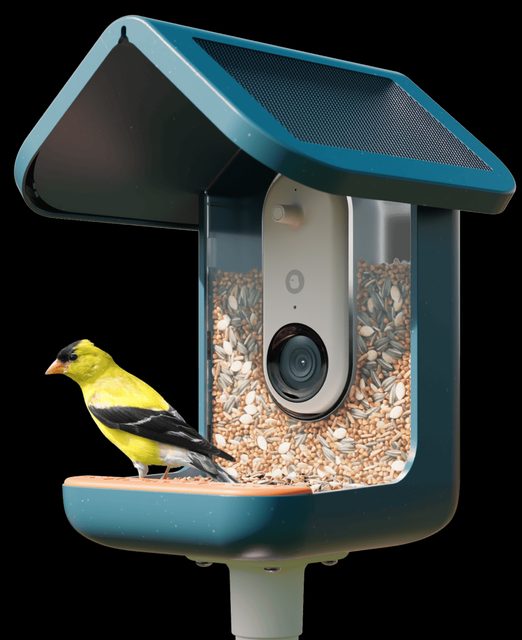
The specification that decides whether you enjoy a bird feeder camera is not resolution, it is how quickly the camera wakes when something lands. A chickadee grabs a seed and leaves in about two seconds. A camera that takes three seconds to start recording gives you a thousand videos of an empty perch, and that single failure is what makes people abandon this category. The Bird Buddy Pro is the fastest and most consistent trigger here, and everything good about owning one follows from that.
The rest is built to the same standard. It shoots 2K video off a 1/2.7 inch sensor, which is physically larger than most rivals use and shows in exactly the conditions that matter, meaning a grey afternoon in January rather than a bright noon in June. The species identification is the most accurate in this group by a clear margin, and the difference is not the headline count of species in the database but how it behaves when unsure, which is to hedge rather than confidently name something that does not occur in your region. The solar roof genuinely keeps it topped up through winter, so it stays on the pole rather than coming down every fortnight for charging.
Two honest limits. It costs roughly twice what the value picks cost, and the argument for that is trigger speed and identification quality rather than any feature you can see on a spec sheet. The seed chamber is also modest, and a garden with an established flock will empty it every few days, which is a chore in cold weather. Some of the more useful storage and library features need the paid plan, so read what the free tier includes before you assume the purchase price is the whole cost.
The one to buy if budget is not the constraint. Best trigger speed, best identification, best app, and the solar roof means you can leave it up all winter.
Check price on Amazon →#2Best value
NETVUE Birdfy AI Smart Bird Feeder Camera Solar Powered
Best for: First-time buyers who want the experience without the premium price
What we like
- Roughly half the price of the premium option for most of the capability
- Solar panel included rather than sold as an upgrade
- Very large species database with free lifetime identification on this model
- Auto-capture and app alerts work without a subscription
- The most widely deployed model here, so setup problems are well documented
What we don't
- Trigger is a step slower, so brief visits are missed more often
- Mounting hardware is the weak point and wants upgrading for a pole
- Camera struggles more than the Bird Buddy in low winter light
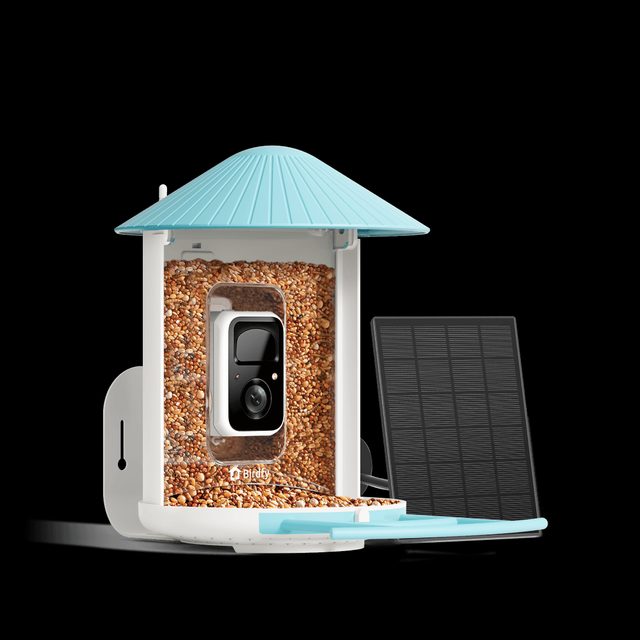
The Birdfy is the model that made this category mainstream, and it is still the one most people should buy first. The reason is not that it beats the Bird Buddy at anything, because it does not, but that it delivers the core experience of getting an alert on your phone, opening it and watching a nuthatch on your own feeder at roughly half the price, with the solar panel already in the box rather than sold separately.
Its identification database is very large and, importantly, identification on this model is included rather than metered, which matters because a feature you are charged for by the month changes how you use the product. Auto-capture and push alerts work out of the box. It is also by far the most widely deployed feeder here, which has a practical benefit that never appears in reviews: when something goes wrong with your wifi handshake or your mounting, someone has already written up the fix.
Where it gives ground is the two things that separate tiers in this category. The trigger is measurably slower, so you lose a share of the two-second visits, and the smaller sensor shows on overcast winter days when the footage goes soft and noisy. The supplied mounting hardware is also the cheapest part of the product and is worth replacing if you are pole-mounting rather than strapping it to a tree. Accept those three things and it is the best money on this page.
The sensible default. It gives you most of what the expensive feeder gives you, includes the solar panel, and does not put identification behind a subscription.
Check price on Amazon →#3
Birdfy 2 Smart Bird Feeder with Dual-Lens Camera
Best for: People who found a single fixed camera angle frustrating
What we like
- Second side-facing lens catches birds that never face the main camera
- 2K main camera with a wider useful field of view than the original
- Live streaming is smoother than the first-generation Birdfy
- Larger seed capacity than the Bird Buddy
- Same free identification approach as the original Birdfy
What we don't
- Two cameras draw more power, so winter solar performance is tighter
- Noticeably bulkier and harder to mount discreetly
- More expensive than the original Birdfy for a benefit some owners never notice
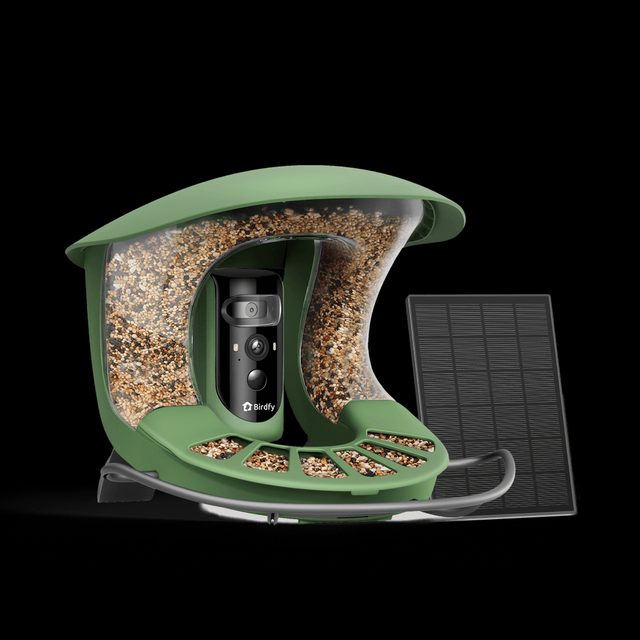
The standard complaint after a month with any feeder camera is not image quality, it is geometry. There is one lens, it points at one perch, and a good half of the visits happen just outside its cone or with the bird facing away. The Birdfy 2 adds a second side-facing lens specifically to cover that, and if the fixed-angle problem is what bothers you, it is the direct fix.
The main camera is a 2K unit with a more usefully wide field of view than the original Birdfy, and the live streaming is smoother, which is the difference between opening the app to check on the feeder and opening the app to watch it. The seed chamber is bigger than the Bird Buddy's, so it goes longer between refills, and it keeps the same free identification arrangement as the original rather than metering it.
The cost of a second camera is power and bulk. Two sensors draw more, and in December with short overcast days the solar margin gets thin enough that some owners end up supplementing it, which undercuts the main reason to buy a solar feeder. It is also physically larger and harder to site somewhere unobtrusive. If the single-angle limitation has not annoyed you, the original Birdfy is the better buy; if it has, this is the product that solves it.
The dual-lens answer to the commonest complaint about feeder cameras, which is that the bird is there and facing the wrong way.
Check price on Amazon →#4
HARYMOR Smart Bird Feeder with Camera and 2L Seed Capacity
Best for: Gardens with a serious squirrel problem, or anyone tired of refilling
What we like
- 2 litre seed chamber, the largest here, so refills are rare
- Metal housing stands up to squirrels far better than the plastic rivals
- 2K HD camera and solar power at a mid-tier price
- Good weather sealing for an exposed mounting position
- Handles common garden species reliably
What we don't
- Identification sometimes proposes species that do not occur in your region
- App is the least refined of the group
- Weight means it needs a solid pole or bracket, not a branch
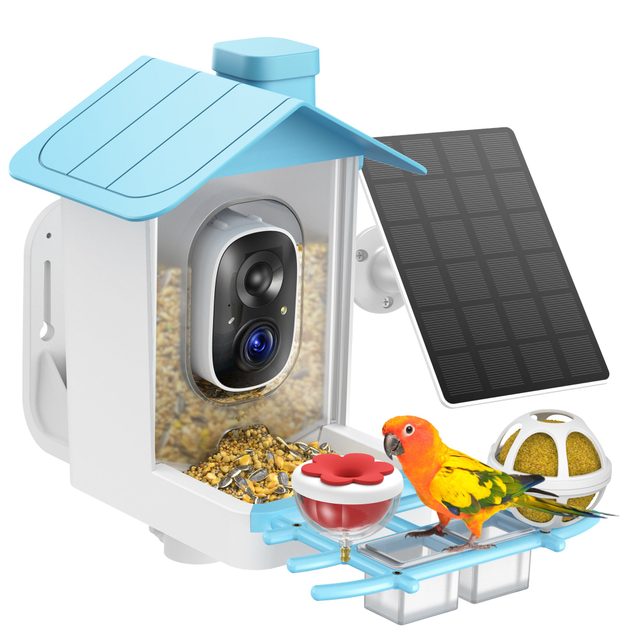
Everything else on this list is a plastic box that a determined grey squirrel will eventually chew, gnaw or knock down. The Harymor is the one built like outdoor equipment: a metal housing that squirrels make far less progress against, decent weather sealing, and a 2 litre seed chamber that is comfortably the largest here. In a garden where you are currently refilling twice a week and repairing squirrel damage, those two facts outweigh app polish.
The camera side is competent rather than exceptional. It is a 2K unit with solar charging at a mid-tier price, and for common garden birds it does the job: cardinals, blue jays, sparrows and the rest come back correctly named often enough that you stop checking. The build quality means it also tolerates a more exposed mounting position than the plastic feeders, which widens where you can actually put it.
The weaknesses are software and weight. Reviewers consistently report that its identification will occasionally propose a species that does not occur anywhere near you, which is the specific failure mode that erodes trust in the whole feature, and the app is the least refined here. It is also heavy enough that it wants a proper pole or bracket rather than a strap around a branch. Buy it for the hopper and the metal, not for the software.
The durable one. A metal shell and a 2 litre hopper solve the two most physical problems in this category, at the cost of a rougher app.
Check price on Amazon →#5Budget pick
SOLIOM Solar Bird Feeder Camera with AI Bird Identification
Best for: Finding out whether you like the idea before spending real money
What we like
- The cheapest genuine 2K solar feeder camera here
- Covers the core features: live view, AI identification, instant alerts
- Solar panel included at this price
- Simple enough to set up without much patience
- Low enough cost to try the category without committing
What we don't
- Slowest trigger of the five, so it misses more short visits than it catches
- Smaller seed capacity needing frequent refills
- Build is plastic and lighter-duty than everything above it
There is a legitimate case for spending the least in this category, which is that plenty of people buy a bird feeder camera, enjoy it for three weeks and then stop opening the app. The Soliom is the cheapest way to discover which sort of owner you are. It covers the actual feature list: 2K live view, AI identification, solar charging and instant alerts, none of it stripped out to hit the price.
For the money, the surprising part is what is included rather than what is missing. The solar panel is in the box at a price where rivals sell it separately, and the setup is simple enough that it does not demand much patience. Common visitors are identified adequately. If your garden gets steady traffic from a handful of familiar species, the day-to-day experience is closer to the expensive feeders than the price gap suggests.
The compromise is concentrated in the one specification that matters most, and you should go in knowing it. The trigger is the slowest of the five, which means the quick smash-and-grab visits that make up much of a winter feeder's traffic are frequently missed, and you will see more empty-perch clips than the owner of a Bird Buddy does. The chamber is small and the plastic build is lighter than the Harymor's. As a way into the category rather than a final answer, it is well judged.
The budget entry. It does the whole job at the lowest price here, provided you accept that a slower trigger means missing more of the quick visits.
Check price on Amazon →Trigger speed is the specification that decides everything
Every other number on the box is downstream of one question: how long does the camera take to start recording after a bird lands? Small birds visit a feeder for one to three seconds. A camera that wakes in under a second gives you a library of birds; a camera that wakes in three gives you a library of empty perches and a slowly growing suspicion that you wasted your money. This is why the expensive feeders are expensive, and it is not something you can infer from resolution, species-database size or any of the specifications manufacturers actually advertise. When you read owner reviews, ignore the ones about picture quality and look for the ones complaining about missed visits.
Sensor size beats resolution in the season you will actually use it
A bird feeder camera does its real work between November and February, on short overcast afternoons, which is the hardest light any small sensor faces. Resolution numbers are collected in good light and tell you almost nothing about that. What matters is the physical size of the sensor, because a larger one gathers more light per pixel and holds detail where a higher-resolution smaller one dissolves into noise and smearing. A 2K camera on a 1/2.7 inch sensor will beat a nominally sharper camera on a smaller one every time in December. If a manufacturer does not publish sensor size, that silence is usually informative.
Do not ignore the feeder half
Reviews of this category obsess over the camera and skip the part that determines whether you keep using it. Seed capacity decides how often you stand outside in freezing weather with a scoop, and the difference between a small chamber and a 2 litre one is the difference between twice a week and once a fortnight. Housing material decides whether a squirrel eventually chews through to the electronics, which plastic models do not reliably survive and metal ones do. Mounting decides both: supplied brackets are usually the cheapest part of the product, and a feeder swaying on a branch triggers falsely, films unusably and invites the squirrels a baffled pole would have stopped.
Getting the birds to show up in the first place is the other half of the job. Pair this with our squirrel-proof bird feeders guide for the feeder that keeps the seed where the camera can see it.
Frequently asked questions
Do bird feeder cameras need a subscription?
It depends entirely on the model, and this is the cost most buyers miss. Some feeders include species identification and basic clip storage permanently, while others meter identification, video history or cloud storage behind a monthly plan. The purchase price tells you nothing about which you are getting. Before buying, find out specifically what the free tier covers for identification and how long clips are retained without paying, because a cheaper feeder on a subscription can easily cost more over two years than a more expensive one with everything included. Most models remain usable without paying, but with reduced storage.
Will the solar panel really keep it running through winter?
Usually, but with less margin than the marketing implies. Solar charging on these feeders is sized for average conditions, and late December combines the shortest days of the year with the heaviest feeder traffic, which is exactly when consumption is highest and generation is lowest. Single-camera models generally cope. Dual-camera models draw noticeably more and are the ones owners most often end up supplementing with a manual charge. Mounting matters too: a panel shaded by a building or an evergreen for half the short day will not keep up. Site it for winter sun angles rather than summer ones.
Can squirrels destroy a bird feeder camera?
They can destroy a plastic one, and they regularly do. A grey squirrel will chew the seed port, work at the housing seams and knock a lightly mounted feeder off its pole, and unlike a plain feeder there is a camera inside worth protecting. Metal-shelled models stand up to this far better, which is the main practical argument for the heavier options. Mounting also helps more than people expect: a proper pole with a baffle beneath it defeats squirrels more reliably than any feeder design, and it stops the swaying that causes false triggers and unusable video.
How accurate is the AI bird identification?
Good for common garden species, less reliable at the edges, and the failure mode matters more than the accuracy rate. The better models hedge when uncertain; the weaker ones confidently name a species that does not occur within a thousand miles of you, which is the specific behaviour that makes owners stop trusting the feature. Cardinals, blue jays, sparrows, chickadees and other frequent visitors come back correctly named on essentially all of these. Treat an unexpected rarity as a prompt to check the footage yourself rather than as a record, and expect more errors with juveniles, females of dimorphic species, and birds seen partially.