Best Squirrel-Proof Bird Feeders 2026
Almost every feeder sold as squirrel-proof is squirrel-resistant at best, and the distinction costs people a seed bill every winter. There are only a few mechanisms that genuinely work: weight-activated shrouds that close the ports when something heavy lands, motorised perches that spin the animal off, and cages sized to admit a chickadee but not a squirrel. Everything else is a marketing claim attached to a plastic tube. The other half of the problem is placement, and it defeats more good feeders than bad design does, because a squirrel that can jump to your feeder from a fence or a branch has already won regardless of what the feeder does when it arrives. Winter is when this matters most, since a squirrel emptying a feeder in an afternoon is not an annoyance then but the removal of a food source birds are relying on. These five use mechanisms that actually work.
| Rank | Product | Score | Best for | Link |
|---|---|---|---|---|
| #1 | Brome Squirrel Buster Plus Squirrel-Proof Bird FeederTop pick | 10 | Almost anyone who wants the problem solved once and not revisited | Check price → |
| #2 | Droll Yankees Yankee Flipper Motorised Squirrel-Proof Feeder | 9 | Persistent squirrel populations that have defeated passive feeders | Check price → |
| #3 | Brome Squirrel Solution 200 Squirrel-Proof Bird FeederBest value | 9 | Getting the Brome mechanism at a lower price, in a smaller garden | Check price → |
| #4 | Woodlink Absolute II Squirrel-Resistant Hopper Feeder | 8 | Busy gardens, mixed seed, and anyone who hates refilling in the cold | Check price → |
| #5 | Brome Squirrel Buster Mini Squirrel-Proof Bird FeederBudget pick | 9 | Balconies, small gardens, or a second feeder alongside a larger one | Check price → |
#1 · Our PickTop pick
Brome Squirrel Buster Plus Squirrel-Proof Bird Feeder
Best for: Almost anyone who wants the problem solved once and not revisited
What we like
- Weight-activated shroud closes the ports reliably, with no batteries or moving motor
- Large 5.1 pound seed capacity gets through a cold week
- Cardinal ring gives larger birds somewhere to perch, which most tube feeders do not
- Adjustable spring tension excludes grackles and starlings as well as squirrels
- Lifetime warranty that Brome has a long record of honouring
What we don't
- Needs periodic disassembly and cleaning to keep the shroud sliding freely
- Expensive compared with an ordinary tube feeder
- Adjusting the tension correctly takes a little trial and error
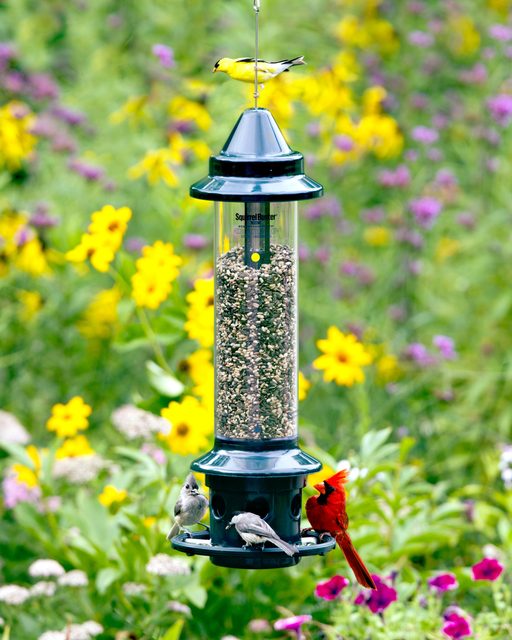
The Squirrel Buster Plus has been the answer in this category for years, and the reason is that its mechanism has no failure mode worth worrying about. A shroud surrounds the seed tube, and the weight of anything heavier than a bird pulls it down until it covers the feeding ports. There is no motor, no battery and nothing to charge in January. A squirrel arrives, the food disappears, and after a few attempts it stops coming.
The details around that mechanism are what make it a keeper rather than merely effective. Capacity is 5.1 pounds, which gets a busy garden through a cold week rather than a cold day. The cardinal ring is a genuinely useful inclusion, because most tube feeders offer nothing a cardinal or grosbeak can comfortably perch on and so quietly exclude the birds people most want to see. The spring tension is adjustable, which means you can also shut out grackles and starlings, and Brome coats the metal parts to resist rust, with plenty of owners reporting five to ten years of service. The lifetime warranty is real and the company has a good record of honouring it without argument.
The honest maintenance note is that this is not a feeder you hang and forget. The shroud has to slide freely to work, and seed dust, damp and general grime will eventually make it sticky, so it needs taking apart and cleaning periodically, which is straightforward but has to actually happen. It costs several times what a plain tube feeder costs, and getting the tension set right for your particular mix of birds takes some experimenting. Neither is a real objection to buying it.
The default recommendation. A purely mechanical weight-activated design, six ports, a proper seed capacity and a lifetime warranty, with nothing to charge or break.
Check price on Amazon →#2
Droll Yankees Yankee Flipper Motorised Squirrel-Proof Feeder
Best for: Persistent squirrel populations that have defeated passive feeders
What we like
- Weight-triggered motorised perch spins squirrels off without harming them
- Most effective deterrent here, and squirrels give up after two or three attempts
- Five pound seed capacity with an internal baffle feeding all ports evenly
- UV-stabilised polycarbonate tube resists yellowing and cracking
- Genuinely entertaining to watch, which is not nothing
What we don't
- Rechargeable battery needs charging, which is a real ongoing commitment
- Motor and battery are failure points a purely mechanical feeder does not have
- The most expensive feeder here
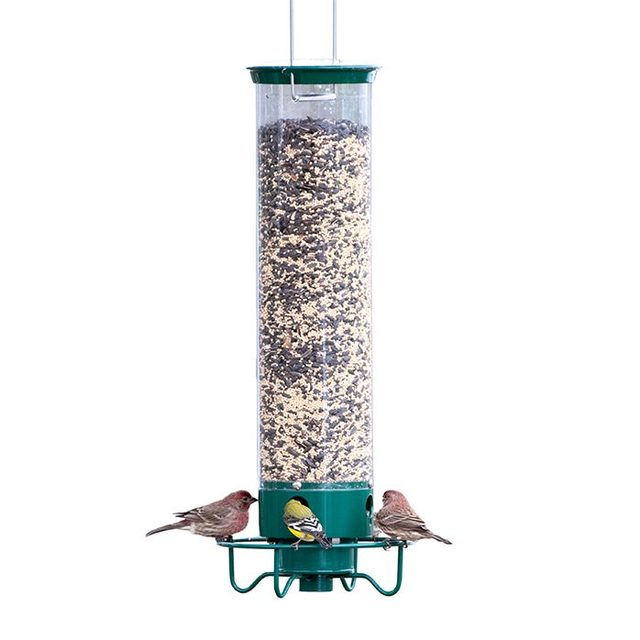
Where a weight-activated shroud simply denies a squirrel the food, the Yankee Flipper actively removes it. The perch ring is motorised, and when something heavier than a bird lands, the motor spins it. The squirrel is thrown clear unharmed, and after two or three attempts almost all of them stop trying entirely. For a garden with a determined population that has already worked around passive feeders, this is the product that ends the problem rather than managing it.
It is a well-built feeder underneath the gimmick. The tube is UV-stabilised polycarbonate, which matters over years of sun because ordinary plastic yellows and goes brittle, and there is an internal baffle so seed feeds evenly to all the ports rather than stranding food at the bottom. Five pounds of capacity puts it alongside the Squirrel Buster Plus. It is also, plainly, entertaining, and that is a legitimate reason to choose it.
The cost is the battery. It is rechargeable rather than disposable, so it is not an expensive habit, but it is a habit: a flat battery turns the most expensive feeder here into an ordinary one at exactly the time of year you least want to be unhooking it and bringing it indoors. There is also a motor and a battery to fail, which a shroud does not have, and it costs more than anything else on this page. If you will genuinely keep up with charging, it is the most effective thing here. If you know you will not, buy the Brome.
The one that ends the argument. A motorised perch that spins squirrels off, at the cost of a battery you have to remember to charge.
Check price on Amazon →#3Best value
Brome Squirrel Solution 200 Squirrel-Proof Bird Feeder
Best for: Getting the Brome mechanism at a lower price, in a smaller garden
What we like
- Same proven weight-activated mechanism as the Squirrel Buster Plus
- Six feeding ports in a more compact body
- Cheaper than the Plus while giving up little that matters
- Seed funnel included, which makes refilling much less wasteful
- Same Brome build quality and warranty approach
What we don't
- 3.4 pound capacity means more frequent refilling in winter
- No cardinal ring, so larger birds are less well served
- Same cleaning requirement as the Plus
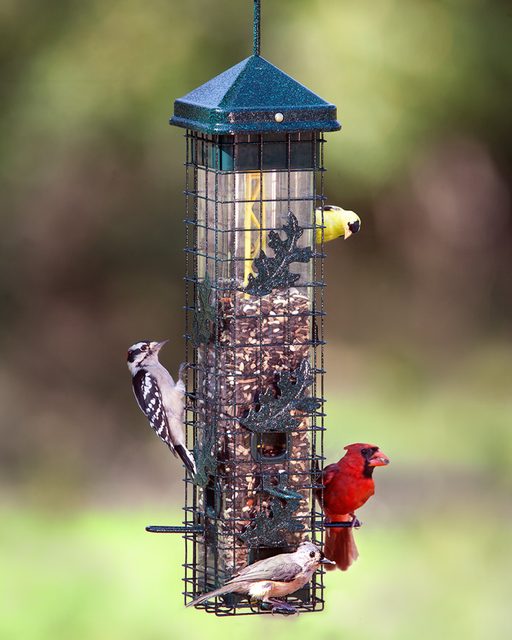
The Squirrel Solution 200 is the Squirrel Buster Plus with the expensive parts trimmed and the important part left alone. The weight-activated shroud is the same idea and works the same way, closing the ports when a squirrel lands and reopening when it leaves, with no battery involved. If the mechanism is what you are buying, this is the cheaper route to it.
It keeps six feeding ports despite the smaller body, so it still serves a reasonable number of birds at once, and Brome includes a seed funnel, which sounds like a trivial accessory until you have poured sunflower hearts down the outside of a feeder in a cold wind. Build quality and the company's approach to warranty are the same as the flagship, which is the main reason to buy Brome at all.
What you give up is capacity and the cardinal ring. At 3.4 pounds it holds about two thirds of what the Plus does, and in a busy garden in January that is the difference between refilling weekly and refilling every few days. There is no ring for larger birds to perch on, so cardinals and grosbeaks are less well accommodated. It also needs the same periodic cleaning to keep the shroud moving. For a smaller garden, or where the big birds are not the point, this is the sensible buy.
The value pick. The mechanism that makes the Plus work, in a smaller and cheaper body, at the cost of capacity and the cardinal ring.
Check price on Amazon →#4
Woodlink Absolute II Squirrel-Resistant Hopper Feeder
Best for: Busy gardens, mixed seed, and anyone who hates refilling in the cold
What we like
- 12 pound capacity, by far the largest here, so refills are rare
- Weight-activated perch bar closes both sides of the hopper
- Hopper design suits mixed seed and larger birds better than a tube
- Powder-coated steel construction stands up to weather and chewing
- Two-sided feeding serves a lot of birds at once
What we don't
- Heavy when full, so it needs a genuinely solid pole or hanger
- Bulky and less discreet than a tube feeder
- Twelve pounds of seed can go stale before it is eaten in a quiet garden
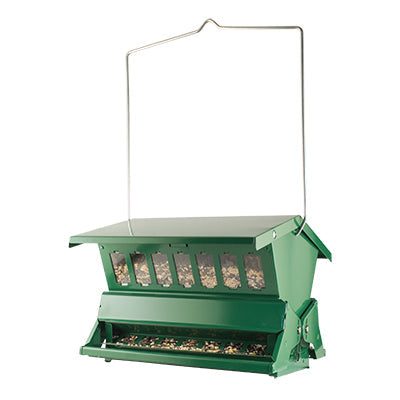
Tube feeders suit small clinging birds and mixed-seed hoppers suit almost everything else, and if your garden is busy the tube runs dry constantly. The Absolute II is the hopper answer with a working squirrel mechanism: a weight-activated perch bar runs along each side, and anything heavier than a bird pulls it down and closes the seed slot behind it. It is simple, mechanical and effective.
Its headline advantage is capacity. Twelve pounds is roughly double the largest tube here, and in practice that turns a weekly winter chore into a monthly one, which is the single thing owners of this feeder are most pleased about. The powder-coated steel body handles weather and squirrel attention far better than polycarbonate, and feeding from both sides means a lot of birds can use it simultaneously without the queueing you get on a six-port tube. The hopper format also handles mixed seed and larger birds better than tubes do.
The drawbacks are all consequences of the size. Full, it is heavy, and it wants a properly rated pole or a solid bracket rather than a shepherd's hook that will bend. It is bulky and not discreet. And in a garden that does not get much traffic, twelve pounds of seed will sit long enough to go stale or damp before it is eaten, which is a real waste, so this is a feeder for busy gardens specifically rather than a default upgrade.
The big one. A steel hopper holding 12 pounds with a weight-activated bar, for gardens where a tube feeder empties too fast.
Check price on Amazon →#5Budget pick
Brome Squirrel Buster Mini Squirrel-Proof Bird Feeder
Best for: Balconies, small gardens, or a second feeder alongside a larger one
What we like
- Cheapest way into a mechanism that genuinely works
- Chew-proof construction with four metal perches
- Small size suits balconies, patios and window positions
- Same lifetime warranty as the larger Brome feeders
- One pound of seed suits small gardens without going stale
What we don't
- One pound capacity needs frequent refilling anywhere busy
- Four perches limit how many birds feed at once
- Too small to be your only feeder in an active garden
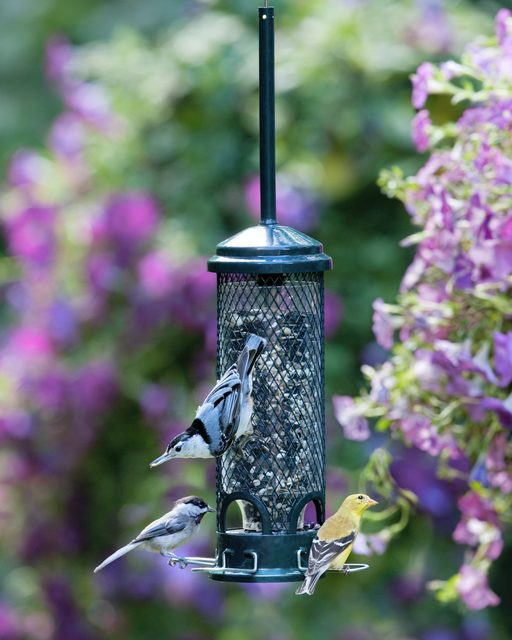
Most cheap squirrel-proof feeders are cheap because the squirrel-proofing does not work. The Squirrel Buster Mini is cheap because it is small, which is a much better reason. It uses the same weight-activated principle as the rest of the Brome range, so a squirrel landing on it closes the ports, and it carries the same lifetime warranty as the flagship.
The construction is better than the price suggests. It is chew-proof where it needs to be, with four metal perches rather than the plastic ones that squirrels destroy first, and the whole thing is built to the standard that gives Brome feeders their reputation for lasting years outdoors. Its size makes it genuinely useful in places the larger feeders do not fit: a balcony rail, a small patio, a window position where a 12 pound hopper would be absurd.
The limitation is simply volume. One pound of seed is a couple of days in an active garden, and four perches means a small queue forms at busy times. It is not intended to be the only feeder for a garden with real traffic, and buying it for that job will disappoint you. As a balcony feeder, or as a second station drawing birds away from a crowded main feeder, it is very well judged for the money.
The small, cheap one that still works. Same weight-activated principle as its bigger siblings, scaled to a balcony.
Check price on Amazon →Only three mechanisms genuinely work
Weight-activated shrouds close the feeding ports when anything heavier than a bird lands on the perch, and because they are purely mechanical there is nothing to charge and almost nothing to break. Motorised perches spin the squirrel off, which is the most decisive deterrent available and typically teaches the local population to give up after a handful of attempts, at the cost of a battery to maintain. Cages exclude squirrels by geometry, which never fails but also excludes cardinals and grosbeaks. That is the complete list. A plain tube feeder with squirrel-proof printed on the packaging is a plain tube feeder, and the seed bill will tell you so within a fortnight.
Placement beats mechanism
A grey squirrel jumps roughly ten feet horizontally and about five vertically, and will drop considerably further than that onto something below it. Any feeder inside that envelope of a fence, roof, shed, wall or overhanging branch is reachable, and once a squirrel can brace against a nearby surface or hang from above, it can often get at the seed without ever putting its weight on the perch that would close the ports. A smooth dedicated pole, five feet high, ten feet clear of everything, with a baffle underneath, does more for you than any feeder design. Owners who conclude that squirrel-proof feeders do not work have usually hung a good one badly.
Clean it or it stops working
The weight-activated feeders are the best answer here, and they have one requirement: the shroud has to slide freely. Seed dust, rain and general grime build up in the channel over a season until the shroud no longer drops fully under a squirrel’s weight, and the feeder quietly reverts to being an ordinary one. Taking it apart, washing it and drying it properly restores it, and doing that a few times a year is the whole maintenance burden. It is also worth doing for the birds regardless of squirrels, since damp seed residue in a feeder that never gets cleaned is a route for disease transmission through your entire garden population.
If you want to watch what turns up once the squirrels are handled, pair this with our bird feeder cameras guide.
Frequently asked questions
Which squirrel-proof mechanism actually works best?
Weight-activated shrouds are the best all-round choice because they work without power, have almost nothing to fail, and can usually be tuned to exclude large nuisance birds as well as squirrels. Motorised spinning perches are the most decisive deterrent and typically train squirrels to give up entirely after a few attempts, but they depend on a battery you have to keep charged through winter. Cages work by geometry and never fail, but they exclude cardinals and other larger birds along with the squirrels. Choose the shroud unless you have a population that has already defeated one.
My squirrel-proof feeder stopped working. What went wrong?
On a weight-activated feeder it is almost always dirt. The shroud has to slide freely, and seed dust, damp and grime gradually make it sticky until it no longer closes fully under a squirrel's weight. Take it apart, wash it, dry it thoroughly and it will usually work again. The second commonest cause is spring tension set too high, often adjusted upward to stop the ports closing under a heavy bird. The third is placement rather than the feeder: if squirrels can reach the seed by hanging from above or bracing against a nearby surface, the mechanism never gets loaded properly.
How far from trees and fences does a feeder need to be?
Further than most people think. A grey squirrel can jump roughly ten feet horizontally and around five feet vertically, and will drop considerably further from above onto a target. That means a feeder needs to sit at least ten feet clear of fences, walls, roofs, sheds and overhanging branches in every direction, and about five feet off the ground on a smooth pole. Add a baffle below it on the pole. Placement solves more of this problem than any feeder mechanism does, and a well-sited ordinary feeder often outperforms a squirrel-proof one hung badly.
Will these feeders keep out grackles and starlings too?
The adjustable weight-activated models will, which is one of their underrated advantages. Because the shroud closes based on weight, tightening the spring tension lowers the threshold so that heavy flocking birds like grackles and starlings also close the ports while chickadees, finches and nuthatches do not. It takes some trial and error to find the setting that excludes the birds you want gone without shutting out cardinals. Motorised and caged designs are less adjustable in this respect, and a cage will exclude nuisance birds and desirable large birds alike.