Best Dog Winter Coats and Jackets 2026
Most dogs do not need a coat, and the ones that do need it badly. A husky in a snowstorm is equipped for the weather; a whippet, a greyhound, a small terrier, a puppy, an arthritic fifteen-year-old or any thin-coated short-haired dog is not, and for those animals a winter coat is a functional item rather than a costume. Fit is what separates the two, because a coat that rides back over the shoulders, gaps at the chest or restricts the front legs is worse than nothing: it chafes, it lets cold air in exactly where the dog loses most heat, and the dog learns to hate the thing that goes on before every walk. The second question is what you are actually protecting against, since insulation and waterproofing are separate problems and a coat that solves one may ignore the other. These five cover dry cold, wet cold, and the dogs that shiver indoors.
| Rank | Product | Score | Best for | Link |
|---|---|---|---|---|
| #1 | Ruffwear Stumptown Quilted Insulated Dog JacketTop pick | 9 | Regular winter walks in real cold, on a dog that needs the warmth | Check price → |
| #2 | Carhartt Firm Duck Insulated Dog Chore Coat | 9 | Working and rural dogs that are hard on their gear | Check price → |
| #3 | Kurgo Loft Reversible Dog JacketBest value | 9 | Everyday winter walks where the cold is real but not extreme | Check price → |
| #4 | Kuoser Waterproof Reversible Dog Coat with Leash HoleBudget pick | 8 | Trying a coat on a dog that may refuse it, or a second coat to rotate | Check price → |
| #5 | Gooby Padded Fleece-Lined Dog Vest with Step-In Design | 8 | Small thin-coated dogs, and dogs that shiver indoors as well as out | Check price → |
#1 · Our PickTop pick
Ruffwear Stumptown Quilted Insulated Dog Jacket
Best for: Regular winter walks in real cold, on a dog that needs the warmth
What we like
- Genuine insulation rather than a single layer of quilted-looking fabric
- Water-resistant shell handles the wet cold that defeats most padded coats
- Leash portal works with a harness worn underneath
- Reflective trim, which matters when winter walks happen in the dark
- Cut allows a full stride instead of restricting the shoulders
What we don't
- Expensive compared with the generic padded coats
- Water-resistant rather than fully waterproof in sustained rain
- Sizing runs to Ruffwear's chart, not to breed labels, so measure first
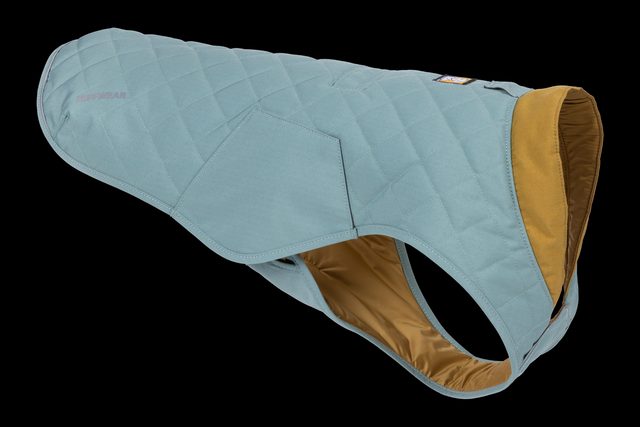
Ruffwear builds dog gear the way outdoor companies build human gear, and the Stumptown is the clearest example of what that buys you. The insulation is real loft rather than a quilted pattern stitched into thin fabric, so it holds warmth by trapping air the way an insulated jacket is supposed to, and the shell is water-resistant, which matters enormously because a padded coat that soaks through in drizzle stops insulating and starts actively chilling the dog.
The design details are the reason it is the top pick rather than merely warm. There is a leash portal, so a dog wearing a harness underneath can be clipped without taking the coat off or threading the lead awkwardly under the hem, which is the single most common daily annoyance with dog coats. The trim is reflective, and since most winter walks happen before work or after dark, that is a safety feature rather than a styling choice. Most importantly the cut allows a full stride: the shoulders and front legs are not bound, so the dog moves normally instead of doing the stiff-legged shuffle that tells you a coat does not fit.
The honest limits are price and weatherproofing. It costs several times what the generic padded coats cost, and the argument for that is construction and fit rather than any feature you can point at. It is water-resistant rather than waterproof, so a long walk in sustained rain will eventually get through, and if you live somewhere genuinely wet you want a hardshell over insulation instead. Ruffwear's sizing is by measurement rather than breed, so measure the dog's chest girth and back length before ordering.
The best-made coat here. Proper insulation, a shell that copes with damp, a harness portal and a cut that lets the dog move normally.
Check price on Amazon →#2
Carhartt Firm Duck Insulated Dog Chore Coat
Best for: Working and rural dogs that are hard on their gear
What we like
- Firm duck canvas is far more abrasion-resistant than any nylon shell here
- Insulated and genuinely built for cold, windy working conditions
- Survives a dog that goes through brush, brambles and fences
- Weather-resistant finish sheds light rain and snow
- The most durable coat on this list by a clear margin
What we don't
- Heavy and stiff compared with the technical jackets
- Product listing notes it contains PFAS, which some owners will want to avoid
- Canvas takes a long time to dry once it does get soaked
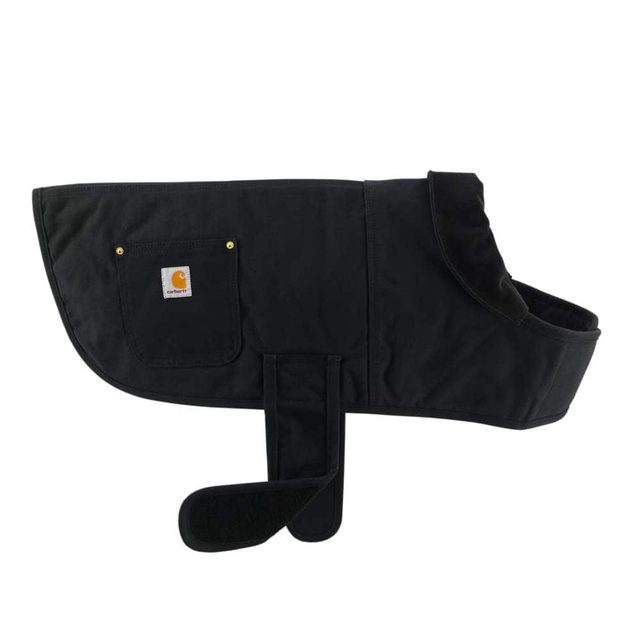
Technical nylon shells are light, packable and get shredded by the first barbed wire fence or blackthorn hedge. For a farm dog, a gundog, or any dog whose walks involve pushing through cover, the Carhartt is built to a different specification: firm duck canvas, the same material that makes their human workwear last, with insulation behind it and a weather-resistant finish on the outside.
What you get is durability that nothing else here approaches. Brambles that would tear a quilted nylon coat open leave scuffs on duck canvas, and the coat comes back the following winter rather than needing replacing. It is genuinely insulated rather than merely windproof, so it handles cold and wind together, which is the combination that actually strips heat out of a dog. The finish sheds light rain and snow well enough for ordinary winter conditions.
There are three things to weigh. It is heavy and stiff next to the technical jackets, which some dogs mind and most get used to within a few wearings. The Amazon listing states plainly that it contains PFAS, and while that is normal for durable water-repellent finishes across the outdoor industry, it is disclosed here and some owners will reasonably prefer to avoid it. And canvas that does eventually soak through takes a very long time to dry, so a soaked coat is out of service for a day or more, which argues for owning two if this is your daily coat in a wet climate.
The tough one. Duck canvas that survives brambles and fences, insulated for genuine cold, in exchange for weight and a long drying time.
Check price on Amazon →#3Best value
Kurgo Loft Reversible Dog Jacket
Best for: Everyday winter walks where the cold is real but not extreme
What we like
- Quilted insulation at roughly half the price of the premium jackets
- Reversible, so one coat gives you two colours and a fresh side when one is dirty
- Water-resistant shell suitable for ordinary winter weather
- Lifetime warranty that Kurgo has a strong record of honouring
- Lightweight enough that most dogs accept it immediately
What we don't
- Less insulation than the Ruffwear, so it falls short in severe cold
- No harness portal, so the lead routes around the coat
- Water resistance is modest and gives up in sustained rain
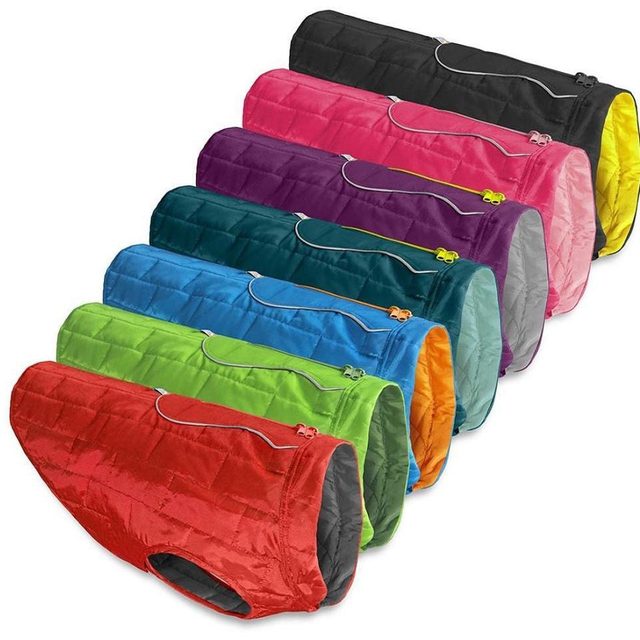
Most dogs that need a coat need it for twenty-minute walks in weather that is cold and damp rather than arctic, and buying a mountaineering-grade jacket for that is spending money on capability you will not use. The Kurgo Loft is sized to the actual job: quilted insulation, a water-resistant outer, light enough that a dog stops noticing it, at roughly half what the premium options cost.
The reversible construction is more useful than it first appears. Two colours is a styling point, but having a clean side to turn out when the other is caked in mud is a practical one, and it effectively doubles how long the coat goes between washes in a wet winter. The warranty is the other reason to pick Kurgo specifically: they offer a lifetime warranty and have a consistent reputation for honouring it without argument, which on a product that gets dragged through hedges is worth more than a feature list.
It is not the coat for severe conditions. There is less loft than the Ruffwear, so in genuinely hard cold, on a thin-coated dog, it will not be enough on its own. There is no harness portal, so you either run the lead around the hem or clip to a collar. And the water resistance is modest, handling drizzle and wet snow but not a downpour. Within the ordinary winter it is aimed at, it is the best money here.
The value pick. Quilted insulation, a water-resistant shell and a lifetime warranty for about half the price of the technical jackets.
Check price on Amazon →#4Budget pick
Kuoser Waterproof Reversible Dog Coat with Leash Hole
Best for: Trying a coat on a dog that may refuse it, or a second coat to rotate
What we like
- The cheapest coat here that still has a waterproof outer and a leash hole
- Reversible with a fleece-lined interior for warmth
- Wide size range that suits small and awkward-shaped dogs
- Easy to put on, which matters with a dog that resists dressing
- Cheap enough to own two and rotate while one dries
What we don't
- Build quality is ordinary, and stitching is the first thing to fail
- Fleece lining collects debris and mats over a season
- Fit is less refined than the technical coats, so measuring carefully is essential
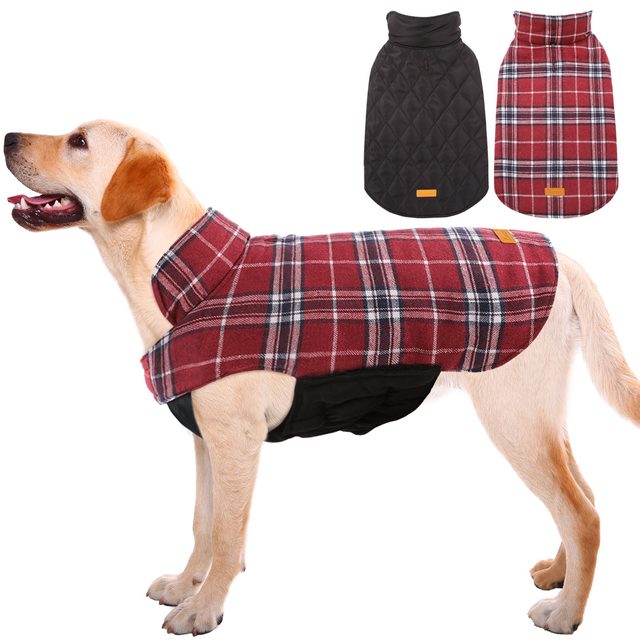
There are two good reasons to buy cheap here. The first is that plenty of dogs object to wearing anything at all, and finding that out with a forty-pound jacket is an expensive lesson. The second is that in a wet winter a single coat is never dry when you need it. The Kuoser answers both: it is inexpensive, and it still covers the actual requirements with a waterproof outer, a fleece-lined interior and a hole for the lead.
For the money the specification is honest. The outer genuinely repels water rather than merely resisting it briefly, the fleece lining adds real warmth for a small thin-coated dog, and the reversible construction gives a clean side when the other is filthy. The size range is wide and includes the small and oddly proportioned dogs that mainstream brands fit poorly. It goes on easily, which matters more than owners expect with a dog that has decided coats are an indignity.
What you are giving up is longevity and fit precision. The construction is ordinary, and stitching around the fastenings is where these fail first, typically inside a season or two of daily use. The fleece picks up burrs, grit and hair and mats down over time, losing some of its loft. And the fit is less carefully shaped than the technical coats, so measuring the dog properly matters more here, not less. Bought as a first coat or a spare, it is sensible; bought as a ten-year purchase, it is not.
The budget option that does the essentials. Waterproof shell, fleece lining and a leash hole for a fraction of the price, with build quality to match.
Check price on Amazon →#5
Gooby Padded Fleece-Lined Dog Vest with Step-In Design
Best for: Small thin-coated dogs, and dogs that shiver indoors as well as out
What we like
- Step-in design with a back zipper suits dogs that hate things over their head
- Fleece-lined insulation aimed squarely at small thin-coated breeds
- Integrated back D-ring means no separate harness needed for short walks
- Lightweight enough for indoor wear on a dog that shivers at home
- Very well shaped for chihuahuas, terriers and similar small builds
What we don't
- Water resistance is minimal, so it is a cold-and-dry coat
- Not enough coat for a long walk in hard winter weather
- Small-breed focus means limited use for medium and large dogs
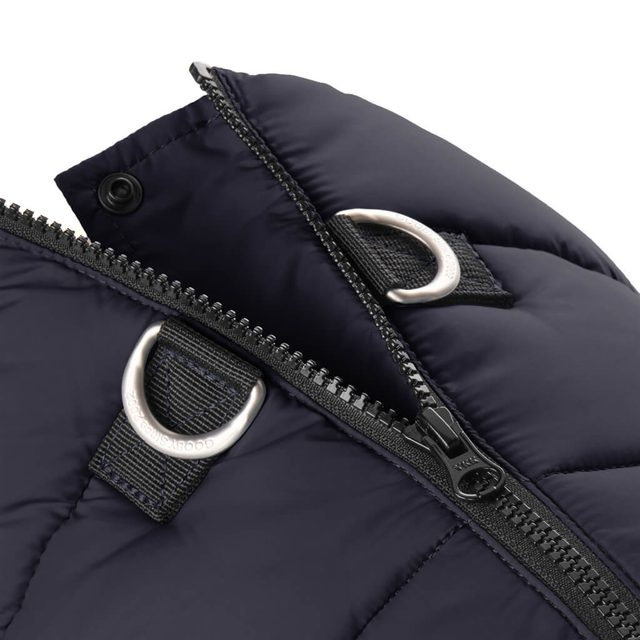
Small thin-coated dogs are the population that most needs a coat and is worst served by the market, because most designs are scaled-down versions of coats shaped for a labrador and they fit a chihuahua badly. The Gooby vest is designed around small builds from the start, and the difference shows in how it sits: it stays where it is put rather than rotating around the dog, and it does not gape at the chest, which is exactly where a small dog sheds heat fastest.
The step-in construction is the feature owners end up valuing most. It fastens with a zipper along the back rather than being pulled over the head, so a dog that panics at anything going near its face can be dressed without a fight, and that alone determines whether a coat gets used daily or abandoned in a drawer. The integrated back D-ring means short walks need no separate harness at all. It is also light enough to leave on indoors, which is a legitimate use for the small elderly dogs that shiver in a normally heated house.
The boundaries are clear. Water resistance is minimal, so this is a coat for cold dry weather and not for rain, and pairing it with a waterproof for wet days makes more sense than expecting it to do both. It is not enough insulation for a long walk in hard winter conditions on a dog with no undercoat. And it is a small-breed product, so medium and large dogs should look at the jackets above. For the dogs it targets, it is very well judged.
The small-dog answer. A step-in fleece-lined vest with a built-in D-ring, shaped properly for the breeds that actually need a coat most.
Check price on Amazon →Fit matters more than warmth rating
A dog coat that does not fit is not a warm coat with a small flaw; it is a coat that fails at the job. The commonest failure is a coat that slides backwards over the shoulders as the dog walks, which simultaneously bunches fabric under the front legs where it chafes and opens a gap across the chest, and the chest is where a dog loses heat fastest. The second is a cut that binds the shoulders, which shortens the stride and teaches the dog that the coat means discomfort. Measure chest girth at the widest point and back length from neck base to tail base, buy to the manufacturer’s own chart rather than a breed label, and then watch the dog walk in it before deciding it fits.
Insulation and waterproofing are two different purchases
Loft keeps a dog warm by trapping air, and it is what you want in dry cold. A waterproof shell keeps rain out, and it matters for a reason that is easy to underestimate: insulation that has soaked through does not merely stop working, it starts conducting heat away from the dog faster than bare fur would, so a wet padded coat on a cold walk is worse than no coat. Very few coats do both jobs properly at once. In a dry climate, buy for insulation. In a wet one, buy for the shell first, and where the weather is reliably cold and wet, a waterproof layer over an insulating one beats a single compromise garment.
The coat that gets used beats the coat that tests better
Half the dog coats bought each autumn end up unused by January, and it is rarely because they were not warm enough. It is because putting them on is a two-person wrestling match every time, so the walk starts with a fight and the coat quietly stops coming out. Dogs that object are almost always objecting to something passing over their head, and a step-in design fastening along the back sidesteps it completely. A leash portal matters for the same practical reason: if every walk requires threading a lead awkwardly under a hem or removing the coat to clip a harness, the friction accumulates. Buy for the daily routine, not the specification sheet.
Paws take the worst of winter and no coat covers them. Pair this with our dog boots and paw protection guide for the other half of cold-weather kit.
Frequently asked questions
How do I know whether my dog actually needs a winter coat?
Coat type and body shape decide it more than temperature does. Double-coated breeds like huskies, malamutes and most northern working dogs carry their own insulation and can overheat in a coat. The dogs that genuinely need one are thin-coated and short-haired breeds such as greyhounds, whippets, boxers and pointers, small dogs of any coat type because they lose heat faster relative to their size, puppies, senior and arthritic dogs whose joints stiffen in cold, and dogs recovering from illness or recently clipped. Watch the dog rather than the thermometer: shivering, a tucked tail, lifting paws off the ground and reluctance to walk on are the signals.
How should a dog coat fit?
It should cover the back from the base of the neck to the base of the tail, sit close at the chest without gaping, and leave the shoulders and front legs completely free to move. Test it by walking the dog: if the stride shortens or the front legs look bound, it is too restrictive, and if the coat slides backwards over the shoulders after a few minutes it is too loose and will chafe while letting cold air down the chest. Measure chest girth at the widest point and back length before ordering, since sizing varies considerably between brands and breed labels are unreliable.
Is a waterproof coat better than an insulated one?
They solve different problems and the right answer depends on your climate. Insulation traps warm air and is what you need in dry cold. A waterproof shell keeps rain and wet snow out and matters because insulation that soaks through stops insulating and begins pulling heat away from the dog faster than no coat at all. In a dry cold climate, prioritise loft. In a wet one, prioritise the shell, and if the weather is both cold and wet the most reliable arrangement is a waterproof outer over an insulating layer rather than a single coat attempting both jobs.
My dog hates having a coat put on. What can I do?
Usually the design is the problem rather than the coat itself. Most dogs that resist are objecting to something being pulled over their head and face, and a step-in style that fastens with a zipper or clips along the back removes that entirely. Beyond that, introduce it indoors with the coat simply present and rewarded rather than worn, then on for a few seconds, then a few minutes, before ever using it on a walk. Check the fit while you are at it, since a dog that has been chafed or restricted by a badly fitted coat has a reasonable basis for its objection.