Best Reptile Thermostats 2026: 5 Controllers + Control Guide
A reptile thermostat should be matched to the heat source, the species-specific temperature gradient and the controller manufacturer’s compatibility guidance. The five ranked products on this page are on/off controllers; they are not a complete list of proportional or dimming systems. PetGearReport has not physically tested these thermostats, so we compare current manufacturer documentation, control mode, published electrical limits, monitoring features and reptile-use constraints rather than claiming measured temperature stability or reliability.
| Rank | Product | Score | Best for | Link |
|---|---|---|---|---|
| #1 | Inkbird ITC-308 Digital Temperature Controller (Dual-Stage)Top pick | 9 | On/off heating/cooling control where the connected equipment is compatible with switched relay operation | Check price → |
| #2 | Inkbird ITC-306T Day/Night Heating ThermostatBest value | 9 | Setups needing separate day/night targets and up to two compatible on/off-controlled heaters | Check price → |
| #3 | Zoo Med ReptiTemp RT-600 Digital Thermostat Controller | 9 | Reptile-specific on/off heat or cooling control with a published 50–122°F range | Check price → |
| #4 | Inkbird ITC-308 WiFi Temperature Controller | 8 | On/off heating/cooling setups where remote app monitoring is worth the added connectivity dependency | Check price → |
| #5 | Zoo Med ReptiTemp 500R Remote Sensor ThermostatBudget pick | 8 | Basic on/off heating control where a separate thermometer is already part of the enclosure setup | Check price → |
#1 · Our PickTop pick
Inkbird ITC-308 Digital Temperature Controller (Dual-Stage)
Best for: On/off heating/cooling control where the connected equipment is compatible with switched relay operation
What we like
- Separate heating and cooling relay outputs
- Current US specification lists 120VAC 10A / 1200W total across two receptacles
- Displays measured and set temperature together
- High/low temperature and sensor-fault alarms
- Pre-wired plug-and-play format
What we don't
- On/off control, not pulse-proportional
- Bulkier than a single-outlet plug controller
- Probe placement takes care to get right
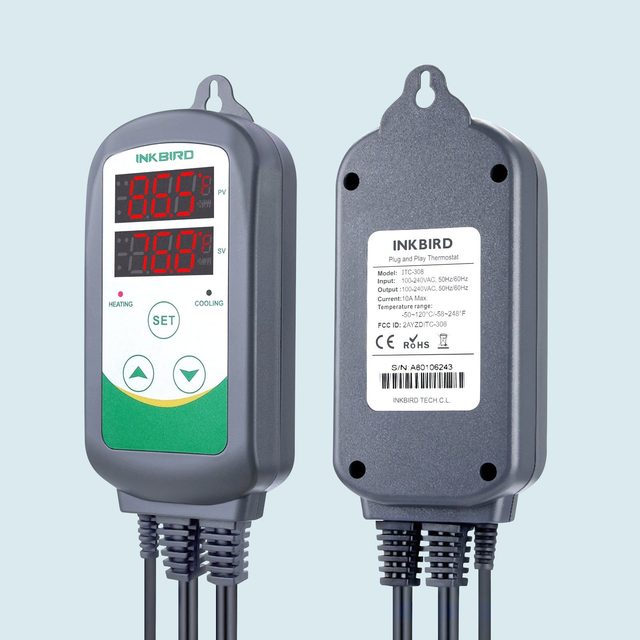
Inkbird currently specifies the ITC-308 as an on/off dual-stage temperature controller with separate heating and cooling outputs. The current US specification lists 120VAC, 10A and 1200W total across the two receptacles, plus high/low temperature alarms, sensor-fault alerts, calibration and a compressor-delay setting. Those are manufacturer specifications, not PetGearReport measurements.
For reptile use, the important boundary is the control method: this is a switched-relay controller. It can be a useful fit when the exact heater or cooling device is compatible with on/off operation, but it is not a substitute for a dimming-proportional controller when a visible-light basking lamp or another heat source calls for smoothly varied power.
The ranking reflects documentation quality, dual-stage flexibility and monitoring features inside the on/off category. It does not mean the ITC-308 is the right controller for every heat source or species.
Our top on/off research pick for setups that benefit from separate heating and cooling outputs, clear alarms and current manufacturer documentation.
Check price on Amazon →#2Best value
Inkbird ITC-306T Day/Night Heating Thermostat
Best for: Setups needing separate day/night targets and up to two compatible on/off-controlled heaters
What we like
- Separate day and night temperature setpoints
- Two heating sockets can control two compatible heaters
- Heating-only on/off control with a current 10A output limit
- Measured and target temperatures shown together
- High-temperature and sensor-fault alarms
What we don't
- Heating only, with no cooling output
- On/off control rather than proportional dimming or pulse
- Both sockets are part of the heating-control design rather than independent zones

Inkbird’s current ITC-306T documentation lists separate day and night temperature cycles, heating-only on/off control, a maximum 10A temperature-control output and dual relay/double sockets that support two heaters at a time. That corrects the older wording on this page that described it as a single-outlet controller.
The two sockets do not turn the unit into two independently controlled terrarium zones; this is still one heating-control platform built around the controller’s probe and programmed temperature cycle. Use it only with heat sources whose manufacturer guidance allows on/off thermostat control, and set day/night temperatures from species-specific husbandry guidance rather than from a generic reptile preset.
Its value is schedule-aware heating without adding cooling control. If the primary daytime heat source is a visible-light basking lamp that benefits from proportional dimming, this ranked on/off shortlist may not be the correct category.
The day/night on/off pick when the species plan calls for different targets and two compatible heating sockets are useful.
Check price on Amazon →#3
Zoo Med ReptiTemp RT-600 Digital Thermostat Controller
Best for: Reptile-specific on/off heat or cooling control with a published 50–122°F range
What we like
- Current 50–122°F control range
- Controls up to 600W heating or 150W cooling
- Six-foot remote temperature sensor
- Dedicated HEAT and COOL modes
- Reptile-specific manufacturer documentation
What we don't
- Lower wattage ceiling than the Inkbird 308
- On/off control rather than pulse-proportional
- Fewer advanced alarm options
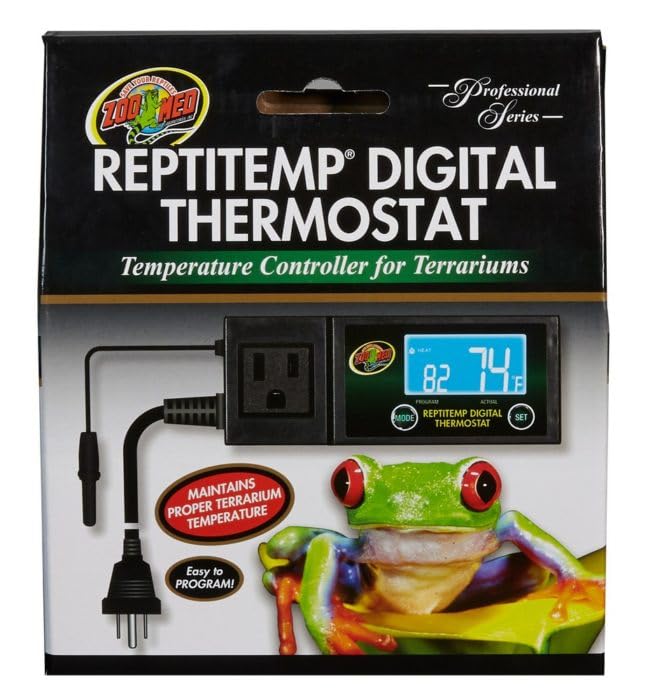
Zoo Med currently specifies the ReptiTemp RT-600 with a 50–122°F control range, a six-foot remote sensor, up to 600W of heating control and up to 150W of cooling control. In HEAT mode it switches heating equipment; in COOL mode it switches compatible cooling equipment such as a fan.
That makes the RT-600 easy to document and easy to bound: its published limits are explicit, and Zoo Med also warns that probe cables should be positioned so the animal cannot chew them or become entangled. The controller still uses on/off operation, so compatibility with the exact heat source remains the first decision.
Choose it when a reptile-specific manufacturer and a clearly published operating envelope matter more than WiFi or day/night scheduling. PetGearReport has not measured its control accuracy in an enclosure.
The reptile-brand on/off pick, with unusually clear current limits for temperature range, heating load, cooling load and probe length.
Check price on Amazon →#4
Inkbird ITC-308 WiFi Temperature Controller
Best for: On/off heating/cooling setups where remote app monitoring is worth the added connectivity dependency
What we like
- WiFi version adds remote monitoring through the INKBIRD app
- Separate heating and cooling outputs
- Current manufacturer page lists a 10A output limit
- High/low temperature and sensor-fault alarms
- Remote access adds an off-site monitoring layer
What we don't
- Depends on WiFi and the app staying connected
- Pricier than the non-WiFi version
- On/off control rather than pulse
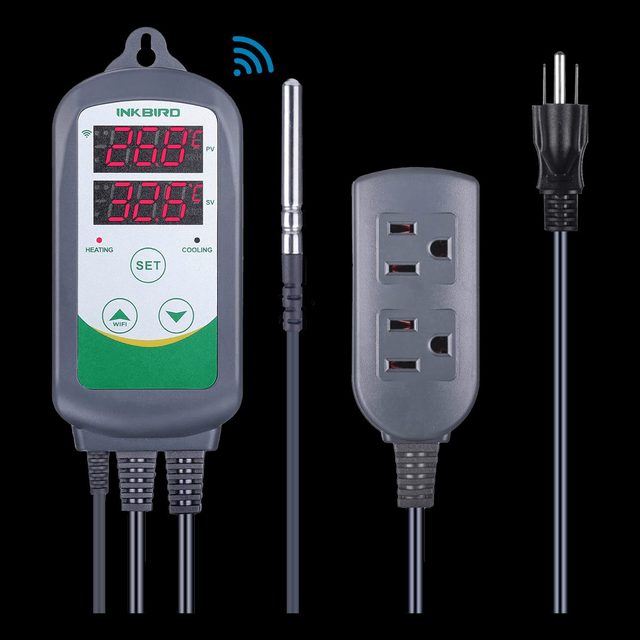
The ITC-308 WiFi variant keeps the series’ separate heating/cooling relay concept and adds remote monitoring through the INKBIRD app. The current manufacturer specification lists a 10A output limit and publishes a dedicated operating range for the WiFi model.
Remote access is useful as an additional monitoring layer, but it should not be treated as the only safety check for a reptile enclosure. WiFi, the app and internet connectivity add dependencies that the non-connected controller does not have, while the local probe still determines the temperature the controller sees.
Like the standard ITC-308, this remains on/off control. Choose it for compatible switched equipment and remote visibility, not as a substitute for a proportional dimming thermostat where the heat source requires one.
The connected on/off option when remote monitoring matters, while local temperature verification remains necessary.
Check price on Amazon →#5Budget pick
Zoo Med ReptiTemp 500R Remote Sensor Thermostat
Best for: Basic on/off heating control where a separate thermometer is already part of the enclosure setup
What we like
- Current approximate 70–110°F thermostat range
- Six-foot remote sensor probe
- Dual receptacle can control up to two compatible heating devices
- Current Zoo Med training material lists up to 500W
- Simple covered dial with no app or menu
What we don't
- No temperature display
- On/off heating control only
- Requires a separate thermometer when setting and verifying enclosure temperature
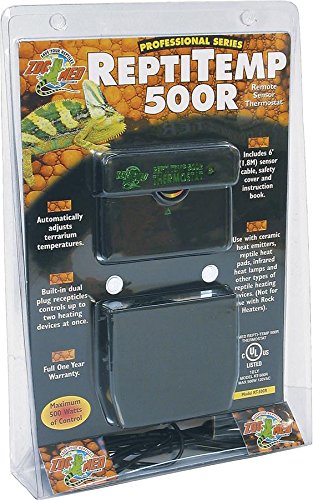
Zoo Med’s current 500R page describes an on/off remote-sensor thermostat with a six-foot probe, dual receptacle and an approximate 70–110°F range. Zoo Med’s current training material lists the controller for up to 500W and recommends using at least one separate thermometer because the 500R itself does not display temperature.
That makes the 500R straightforward but intentionally limited. The dial sets the control point; a separate thermometer is needed to observe and verify the enclosure temperature while programming it. Zoo Med also specifies it for compatible heating devices rather than as a universal controller for every lamp or UV product.
Choose it when basic switched heating control is enough and you already use independent temperature monitoring. For day/night scheduling, cooling, WiFi or proportional output, choose a different control architecture.
The simple analog on/off option when its 70–110°F range and 500W published limit match the setup.
Check price on Amazon →Quick answer
The five ranked products on this page are on/off controllers. They are useful when the connected heater or cooling device is designed to work with full-power switching, but they are not a complete list of proportional or dimming systems.
Before choosing any thermostat, identify the heat source, confirm the controller type the heater manufacturer supports, and establish the species-specific temperature plan. Merck Veterinary Manual recommends appropriately sized reptile heaters be thermostat controlled and positioned toward one end of the enclosure to create a thermal gradient. A thermostat is therefore part of the husbandry system, not a universal temperature prescription.
If your primary daytime heat source is a visible-light basking lamp, do not assume an on/off controller is automatically the best fit. Current Exo Terra documentation separates on/off, pulse-proportional and dimming-proportional control; its proportional thermostat guidance uses pulse for compatible non-visible-light heat sources and dimming for visible-light heat sources.
How we researched and scored
PetGearReport has not physically tested these thermostats, measured enclosure temperature stability, verified relay life, or compared long-term failure rates. We reviewed current manufacturer specifications and manuals plus veterinary husbandry guidance, and we keep the product-specific claims within those published boundaries.
The displayed numbers are PetGearReport research scores, not customer ratings or hands-on test results. We use five categories:
- Control documentation & electrical limits — 30%
- Use-case fit inside the on/off category — 25%
- Monitoring, alarms & scheduling — 20%
- Setup/probe clarity — 15%
- Manufacturer documentation/support — 10%
The ranking is use-case editorial judgment within this on/off shortlist; it is not a claim that an on/off controller is superior to a proportional thermostat for every heat source.
| Controller | Control mode | Current manufacturer highlights | Published research score |
|---|---|---|---|
| Inkbird ITC-308 | On/off heat + cool | Dual relay; high/low alarms; current US page lists 120VAC 10A / 1200W total | 9/10 |
| Inkbird ITC-306T | On/off heating only | Separate day/night cycles; two heating sockets; max 10A | 9/10 |
| Zoo Med RT-600 | On/off heat or cool | 50–122°F; 600W heating; 150W cooling; 6-ft sensor | 9/10 |
| Inkbird ITC-308 WiFi | On/off heat + cool | Remote INKBIRD-app monitoring plus ITC-308-family relay/alarm functions | 8/10 |
| Zoo Med 500R | On/off heating | Approx. 70–110°F; dual receptacle; 6-ft probe; current training material says up to 500W | 8/10 |
Match the thermostat control type to the heat source
| Control type | How it regulates power | Heat-source context | Main decision point |
|---|---|---|---|
| On/off | Switches the connected output fully on or off around the setpoint | Compatible heaters/coolers whose manufacturer allows switched operation | Simple and common, but visible cycling and temperature swing may make it a poor match for some heat sources |
| Pulse proportional | Sends power in proportionate pulses as temperature approaches the setpoint | Non-light-emitting heat sources such as compatible mats, cables or ceramic heaters | Confirm both heater and thermostat manufacturer compatibility; pulsing is not for a visible lamp that would visibly flash |
| Dimming proportional | Smoothly changes delivered power instead of full on/off switching | Visible-light basking lamps and other dimmable heat sources when the manufacturers support dimming | Avoids obvious brightness cycling and can hold output more smoothly than switched control |
This matrix is a control-architecture guide, not permission to mix any thermostat with any heater. Follow the exact manuals and electrical limits for both devices.
Current product-spec corrections that matter
Inkbird ITC-306T: two heating sockets, not one
The current Inkbird page states that the ITC-306T has a dual relay/double-socket arrangement, supports two heaters at a time, operates in heating only mode, and supports separate day and night temperature cycles. The previous PetGearReport copy incorrectly described it as a single-outlet controller; that has been corrected.
Zoo Med RT-600: published heat/cool limits
Zoo Med currently lists the ReptiTemp RT-600 with a 50–122°F control range, a six-foot sensor cable, up to 600W heating control and up to 150W cooling control. Its HEAT and COOL modes are switched control modes, not proportional dimming.
Zoo Med 500R: basic analog control needs separate temperature verification
Zoo Med currently lists the 500R at approximately 70–110°F, with a six-foot remote probe and dual receptacle. Zoo Med training material lists it for up to 500W and specifically recommends using a separate thermometer while programming it because the 500R itself does not display temperature.
Species-specific temperature and gradient come before the controller
Reptiles are ectothermic, and temperature requirements differ by species. Merck Veterinary Manual recommends providing an appropriate thermal gradient so the animal can move between warmer and cooler areas. The thermostat setpoint is therefore not the whole enclosure plan.
Use species-appropriate veterinary or authoritative husbandry guidance to establish the target gradient and day/night pattern. Then use the thermostat to regulate the chosen heat source, and use a separate thermometer or thermometers to verify what temperatures the enclosure actually reaches away from the thermostat probe.
Probe placement and cable safety
A controller reacts to the temperature at its probe. Secure the probe so it stays at the intended measurement point, and re-check it after enclosure maintenance or rearrangement. Zoo Med specifically warns that probe cables should be positioned so the animal cannot chew them or become entangled.
Do not use one probe reading as proof that the whole enclosure has the correct gradient. Verify both the warm area and cooler area independently.
Sources
Product and husbandry references rechecked October 1, 2026:
- Inkbird — ITC-308 Digital Temperature Controller
- Inkbird — ITC-306T Digital Temperature Controller
- Zoo Med — ReptiTemp RT-600 Digital Thermostat
- Zoo Med — ReptiTemp 500R Remote Sensor Thermostat
- Exo Terra — On/Off, Dimming or Pulse Proportional?
- Exo Terra — 600W Dimming & Pulse Proportional Thermostat
- Merck Veterinary Manual — Management and Husbandry of Reptiles
For the heat-source side of the setup, see our reptile heat and UVB lamps guide. For enclosure-wide planning, see reptile heat and lighting basics.
Frequently asked questions
Do I really need a thermostat for my reptile's heat lamp?
Merck Veterinary Manual recommends appropriately sized reptile heaters be thermostat controlled and positioned to create a thermal gradient. Match the controller to the exact heat source and species plan, then verify the gradient with independent temperature measurement rather than assuming one thermostat setting is correct for every reptile.
What is the difference between on/off, pulse, and dimming thermostats?
On/off thermostats switch full power, pulse-proportional thermostats send controlled pulses, and dimming-proportional thermostats vary the delivered power. Exo Terra currently describes pulse control for compatible non-visible-light heat sources and dimming control for visible-light heat sources. Always follow the exact heat-source and thermostat manufacturer compatibility guidance.
Where should I put the thermostat probe?
Place and secure the thermostat probe according to the controller and species setup so it measures the temperature the control decision is intended to regulate. Prevent the animal from chewing or becoming entangled in the cable, and use separate thermometers to verify the warm and cool parts of the species-appropriate thermal gradient.
Can one thermostat control day and night temperatures?
Some can. The current Inkbird ITC-306T supports separate day and night temperature cycles and two heating sockets. Whether a night drop is appropriate, and how large it should be, depends on the species rather than on a generic reptile setting.