Best Aquarium Air Stones: 4 Picks by Pump Fit, Bubble Pattern & Maintenance
The best aquarium air stone is the one your air pump can drive reliably at the depth and resistance of your actual setup. If the pump is not selected yet, the [aquarium air pump size guide](/aquarium-air-pump-size-guide) explains airflow, pressure/head, outlet count and backpressure without inventing a universal L/min-per-gallon rule. We researched four current diffusers using manufacturer documentation and exact Amazon.com variant checks, focusing on documented pump requirements, physical form, retention, maintenance and use-case fit. PetGearReport has not physically tested these air stones or measured bubble size, dissolved oxygen, noise, clogging rate or long-term durability. Match the air stone to the pump and job rather than assuming the finest-looking bubble cloud is automatically the best choice.
| Rank | Product | Score | Best for | Link |
|---|---|---|---|---|
| #1 | hygger HG168 Stainless-Base Air Stone (2.3 Inch)Best overall | 9 | General aquarium aeration when you want a weighted fine-bubble disc with unusually clear size-to-pump documentation | Check price → |
| #2 | UPETTOOLS T60 Nano Air Stone Kit (60 mm)Best compact kit | 8 | Compact tanks and installations where a 60 mm disc plus included flow-control hardware is more useful than a larger weighted diffuser | Check price → |
| #3 | AQUANEAT Cylindrical Air Stone (5 Inch, 2 Pack)Best larger cylinder | 8 | Larger aeration jobs where a taller cylindrical diffuser and a stronger compatible pump are already part of the setup | Check price → |
| #4 | Pawfly ASC-025 Air Stone (1 Inch, 10 Pack)Best for multiple small setups | 8 | Keepers running several small air-driven setups who value inexpensive, replaceable 1-inch stones over one large diffuser | Check price → |
#1 · Our PickBest overall
hygger HG168 Stainless-Base Air Stone (2.3 Inch)
Best for: General aquarium aeration when you want a weighted fine-bubble disc with unusually clear size-to-pump documentation
What we like
- hygger documents the 2.28-inch HG168 size for air pumps rated at least 3W
- 4 mm airline specification matches common aquarium air tubing
- Weighted stainless-steel base helps keep the disc positioned on the bottom
- Current manufacturer documentation includes size-specific pump guidance
- Exact Amazon.com 2.3-inch child was independently verified
What we don't
- Needs more pump than a tiny 1W nano setup
- Fine-pore diffusers still require cleaning when deposits or biofilm restrict output
- Published pump wattage is a compatibility signal, not a universal airflow measurement
hygger's current HG168 documentation identifies the middle size as approximately 2.28 inches (5.8 cm) in diameter, specifies 4 mm airline and lists a required air-pump power of at least 3W. The exact Amazon.com child we checked is the 2.3-inch stainless-base kit represented by this ASIN.
Those details make pump matching easier than a vague promise of 'more oxygen.' The weighted stainless base is also useful when you want a disc that stays on the aquarium floor without relying entirely on suction cups. The included kit hardware on the exact marketplace variant adds a control valve, check valve, suction cup, connector and 4 mm airline.
Choose the HG168 when a 3W-or-stronger compatible pump and a compact weighted disc fit the job. Do not interpret its fine-bubble design as a PetGearReport measurement of dissolved-oxygen performance; real output depends on pump pressure, water depth, airline resistance and the condition of the diffuser.
Our strongest general-purpose research pick because the 2.3-inch HG168 combines a stable weighted format with specific 4 mm airline and at-least-3W pump guidance from the manufacturer.
Check price on Amazon →#2Best compact kit
UPETTOOLS T60 Nano Air Stone Kit (60 mm)
Best for: Compact tanks and installations where a 60 mm disc plus included flow-control hardware is more useful than a larger weighted diffuser
What we like
- Exact current T60 listing identifies a 60 mm nano disc
- Marketplace documentation specifies a 2W-6W pump range
- Includes an airflow control valve and two suction cups
- Compact disc format can fit where a long cylinder is awkward
- Exact Amazon.com child was independently verified
What we don't
- Current product-specific documentation is primarily the marketplace listing rather than a detailed manufacturer manual
- Suction-cup mounting adds parts that need periodic inspection
- The listing's oxygen-performance marketing is not treated as independent evidence
The exact B08HRJ6HMB product page identifies the UPETTOOLS T60 as a 60 mm nano air-disc kit and specifies a 2W-6W air-pump range. It also lists a control valve and two suction cups, which makes the physical setup easy to understand before buying.
We use those concrete fit and accessory details, not the listing's promotional claims about oxygen transfer, to score the product. A valve can help reduce delivered airflow when the pump has more output than the tank needs, but it cannot make an undersized pump overcome excessive water depth or diffuser resistance.
Choose this kit when compact mounting and included adjustment hardware matter. Avoid choosing it solely because the listing describes dense or quiet bubbles; PetGearReport has not measured either bubble size or sound.
The compact-kit pick: the exact T60 listing gives a clear 60 mm format, 2W-6W pump range and included control hardware, but its documentation is less robust than hygger's model-specific manufacturer page.
Check price on Amazon →#3Best larger cylinder
AQUANEAT Cylindrical Air Stone (5 Inch, 2 Pack)
Best for: Larger aeration jobs where a taller cylindrical diffuser and a stronger compatible pump are already part of the setup
What we like
- Exact listing specifies a 1.5-inch diameter by 5-inch height for each cylinder
- Manufacturer marketplace guidance calls for at least a 5W air pump
- Fits standard 3/16-inch airline
- Two bases are intended to keep the cylinders stable in water
- Published care guidance says to soak before use and brush-clean as deposits accumulate
What we don't
- At-least-5W requirement is more demanding than the smaller picks
- Tall cylindrical form takes more vertical and floor space
- A 2-pack is unnecessary if the setup only needs one compact diffuser
The exact B0FK1GXMPT listing describes two cylindrical diffusers measuring about 1.5 inches in diameter by 5 inches high, compatible with 3/16-inch airline and recommended for an air pump rated at least 5W. That makes this a materially different air-side load from a tiny 1-inch stone.
AQUANEAT's current marketplace instructions say to soak the stone completely for one hour before first use and clean it periodically with a brush as it clogs over weeks or months. Those maintenance details matter because mineral deposits, algae and biofilm can raise resistance and change the bubble pattern over time.
Choose this pair when the physical size and stronger-pump requirement fit the installation. Avoid treating the larger body as an automatic upgrade for a small tank; a bigger diffuser that the pump cannot drive evenly is a poor match.
The larger-format pick: its 5-inch cylinder, at-least-5W pump requirement and explicit soak/clean guidance make the trade-offs unusually clear before installation.
Check price on Amazon →#4Best for multiple small setups
Pawfly ASC-025 Air Stone (1 Inch, 10 Pack)
Best for: Keepers running several small air-driven setups who value inexpensive, replaceable 1-inch stones over one large diffuser
What we like
- Ten small stones suit multiple nano tanks, breeding tubs or spare setups
- Exact listing specifies 0.8 L/min jetting volume per ASC-025 stone
- Designed for 3/16-inch airline and 2W-4W nano air pumps
- Published instructions specify a one-hour pre-soak and periodic brush cleaning
- Exact Amazon.com 10-pack child was independently verified
What we don't
- Small individual stones are not intended to spread bubbles across a large footprint
- Ten-pack format is wasteful if only one diffuser is needed
- Published 0.8 L/min figure still depends on the pump and installation actually supplying air
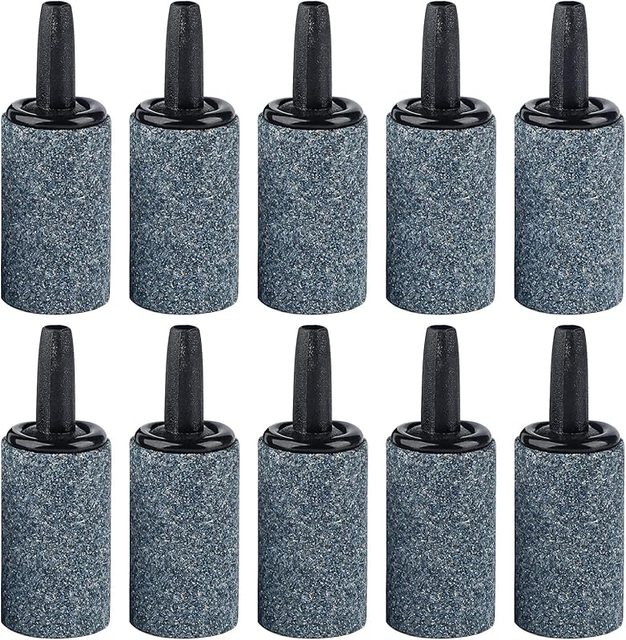
The exact B075QCWGZQ listing identifies the Pawfly ASC-025 as a 1-inch air stone sold in a 10-pack. Pawfly publishes a 0.8 L/min jetting-volume figure, 3/16-inch airline compatibility and a 2W-4W nano-pump range for the product.
The small size is the reason to buy it. A breeder, shrimp keeper or multi-tank owner can place separate diffusers where needed without buying several large discs. The listing also says to soak each stone for one hour before use and brush-clean it when clogging develops.
Choose the pack when several small setups or ready spares are genuinely useful. For one display tank that needs a wider bubble field, a larger disc or cylinder can be easier to position and maintain than scattering several small stones.
The multi-setup specialist: ten 1-inch ASC-025 stones, a documented 2W-4W pump range and straightforward cleaning guidance make it practical for several small tanks or spares.
Check price on Amazon →If an existing air stone suddenly weakens, use the aquarium air pump troubleshooting guide to separate a clogged diffuser from tubing, check-valve, depth or pump-output problems.
How we researched and scored
PetGearReport has not physically tested these aquarium air stones or measured their real bubble diameter, dissolved-oxygen transfer, sound, clogging rate or long-term durability. We compared current manufacturer documentation where available, exact Amazon.com product identity, published pump and airline requirements, physical geometry, retention hardware and maintenance instructions. Current price, availability, Amazon customer stars, review counts and popularity are not scoring inputs.
The displayed 1–10 number is a PetGearReport research score, rounded to the nearest whole number from the same five weighted categories for every product:
- Pump fit & documented requirements — 30%: clarity of pump-power, airflow, airline or depth-related fit information.
- Maintenance & serviceability — 25%: useful soak, cleaning and clog-management guidance plus how straightforward the form is to service.
- Setup & retention — 15%: weighted base, suction hardware, included valves and how predictably the diffuser can be positioned.
- Use-case fit — 15%: whether the geometry solves a distinct aquarium job instead of merely duplicating another pick.
- Documentation & exact-product identity — 15%: current manufacturer evidence where available plus independently checked exact Amazon.com child identity.
| Product | Pump fit 30% | Maintenance 25% | Setup & retention 15% | Use-case fit 15% | Documentation 15% | Weighted result | Published score |
|---|---|---|---|---|---|---|---|
| hygger HG168 2.3 in | 10 | 9 | 9 | 9 | 10 | 9.45 | 9/10 |
| UPETTOOLS T60 60 mm | 9 | 7 | 9 | 8 | 7 | 8.05 | 8/10 |
| AQUANEAT 5 in cylinder | 9 | 8 | 8 | 8 | 7 | 8.15 | 8/10 |
| Pawfly ASC-025 10 pack | 9 | 8 | 7 | 8 | 8 | 8.15 | 8/10 |
The weighted decimals make the method auditable; they are not laboratory measurements. A 9.45 research score does not prove that the hygger raises dissolved oxygen more than an 8.15 product in a particular aquarium. The ranking reflects evidence quality and fit for the stated job, not a controlled oxygen-transfer test.
Quick decision table
| Pick | Shape / size | Documented air-side fit | Maintenance signal | Best for | Avoid if |
|---|---|---|---|---|---|
| hygger HG168 2.3 in | Weighted disc, ~2.28 in | 4 mm airline; ≥3W pump | Manufacturer shows cleaning workflow | General-purpose weighted fine-bubble disc | Your pump is below the documented requirement |
| UPETTOOLS T60 | 60 mm suction-mounted disc | 2W-6W pump on exact listing | No equally detailed manufacturer cleaning manual found | Compact kit with included control valve | You want the strongest documentation trail |
| AQUANEAT 5 in cylinder | 1.5 in × 5 in cylinder, 2-pack | 3/16 in airline; ≥5W pump | Soak 1 hour; brush as clogging develops | Larger cylindrical diffusion | You have a low-power nano pump |
| Pawfly ASC-025 | 1 in small cylinder, 10-pack | 3/16 in airline; 2W-4W pump; 0.8 L/min listed | Soak 1 hour; periodic brushing | Several small tanks or spares | You only need one wider diffuser |
HG168 size-to-pump compatibility ladder
Manufacturer page checked September 23, 2026. hygger currently publishes three HG168 sizes with the same 4 mm airline connection but different minimum pump-power and aquarium-length guidance:
| HG168 size | Manufacturer minimum pump power | Manufacturer applicable aquarium length |
|---|---|---|
| 1.5 in / 3.8 cm | ≥1W | <16 in / 40 cm |
| 2.28 in / 5.8 cm | ≥3W | 16–32 in / 40–80 cm |
| 3 in / 7.8 cm | ≥4W | 24–52 in / 60–130 cm |
This ladder is useful because it ties a diffuser size to a documented pump-fit boundary, but it is not a universal watts-to-airflow rule. Pump wattage does not tell you delivered L/min at depth, and the HG168 tank-length labels are manufacturer fit guidance for this specific product family. Do not transfer the 1W/3W/4W thresholds to UPETTOOLS, AQUANEAT, Pawfly or another diffuser.
The exact ranked HG168 child on this page is the 2.3-inch marketplace variant represented by ASIN B0DP25RKJG. The repository’s identity record for that exact child remains unchanged; this update adds current manufacturer-family documentation without changing the selected product.
If you have not chosen the pump yet, use the aquarium air pump size guide to compare airflow, depth/backpressure and outlet architecture, then use the best aquarium air pumps guide for current product selection.
Air-stone failure-signal map
Weak or uneven bubbles do not automatically mean “buy a stronger pump.” Use the symptom to decide whether to inspect the diffuser, pressure path or wider aquarium conditions first.
| What you observe | Most useful first interpretation | Conservative next step |
|---|---|---|
| Bubbles weaken gradually over time | Diffuser pores may be accumulating mineral deposits, algae or biofilm | Follow the exact stone’s cleaning guidance; also inspect airline and valves before upsizing the pump |
| Output drops sharply when the stone is moved deeper | Water depth/backpressure may be exceeding the useful margin of the pump/setup | Return to the shallower position and check the air-pump sizing guide rather than inferring a universal wattage fix |
| One branch on a splitter bubbles much harder than another | The two air paths may have different resistance or valve balance | Check tubing, valves, diffuser condition and branch balance; do not assume the weaker stone is defective |
| A previously even disc bubbles only in one area | Partial clogging or uneven air delivery is plausible | Clean/inspect the diffuser and air path first; use the air-pump troubleshooting guide if the pump itself is weak, noisy or intermittent |
| Bubbles look strong but fish still show respiratory distress | Visible bubbles do not prove adequate dissolved oxygen or rule out other water-quality problems | Use the dissolved oxygen guide and fish gasping at the surface workflow instead of treating bubble appearance as the diagnosis |
| You need filtration as well as aeration | A bare diffuser does not provide the same mechanical/biological-media function as an air-driven filter | Compare aquarium sponge filters rather than simply adding more air stones |
The failure map is observational guidance, not a laboratory diagnosis. PetGearReport has not physically tested these air stones, measured diffuser backpressure, bubble diameter, dissolved-oxygen transfer or the pressure curve of a pump attached to them.
Match the air stone to the pump, not just the tank
An air stone is a restriction in the air line. The pump must create enough pressure and airflow to push air through the diffuser pores at the installed water depth. As water depth increases, the pump has to overcome more pressure before any useful flow reaches the stone. Fine pores, long tubing, control valves, check valves and splitters can add further resistance.
That is why this guide gives more weight to documented pump fit than to phrases such as “nano,” “micro bubble” or “high oxygen.” The hygger HG168 2.3-inch model is documented for at least 3W, the exact UPETTOOLS T60 listing specifies 2W-6W, the AQUANEAT 5-inch cylinders call for at least 5W, and the Pawfly ASC-025 listing specifies 2W-4W.
Pump wattage itself is not a universal airflow standard across brands. It is useful here only as product-specific manufacturer/listing guidance. If you are choosing the air source as well as the diffuser, use our best aquarium air pumps guide, which compares documented airflow, outlet count, adjustment and deep-water capability rather than assuming every pump with the same wattage behaves identically.
Bubble size is not a dissolved-oxygen meter
A fine bubble cloud is visually obvious, but it is not a direct measurement of dissolved oxygen. Air-driven equipment can support gas exchange by moving water upward and disturbing the surface, and bubble size/contact time can influence transfer conditions, but the aquarium’s actual oxygen level also depends on temperature, stocking, respiration, biological demand, circulation and surface exchange.
This matters because several current air-stone listings use strong oxygen-performance language. We do not convert those marketing claims into measured PetGearReport performance. If a direct oxygen reading is actually needed, the aquarium dissolved oxygen meter guide compares exact instruments and their compensation/probe-maintenance requirements. If fish are piping or gasping at the surface, treat that as a warning that deserves broader water-quality assessment rather than assuming a finer air stone is the whole fix. Our aquarium water parameters guide explains the core ammonia, nitrite, nitrate and pH checks that belong in that diagnostic workflow.
Disc, cylinder or several small stones?
Weighted disc
A weighted disc such as the hygger HG168 spreads bubbles over a compact circular footprint and stays low in the tank without depending entirely on suction cups. This is the easiest all-round geometry in the shortlist when the pump requirement is satisfied.
Compact suction-mounted disc
The UPETTOOLS T60 uses a 60 mm disc with suction cups and a control valve. That can be useful when you want the diffuser attached to a particular glass position rather than sitting freely on the substrate. The extra mounting hardware also means more pieces to inspect and clean.
Larger cylinder
A 5-inch AQUANEAT cylinder uses a taller porous surface and requires a stronger documented pump. It can make sense when you want a larger diffuser body, but it also occupies more space and is a poor match for a very small air pump.
Multiple small stones
The Pawfly 10-pack is useful when one pump/manifold or several small pumps serve multiple nano, breeding or quarantine setups. Its advantage is distribution and replaceable spares, not superior per-stone output versus a larger diffuser.
If your actual goal is air-driven filtration rather than a decorative/aeration diffuser, start with our best aquarium sponge filters guide. A sponge filter uses the air source to move water through filter media, so it solves a different job from a bare air stone.
Water depth and back pressure
The deeper the diffuser sits, the more static water pressure the air pump must overcome. The air path then adds its own resistance through tubing, valves and the diffuser material. A setup that bubbles strongly in a shallow bucket can therefore behave differently at the bottom of a deep aquarium.
Do not respond to weak output by assuming the stone is defective. Check, in order:
- whether the pump meets the exact diffuser guidance;
- whether the airline is kinked, leaking or unusually long;
- whether a valve, splitter or check valve is restricting the path;
- whether the stone is clogged with mineral deposits, algae or biofilm;
- whether the installed depth is beyond what the pump can drive comfortably.
A stronger pump can help only when insufficient pressure/flow is actually the problem. If the diffuser is clogged, cleaning it according to the product instructions is the better first step.
Cleaning and maintenance
Air stones are consumable or serviceable parts depending on their material and design. As pores accumulate mineral scale, algae or biological film, output can become patchy and the pump can face more resistance.
The exact guidance differs across this shortlist. The AQUANEAT cylinders and Pawfly ASC-025 stones both specify a one-hour soak before first use and periodic brush cleaning. hygger publishes a cleaning workflow for the HG168 family. The UPETTOOLS T60 exact listing gives useful setup hardware information but less detailed product-specific maintenance documentation, which is one reason it scores lower on evidence quality.
Use observed bubble pattern and airflow as maintenance signals rather than replacing every stone on an arbitrary calendar. During routine equipment checks, inspect airline connections, valves and the diffuser surface as part of the same air-side system. Our aquarium maintenance schedule includes monthly airline/equipment inspection without turning every month into an automatic replacement event.
What each pick is really best at
hygger HG168: strongest all-round documentation
The HG168 wins because the manufacturer publishes the size, airline diameter, pump-power requirement and aquarium-length guidance for each size in the family. That makes the 2.3-inch variant easier to match to a real setup before buying.
UPETTOOLS T60: compact control kit
The T60 is most useful when you want a small disc plus control/mounting hardware in one package. Its weaker point is evidence depth: product-specific setup facts are clear on the current exact listing, but the documentation trail is not as strong as hygger’s current model page.
AQUANEAT 5-inch: larger cylindrical option
The AQUANEAT pair provides the clearest step up in physical diffuser size. Its at-least-5W pump guidance matters: this is not the product to pair casually with the smallest nano air pump.
Pawfly ASC-025: several small tanks or ready spares
The Pawfly 10-pack solves a multi-setup problem rather than a single-display-tank problem. Its 1-inch format, 2W-4W pump guidance and published maintenance steps are straightforward, but a single wider diffuser is simpler when only one bubble zone is needed.
Sources
PetGearReport used current manufacturer documentation where available and direct Amazon.com identity/specification checks for the exact variants represented by the affiliate cards. Marketplace marketing claims about oxygen transfer, quietness and health outcomes were not treated as independent performance evidence.
- hygger — HG168 Stainless Steel Aquarium Air Stone — current size-specific diameter, 4 mm airline, ≥1W/≥3W/≥4W pump guidance, aquarium-length ranges and cleaning information; rechecked September 23, 2026.
- Pawfly — aquarium product range — current brand product-range reference; exact ASC-025 package identity and specifications were cross-checked on Amazon.com.
- AQUANEAT — official site — current brand reference; exact 5-inch two-pack dimensions, pump guidance and care instructions were cross-checked on Amazon.com.
The four exact Amazon.com children were directly checked on September 13, 2026: hygger HG168 2.3-inch B0DP25RKJG, UPETTOOLS T60 60 mm B08HRJ6HMB, AQUANEAT 5-inch 2-pack B0FK1GXMPT, and Pawfly ASC-025 1-inch 10-pack B075QCWGZQ.
Frequently asked questions
What size air stone should I use in my aquarium?
Start with the exact air stone's pump requirement and physical footprint rather than tank gallons alone. Water depth, airline length and diffuser resistance affect how much pressure the pump must overcome. A small stone can be enough for a targeted nano setup, while a wider disc or longer cylinder can make more sense when you want bubbles distributed over a larger area.
Do smaller bubbles put more oxygen in the water?
Bubble size can affect gas-transfer conditions, but the visible bubble cloud is not a direct dissolved-oxygen measurement. In an aquarium, oxygen conditions also depend on surface agitation, circulation, temperature, stocking, biological demand and the pump's ability to drive the diffuser at the installed depth. Do not choose a product from a 'micro bubble' claim alone.
Why did my air stone stop bubbling evenly?
Check the pump, airline, valves and connections first, then inspect the diffuser for deposits or biofilm. Several products in this guide explicitly call for periodic brushing or cleaning when clogging develops. A partially blocked fine-pore stone increases resistance, so follow the exact product's cleaning instructions rather than simply turning the pump up indefinitely.
Do I need to soak a new air stone before using it?
Follow the exact product instructions. The AQUANEAT 5-inch cylinders and Pawfly ASC-025 stones represented here both specify a one-hour pre-soak. Other diffuser materials and designs can have different instructions, so do not apply one preparation rule to every air stone.