Best Aquarium Dissolved Oxygen Meters: 4 Picks for DO & Saturation
A dissolved oxygen meter is useful only if its probe, compensation settings and calibration match the sample. We researched four exact marketplace variants from Hanna, Extech and Milwaukee, comparing concentration and saturation capability, published accuracy, temperature/salinity/altitude compensation, probe maintenance and aquarium fit. PetGearReport has not physically tested these meters, checked them against laboratory reference methods, measured calibration drift or established a universal aquarium dissolved-oxygen target.
| Rank | Product | Score | Best for | Link |
|---|---|---|---|---|
| #1 | Hanna Instruments HI9147-04 Galvanic DO MeterBest documented aquaculture pick | 9 | freshwater, marine, pond and aquaculture users who want broad DO/saturation range, salinity/altitude compensation and a galvanic probe with no warm-up requirement | Check price → |
| #2 | Extech DO600 Waterproof ExStik IIBest compact saturation meter | 8 | users who want a compact waterproof meter that displays both concentration and percent saturation with unusually broad altitude and salinity compensation | Check price → |
| #3 | Extech DO210 Compact Dissolved Oxygen MeterBest cabled field-probe option | 8 | users who prefer a conventional handheld meter with a cabled probe, ATC and adjustable altitude/salinity compensation | Check price → |
| #4 | Milwaukee MW600 PRO Dissolved Oxygen MeterBest simple mg/L-only workflow | 7 | users who want a straightforward portable mg/L meter and do not need direct saturation display or salinity/altitude compensation controls | Check price → |
#1 · Our PickBest documented aquaculture pick
Hanna Instruments HI9147-04 Galvanic DO Meter
Best for: freshwater, marine, pond and aquaculture users who want broad DO/saturation range, salinity/altitude compensation and a galvanic probe with no warm-up requirement
What we like
- 0.0–50.0 mg/L and 0–600% saturation ranges
- Manufacturer publishes ±1% of reading DO accuracy
- Automatic temperature compensation plus adjustable salinity and altitude compensation
- Galvanic probe requires no polarization/conditioning time before measurement
- Exact HI9147-04 variant uses HI76409/4 4 m probe and maps to ASIN B0085X2GZ6
What we don't
- 0.1 mg/L concentration resolution is coarser than the DO600 display
- Calibration is manual in saturated air rather than a guided digital workflow
- Galvanic membrane and electrolyte still require inspection and replacement
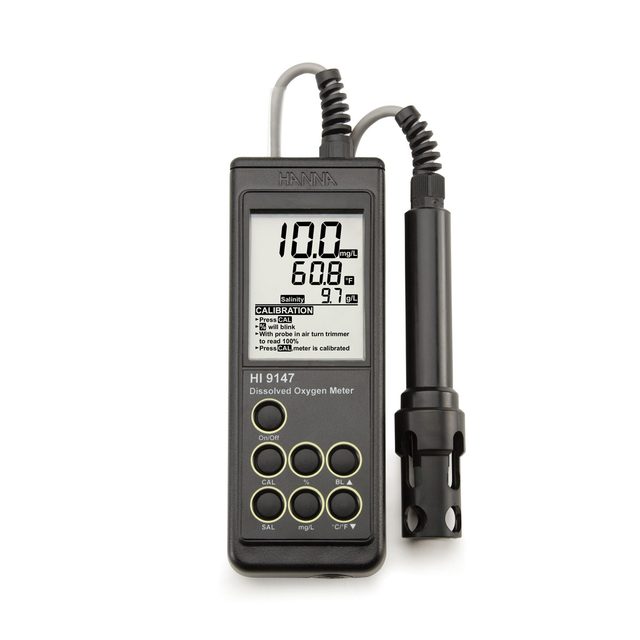
Hanna's current HI9147 documentation lists 0.0–50.0 mg/L and 0–600% saturation, 0.1 mg/L or 1% resolution and ±1% of reading DO accuracy at 25°C. It includes automatic temperature compensation, altitude compensation to 4000 m and salinity compensation from 0 to 51 g/L. The galvanic sensor uses replaceable HDPE membrane caps and electrolyte and does not need polarization time.
The exact marketplace variant here is HI9147-04 with the HI76409/4 4 m probe, not the 10 m HI9147-10 package. Exact HI9147-04 reconciles to Amazon.com ASIN B0085X2GZ6.
The strongest research pick because current Hanna documentation combines broad range, ±1% of reading accuracy, saturation display, salinity/altitude compensation and a clearly documented galvanic maintenance system.
Check price on Amazon →#2Best compact saturation meter
Extech DO600 Waterproof ExStik II
Best for: users who want a compact waterproof meter that displays both concentration and percent saturation with unusually broad altitude and salinity compensation
What we like
- 0–20.00 mg/L concentration and 0–200.0% saturation display
- 0.01 mg/L maximum display resolution
- Adjustable altitude compensation to 20,000 ft and salinity compensation to 50 ppt
- IP57 compact pen-style housing
- Exact DO600 / UPC 793950056004 identity maps to ASIN B000R8253K
What we don't
- Current Extech page lists 0.4 mg/L basic accuracy despite the much finer 0.01 mg/L display step
- Membrane/electrolyte probe maintenance is more involved than a simple chemical test
- Compact form factor does not remove the need to set salinity and altitude correctly
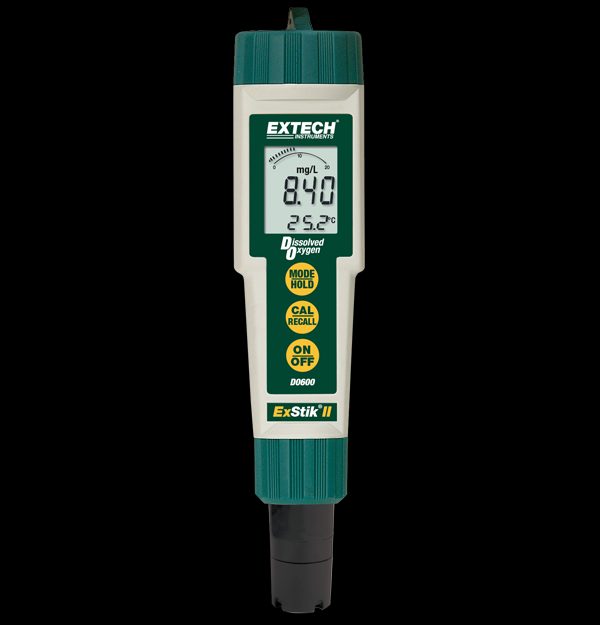
Extech's current DO600 page specifies 0–20.00 mg/L concentration, 0–200.0% saturation, 0.01 mg/L maximum resolution, 0.4 mg/L basic accuracy in the DO specification table, adjustable altitude compensation from 0 to 20,000 ft and salinity compensation from 0 to 50 ppt. The housing is IP57.
That combination makes DO600 easy to carry between tanks, but resolution is not accuracy: a 0.01 mg/L display does not mean ±0.01 mg/L analytical performance. Exact DO600 / UPC 793950056004 reconciles to Amazon.com ASIN B000R8253K.
The compact specialist: strong compensation features and a fine display, deliberately ranked below Hanna because published accuracy is much wider than the display resolution.
Check price on Amazon →#3Best cabled field-probe option
Extech DO210 Compact Dissolved Oxygen Meter
Best for: users who prefer a conventional handheld meter with a cabled probe, ATC and adjustable altitude/salinity compensation
What we like
- 0–20.0 mg/L and 0–100.0% oxygen ranges
- Published ±0.4 mg/L concentration and ±0.7% saturation accuracy
- Automatic temperature compensation with adjustable altitude and salinity compensation
- Remote polarographic probe keeps the meter body away from the sample
- Exact DO210 marketplace identity maps to ASIN B00SYIVFVI
What we don't
- 0.1 mg/L class workflow is less compact than the pen-style DO600
- Polarographic probe uses membrane and electrolyte consumables
- Current product copy is inconsistent about supplied cable length, so this guide does not score cable length as a differentiator
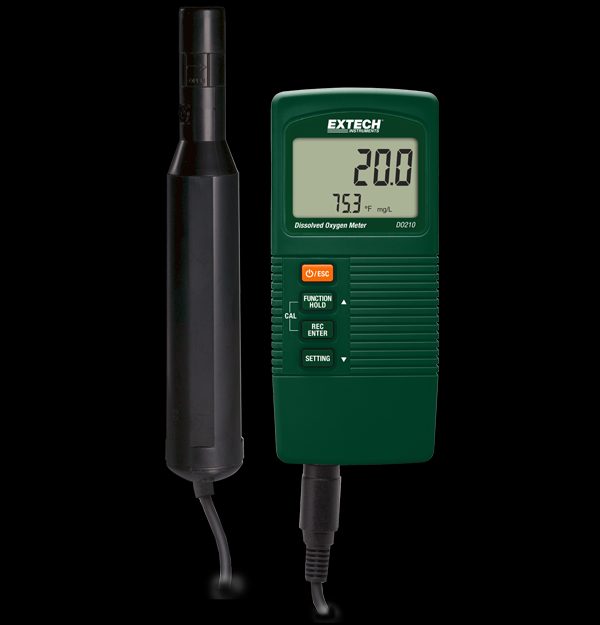
Extech currently lists 0–20.0 mg/L DO, 0–100.0% saturation, ±0.4 mg/L concentration accuracy, ±0.7% saturation accuracy and automatic temperature compensation. The polarographic probe uses a membrane and electrolyte, and the meter offers adjustable altitude and salinity compensation.
Extech's current page contains inconsistent cable-length copy in different sections, so PetGearReport does not use cable length as a scored advantage. Exact DO210 reconciles consistently to Amazon.com ASIN B00SYIVFVI.
A practical field-style meter with clear current Extech accuracy specifications, ranked just behind DO600 because it is bulkier and offers a narrower saturation range.
Check price on Amazon →#4Best simple mg/L-only workflow
Milwaukee MW600 PRO Dissolved Oxygen Meter
Best for: users who want a straightforward portable mg/L meter and do not need direct saturation display or salinity/altitude compensation controls
What we like
- Current Milwaukee specification publishes ±1.5% Full Scale accuracy
- 0.0–19.9 mg/L range with 0.1 mg/L resolution
- Automatic temperature compensation from 0 to 30°C
- Manual two-point zero-and-slope calibration
- Exact MW600 / UPC 810666003600 identity maps to ASIN B007Z4KKIQ
What we don't
- Current MW600 is an mg/L-only workflow rather than a meter that displays percent saturation
- Current manufacturer documentation does not provide user-entered salinity or altitude compensation like the higher-ranked meters
- Polarographic MA840 probe requires membrane/electrolyte maintenance and stabilization
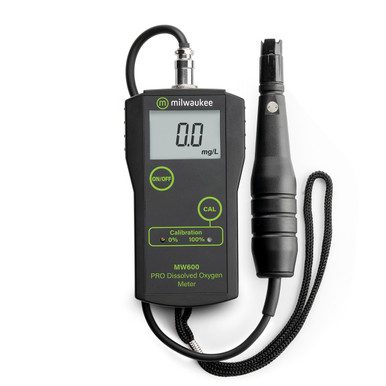
Milwaukee's current MW600 PRO specification lists 0.0–19.9 mg/L, 0.1 mg/L resolution, ±1.5% Full Scale accuracy, automatic temperature compensation from 0 to 30°C and manual two-point calibration for zero and slope. It uses the refillable MA840 polarographic probe.
The current meter is best treated as an mg/L-only workflow; PetGearReport does not infer percent-saturation display or salinity/altitude compensation that Milwaukee does not publish for this model. Exact MW600 / UPC 810666003600 reconciles to Amazon.com ASIN B007Z4KKIQ.
The simpler measurement pick: solid manufacturer documentation and a clear two-point workflow, but fewer compensation and saturation features for marine or high-altitude aquarium use.
Check price on Amazon →A dissolved oxygen meter can answer a question that air-pump bubbles cannot:
How much oxygen is actually dissolved in the water?
But a useful DO reading depends on the instrument, probe condition, calibration and compensation settings.
Start with the aquarium dissolved oxygen guide for the chemistry behind mg/L versus % saturation, temperature, salinity, altitude and daily oxygen cycles. If fish are already breathing hard or crowding the surface, use the fish gasping at the surface guide instead of waiting for a meter.
There is no universal aquarium dissolved-oxygen target for every species and system.
How we researched and scored
PetGearReport has not physically tested these dissolved oxygen meters, compared them with Winkler titration or a laboratory reference sensor, measured response time, checked waterproofing, aged membranes or independently validated manufacturer accuracy claims.
The displayed number is a PetGearReport research score, not a hands-on result, customer rating or laboratory measurement.
- Measurement specification — 30% — concentration/saturation range, published accuracy and resolution, with accuracy kept separate from display resolution.
- Compensation & calibration — 25% — temperature, salinity and altitude/pressure handling plus calibration workflow.
- Probe & maintenance — 20% — galvanic/polarographic architecture, membrane/electrolyte requirements and conditioning/stabilization burden.
- Aquarium usability — 15% — freshwater/marine/aquaculture fit, portability and practical sampling workflow.
- Exact identity & documentation — 10% — exact model/variant/UPC evidence reconciled to the marketplace listing.
| DO meter | Measurement 30% | Compensation/calibration 25% | Probe/maintenance 20% | Aquarium usability 15% | Identity 10% | Weighted | Score |
|---|---|---|---|---|---|---|---|
| Hanna HI9147-04 | 10 | 10 | 9 | 9 | 9 | 9.55 | 9/10 |
| Extech DO600 | 8 | 10 | 7 | 9 | 10 | 8.65 | 8/10 |
| Extech DO210 | 8 | 9 | 7 | 8 | 10 | 8.25 | 8/10 |
| Milwaukee MW600 | 8 | 6 | 6 | 7 | 10 | 7.15 | 7/10 |
The decimals make the weighting auditable; they do not imply laboratory precision.
Resolution is not accuracy
Resolution is not accuracy.
Resolution describes the smallest step the display can show. Published accuracy describes how close the instrument is expected to be to a reference under stated conditions.
The clearest example here is Extech DO600:
- maximum concentration resolution: 0.01 mg/L;
- current DO-table basic accuracy: 0.4 mg/L.
Those figures are not contradictory. The display can show small changes more finely than the manufacturer’s stated absolute accuracy.
The other current specifications include:
- Hanna HI9147: 0.1 mg/L resolution and ±1% of reading DO accuracy;
- Extech DO210: published ±0.4 mg/L concentration accuracy;
- Milwaukee MW600: ±1.5% Full Scale accuracy with 0.1 mg/L resolution.
mg/L and percent saturation are different capabilities
The dissolved oxygen foundation guide explains why concentration and saturation are not interchangeable.
The four meters differ materially:
- Hanna HI9147 — 0.0–50.0 mg/L and 0 to 600% saturation;
- Extech DO600 — 0–20.00 mg/L and 0 to 200.0% saturation;
- Extech DO210 — 0–20.0 mg/L and 0 to 100.0% saturation;
- Milwaukee MW600 — current manufacturer specification presents an mg/L-only measurement range of 0.0–19.9 mg/L.
A direct percent-saturation display is useful when physical conditions differ, but it is only as good as the temperature, salinity and pressure/altitude handling behind it.
Temperature, salinity and altitude compensation
Water holds different amounts of oxygen as temperature, salinity and atmospheric pressure change.
Hanna HI9147
Hanna documents:
- automatic temperature compensation;
- altitude compensation up to 4000 m;
- salinity compensation from 0 to 51 g/L.
That is the most complete aquarium/aquaculture compensation package in this shortlist.
Extech DO600
DO600 documents:
- temperature measurement;
- adjustable altitude compensation from 0 to 20,000 ft;
- adjustable salinity compensation from 0 to 50 ppt.
Its compact design is useful only if those settings are entered correctly for the sample.
Extech DO210
DO210 also provides automatic temperature compensation plus adjustable altitude and salinity compensation.
Its current page clearly publishes the compensation features, although not every adjustment range is repeated in the short product table.
Milwaukee MW600
MW600 documents Automatic Temperature Compensation from 0 to 30°C.
The current MW600 specification does not publish user-entered salinity or altitude compensation, so this guide does not infer those features.
For marine or high-altitude use, that distinction matters.
Galvanic versus polarographic probes
All four products here are electrochemical rather than optical DO meters.
Galvanic: Hanna HI9147
Hanna’s HI76409 probe uses a galvanic measuring system.
The galvanic cell generates its own potential, so Hanna states that it requires no external voltage and the probe can measure without polarization/conditioning time.
It still uses:
- an HDPE membrane cap;
- electrolyte;
- a silver cathode and zinc anode;
- periodic inspection/replacement.
“No warm-up” does not mean “no maintenance.”
Polarographic: Extech and Milwaukee
Extech DO210 explicitly identifies its probe as polarographic, and Milwaukee MW600 uses the MA840 refillable polarographic probe.
DO600 likewise uses a membrane/electrolyte DO electrode system.
Polarographic sensors use an applied potential and require the exact manufacturer’s preparation, stabilization, membrane and electrolyte procedure.
Do not transplant Hanna’s galvanic workflow onto an Extech or Milwaukee probe.
Calibration is part of the measurement
Hanna HI9147 uses manual calibration in saturated air.
Milwaukee MW600 specifies manual two-point calibration: zero and slope.
Extech DO600 and DO210 use their own product-specific calibration procedures; follow the current manual rather than assuming every membrane probe uses the same button sequence or zero solution.
A calibration performed with damaged membrane, depleted electrolyte, trapped bubbles or incorrect compensation settings can still produce a misleading reading.
Product-by-product fit
Hanna HI9147-04
Exact Amazon.com identity: HI9147-04 with HI76409/4 4 m probe → ASIN B0085X2GZ6.
This is the strongest all-around measurement package here: broad 50 mg/L / 600% ranges, ±1% of reading published accuracy, ATC, salinity and altitude compensation, and a galvanic probe with no polarization delay.
Avoid it if you want the smallest pocket instrument or an optical sensor with no membrane/electrolyte system.
Extech DO600
Exact Amazon.com identity: DO600 / UPC 793950056004 → ASIN B000R8253K.
DO600 is the compact option. It shows both mg/L and percent saturation and offers the broadest explicit altitude range in the shortlist plus 0–50 ppt salinity adjustment.
Its 0.01 mg/L display is not evidence of 0.01 mg/L accuracy.
Extech DO210
Exact Amazon.com identity: DO210 → ASIN B00SYIVFVI.
DO210 uses a conventional cabled polarographic probe and provides concentration, saturation, temperature, altitude and salinity handling.
It is a good fit when a remote probe is preferable to dipping a pen-style meter body near the tank.
Milwaukee MW600
Exact Amazon.com identity: MW600 / UPC 810666003600 → ASIN B007Z4KKIQ.
MW600 is the straightforward mg/L option: 0–19.9 mg/L, 0.1 mg/L resolution, ±1.5% Full Scale published accuracy, ATC and manual zero/slope calibration.
It is deliberately ranked below meters that add direct saturation plus salinity/altitude compensation.
Which dissolved oxygen meter fits which workflow?
| Need | Research fit | Why |
|---|---|---|
| Broad aquarium/aquaculture capability | Hanna HI9147-04 | wide ranges, ±1% reading spec, salinity + altitude compensation, galvanic no-polarization probe |
| Compact meter with saturation display | Extech DO600 | 0–200% saturation, 0.01 mg/L display, IP57, broad altitude/salinity settings |
| Conventional cabled field probe | Extech DO210 | remote polarographic probe, ATC, altitude/salinity compensation |
| Simple mg/L workflow | Milwaukee MW600 | clear mg/L specification, ATC, two-point manual calibration |
If your real problem is weak gas exchange rather than measurement, see do fish need an air pump?, the best aquarium air pumps and best aquarium air stones.
Temperature strongly affects oxygen capacity, so verify it independently with an aquarium thermometer. Use the aquarium water parameters guide when oxygen concerns occur alongside ammonia, nitrite, nitrate, pH, GH or KH questions, and use the aquarium maintenance schedule to put measurements into a repeatable trend rather than reacting to one isolated number.
Do not wait for a meter when fish are distressed
A meter is a diagnostic tool, not an emergency response prerequisite.
Surface gasping is a warning sign, not a diagnosis. Low dissolved oxygen, nitrite, high CO₂, gill irritation/disease and other problems can overlap.
If livestock are acutely distressed, increase safe gas exchange and follow the fish gasping at the surface guide while checking temperature, filtration, ammonia and nitrite.
Sources and methodology
Manufacturer specifications were checked against current Hanna Instruments, Extech and Milwaukee Instruments documentation. Exact Amazon.com identity was reconciled using exact model/variant/UPC evidence plus indexed marketplace metadata; PetGearReport did not use direct Amazon product-page probing as a release gate.
- Hanna Instruments — HI9147 Portable Galvanic Dissolved Oxygen Meter — range, resolution, accuracy, calibration, galvanic probe, temperature/salinity/altitude compensation and maintenance.
- Hanna Instruments — HI76409 probe — exact HI9147-04 4 m and HI9147-10 10 m variant distinction.
- Extech — DO600 Waterproof ExStik II — range, saturation, current DO-table resolution/accuracy, IP57, salinity and altitude compensation.
- Extech — DO210 Compact Dissolved Oxygen Meter — concentration/saturation accuracy, ATC, remote polarographic probe, salinity and altitude compensation.
- Milwaukee Instruments — MW600 PRO — exact SKU/UPC, range, resolution, ±1.5% Full Scale accuracy, ATC and two-point calibration.
- Milwaukee Instruments — MW600 manual — probe preparation, membrane/electrolyte maintenance and calibration details.
No Amazon price, stock or availability claim is made here. Those are dynamic and are not part of the research score.
Frequently asked questions
What is the best dissolved oxygen meter for an aquarium?
Our strongest documentation-based pick is Hanna HI9147-04 because it combines broad concentration and saturation ranges, ±1% of reading published accuracy, temperature/salinity/altitude compensation and a galvanic probe that does not require polarization time. This is a PetGearReport research conclusion, not a hands-on test result.
Is 0.01 mg/L resolution the same as 0.01 mg/L accuracy?
No. Resolution is the smallest displayed increment; accuracy describes closeness to a reference under specified conditions. Extech DO600 can display 0.01 mg/L increments while its current DO table lists 0.4 mg/L basic accuracy. Resolution is not accuracy.
Do I need percent saturation or just mg/L?
mg/L tells you oxygen concentration, while percent saturation relates the concentration to what the water can hold under the relevant physical conditions. Percent saturation can be useful when comparing temperatures, salinity or altitude. The MW600 workflow is suitable when mg/L concentration is the main requirement.
What is the difference between galvanic and polarographic DO probes?
Both are membrane-based electrochemical methods. A galvanic probe generates its own potential and can measure without polarization/conditioning time; a polarographic probe uses an applied voltage and has its own preparation/stabilization requirements. Both require manufacturer-specific membrane, electrolyte, calibration and cleaning care.
Should I buy a DO meter because fish are gasping?
Do not delay immediate troubleshooting for distressed fish while shopping for a meter. Surface gasping is a warning sign, not a diagnosis; low oxygen, nitrite, high CO2 and gill problems can overlap. Increase safe gas exchange and use the fish-gasping triage guide.