Best Aquarium Sponge Filters: 5 Picks for Gentle Filtration & Easy Maintenance
Sponge filters are a practical choice when gentle intake, biological surface area and straightforward maintenance matter more than high-powered circulation. We researched current manufacturer documentation, product specifications and exact Amazon.com variants to compare five designs for shrimp, fry, breeding tanks, nano tanks and small community aquariums. PetGearReport has not physically tested these products, so the recommendations below are research-based rather than hands-on verdicts.
| Rank | Product | Score | Best for | Link |
|---|---|---|---|---|
| #1 | hygger Double Biochemical Sponge Filter (Small, 10-40 Gallon)Top pick | 9 | Shrimp, fry and community tanks that benefit from gentle flow plus configurable media | Check price → |
| #2 | Hikari Bacto-Surge Sponge Filter (Large)Best simple design | 9 | Keepers who want a proven, uncomplicated sponge filter with clear manufacturer guidance | Check price → |
| #3 | AQUANEAT 3 Pack Aquarium Bio Sponge FilterBudget pick | 8 | Nano tanks, fry or shrimp setups where several small filters or spares are useful | Check price → |
| #4 | Pawfly Aquarium Corner Sponge FilterBest corner filter | 8 | Small aquariums where preserving open floor and swimming space matters | Check price → |
| #5 | Pawfly Aquarium Air Pump + Nano Sponge Filter KitBest starter kit | 8 | First-time small-tank owners who need both the sponge filter and the equipment to drive it | Check price → |
#1 · Our PickTop pick
hygger Double Biochemical Sponge Filter (Small, 10-40 Gallon)
Best for: Shrimp, fry and community tanks that benefit from gentle flow plus configurable media
What we like
- Dual sponges provide a broad mechanical and biological surface
- Two media chambers add configurable biological-media space
- Sponges and ceramic media are replaceable
- Adjustable outlet plus suction-cup or hang-on mounting
What we don't
- Requires a separate air pump
- Larger in-tank footprint than a traditional single-sponge filter
- More parts to clean than a one-piece foam design
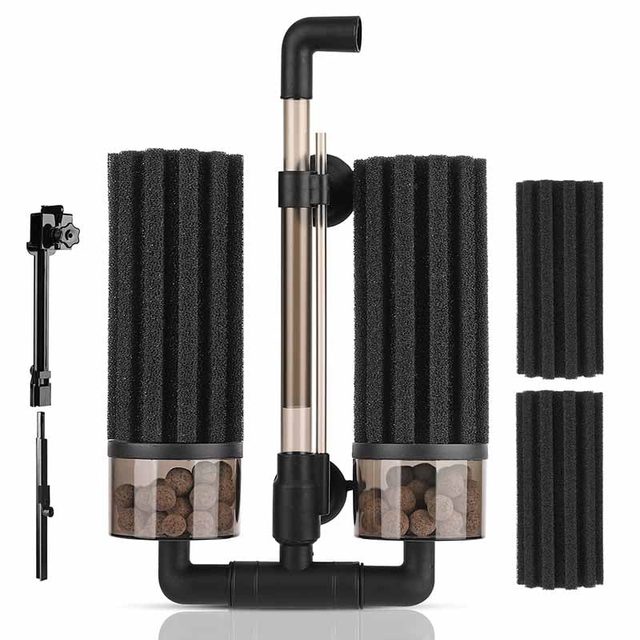
hygger's current HG256 design combines two foam elements with separate media chambers, so it offers more configuration flexibility than a traditional single-sponge filter. The manufacturer lists replaceable sponges, reusable bio-ceramic media, a 360-degree adjustable outlet and both suction-cup and hang-on mounting. The small version is the 10-40 gallon variant represented by this ASIN.
That makes it a strong fit when you want gentle air-driven filtration but still care about media choice and outlet positioning. It does not include an air pump, and the double-sponge body occupies more tank space than a compact single block. Skip it if your priority is the smallest possible in-tank filter or the fewest parts to service.
The strongest all-round researched design here: flexible media, replaceable sponges and adjustable placement without giving up the gentle intake that makes sponge filtration useful.
Check price on Amazon →#2Best simple design
Hikari Bacto-Surge Sponge Filter (Large)
Best for: Keepers who want a proven, uncomplicated sponge filter with clear manufacturer guidance
What we like
- Simple air-driven foam design with few parts to manage
- Highly porous sponge provides mechanical and biological filtration
- Official Large model guidance covers aquariums up to 75 gallons
- Manufacturer publishes detailed setup, cycling and cleaning directions
What we don't
- Requires a separate air pump
- No dedicated media chamber for customizing biological or chemical media
- Large foam block is more visible than a compact corner design
Hikari's Bacto-Surge is the most traditional design in this shortlist. The manufacturer describes it as an air-driven mechanical and biological sponge filter and lists the Large kit for aquariums up to 75 gallons. Hikari also publishes unusually specific setup guidance, including soaking the sponge before installation and cleaning it with aquarium water rather than hot or tap water.
The simplicity is the point: there are no extra media baskets or complicated plumbing to configure. In return, you give up the media flexibility of the hygger and the tucked-away footprint of a corner unit. Choose it when you value a straightforward foam filter with a well-documented care routine; avoid it if you specifically want separate media chambers or a less visible shape.
The best simple traditional option in this group: a large porous foam block, an uplift assembly and unusually clear manufacturer maintenance guidance.
Check price on Amazon →#3Budget pick
AQUANEAT 3 Pack Aquarium Bio Sponge Filter
Best for: Nano tanks, fry or shrimp setups where several small filters or spares are useful
What we like
- Three filters suit multiple nano tanks, breeding setups or spares
- Soft sponge intake is well suited to fry and shrimp applications
- Simple airline-driven setup
- Each small unit is listed for tanks up to 10 gallons
What we don't
- Requires a separate air pump and airline
- Small individual filters are not the right choice for larger or high-waste tanks
- Basic design offers less media flexibility than chamber-style filters

This AQUANEAT pack is useful for a different reason than the larger filters above: it gives you three small sponge filters rather than one more elaborate unit. The current exact variant is sold as the small model, with each filter intended for aquariums up to 10 gallons, which makes the pack relevant to nano tanks, fry grow-out setups, quarantine use or keepers who want a spare ready to seed.
The design is intentionally basic. That keeps cleaning and replacement simple, but it also means there is no separate media chamber and no bundled air pump. Treat the stated tank size as a product-selection boundary rather than permission to overload a small aquarium. Skip this pack for a larger, messy community tank where more mechanical capacity and circulation are priorities.
A practical multi-pack for small tanks and breeding setups, with the main limitation being the modest capacity of each individual filter.
Check price on Amazon →#4Best corner filter
Pawfly Aquarium Corner Sponge Filter
Best for: Small aquariums where preserving open floor and swimming space matters
What we like
- Corner shape uses otherwise awkward tank space
- Layered sponge-and-media design adds biological-media capacity
- Weighted base keeps the filter on the aquarium floor
- Current variant is marketed for small tanks in the 10-30 gallon range
What we don't
- Requires a separate air pump
- More components to disassemble than a single foam block
- Corner placement can make access less convenient in heavily decorated tanks
Pawfly's corner format is useful when a conventional cylindrical or block sponge would occupy visually valuable space. The current B0BZH9PNCW variant uses a corner body with sponge layers and additional media, and the product family is positioned for small aquariums rather than large, high-flow systems.
The trade-off is service access. A layered corner unit has more pieces to remove and rinse than a plain sponge, and it still needs an external air pump. Choose it when the corner footprint solves a real layout problem; avoid it when the simplest possible cleaning routine is more important than space efficiency.
The space-conscious option: it trades the simplicity of a bare sponge block for a corner footprint and layered media arrangement.
Check price on Amazon →#5Best starter kit
Pawfly Aquarium Air Pump + Nano Sponge Filter Kit
Best for: First-time small-tank owners who need both the sponge filter and the equipment to drive it
What we like
- Bundles the air pump and nano sponge filter in one starter setup
- Includes airline and a check valve rather than requiring every air-side part separately
- Useful for first-time small-tank setups
- Compact pump is easier to place than larger multi-outlet models
What we don't
- Nano sponge has less filtration capacity than larger standalone filters
- Bundled pump limits future expansion compared with a stronger adjustable multi-outlet pump
- Not the best choice for a larger or high-waste aquarium

A common first-time sponge-filter mistake is buying the foam unit and only then discovering that an air pump, airline and back-siphon protection are separate parts. This Pawfly kit solves that setup problem by pairing a compact pump with a nano sponge filter, airline and check valve in one product family.
Convenience is the reason to choose it, not maximum filtration capacity. The bundled nano filter is smaller than the standalone picks above, and the compact pump leaves less expansion headroom than a larger adjustable model. It makes most sense as a starter package for a small aquarium; skip it if you already own a suitable pump or plan to drive several filters from one air source.
The easiest path from no aeration equipment to a working nano sponge-filter setup because the essential air-side components are bundled together.
Check price on Amazon →Because a sponge filter is air-driven, it needs a pump even when another aquarium might not; do fish need an air pump? separates equipment requirements from general aeration needs.
If an established sponge filter stops bubbling or its air-lift becomes weak, use the aquarium air pump troubleshooting guide before assuming the sponge filter body itself has failed.
How we researched and scored
PetGearReport has not physically tested these sponge filters. We compared current manufacturer documentation, published specifications, setup requirements, replacement-media information and exact Amazon.com variants. We did not use current Amazon price or customer-star ratings as scoring inputs because both can change independently of the filter’s design.
The 1-10 score shown in the comparison table and product cards is a PetGearReport research score, rounded to the nearest whole number from the weighted categories below:
- Filtration and media design — 30%: sponge area, mechanical/biological design and useful media flexibility.
- Gentle-flow and use-case suitability — 25%: how well the documented design fits shrimp, fry, bettas, breeding or other calm-water use cases.
- Maintenance and serviceability — 20%: access, cleaning complexity and replaceable or reusable parts.
- Setup, adjustability and included accessories — 15%: installation options, airflow/outlet control and whether required air-side components are included.
- Documentation, replacement parts and long-term usability — 10%: clarity of official instructions plus availability of replaceable media or parts where documented.
| Product | Filtration & media 30% | Gentle flow & fit 25% | Maintenance 20% | Setup & accessories 15% | Documentation & parts 10% | Weighted result | Published score |
|---|---|---|---|---|---|---|---|
| hygger Double Biochemical | 9 | 9 | 8 | 8 | 9 | 8.65 | 9/10 |
| Hikari Bacto-Surge Large | 9 | 9 | 9 | 7 | 9 | 8.70 | 9/10 |
| AQUANEAT 3 Pack | 7 | 9 | 8 | 7 | 7 | 7.70 | 8/10 |
| Pawfly Corner | 8 | 9 | 8 | 7 | 7 | 8.00 | 8/10 |
| Pawfly Pump + Nano Filter Kit | 6 | 8 | 8 | 10 | 7 | 7.60 | 8/10 |
The table makes the trade-off explicit: Hikari scores highly because its simple foam design is easy to service and unusually well documented, while the hygger earns the top editorial position because its separate media chambers and adjustable hardware make it the more flexible all-round choice. The Pawfly kit scores lower on filtration capacity but highest on included setup components, which is why it is a starter-kit recommendation rather than the overall winner.
What sponge filters do well
A sponge filter pulls aquarium water through porous foam using air-driven uplift. The foam catches suspended debris while also providing wetted surface area where the aquarium’s biological filter can establish. Because the intake is distributed across the sponge rather than concentrated at a narrow powered intake, this architecture can be useful around small shrimp and fry.
That makes sponge a useful example of one medium doing two jobs; our aquarium filter media guide explains how mechanical, biological and optional chemical media fit together in other filter designs. If you specifically need a separate loose biological stage in another filter architecture, our best biological filter media for aquariums compares four current products without assuming that a mature sponge must be replaced.
The other advantage is maintenance simplicity. Traditional sponge filters have few moving parts inside the tank, and the foam can usually be removed and rinsed in aquarium water when debris begins restricting flow. They are also useful as secondary filters because an established sponge can provide additional biological-media capacity without adding another motorized water pump inside the aquarium.
They are not magic, however. A sponge filter still needs adequate airflow, correct sizing and routine cleaning, and it cannot compensate for unsafe stocking or poor water-change practices. If the tank is new, read our aquarium cycling guide before assuming that installing a filter creates an instant biological cycle.
Coarse vs fine sponge foam
Foam pore size changes the balance between debris capture and resistance to clogging. Finer foam can catch smaller particles but can also load with debris faster. Coarser foam lets larger particles through more readily, but it usually preserves water movement longer between cleanings and is easier to rinse thoroughly.
There is no single best pore size for every tank. Aquarium Co-Op, for example, deliberately uses coarse 25 PPI foam in its current sponge-filter line to emphasize reusable mechanical/biological filtration and easier cleaning. Hikari takes a different approach with its Bacto-Surge line, highlighting a fine porous structure and high bacterial surface area. Those are two legitimate design choices, not proof that one pore density is universally superior.
For a breeding or shrimp tank, prioritize intake safety and reliable biological filtration. For a tank with more visible debris, consider how quickly the chosen foam is likely to clog and how easy it is to access. The filter you will actually service when flow falls is more useful than a theoretically finer medium that is allowed to stay blocked.
How to choose the right size
Start with the exact model’s published aquarium range rather than applying one gallons-per-sponge rule across brands. The products in this guide illustrate why: Hikari sells several Bacto-Surge sizes from nano to much larger aquariums, hygger offers separate HG256 size variants, while the AQUANEAT multi-pack is built around small individual units.
Then consider the actual system. More fish, heavier feeding and messy species create more solid waste and biological load. A long tank can also need more deliberate circulation than a cube of the same volume. If you are deciding whether a sponge filter is enough or whether a powered architecture fits better, use our broader best aquarium filters guide and canister filter vs HOB comparison.
Do not simply add manufacturer gallon ratings together and treat the total as a stocking formula. Multiple sponge filters can add media area and circulation points, but water quality still depends on stocking, feeding, maintenance and an established nitrogen cycle.
Air pump, airline and check valve requirements
Most sponge filters do not move water by themselves. Rising air inside the uplift tube is what draws aquarium water through the foam, which means the filter needs an air source with enough output for the water depth and the number of devices it is driving.
For the first four picks in this guide, plan on a separate air pump and airline. Our aquarium air pump guide compares current pump options if you do not already own one. If the same air source will also run a separate diffuser, our best aquarium air stones guide explains pump-fit, shape and cleaning trade-offs. The Pawfly starter kit is different because it bundles a compact pump, airline, check valve and nano sponge filter.
A check valve is especially important when the pump is positioned below the aquarium waterline. Install it in the correct direction according to the accessory instructions so water cannot easily siphon back toward the pump when power or airflow stops. If the flow is too strong for a betta, fry or shrimp tank, use an adjustable pump, an inline airflow valve, or the filter manufacturer’s supported adjustment method rather than kinking the airline.
When not to choose a sponge filter
A sponge filter is not automatically the right primary filter just because it is gentle and inexpensive. Consider another architecture, or supplemental filtration, when:
- the aquarium produces enough solid waste that a small foam block clogs rapidly;
- you need stronger, deliberately directed circulation across a long tank;
- you want substantial chemical-media capacity or several separated media stages;
- you want most filtration hardware outside the display;
- the livestock and feeding load exceed the exact sponge filter’s documented use case;
- you are unwilling to run and maintain a separate air pump.
For those cases, a HOB or canister may be more suitable. The decision should come from the tank’s requirements, not a blanket rule that one filter architecture is always superior.
Cleaning and maintenance
Clean a sponge filter based on observed flow and debris accumulation, not because a calendar says every sponge must be stripped on the same day. When output falls or the foam is visibly loaded, follow the manufacturer’s instructions for disassembly and rinsing.
Both Hikari and hygger explicitly direct users to clean sponge media with aquarium water. Using water removed during a routine water change is a practical way to do that without exposing established media to untreated tap-water disinfectants. Squeeze or swish out enough debris to restore flow, then reassemble the filter correctly and confirm that air is moving through the uplift tube.
Do not confuse cleaning with replacing all biological media. Some manufacturers publish replacement intervals or sell spare foam, but a fresh sponge starts without the established microbial community of the old one. When replacement is necessary, follow the model-specific instructions for seeding or transition rather than discarding all mature media without a plan. Our aquarium maintenance schedule separates routine filter checks from broader water-change and equipment tasks.
Sponge filter vs HOB or canister
Sponge filters, HOB filters and canisters solve overlapping but different problems.
A sponge filter keeps the intake gentle, has simple in-tank media and uses an external air pump. It is especially attractive for shrimp, fry, breeding, quarantine and calm-water setups when the selected model has enough capacity.
A HOB filter puts a powered filter body on the aquarium rim. It often provides faster access to media and stronger water movement without a separate air pump. If your decision is specifically between these two architectures, our sponge filter vs HOB comparison compares intake behavior, flow, media flexibility and setup hardware directly. A canister filter moves the main media body outside the aquarium and can provide more configurable media capacity and flexible return placement, at the cost of hoses and more involved servicing.
If the choice is specifically between air-driven sponge filtration and an external canister, use our sponge filter vs canister comparison for the capacity, flow, hardware and maintenance trade-offs. If you are choosing between the two powered architectures, our canister filter vs HOB filter guide covers that decision in detail. A sponge filter can also run alongside either one when the additional gentle intake, biological media or redundancy serves a specific purpose.
Sources
Mechanical and maintenance claims on this page are based primarily on current manufacturer documentation. Exact Amazon.com ASINs were cross-checked for the product variants used by the affiliate buttons; price and availability are intentionally not stated because they change.
- hygger — Double Biochemical Sponge Filter HG256
- Hikari — Bacto-Surge Biological Action Sponge Filters
- Aquarium Co-Op — Coarse Sponge Filter
- Pawfly — aquarium products and sponge-filter range
- AQUANEAT — filtration product range
If the livestock decision is specifically about shrimp, use our best filters for shrimp guide, which puts shrimplet intake safety first and compares sponge filtration with guarded HOB and canister options. For Siamese fighting fish, use our best filters for betta fish guide. It separates betta welfare tank sizing from filter product ratings and compares air-driven sponge, adjustable HOB and powered-internal options by current and intake behavior. For axolotls, use the axolotl filter guide, which applies veterinary low-flow guidance and does not assume every ornamental-fish sponge product is suitable for an amphibian.
Frequently asked questions
Do aquarium sponge filters need an air pump?
Most of the sponge filters in this guide are air-driven, so yes: they need a compatible air pump and airline. A check valve is also important when the pump sits below the aquarium waterline because it helps prevent back-siphoning if airflow stops. The Pawfly starter kit is the exception here because it bundles the pump and air-side accessories with the sponge filter.
Can a sponge filter be the only filter in an aquarium?
It can be in a suitably sized, appropriately stocked aquarium, but there is no universal rule. Follow the exact filter manufacturer's tank guidance, consider the aquarium's waste load and circulation needs, and verify performance with regular water testing. A sponge filter does not make overstocking or an uncycled aquarium safe.
Are sponge filters good for shrimp, fry and bettas?
They are often a useful fit because the intake is spread across soft foam and the air-driven flow can be gentle. That can reduce the strong localized suction and current produced by some powered filters. The airflow still needs to suit the livestock, so use an adjustable pump or valve when a very calm tank is required.
How should I clean a sponge filter?
Follow the manufacturer instructions for your model. Hikari and hygger both direct owners to clean sponge media with aquarium water; a practical time to do that is during a water change, using removed tank water. Clean enough debris out to restore flow without treating established biological media as disposable after every service.
Does a sponge filter oxygenate the aquarium?
An air-driven sponge filter moves water by rising bubbles, which also creates surface movement and supports gas exchange. The useful effect comes from water circulation and surface agitation, not from assuming every visible bubble directly dissolves into the water.