Best Aquarium Thermometers: Digital, Probe & Submersible Picks
A separate aquarium thermometer gives you an independent temperature reference instead of asking the heater controller to verify itself. We researched current manufacturer documentation and four exact product identities across external-glass, probe, liquid-crystal strip and floating analog formats. PetGearReport has not physically tested or calibrated these thermometers, so manufacturer accuracy or tolerance figures remain manufacturer specifications rather than PetGearReport measurements.
| Rank | Product | Score | Best for | Link |
|---|---|---|---|---|
| #1 | hygger HG073 External Aquarium Thermometer (Small)Top pick | 9 | Owners who want an external digital display plus recent min/max history without an in-water probe cable | Check price → |
| #2 | Zacro 2-Pack LCD Digital Aquarium ThermometerBest probe value | 8 | Owners who prefer a true in-water probe and want two simple digital units for separate tanks or cross-checking | Check price → |
| #3 | LCR Hallcrest Vertical Liquid Crystal Aquarium ThermometerBest battery-free strip | 7 | Owners who want a simple battery-free external reference without probes, cables or glass thermometer tubes | Check price → |
| #4 | Marina Floating Thermometer with Suction CupBest simple analog | 6 | Owners who want a battery-free in-water reference and do not need digital history or alarms | Check price → |
#1 · Our PickTop pick
hygger HG073 External Aquarium Thermometer (Small)
Best for: Owners who want an external digital display plus recent min/max history without an in-water probe cable
What we like
- Small HG073 variant records minimum and maximum temperature
- External stick-on design keeps wiring and probes out of the aquarium
- Exact marketplace variant lists a 32°F–140°F measurement range
- Replaceable front-access battery
- Current listing covers freshwater and saltwater monitoring
What we don't
- Stick-on placement is less repositionable than a suction-cup design
- The small variant is the min/max-history version, not the larger high/low-alarm version
- Published measurement figures remain manufacturer specifications rather than PetGearReport calibration results
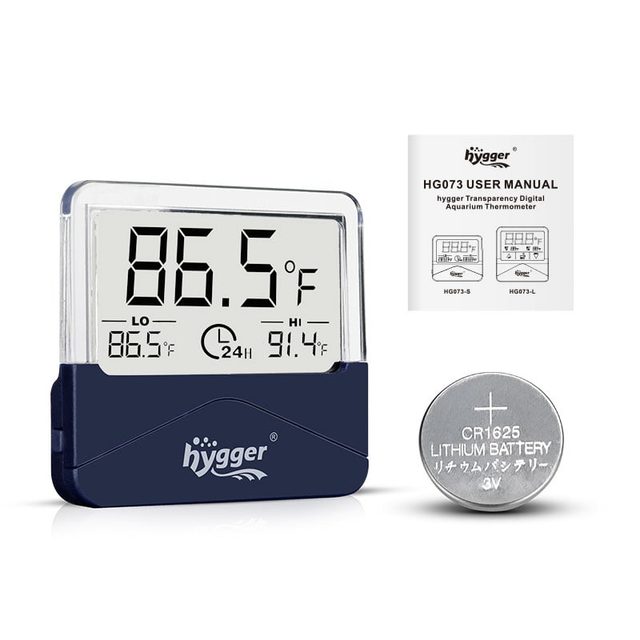
hygger sells the HG073 in more than one format, so variant identity matters. The exact B0C7GDL9J1 Amazon.com listing is the small external version with min/max temperature records, not the larger HG073 version with configurable high/low alarms. Current hygger documentation separates those choices.
The exact small marketplace variant lists a 32°F–140°F measurement range. PetGearReport has not calibrated the unit, so any range or tolerance statement is treated as a manufacturer specification rather than a verified accuracy result. The practical differentiator is the min/max history, which can reveal that the tank moved farther overnight or during the day than the current reading suggests.
The external adhesive format removes a wet probe and cable but makes placement more permanent. Product identity evidence checked September 25, 2026: B0C7GDL9J1 matched hygger HG073 / small min-max-record variant, without freezing current Amazon price or availability.
The strongest all-round fit in this research shortlist: useful min/max history, clear external reading and current exact-variant documentation without adding a wet probe cable.
Check price on Amazon →#2Best probe value
Zacro 2-Pack LCD Digital Aquarium Thermometer
Best for: Owners who prefer a true in-water probe and want two simple digital units for separate tanks or cross-checking
What we like
- Submerged probe measures water while the LCD body stays dry
- Zacro specifies readings to within 1 degree
- Manufacturer lists a -50°C to +70°C sensing range
- Large LCD and suction-cup mounting
- Exact Amazon.com variant includes two thermometer units
What we don't
- Only the probe may be submerged; the display body must remain dry
- Probe cable adds visible routing around the aquarium rim
- No min/max history or configurable alarm
Zacro's current product page is explicit about the installation boundary: submerge the probe, not the thermometer display. It also states readings to within 1 degree, a -50°C to +70°C sensing range and LR44 power. Those are manufacturer specifications, not independent PetGearReport measurements.
The sensor sits in the aquarium water while the larger LCD stays outside. That can be easier to read than a small in-tank scale, but it adds a cable over the rim and another component to position. The exact B01C6PE4G2 Amazon.com variant is a two-pack, useful for two tanks or for keeping a second reference unit.
Product identity evidence checked September 25, 2026: B01C6PE4G2 matched the Zacro two-pack LCD probe thermometer, without freezing current Amazon price or availability.
The clearest wired-probe option here, with explicit manufacturer installation boundaries and two units in the exact two-pack variant.
Check price on Amazon →#3Best battery-free strip
LCR Hallcrest Vertical Liquid Crystal Aquarium Thermometer
Best for: Owners who want a simple battery-free external reference without probes, cables or glass thermometer tubes
What we like
- External liquid-crystal strip requires no battery
- LCR Hallcrest documents aquarium thermometers as outside-glass color-change indicators
- Current exact-product retail data lists a 66–84°F / 19–29°C scale
- Non-toxic, non-corrosive and unbreakable construction is documented by the manufacturer
- Repositionable vertical format
What we don't
- Scale covers a narrower aquarium-oriented range than the digital sensors
- Liquid-crystal color bands are less precise-looking than a numeric LCD
- No history, alarm or room-temperature comparison
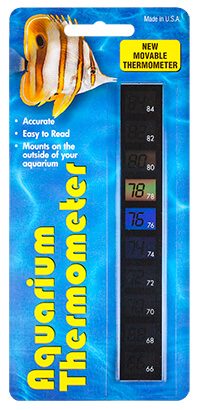
LCR Hallcrest manufactures temperature-sensitive liquid-crystal indicators and has specifically documented its aquarium thermometers as adhesive outside-glass products that change color with temperature. The exact vertical aquarium product represented by ASIN B00ZZR1OW6 is model 43330972; current product data lists a 66–84°F / 19–29°C scale.
The format has no battery, wet probe or fragile glass tube. In exchange, you get a colored scale rather than a large numeric screen, and there is no memory or alarm function. PetGearReport has not calibrated the strip, so we do not convert the color-change scale into an unsupported laboratory-accuracy claim.
Product identity evidence checked September 25, 2026: B00ZZR1OW6 matched LCR Hallcrest model 43330972 / GTIN 00034637309724, without freezing current Amazon price or availability.
A useful low-complexity strip: always on, battery-free and supported by LCR Hallcrest's own liquid-crystal aquarium-thermometer documentation.
Check price on Amazon →#4Best simple analog
Marina Floating Thermometer with Suction Cup
Best for: Owners who want a battery-free in-water reference and do not need digital history or alarms
What we like
- Direct in-water analog reading requires no battery
- Can float or mount to aquarium glass with the suction cup
- Displays Celsius and Fahrenheit
- Exact 11201A1 identity is consistently tied to UPC 015561112017 and the exact affiliate ASIN
What we don't
- Thin analog scale is less glanceable than a large digital display
- Glass construction needs more care during handling
- No current manufacturer numeric tolerance, memory, alarm or room-temperature comparison
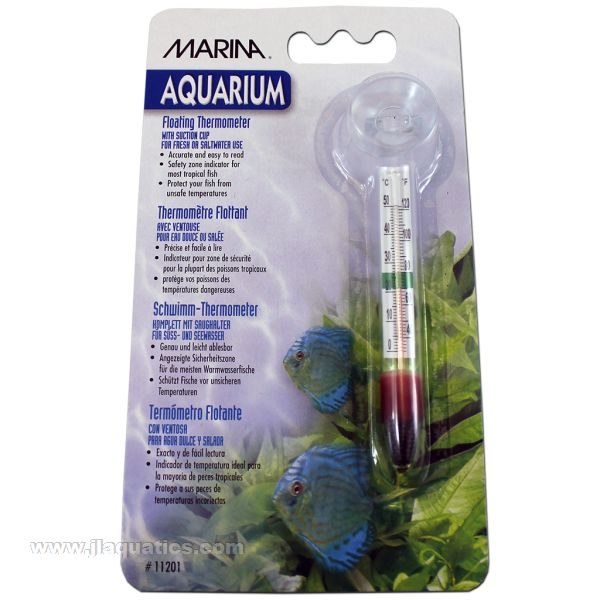
The Marina 11201A1 is the simplest product in this guide. It sits in the water, can float vertically or attach with its suction cup, and provides Celsius and Fahrenheit scales without a battery or electronic display. Current catalog data consistently ties UPC 015561112017 and model 11201A1 to Amazon.com ASIN B0002AQITK.
The scale takes more effort to read, the glass body needs careful handling, and a current first-party numeric tolerance was not available for us to score. That is a documentation limitation, not permission to invent a precision figure.
Product identity evidence checked September 25, 2026: B0002AQITK matched Marina 11201A1 / UPC 015561112017, without freezing current Amazon price or availability.
The deliberately simple in-water baseline: no battery or cable, but less documentation and fewer monitoring features than the higher-ranked options.
Check price on Amazon →How we researched and scored
PetGearReport has not physically tested these aquarium thermometers, calibrated them against a laboratory reference, or measured long-term drift. We compared current manufacturer documentation, exact model identity, published measurement ranges or tolerances where available, sensor placement, display design, monitoring features, battery/service requirements and current public product-identity evidence. We did not use current Amazon price, availability or customer-star ratings as scoring inputs. The displayed 1–10 number is a PetGearReport research score, rounded to the nearest whole number from the same five weighted categories for every thermometer:
- Measurement evidence & documented fit — 30%: current manufacturer range/tolerance information, aquarium-use documentation and how directly the sensor measures the intended environment.
- Placement & installation — 20%: mounting clarity, in-water vs external architecture, cable requirements and how easily the unit can be positioned correctly.
- Readability & daily use — 20%: display size, scale clarity, Celsius/Fahrenheit support and how easy the reading is to check routinely.
- Monitoring features — 15%: useful extras such as room-temperature comparison, min/max memory or alarms when the exact model provides them.
- Documentation & serviceability — 15%: current official instructions, battery access, replacement information and exact model identification.
| Product | Measurement 30% | Placement 20% | Readability 20% | Monitoring 15% | Documentation 15% | Weighted result | Published score |
|---|---|---|---|---|---|---|---|
| hygger HG073 Small | 9 | 8 | 9 | 9 | 8 | 8.65 | 9/10 |
| Zacro 2-Pack | 8 | 7 | 8 | 6 | 8 | 7.50 | 8/10 |
| LCR Hallcrest Vertical | 7 | 9 | 7 | 4 | 8 | 7.10 | 7/10 |
| Marina 11201A1 | 6 | 8 | 6 | 4 | 6 | 6.10 | 6/10 |
The decimals make the method auditable; they are not precise measurements of real-world accuracy. A manufacturer-published tolerance earns evidence credit, but it remains a manufacturer specification and not a PetGearReport calibration result.
Sensor path & evidence matrix
Manufacturer pages rechecked September 25, 2026. The most important comparison is not whether a thermometer is labeled digital or analog. It is where the sensing element sits, what the display actually tells you, and how strong the published measurement evidence is for the exact product.
| Ranked product | Sensor path | Published measurement evidence | Evidence boundary |
|---|---|---|---|
| hygger HG073 Small | Outside-glass electronic sensor | Exact small marketplace variant lists 32°F–140°F; current hygger family material also publishes family-level range/tolerance information | Current HG073 family material and the exact small marketplace listing do not publish the same range, so family and exact-variant figures are kept separate |
| Zacro 2-Pack LCD | In-water wired probe with display body kept dry | Current Zacro page states -50°C to +70°C sensing range and readings within 1 degree | Manufacturer wording does not turn the LCD’s displayed digits into a PetGearReport calibration result |
| LCR Hallcrest Vertical | Outside-glass liquid-crystal strip | Current Hallcrest aquarium page lists a vertical outside-glass format covering 66–84°F; exact marketplace/catalog records identify model 43330972 / ASIN B00ZZR1OW6 | Current manufacturer family data and exact marketplace identity are separate evidence layers |
| Marina 11201A1 | Direct in-water analog glass thermometer | Current catalog identity supports model 11201A1 / UPC 015561112017 / ASIN B0002AQITK, but we did not find a current first-party numeric tolerance | Lack of a current tolerance is scored as an evidence limitation rather than filled with a retailer or inferred precision claim |
This matrix is deliberately conservative. Measurement range is not accuracy. Display resolution is not tolerance. A device can show decimal digits without having a published tolerance that supports those digits, and a wide operating or sensing range does not prove how close a reading is to a reference standard.
HG073: keep family documentation and the exact small variant separate
The HG073 family documentation and the exact small marketplace variant do not publish an identical measurement range. The exact B0C7GDL9J1 small-variant marketplace evidence lists 32°F–140°F, while a current hygger supporting article for the HG073 family lists 32–158°F and separately publishes a family-level tolerance figure.
That difference is material enough that we do not merge those two ranges into one exact-variant specification. The ranked small unit remains tied to the exact marketplace variant’s 32°F–140°F range and min/max-history feature. The broader family page is useful for understanding the HG073 architecture and S-versus-L feature split, but it is not permission to transplant every family-level specification onto the small ASIN.
The same rule applies across the guide: when a current manufacturer family page, an exact marketplace child variant and a catalog record do not expose the same level of detail, the narrower exact-product evidence wins and the missing field stays missing.
Measurement range, display resolution and tolerance answer different questions
- Measurement range tells you the span over which the manufacturer says the device can report a temperature.
- Display resolution tells you the smallest step the screen or scale shows. Display resolution is not tolerance.
- Published tolerance / accuracy describes the manufacturer’s stated closeness to a reference under its own conditions, when such a specification is actually published.
- Sensor path tells you whether the sensing element is directly in the water, connected by a probe, or inferring the water temperature through the aquarium wall.
Those categories should not be collapsed into a single “most accurate thermometer” claim. PetGearReport has not independently calibrated these four products, so a manufacturer-published tolerance earns documentation credit but does not become a hands-on accuracy result.
When two aquarium temperature readings disagree
A mismatch is useful because it tells you the system needs investigation. Do not average the two readings automatically. Two disagreeing instruments can both be affected by placement, response time, circulation or calibration error.
Use a repeatable check:
- Confirm that each device is installed exactly as its manufacturer requires — especially that only a wired probe, not the display body, is submerged when that is the design.
- Give the aquarium time to reach stable circulation and avoid checking immediately after a water change, heater relocation or large room-temperature swing.
- Temporarily compare the two sensors at the same location in the aquarium when their installation format allows it. If the readings converge, the original difference may have been a real temperature gradient rather than an instrument disagreement.
- Move the independent sensor back to a useful monitoring point away from the heater or controller probe and watch whether the difference returns.
- If the disagreement remains material, compare against a known reference or a third thermometer with documented measurement evidence rather than deciding that the higher or lower number must be correct.
- If the aquarium is outside the species-appropriate temperature range or livestock is showing distress, correct the husbandry problem conservatively and investigate the heater/chiller system rather than repeatedly changing set points to chase one display.
PetGearReport has not calibrated the ranked thermometers against a laboratory reference. This workflow is for isolating placement and instrument disagreement, not for assigning a new accuracy specification.
Which thermometer architecture should you choose?
The useful distinction is not simply digital versus analog. It is where the sensor is and what else you have to install.
An external-glass digital thermometer such as the hygger keeps the display and sensing assembly outside the aquarium. A liquid-crystal strip such as the LCR Hallcrest also reads through the aquarium wall but needs no battery. A wired-probe design such as the Zacro keeps the display dry while placing only the sensor in the tank. The Marina is a direct in-water analog reference with no electronics.
None of those architectures is automatically correct for every aquarium. Pick the one you can position, read and maintain consistently.
Published accuracy is evidence, not a lab result
Zacro states readings to within 1 degree for its probe design. The exact hygger HG073 small marketplace variant publishes a measurement range of 32°F–140°F. LCR Hallcrest’s exact vertical aquarium strip is sold with a 66–84°F / 19–29°C aquarium-oriented scale.
Those statements describe published range or reading information, not PetGearReport calibration results. We score documented evidence when it exists and reduce the documentation score when a current numeric tolerance is not available rather than inventing one.
Put the thermometer where it can challenge the heater reading
A heater controller and its own probe are part of the same control loop. The independent thermometer is more useful when it can tell you what is happening elsewhere in the aquarium rather than simply sitting beside the heating element.
When that independent reading shows a persistent mismatch or unsafe trend, use the aquarium heater troubleshooting guide before assuming the heater dial or thermometer is correct.
For heater sizing, use our aquarium heater size guide; for circulation, orientation and probe-position details, use the aquarium heater placement guide. If you are still choosing the heater itself, compare the best aquarium heaters; for smaller tanks, see our best aquarium heaters for 10-gallon tanks, then our best aquarium heaters for 20-gallon tanks, or for larger systems see our best aquarium heaters for 40-gallon tanks, best aquarium heaters for 55-gallon tanks, and best aquarium heaters for 75-gallon tanks, and best aquarium heaters for 90-gallon tanks, plus best aquarium heaters for 125-gallon tanks. If the problem is excess heat rather than insufficient heat, use the aquarium chiller guide to match cooling load, flow and plumbing before choosing active refrigeration. For a same-family heating example, see Fluval T200 vs T300, or compare integrated versus external-probe monitoring in Fluval T200 vs hygger HG802 200W. The thermometer does not make an undersized, incorrectly installed or improperly sized temperature-control system adequate; it tells you whether the installed system is actually holding the intended temperature.
Daily checks matter more than chasing decimal precision
For routine aquarium care, the most valuable reading is often a stable trend plus early detection of a meaningful change. Our aquarium maintenance schedule already includes a daily temperature check because heater failure, room-temperature swings and circulation changes can all move the tank away from its normal range.
Do not treat a tenth-of-a-degree digital display as proof of tenth-of-a-degree real-world accuracy. Display resolution, manufacturer tolerance and actual calibration are different concepts. When two thermometers disagree materially, investigate rather than averaging the numbers automatically.
Exact product identity verification
Product identity evidence checked September 25, 2026, without freezing current Amazon price or availability:
- B0C7GDL9J1 matched hygger HG073 / small min-max-record variant. The current hygger HG073 family page independently confirms the small-versus-large feature split.
- B01C6PE4G2 matched the Zacro two-pack LCD probe thermometer. Zacro’s current product page independently confirms probe-only submersion, the sensing range and the within-1-degree manufacturer statement.
- B00ZZR1OW6 matched LCR Hallcrest model 43330972 / GTIN 00034637309724.
- B0002AQITK matched Marina 11201A1 / UPC 015561112017.
These identity checks keep the affiliate destinations tied to the intended products without treating marketplace availability as a durable specification. No direct Amazon product-page probe was used for this refresh.
Sources
Technical claims on this page prioritize current manufacturer documentation. Public product-catalog records were cross-checked against exact model names and identifiers; current Amazon price and availability are intentionally not treated as editorial evidence.
- hygger — External Aquarium Thermometer — HG073 family and current small min/max versus large alarm variant distinction; supporting current hygger HG073 material is treated as family-level evidence where its range differs from the exact small marketplace child.
- Zacro — LCD Digital Aquarium Thermometer — probe-only submersion, manufacturer range, reading specification and LR44 power.
- LCR Hallcrest / Thermographics — Aquarium thermometer technology — current manufacturer site identifies aquarium thermometers as a consumer application; LCR Hallcrest’s published aquarium launch documentation describes outside-glass, color-change, non-toxic, non-corrosive and unbreakable designs.
- LCR Hallcrest model 43330972 scale and ASIN identity were cross-checked against current exact-product retail/catalog records.
- Marina 11201A1 identity was cross-checked by model number, UPC 015561112017 and Amazon.com ASIN B0002AQITK across current aquarium-retail/catalog records because a current first-party Marina product page for this legacy model was not available.
- PriceHistory — hygger HG073 small product record — public ASIN B0C7GDL9J1 to HG073 small/min-max identity evidence.
- Device.report — Zacro B01C6PE4G2 — public ASIN identity evidence for the two-pack Zacro probe thermometer.
- Yaxa — LCR Hallcrest 43330972 — public ASIN B00ZZR1OW6 to model 43330972 / GTIN 00034637309724 identity evidence.
- Desertcart — Marina Floating Thermometer — public ASIN B0002AQITK to Marina 11201A1 / UPC 015561112017 identity evidence.
A thermometer is the monitoring layer. Use it alongside the aquarium heater guide, heater size guide and maintenance schedule rather than treating any single display as the whole temperature-control system.
Frequently asked questions
Where should I put an aquarium thermometer?
Follow the exact thermometer's installation instructions and place the reading point where it provides a useful independent check of the aquarium rather than simply duplicating the heater controller's sensor location. For a submerged or probe thermometer, a position away from the heating element can help reveal whether water elsewhere in the tank is reaching the intended temperature. External-glass models must be mounted as their manufacturers specify because they infer water temperature through the aquarium wall.
Can I trust the temperature shown on my aquarium heater?
Treat the heater display or thermostat as part of the control system, not as its own independent verification. A separate thermometer gives you a second reference and can expose a mismatch caused by placement, circulation, sensor drift or a heater problem. If readings disagree materially, do not assume either device is correct without further checking.
Are digital aquarium thermometers more accurate than glass thermometers?
Not automatically. Display technology does not prove measurement accuracy. Compare the exact manufacturer's published tolerance or accuracy specification when one exists, and note when a manufacturer does not publish one. PetGearReport has not calibrated the products in this guide, so we do not rank digital formats as inherently more accurate than analog ones.
Do I need more than one thermometer in a large aquarium?
Not as a universal rule. One independent thermometer may be enough when circulation is good and the reading is stable, while a long, partitioned or temperature-sensitive setup can benefit from checking more than one location. The goal is to understand the actual temperature distribution rather than to hit an arbitrary device count.