Best Aquarium Filters for Shrimp: 5 Picks for Gentle Flow & Shrimplet Safety
Shrimp filtration is primarily an intake-safety and gentle-flow decision. Aqueon recommends guarding HOB and canister intakes so shrimp are not drawn into the filter, while OATA emphasizes stable water quality and gentle flow for commonly kept freshwater shrimp. We compared five exact Amazon.com variants already identity-verified in current PetGearReport content. PetGearReport has not physically tested these filters, measured installed current or observed shrimplet survival with them.
| Rank | Product | Score | Best for | Link |
|---|---|---|---|---|
| #1 | hygger HG256 Double Biochemical Sponge Filter (Small)Best overall | 9 | Shrimp tanks in the 10–40 gallon product range where intake safety, gentle circulation and extra biomedia capacity matter | Check price → |
| #2 | AQUANEAT 3 Pack Bio Sponge Filter (Small)Best nano & breeding value | 9 | Nano shrimp tanks, breeding setups and keepers who value multiple small filters or a seeded spare | Check price → |
| #3 | Pawfly Compact Air Pump + Nano Sponge Filter KitBest complete starter kit | 8 | First shrimp setup where the filter, air pump, airline and check valve are all needed in one package | Check price → |
| #4 | Fluval AC20 Power FilterBest adjustable HOB | 9 | Shrimp aquariums inside the AC20 range where a powered HOB is preferred and the intake is protected with a correctly fitted sponge pre-filter | Check price → |
| #5 | Fluval 107 Performance Canister FilterBest larger display canister | 9 | Larger planted or display shrimp aquariums in the 10–30 gallon range that need external media capacity and can protect the intake | Check price → |
#1 · Our PickBest overall
hygger HG256 Double Biochemical Sponge Filter (Small)
Best for: Shrimp tanks in the 10–40 gallon product range where intake safety, gentle circulation and extra biomedia capacity matter
What we like
- Broad dual-sponge intake is naturally shrimplet-friendly
- Small HG256 is documented for 10–40 gallon tanks
- Separate biomedia chambers add flexibility beyond plain foam
- Air-driven architecture avoids a powered intake
- Exact Amazon.com identity already verified in current PetGearReport content
What we don't
- Requires a separate air pump and airline
- Air-pump output is not aquarium water-flow GPH
- Larger in-tank footprint than a compact single sponge
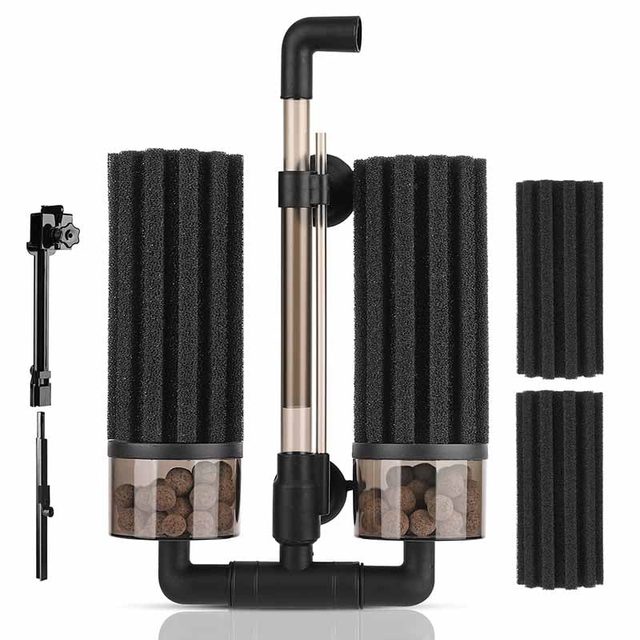
hygger documents the Small HG256 for 10–40 gallon aquariums. Water is drawn through two sponge bodies by air-driven uplift, and the filter includes separate media chambers plus a 360-degree adjustable outlet. The manufacturer also states that an air pump is required and is not included.
For shrimp, the useful design feature is the broad sponge intake rather than a narrow powered intake screen. That architecture reduces the need for a separate intake guard, while the air source can be selected and regulated independently. It still has to be maintained before debris restricts the sponge surface.
Choose the HG256 when its 10–40 gallon range fits and the larger in-tank body is acceptable. For smaller nano shrimp tanks, the more compact options below can be a better physical fit.
The strongest all-round shrimp fit here because the intake is spread across soft foam, the flow is air-driven and the current Small variant adds separate biomedia chambers without a powered suction inlet.
Check price on Amazon →#2Best nano & breeding value
AQUANEAT 3 Pack Bio Sponge Filter (Small)
Best for: Nano shrimp tanks, breeding setups and keepers who value multiple small filters or a seeded spare
What we like
- Soft sponge intake suits baby shrimp and breeding setups
- Three small filters support multiple nano tanks or seeded spares
- Each current small unit is listed for aquariums up to 10 gallons
- Simple air-driven setup has no powered intake motor
- Exact Amazon.com identity already verified in current PetGearReport content
What we don't
- Requires a separate air pump and airline
- No separate media chamber
- Each individual filter has modest mechanical capacity

The exact current AQUANEAT small three-pack is already identity-verified in PetGearReport's production inventory, with each filter positioned for aquariums up to 10 gallons. The architecture is deliberately simple: foam, uplift tube and an external air source.
That simplicity works well for shrimp because there is no narrow powered intake. Aqueon's shrimp guidance specifically notes that air-operated sponge filters are a good choice because shrimp cannot be sucked into them and can graze on biofilm growing on the sponge.
The trade-off is capacity. One small sponge is not a substitute for a larger filter in a heavier-load aquarium. Use the manufacturer's size boundary and actual water tests rather than adding the three gallon ratings together as if they were a stocking formula.
The best small-tank value because the three-pack gives you several simple, soft-intake filters rather than paying for features a nano breeding setup may not need.
Check price on Amazon →#3Best complete starter kit
Pawfly Compact Air Pump + Nano Sponge Filter Kit
Best for: First shrimp setup where the filter, air pump, airline and check valve are all needed in one package
What we like
- Bundles the pump, nano sponge filter, airline and check valve
- Current Pawfly product family covers 3–20 gallon buckets and fish tanks
- Sponge intake avoids a narrow powered suction point
- Useful when no air-side equipment is already owned
- Exact Amazon.com identity already verified in current PetGearReport content
What we don't
- Bundled nano sponge has less media area than larger standalone filters
- Compact pump offers less expansion headroom than a larger adjustable air system
- Air output cannot be compared directly with powered-filter water GPH

Pawfly currently lists a compact air-pump package with a nano bio sponge filter, airline and check valve for 3–20 gallon buckets and fish tanks. PetGearReport's exact Amazon.com variant is already identity-verified.
The key advantage is completeness. A common sponge-filter setup mistake is buying only the foam body and then discovering that the pump, airline and back-siphon protection are separate. This kit avoids that gap while retaining a broad sponge intake.
Do not treat the pump's air-delivery specification as aquarium circulation GPH. Air output and water flow are different measurements, and this page does not convert one into the other.
The easiest complete path from no aeration hardware to a shrimp-safe sponge-filter setup, with less long-term expansion flexibility than choosing the pump separately.
Check price on Amazon →#4Best adjustable HOB
Fluval AC20 Power Filter
Best for: Shrimp aquariums inside the AC20 range where a powered HOB is preferred and the intake is protected with a correctly fitted sponge pre-filter
What we like
- Fluval documents a 5–20 US gallon range
- Adjustable flow control supports lower-output tuning
- Four-stage media path adds more debris and media capacity than a nano sponge
- Rim-mounted basket is easy to access for service
- Exact Amazon.com identity already verified in current PetGearReport content
What we don't
- Powered intake needs an added sponge pre-filter for shrimplet protection
- HOB return is more localized than an air-driven sponge
- Rear-rim installation needs clearance

Fluval specifies the current AC20 for 5–20 US gallons and documents adjustable flow control, four-stage filtration and a serviceable media basket. Those features make it more configurable than a fixed-output cartridge HOB.
For shrimp, however, the powered intake changes the recommendation. Aqueon explicitly advises fitting a sponge pre-filter over HOB and canister intake screens to prevent shrimp from being sucked into the filter. The AC20 therefore belongs on this list only as a guarded-intake option, not as an unmodified shrimplet-safe design.
After adding the intake sponge, monitor it for debris loading because a clogged pre-filter can reduce system flow. Use the AC20's supported flow control to tune the return rather than inventing a universal shrimp turnover target.
The best powered HOB option here because Fluval documents adjustable output and a defined small-tank range, but it only earns a shrimp recommendation when the powered intake is guarded.
Check price on Amazon →#5Best larger display canister
Fluval 107 Performance Canister Filter
Best for: Larger planted or display shrimp aquariums in the 10–30 gallon range that need external media capacity and can protect the intake
What we like
- Fluval documents a 10–30 US gallon range
- 95 US GPH Filter Circulation is published separately from 145 GPH Pump Output
- External canister provides more configurable media capacity
- Return placement can be managed independently from the intake
- Exact Amazon.com identity already verified in current PetGearReport content
What we don't
- Powered intake requires a shrimp-safe sponge pre-filter
- More hoses and service steps than air-driven sponge filtration
- Canister circulation is unnecessary complexity for many nano shrimp tanks
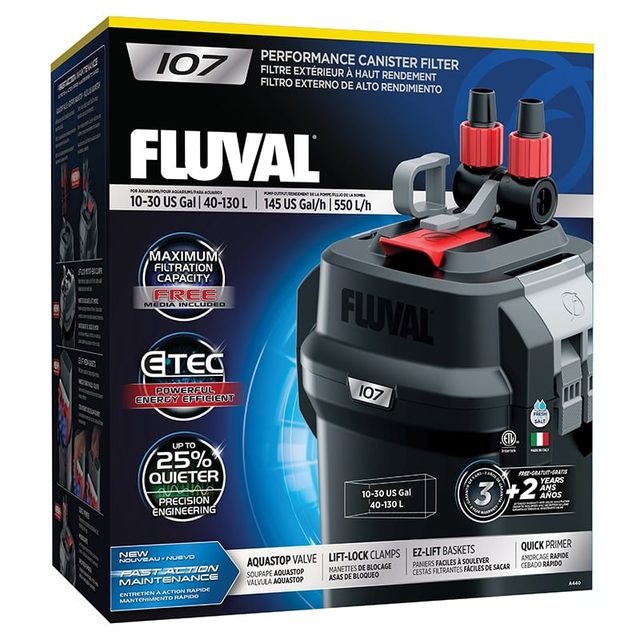
Fluval documents the 107 for 10–30 US gallons and publishes 95 US GPH Filter Circulation separately from 145 GPH Pump Output. Keeping those labels separate matters because this page does not compare unlike hydraulic figures as if they were identical.
A canister can be useful when you want more media outside the display, but the intake must be addressed first. Aqueon's shrimp guidance recommends a sponge pre-filter on canister intakes so shrimp are not drawn into the filter. That is a requirement for this recommendation, not an optional cosmetic add-on.
Use the 107 where its exact range and external-media advantages justify the extra plumbing. For a small breeding tank, a simple air-driven sponge remains the cleaner solution.
The strongest canister option for a larger shrimp display when external media capacity matters, provided the intake is sponge-guarded and the return is positioned for gentle circulation.
Check price on Amazon →Shrimp filter safety at a glance
Aqueon guidance rechecked October 1, 2026: when a hang-on-back or canister filter is used with freshwater shrimp, Aqueon advises sliding a sponge pre-filter over the intake screen to prevent shrimp from being drawn into the filter; its setup guidance identifies air-operated sponge filters as the exception because shrimp cannot be sucked into the intake and can graze on the biofilm. OATA guidance rechecked October 1, 2026: commonly kept freshwater shrimp need good water quality and gentle water flow, so intake protection is only one part of the fit decision.
| Filter architecture | Shrimplet intake safety | Flow / setup implication | Best use on this page |
|---|---|---|---|
| Air-driven sponge | Naturally broad sponge intake; no powered intake | Water movement depends on sponge design, air delivery and placement rather than a published powered-filter GPH figure | Shrimp-only, breeding and nano setups where simple intake safety and gentle circulation are priorities |
| HOB + intake pre-filter | Powered intake must be guarded with a correctly fitted sponge pre-filter | Adjustable HOB flow can be useful, but the intake sponge becomes a maintenance point and the return can still create localized current | Small-to-medium shrimp displays where rim access and reusable media are worth the extra intake safeguard |
| Canister + intake pre-filter | Powered intake must be guarded with a correctly fitted sponge pre-filter | More external media capacity and flexible intake/return placement, with more hoses and service steps | Larger planted/display shrimp tanks where external media capacity justifies the added plumbing |
This matrix does not mean that every sponge filter is automatically large enough for every shrimp aquarium, or that a guarded HOB/canister is automatically gentle enough. Start with the exact manufacturer’s aquarium range, protect any powered intake, then verify the return current and water-quality trend in the actual setup.
How we researched and scored
PetGearReport has not physically tested these filters, measured installed current, counted shrimplet losses or independently measured manufacturer flow figures. We compared current husbandry guidance, manufacturer documentation, existing exact-product identity checks and the filtration architecture of each option. The displayed numbers are PetGearReport research scores, not hands-on results or animal-welfare certifications.
The weighted categories are:
- Shrimplet intake safety & flow management — 35%: how naturally the intake protects very small shrimp and how controllable or diffuse the return can be.
- Filtration & media architecture — 20%: mechanical/biological design, useful media flexibility and debris capacity.
- Tank fit & hydraulic documentation — 15%: exact manufacturer range and clarity of published water-flow labels where applicable.
- Maintenance & serviceability — 15%: access, cleaning burden and how easily intake protection can be kept clear.
- Setup & evidence quality — 15%: required accessories, current documentation and exact variant identity confidence.
| Product | Intake & flow 35% | Filtration/media 20% | Tank/docs 15% | Maintenance 15% | Setup/evidence 15% | Weighted | Score |
|---|---|---|---|---|---|---|---|
| hygger HG256 Small | 10 | 9 | 8 | 8 | 9 | 9.05 | 9/10 |
| AQUANEAT Small 3-Pack | 10 | 7 | 8 | 9 | 8 | 8.65 | 9/10 |
| Pawfly Pump + Nano Kit | 10 | 6 | 8 | 9 | 8 | 8.45 | 8/10 |
| Fluval AC20 | 7 | 10 | 10 | 8 | 10 | 8.65 | 9/10 |
| Fluval 107 | 7 | 10 | 10 | 7 | 10 | 8.50 | 9/10 |
The arithmetic is only one input to the editorial order. The AC20 and Fluval 107 score well because their documentation and media architecture are strong, but both require an added intake sponge before we consider them shrimp-oriented choices. The three air-driven options rank ahead of them because intake safety is built into the architecture rather than added afterward.
Why intake safety is the first filter question for shrimp
Aqueon’s freshwater shrimp care guide recommends sliding a sponge pre-filter over HOB or canister intake screens so shrimp are not sucked into the filter. Its shrimp setup guidance goes further for babies: the intake should be guarded because shrimplets are tiny, while air-operated sponge filters avoid that powered-intake hazard by design.
That makes this buying problem different from a generic best aquarium filters guide. A filter can be excellent at moving water and holding media yet still need modification before it is a sensible shrimp choice.
For a dedicated breeding or nano setup, the simplest safe path is usually a correctly sized air-driven sponge. Our broader best aquarium sponge filters guide compares foam and chamber designs without limiting the decision to shrimp. If the choice is specifically between staying with air-driven sponge filtration and moving to an external canister, the sponge filter vs canister comparison separates intake safety, media capacity, circulation and service complexity before the species-specific safeguards are applied.
Gentle flow without a made-up turnover target
OATA notes that commonly kept freshwater shrimp thrive with gentle water flow and good water quality. That does not justify one universal gallons-per-hour rule for every Neocaridina, Caridina, Amano or mixed shrimp aquarium.
There is no universal turnover target on this page. Flow experienced by the animals changes with tank dimensions, plants, hardscape, return geometry, water level and media loading. Manufacturer gallon ranges are product boundaries, not livestock-density rules.
Air-driven sponge filters add another measurement problem: air-pump output is not aquarium water-flow GPH. We do not convert an air-pump rating into a water-circulation number or compare it directly with Fluval’s published Filter Circulation figure.
Powered HOB and canister filters can still work
A shrimp filter does not have to be a sponge filter. Powered filters become reasonable when their extra media capacity, rim access or external plumbing solves a real need and the intake is made safe.
For the Fluval AC20, add a correctly fitted sponge pre-filter over the powered intake and use the manufacturer’s adjustable flow control to tune the return. The current AC20 is documented for 5–20 US gallons and uses a four-stage media layout. The pre-filter becomes a service item: inspect it often enough that trapped debris does not choke the filter.
If the powered return is still too concentrated, use the aquarium strong-flow troubleshooting guide for supported flow controls, output redirection and diffuser options without using the intake as a throttle.
For the Fluval 107, intake protection is equally important. Fluval documents the canister for 10–30 US gallons and publishes 95 US GPH Filter Circulation separately from 145 US GPH Pump Output. That distinction is preserved here rather than turning every hydraulic label into one fake apples-to-apples leaderboard.
If you use either powered architecture, our best aquarium pre-filter sponges guide explains fit, pore size and the maintenance trade-off introduced by adding foam to the intake.
Size the filter to the aquarium, then check the livestock load
Start with the exact product’s published aquarium range. Our aquarium filter size guide explains why a manufacturer gallon range is a selection boundary rather than a universal turnover or stocking formula.
Then consider the actual aquarium. More feeding, a growing colony and accumulated plant debris all add material the filter has to process. A tiny sponge can be safe at the intake yet still be too limited mechanically for a larger system.
If the tank is new, establish biological filtration before relying on it for livestock. The aquarium cycling guide covers the ammonia → nitrite → nitrate process and why installing a filter does not instantly create a mature biofilter.
Water quality matters more than visible clarity
OATA stresses established biological filtration and regular testing for freshwater shrimp and notes that even small amounts of ammonia or nitrite can be stressful. Do not judge a shrimp filter only by how clear the water looks.
Use the aquarium water parameters guide for the testing framework, then check the requirements of the exact shrimp species you keep rather than assuming one pH, hardness or temperature range fits every Neocaridina, Caridina and Amano setup. Our best aquarium water test kits guide compares practical options for monitoring the nitrogen cycle and other parameters.
Routine service still matters. The aquarium maintenance schedule separates recurring water tests, partial water changes and equipment checks so intake sponges and filter media do not become invisible maintenance debt.
Sponge-filter air supply is part of the system
The first three picks do not move water by themselves. They need an air pump, airline and appropriate back-siphon protection when the pump sits below the waterline. The Pawfly kit bundles those pieces; the hygger and AQUANEAT filters require you to provide them separately.
Use our best aquarium air pumps guide when selecting the air source. Choose enough output for the filter and water depth, then regulate the system for useful circulation without turning the tank into a high-current setup.
Do not rank air pumps by assuming their air-delivery number equals aquarium water circulation. It does not.
Maintenance and biofilm
Sponge filters are attractive in shrimp tanks partly because shrimp can graze on the biofilm that develops on established foam. That does not mean the sponge should never be cleaned. When debris begins to restrict flow, rinse the sponge according to the manufacturer’s directions, preferably using removed aquarium water when the instructions call for preserving established media.
For powered filters with a sponge pre-filter, the intake foam usually loads before the main media. Treat that as a useful sacrificial mechanical stage and clean it before restriction becomes severe. Avoid replacing every mature biological surface at once unless the manufacturer specifically requires it and you have a transition plan.
Sources
Husbandry and technical claims on this page are based on current welfare guidance and manufacturer documentation. Exact Amazon.com ASIN identities were already verified in PetGearReport’s current production inventory on 2026-09-14; this page does not state dynamic Amazon price or availability.
- OATA — How to look after freshwater shrimp and snails
- OATA — How to look after tropical algae eaters
- Aqueon — Freshwater Shrimp Care Guide
- Aqueon — Freshwater Shrimp Aquarium Setup Tips
- hygger — HG256 Double Biochemical Sponge Filter
- Pawfly — aquarium product range
- AQUANEAT — filtration product range
- Fluval — AC20 Power Filter
- Fluval — 07 Series specifications
Frequently asked questions
What type of filter is best for a shrimp tank?
Air-driven sponge filters are often the simplest shrimp-oriented architecture because the intake is spread across foam and baby shrimp cannot be pulled through a narrow powered intake. A powered HOB or canister can also work when the intake is protected with a sponge pre-filter and the return current remains gentle.
Do shrimp need a filter?
A filter is an important part of maintaining stable water quality. OATA recommends established biological filtration and regular testing, while Aqueon advises using mature aquariums and shrimp-safe intake protection. Filtration does not replace cycling, water changes or species-appropriate water parameters.
Do I need a pre-filter sponge for shrimp?
Use one when a powered HOB or canister intake can expose shrimp or shrimplets to concentrated suction. Aqueon specifically recommends a sponge pre-filter over HOB and canister intake screens. Inspect and rinse the pre-filter before accumulated debris restricts system flow.
How much filter flow do shrimp need?
There is no universal turnover target that PetGearReport can defend for every shrimp aquarium. OATA notes that commonly kept shrimp thrive with gentle water flow, while actual circulation depends on tank shape, hardscape, plants, return geometry and filter loading.
Can a sponge filter be the only filter in a shrimp tank?
Yes, when the exact sponge filter, air source, aquarium size and biological load are appropriate. Verify performance with ammonia, nitrite and nitrate testing and service the sponge when debris begins to restrict flow rather than assuming any small sponge is sufficient for every tank.