Best Aquarium Heaters for 90-Gallon Tanks: 4 Picks by Room Temperature & Heating Headroom
A 90-gallon aquarium is large enough that wattage shortcuts become especially risky. We researched four current US-market variants by exact manufacturer tank range, room-to-target temperature guidance, controls, safety protections, physical placement and exact marketplace identity. PetGearReport has not physically tested these heaters, measured recovery time, thermostat drift, installed temperature gradients or long-term durability.
| Rank | Product | Score | Best for | Link |
|---|---|---|---|---|
| #1 | Aqueon Pro Adjustable Heater 300WBest documented 90-gallon fit | 9 | 90-gallon aquariums where you want the clearest current Aqueon catalog match between exact model, tank ceiling and temperature-rise table | Check price → |
| #2 | Fluval E300 Electronic Aquarium HeaterBest digital monitoring & alerts | 9 | 90-gallon owners who value a built-in numeric display and visible temperature alerts without exceeding Fluval's published 100-gallon envelope | Check price → |
| #3 | EHEIM Jager TruTemp 200W Aquarium HeaterBest calibratable conventional dial | 8 | 90-gallon owners who prefer a calibratable conventional heater and whose installation fits EHEIM's documented 300–400 L range | Check price → |
| #4 | hygger HG802 500W Titanium Aquarium HeaterBest external-controller titanium option | 8 | 90-gallon glass aquariums where a titanium tube, external controller and separate sensor fit the installation better than an integrated glass or plastic-bodied heater | Check price → |
#1 · Our PickBest documented 90-gallon fit
Aqueon Pro Adjustable Heater 300W
Best for: 90-gallon aquariums where you want the clearest current Aqueon catalog match between exact model, tank ceiling and temperature-rise table
What we like
- Aqueon's 2025 catalog lists exact Pro 300 model 100532087 up to 100 gallons
- The same catalog's 90-gallon recommendation row specifies 300W at +5°F, +10°F and +15°F above a 68–72°F room
- Adjustable 68–88°F electronic thermostat
- Thermal shatterproof plastic housing
- Automatic over-temperature shut-off
What we don't
- Aqueon's older Pro instructions used lower 90-gallon wattages, so document generation matters
- 15-inch body needs unobstructed submerged placement
- Manufacturer +/- 1°F thermostat figure is not a PetGearReport measurement
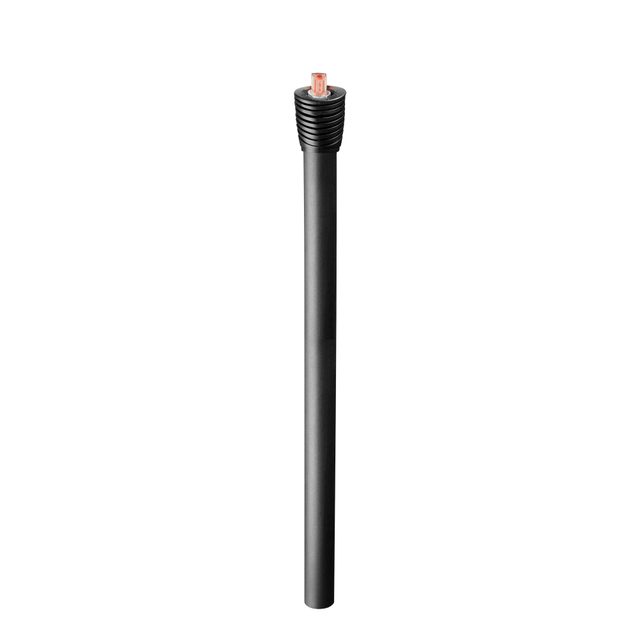
Aqueon's 2025 catalog identifies Pro 300 as SKU 100532087 / UPC 015905000611, 300W, for aquariums up to 100 gallons. Current indexed marketplace metadata maps that exact model and UPC to ASIN B07JDQQ51Q. A 90-gallon aquarium is therefore inside the product's published capacity rather than sitting at its absolute ceiling.
The catalog's heater recommendation table is unusually specific: for a standard 68–72°F room, its 90-gallon row specifies 300W for +5°F, 300W for +10°F and 300W for +15°F above room temperature. Older Aqueon Pro instructions previously listed 200W, 250W and 250W for those same three 90-gallon columns. We use the current 2025 catalog as the primary sizing reference and make the historical mismatch visible rather than silently combining generations.
Aqueon documents an adjustable 68–88°F electronic thermostat, thermal shatterproof housing, over-temperature shut-off and fully submerged installation. Its +/- 1°F thermostat accuracy is a manufacturer specification, not a PetGearReport measurement; verify the aquarium independently after installation.
Our strongest documented starting point because Aqueon's current catalog ties its exact Pro 300 model to both a 100-gallon product ceiling and an explicit 90-gallon 300W recommendation row.
Check price on Amazon →#2Best digital monitoring & alerts
Fluval E300 Electronic Aquarium Heater
Best for: 90-gallon owners who value a built-in numeric display and visible temperature alerts without exceeding Fluval's published 100-gallon envelope
What we like
- Exact E300 is 300W and documented for aquariums up to 100 US Gal / 375 L
- Dual-sensor VueTech system continuously displays water temperature
- Color alerts indicate low, safe-zone and high temperature conditions
- Temperature setting adjusts in 0.5-degree increments
- Integrated fish guard adds physical protection
What we don't
- Fluval publishes a tank-capacity ceiling rather than an Aqueon-style 90-gallon room-delta table
- Built-in display is still part of the same heating system and does not replace an independent thermometer
- 14-inch body needs suitable submerged mounting space

Fluval identifies the E300 as Item A774 / UPC 015561107747, a 300W electronic heater for aquariums up to 100 US Gal / 375 L. Safe indexed product records map that exact A774 identity to ASIN B001VMSK0I. This ASIN previously appeared on PetGearReport under a mismatched T300 label and was correctly replaced there; it is the appropriate identity for the E300 itself.
Fluval documents dual-sensor VueTech microprocessor monitoring, a continuously displayed water temperature, 0.5-degree setting increments and screen colors that indicate low, safe-zone and high temperature conditions. The E300 also includes an integrated fish guard and is listed for freshwater and saltwater aquariums.
Unlike Aqueon's 2025 catalog, Fluval's E300 page does not publish a dedicated +5°F / +10°F / +15°F row for 90 gallons. Treat the 100-gallon ceiling as one boundary, then verify the installed tank under its actual room conditions with an independent thermometer.
The monitoring-first choice: exact 100-gallon capacity, dual sensors, a digital display and visible high/low alerts, but no model-specific 90-gallon room-delta table.
Check price on Amazon →#3Best calibratable conventional dial
EHEIM Jager TruTemp 200W Aquarium Heater
Best for: 90-gallon owners who prefer a calibratable conventional heater and whose installation fits EHEIM's documented 300–400 L range
What we like
- EHEIM documents thermocontrol 200 for approximately 300–400 L
- 90 US gallons is about 341 L and sits inside that manufacturer envelope
- 18–34°C adjustable range
- Manufacturer publishes ±0.5°C control accuracy and ±2°C recalibration
- Thermo Safety Control provides automatic dry-run shut-off
What we don't
- Long 406 mm / about 16-inch glass body needs careful physical placement
- No digital water-temperature display
- Published control accuracy is a manufacturer specification, not a PetGearReport measurement
- Do not import another brand's wattage or room-delta rule just because this model is 200W
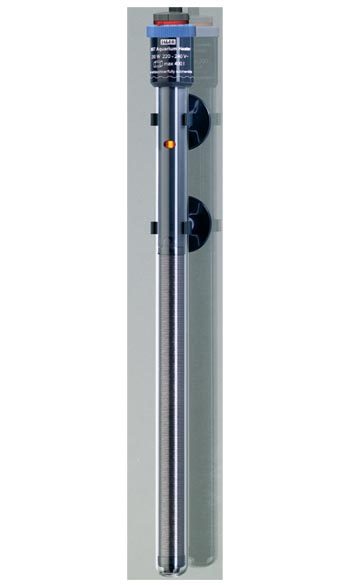
EHEIM identifies thermocontrol 200 as product number 3617010 / EAN 4011708361214. The manufacturer lists 200W, approximately 300–400 L, an 18–34°C setting range, ±2°C recalibration, ±0.5°C control accuracy, full submersion and Thermo Safety Control dry-run shut-off. Safe indexed marketplace evidence maps the 200W Jager/thermocontrol variant to ASIN B001MZYLIE.
Ninety US gallons is roughly 341 L, which sits inside EHEIM's documented 300–400 L envelope. That is materially different from saying every 200W heater is appropriate for 90 gallons. It shows why exact model documentation matters more than a cross-brand watts-per-gallon shortcut.
The 406 mm / roughly 16-inch body is the longest conventional rod in this shortlist, so measure the intended submerged location before buying. EHEIM's published accuracy and calibration figures remain manufacturer specifications; use a separate thermometer elsewhere in the aquarium as the independent check.
The strongest counterexample to a universal wattage rule: only 200W, yet EHEIM explicitly documents this exact model for roughly 300–400 L, which contains a 90-gallon tank.
Check price on Amazon →#4Best external-controller titanium option
hygger HG802 500W Titanium Aquarium Heater
Best for: 90-gallon glass aquariums where a titanium tube, external controller and separate sensor fit the installation better than an integrated glass or plastic-bodied heater
What we like
- Manufacturer HG-802 chart lists the 500W variant for 60–120 gallon / 273–545 L aquariums
- Titanium heating tube avoids a glass heater body
- External digital controller and separate temperature sensor
- Manufacturer directs the sensor away from the heater and the heater into useful circulation
- 12.3-inch heating tube is relatively compact for this capacity
What we don't
- 500W is not automatically better than a lower-wattage model whose exact manufacturer range already includes 90 gallons
- Manufacturer says not to use the heater without its controller
- Manufacturer advises against acrylic or plastic tanks
- Controller/probe system adds components and cable management
hygger identifies this family as model HG-802 and publishes 500W for aquariums from 60–120 gallons / 273–545 L. Safe indexed marketplace records map the exact 500W / 60–120 gallon variant to ASIN B07QQRYN7Z. A 90-gallon tank sits near the middle of that manufacturer range.
The HG-802 uses a titanium heating tube, an external digital controller and a separate temperature sensor. hygger instructs users to keep the heater fully submerged, place the sensor away from the heater, maintain circulation, and install the heating tube horizontally near intake or flowing water. It also says the heater should not be used without the digital controller and advises against acrylic or plastic tanks.
The manufacturer publishes its own broad wattage-per-gallon shorthand, but PetGearReport does not generalize that ratio across brands. The defensible evidence here is the exact HG-802 500W model's 60–120 gallon range and installation instructions, not the idea that every 90-gallon aquarium needs 500W.
A valid 90-gallon fit inside hygger's 60–120 gallon HG-802 envelope, but the 500W rating is a product-specific design choice rather than proof that higher wattage is inherently better.
Check price on Amazon →How we researched and scored
PetGearReport has not physically tested these heaters, measured recovery time, thermostat drift, installed temperature gradients or long-term durability. We compared current manufacturer documentation, exact identifiers, indexed marketplace identity, documented 90-gallon fit, ambient-temperature guidance where available, controls, safety features, physical placement and service documentation. Current Amazon prices, stock, star ratings, review counts and popularity were not scoring inputs.
Each product receives a PetGearReport research score, not a hands-on or customer rating:
- 90-gallon fit & ambient-delta headroom — 30%
- Temperature control & monitoring — 25%
- Safety protections — 20%
- Physical fit & circulation — 15%
- Documentation & exact identity — 10%
| Heater | 90-gal fit 30% | Control 25% | Safety 20% | Fit/circulation 15% | Docs/identity 10% | Weighted | Score |
|---|---|---|---|---|---|---|---|
| Aqueon Pro 300W | 10 | 9 | 9 | 7 | 10 | 9.10 | 9/10 |
| Fluval E300 | 9 | 10 | 8 | 8 | 10 | 9.00 | 9/10 |
| EHEIM thermocontrol 200 | 9 | 9 | 8 | 5 | 10 | 8.30 | 8/10 |
| hygger HG802 500W | 9 | 9 | 7 | 8 | 8 | 8.35 | 8/10 |
The score does not reward raw wattage. The hygger 500W is not promoted above the 200W EHEIM merely because its electrical rating is larger. Editorial rank also considers how directly the manufacturer documents a 90-gallon fit and how much interpretation the installation requires.
Quick decision: exact model first, then room conditions
| Situation | Best fit here | Why |
|---|---|---|
| Strongest documented 90-gallon starting point | Aqueon Pro 300W | 100-gallon model ceiling plus explicit 2025 catalog 90-gallon 300W row |
| Prefer numeric display and high/low alerts | Fluval E300 | 100-gallon ceiling, dual sensors, digital display and VueTech alerts |
| Prefer a calibratable conventional dial | EHEIM thermocontrol 200 | Exact 300–400 L manufacturer range contains a 90-gallon tank |
| Prefer titanium tube + external controller | hygger HG802 500W | Exact 500W variant is documented for 60–120 gallons |
If you have not calculated the room-to-target difference yet, use our aquarium heater size guide first. You can also use the aquarium heater size calculator to calculate the delta and check current Aqueon published rows without interpolating a generic wattage. For broader heater architectures, compare the best aquarium heaters. The 75-gallon heater guide shows how product ceilings and room-temperature guidance shift one size down, while Fluval T200 vs T300 demonstrates why wattage steps inside one family still need an exact tank-fit check.
Current and historical Aqueon guidance do not agree
Aqueon’s 2025 product catalog gives a simple current answer for its own range: the 90-gallon row shows 300W at +5°F, 300W at +10°F and 300W at +15°F above a standard 68–72°F room. The same catalog lists Pro 300 model 100532087 for aquariums up to 100 gallons.
Older Aqueon Pro instructions previously showed 200W at +5°F, 250W at +10°F and 250W at +15°F for 90 gallons. A separate Aqueon wattage guideline also maps 300W to a broad 65–90 gallon band. Those documents illustrate why publication date and exact product generation matter. This guide follows the 2025 catalog for the current Aqueon recommendation and tells readers to follow the instructions supplied with the exact heater if they differ again.
Why 200W, 300W and 500W can all appear on a 90-gallon shortlist
At first glance, a shortlist spanning 200W to 500W looks inconsistent. It is actually the point of the comparison.
EHEIM documents thermocontrol 200 for approximately 300–400 L. Fluval documents E300 at 300W up to 100 US gallons / 375 L. Aqueon documents Pro 300 up to 100 gallons and separately gives its own 90-gallon recommendation row. hygger documents the 500W HG-802 variant for 60–120 gallons.
Those are different product architectures and different manufacturer sizing methods. The watt number alone cannot tell you which control system, tank envelope, physical size or installation constraints apply. Do not import Aqueon’s room-delta table into EHEIM, Fluval or hygger documentation.
Physical fit and circulation matter at 90 gallons
A larger tank does not make heater placement automatic. Fluval lists the E300 body at 14 inches / 35.5 cm. Aqueon’s Pro 300 is about 15 inches. EHEIM lists thermocontrol 200 at 406 mm, roughly 16 inches. hygger lists the 500W HG-802 heating tube at 12.3 inches, plus its controller and separate sensor cables.
Measure the actual unobstructed submerged location after accounting for substrate, hardscape, filter intakes and the normal water line. Follow each model’s permitted orientation. Position the heater where useful circulation can distribute heat through the aquarium rather than creating a warm local pocket.
For the filtration side of the same tank-size decision, our 90-gallon aquarium filter guide compares flow and media capacity separately. Heater wattage and filter flow solve different problems even though both depend on tank layout.
One heater versus two is a design decision, not a 90-gallon rule
Two heaters can provide optional redundancy or distribute heat across a long aquarium, but they are not automatically required at 90 gallons. Aqueon’s current catalog first moves to an explicit two-heater recommendation at the 120/125-gallon row rather than at 90 gallons.
If you choose two smaller heaters anyway, size the combined system deliberately. Consider what happens if one stops heating and what happens if one remains on when it should not. Two devices mean two thermostats and two failure points as well as potential redundancy.
Always verify with an independent thermometer
The heater’s dial, digital display, thermostat or external probe is part of the heating system. It is not an independent audit of water elsewhere in a 90-gallon aquarium. Use a separate thermometer positioned away from the heating element or control probe so you can detect a meaningful mismatch or poor circulation.
Our aquarium thermometer guide compares monitoring formats. Add the temperature check to the aquarium maintenance schedule so seasonal room changes and heater behavior are more likely to be noticed early.
Sources
- Aqueon — 2025 Product Catalog — Pro 300 model 100532087 / UPC 015905000611, 100-gallon ceiling and 90-gallon 300W recommendation row.
- Aqueon — Pro Adjustable Heater — Pro-family thermostat range, manufacturer accuracy claim, housing and over-temperature shutoff.
- Aqueon — older Pro Heater instructions — historical 90-gallon 200W / 250W / 250W row used only to explain the documentation mismatch.
- Fluval — E300 Electronic Heater — Item A774 / UPC 015561107747, 300W, 100-gallon ceiling, digital monitoring, alerts and dimensions.
- EHEIM — thermocontrol 200 — product 3617010 / EAN 4011708361214, 200W, approximately 300–400 L and calibration/safety specifications.
- hygger — HG802 Titanium Aquarium Heater — HG-802 family, 500W 60–120 gallon variant, controller/sensor architecture and installation instructions.
Frequently asked questions
What wattage heater do I need for a 90-gallon aquarium?
There is no one cross-brand wattage answer. Aqueon's 2025 catalog lists 300W across its +5°F, +10°F and +15°F 90-gallon columns, EHEIM documents thermocontrol 200 at 200W for approximately 300–400 L, Fluval rates E300 at 300W up to 100 gallons, and hygger rates HG-802 500W for 60–120 gallons. Follow the exact model's manufacturer guidance.
Is a 300W heater enough for a 90-gallon tank?
It can be when the exact model is documented for that tank and room condition. Aqueon's 2025 catalog explicitly uses 300W for its 90-gallon row, and Fluval rates E300 up to 100 gallons. That does not make every 300W heater interchangeable.
Can a 200W heater work in a 90-gallon aquarium?
EHEIM's exact thermocontrol 200 is documented for approximately 300–400 L, which contains about 341 L / 90 US gallons. That is model-specific evidence, not a rule that any 200W heater is suitable for 90 gallons.
Do I need two heaters in a 90-gallon aquarium?
Not automatically. Two heaters can be an optional redundancy or heat-distribution strategy, but they are not a universal 90-gallon requirement. Aqueon's current catalog does not move to an explicit two-heater recommendation until the 120/125-gallon row. If you use two, size the combined system deliberately and consider both failure directions.
Do I need a separate thermometer with a 90-gallon heater?
Yes. A heater display, thermostat or external controller is part of the same control system. Use an independent thermometer away from the heating element or probe so you can verify temperature elsewhere in the aquarium and detect circulation or control problems.