Best Aquarium Heaters: 5 Picks by Tank Size, Controls & Safety
Aquarium heater sizing is not just a watts-per-gallon calculation. We researched the exact Amazon.com variants in this shortlist against current Fluval, EHEIM and hygger manufacturer documentation, then compared their documented temperature controls, safety protections, sizing envelopes, monitoring and serviceability. PetGearReport has not physically tested these heaters or measured their temperature stability. Start with the manufacturer's tank range, then account for the difference between room temperature and your species-appropriate target, water circulation and an independent thermometer.
| Rank | Product | Score | Best for | Link |
|---|---|---|---|---|
| #1 | Fluval T300 Fully Electronic Aquarium HeaterTop pick | 9 | Aquariums within the T300's documented sizing envelope where visible heating status and integrated safety features matter | Check price → |
| #2 | Eheim Jager TruTemp 250W Aquarium HeaterBest calibratable dial | 9 | Large aquariums in the documented 400–600 L range where a calibratable manual control is preferred | Check price → |
| #3 | hygger 200W Titanium Aquarium Heater with External Controller | 9 | 20–45 gallon setups that benefit from an external controller, separate probe and titanium heating element | Check price → |
| #4 | Fluval T200 Fully Electronic Aquarium HeaterMid-size Fluval pick | 9 | Aquariums up to the documented 65-gallon envelope that need the current T-Series electronic controls and safety features without stepping up to 300W | Check price → |
| #5 | hygger HG096 150W Mini Aquarium Submersible HeaterSmall-tank pick | 8 | Small aquariums within the exact 150W HG096 model's documented 16–26 gallon range | Check price → |
Specifications compared
Published specs are available for 2 of 5 picks in this review; the rest are not shown because no manufacturer specs are published for them yet.
| Spec | Fluval T300 Fully Electronic Aquarium Heater | hygger 200W Titanium Aquarium Heater with External Controller |
|---|---|---|
| Max tank size (gal) | 80 | 45 |
| Power draw (W) | 300 | 200 |
| Dimensions | 14 in long | 10.7 in long |
Compare top picks
#1 · Our PickTop pick
Fluval T300 Fully Electronic Aquarium Heater
Best for: Aquariums within the T300's documented sizing envelope where visible heating status and integrated safety features matter
What we like
- 300W model is documented for aquariums up to 80 US gal / 300 L
- Electronic control with a 360-degree red/blue status ring
- Automatic power cut-off when the heater detects an absence of water
- Integrated heater guard adds physical protection
What we don't
- No numeric water-temperature display
- Fluval does not publish a numeric control-tolerance figure for the T300 on its current product page
- Fluval says additional capacity may be needed when room-to-set temperature difference exceeds 10°F / 6°C
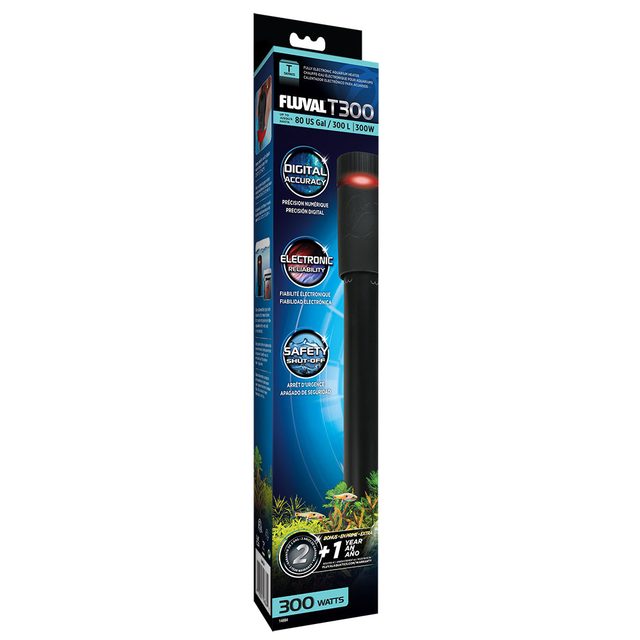
The exact T300 variant here is the 300W model that Fluval specifies for aquariums up to 80 US gallons / 300 L. Its strongest documented differentiator is monitoring: the 360-degree indicator ring is red while heating and blue when the desired setting is reached, so operating state is easier to see than on a basic dial heater. Fluval also documents automatic power cut-off when the heater is out of water and an integrated guard intended to reduce breakage risk.
Those features do not make the heater self-verifying. The T300 does not display a numeric water-temperature reading, and Fluval's current product page does not give a numeric control-tolerance specification for this model. Use a separate thermometer away from the heater to verify the aquarium rather than treating the status ring as an independent measurement.
Sizing also depends on ambient conditions. Fluval states that if room temperature is more than 10°F / 6°C below the heater's set temperature, additional heating capacity may be necessary. That is why this guide treats the 80-gallon ceiling as a manufacturer envelope rather than a guarantee for every 80-gallon installation.
Our top research pick for its combination of documented electronic control, visible status monitoring and safety protections, while still requiring an independent thermometer and correct sizing for room conditions.
Check price on Amazon →#2Best calibratable dial
Eheim Jager TruTemp 250W Aquarium Heater
Best for: Large aquariums in the documented 400–600 L range where a calibratable manual control is preferred
What we like
- EHEIM specifies the 250W thermocontrol for approximately 400–600 L
- Temperature can be set from 18–34°C and recalibrated by ±2°C
- Manufacturer publishes control accuracy of ±0.5°C
- Thermo Safety Control provides dry-run shut-off
- EHEIM lists the laboratory-glass heater for both fresh and marine water
What we don't
- No digital temperature display
- Long 250W body needs enough unobstructed mounting space
- Published control accuracy is a manufacturer specification, not a PetGearReport measurement
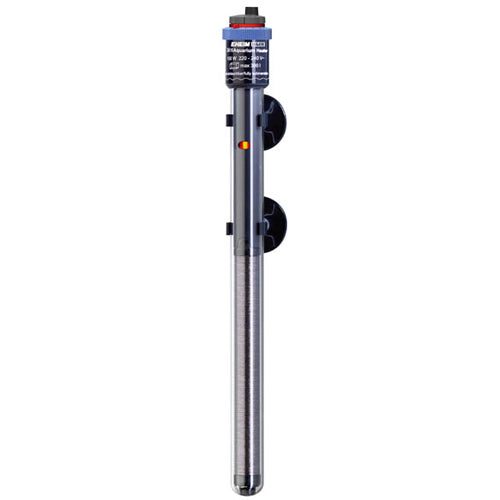
The 250W EHEIM thermocontrol has a very different documented sizing envelope from the one previously shown on this page. EHEIM specifies this model for aquariums of approximately 400–600 L, not 40–65 US gallons. That manufacturer range is the starting point for sizing this exact variant.
Its main advantage is the amount of control information EHEIM actually publishes. The temperature is adjustable from 18–34°C, the control can be recalibrated by ±2°C, and EHEIM states a control accuracy of ±0.5°C. Those are manufacturer specifications; PetGearReport has not independently measured them. A separate aquarium thermometer remains useful for checking the installed system rather than assuming the dial and water at the far end of the tank always agree.
EHEIM also documents automatic dry-run shut-off, full submersion, special laboratory glass and suitability for both freshwater and marine aquariums. That last point matters because glass construction by itself is not a reason to exclude a heater from saltwater use: compatibility should follow the specific manufacturer's documentation.
The strongest documented calibratable-dial option here: EHEIM publishes both a recalibration range and a control-accuracy specification for the thermocontrol line.
Check price on Amazon →#3
hygger 200W Titanium Aquarium Heater with External Controller
Best for: 20–45 gallon setups that benefit from an external controller, separate probe and titanium heating element
What we like
- Exact HG802 200W model is documented for 20–45 gal
- Titanium heating element avoids a glass heater tube
- Separate external controller and temperature probe display current and set temperature
- hygger directs installation where water current is strong
- Manufacturer documents automatic shut-off at the selected temperature
What we don't
- External controller and separate probe add installation complexity
- Heater and probe both need correct submersion and placement
- Manufacturer specifically says this model is not suitable for turtle tanks because it has no protective cover

The exact HG802 variant represented by this ASIN is the 200W titanium model, which hygger lists for 20–45 gallon aquariums. The manufacturer instructs users to place it where water current is strong so heat can circulate through the aquarium; that makes placement part of heater performance rather than an afterthought.
The external controller shows current and set temperature and works with a separate in-water probe. hygger publishes its own accuracy claim for this controller, but our score treats that as manufacturer documentation rather than an independent PetGearReport result. The split layout is useful because the controls remain outside the tank, although it also means there are more components to position correctly.
Titanium removes the glass heater tube, but that does not make the product appropriate for every physically demanding setup. hygger specifically warns that the HG802 lacks a protective cover and is not suitable for turtle tanks. We therefore recommend it based on its documented 20–45 gallon envelope, controller/probe design and corrosion-resistant titanium construction rather than calling it unbreakable or universally safer.
The most monitoring-oriented titanium option in this shortlist, with a separate probe and controller, but it needs careful placement and is not a universal choice for every high-impact tank.
Check price on Amazon →#4Mid-size Fluval pick
Fluval T200 Fully Electronic Aquarium Heater
Best for: Aquariums up to the documented 65-gallon envelope that need the current T-Series electronic controls and safety features without stepping up to 300W
What we like
- Exact T200 is 200W and documented for aquariums up to 65 US gal / 200 L
- Electronic control with 360-degree red/blue status ring
- Automatic power cut-off when the heater detects an absence of water
- Integrated heater guard adds physical protection
- Fully submersible with vertical or horizontal placement
What we don't
- No numeric water-temperature display
- Fluval does not publish a numeric control-tolerance figure for the T200 on its current product page
- Fluval says additional capacity may be needed when room-to-set temperature difference exceeds 10°F / 6°C
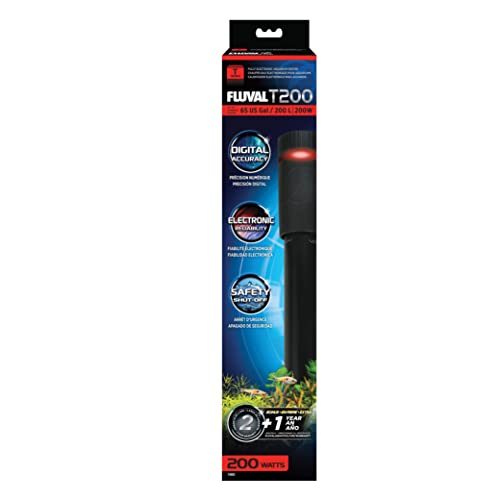
Fluval identifies the current T200 as Item # 14883 / UPC 015561148832. It is a 200W fully electronic heater that Fluval specifies for aquariums up to 65 US gallons / 200 L. The exact Amazon.com variant used here is ASIN B0B1SW81L2, which was live when re-verified on September 9, 2026.
The T200 uses the same core T-Series control architecture as the T300: a 360-degree indicator ring that is red while heating and blue when the desired setting is reached, automatic power cut-off when the heater detects an absence of water, and an integrated heater guard. Fluval lists a 72–90°F / 22–32°C adjustment range and allows fully submerged vertical or horizontal placement.
The status ring is not an independent numeric thermometer, and Fluval's current product page does not publish a numeric control-tolerance specification for the T200. Use a separate thermometer elsewhere in the aquarium. Fluval also says T-Series installations may need additional heating capacity when ambient room temperature is more than 10°F / 6°C below the set temperature, so the 65-gallon ceiling is a manufacturer sizing envelope rather than a guarantee for every room condition.
The current mid-size Fluval choice: the T200 keeps the T-Series status ring, dry-run protection and heater guard in a 200W model with a 65-gallon manufacturer ceiling.
Check price on Amazon →#5Small-tank pick
hygger HG096 150W Mini Aquarium Submersible Heater
Best for: Small aquariums within the exact 150W HG096 model's documented 16–26 gallon range
What we like
- Exact 150W HG096 variant is documented for 16–26 gal
- Digital controller displays water temperature and allows adjustment
- Compact format is intended for smaller aquariums
- Manufacturer documents over-temperature and out-of-water safety functions
What we don't
- The 16–26 gallon range is much narrower than the 300W model in the same product family
- Display is not a substitute for an independent thermometer
- Exact safety behavior and placement instructions should be followed from the current manual
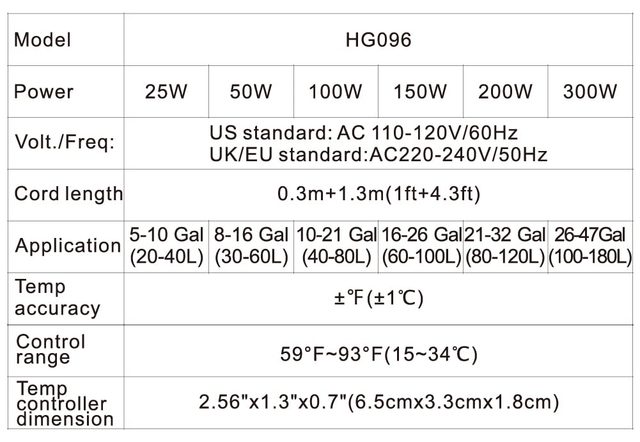
The exact B0CJJ73MJT marketplace variant is the HG096 150W model. hygger's current sizing chart lists that version for 16–26 gallon aquariums; the 300W model in the same family is the one listed for 26–47 gallons. The previous copy mixed those series-level capacities, so this recommendation now stays tied to the exact 150W variant.
The HG096 uses a compact submersible heating body with a digital controller. That makes set-point changes and status easier to see than on a plain mechanical dial, but an electronic display still should not be the only temperature reference in the aquarium. An independent thermometer in a different part of the tank provides a second reading and helps reveal circulation or placement problems.
This is therefore the small-tank option rather than a general budget heater for tanks approaching 50 gallons. If your aquarium is outside the documented 16–26 gallon envelope, select a heater whose exact wattage and manufacturer range match the installation instead of extrapolating from this model.
A compact controlled heater for 16–26 gallon tanks; the key is buying and sizing the exact 150W variant rather than borrowing specifications from the larger HG096 models.
Check price on Amazon →Quick decision table: tank range, controls and safety
Use this table as a first-pass fit screen, not as a substitute for the exact heater manual. The manufacturer tank range is only the starting envelope: confirm the coldest realistic room-to-target temperature difference, water circulation, physical placement and an independent thermometer before relying on the installed system.
| Heater | Exact wattage | Manufacturer tank range | Control / display | Physical / safety protection | Best fit | Avoid if |
|---|---|---|---|---|---|---|
| Fluval T300 | 300W | Up to 80 US gal / 300 L | Electronic dial; red/blue status ring | Dry-run power cut-off; integrated heater guard | Medium-large tanks inside Fluval’s envelope where integrated protection and visible heating status matter | You need a numeric water-temperature display or the room-to-set rise exceeds Fluval’s published guidance without added capacity |
| EHEIM thermocontrol 250 | 250W | Approx. 400–600 L / 106–159 US gal | Calibratable mechanical control; on/off indicator | Thermo Safety Control dry-run protection; laboratory-glass body | Large tanks that physically fit the long heater and benefit from EHEIM’s documented range and recalibration | You need a digital display or a shorter heater body |
| hygger HG802 200W | 200W | 20–45 gal | External controller plus separate temperature probe/display | Titanium heating tube; automatic stop at set temperature; no protective cover | Tanks inside 20–45 gal where external controls and a separate probe are useful | The heater can be struck or contacted by animals such as turtles, or you want an integrated guarded design |
| Fluval T200 | 200W | Up to 65 US gal / 200 L | Electronic dial; red/blue status ring | Dry-run power cut-off; integrated heater guard | Mid-size tanks that fit Fluval’s envelope and benefit from the T-Series integrated architecture | You need a numeric water-temperature display or the room-to-set rise exceeds published guidance without added capacity |
| hygger HG096 150W | 150W | 16–26 gal | External digital controller/display | Out-of-water and over-temperature protection documented by hygger | Smaller tanks inside the exact 150W model’s published range | Your tank falls outside the 16–26 gal envelope or you are using a different HG096 wattage and assuming the same sizing |
The table intentionally does not rank heaters by claimed real-world reliability, failure rate or measured temperature stability. PetGearReport has not run controlled longevity, thermal-recovery or fault testing on these units.
Start with the manufacturer’s sizing envelope
A heater’s wattage and tank-volume label are a starting envelope, not a promise that every aquarium of that size will reach the same temperature. The room-to-target temperature difference matters: Fluval’s current T-Series guidance says additional heating capacity may be needed when ambient room temperature is more than 10°F / 6°C below the set temperature, while its M-Series guidance uses an 18°F / 10°C threshold. Follow the guidance for the exact heater rather than applying one universal watts-per-gallon formula.
Water circulation matters too. A heater warms the water around it first, so placement near useful flow can help distribute that heat through the tank. The hygger HG802 instructions explicitly tell users to place the heater where current is strong. Always follow the exact model’s allowed orientation, submersion and clearance instructions. The aquarium heater placement guide compares those installation boundaries directly.
Match temperature to the livestock, then verify it independently
There is no single correct aquarium temperature for every fish, invertebrate or planted setup. Choose a species-appropriate target from reliable husbandry guidance, then confirm that the heater can cover the tank volume and room conditions needed to maintain that target.
Keep an independent thermometer away from the heater or its probe. It provides a second reference for the water elsewhere in the aquarium and can reveal a mismatch between the controller setting and actual tank conditions. If you still need that independent reference, our aquarium thermometer guide compares external, submersible, probe and analog formats. This does not turn a hobby thermometer into a laboratory instrument; it gives you an independent check rather than relying on one control system. If the independent reading shows persistent underheating, overheating or unstable control, use the aquarium heater troubleshooting guide.
Two heaters are an optional redundancy strategy, not a threshold rule
Using two appropriately sized heaters can be useful when you want heat sources in different well-circulated areas or want some heating capacity to remain if one unit stops heating. But there is no evidence-based universal rule that every aquarium above 40 gallons should use two heaters. A two-heater setup also adds another thermostat and another possible failure point.
If you choose redundancy, size the combined system deliberately and consider what happens if either heater fails on or off. Do not simply double the capacity of a single-heater recommendation. The safer configuration is the one that matches the exact equipment, layout and monitoring plan.
Glass versus titanium is a product-specific decision
Material alone does not determine saltwater compatibility or safety. EHEIM documents its special laboratory-glass thermocontrol as suitable for both fresh and marine water, while hygger describes the HG802 titanium element as corrosion-resistant. A titanium element removes the risk of breaking a glass heater tube, but that does not remove other hazards: hygger specifically says the HG802 has no protective cover and is not suitable for turtle tanks.
Use the manufacturer’s compatibility and placement instructions for the exact model, especially with animals that can contact or move equipment.
How we researched and scored
PetGearReport has not physically tested these heaters, measured their temperature stability, or observed their long-term durability. We compared the exact variants against current manufacturer documentation and use a PetGearReport research score, not a hands-on test score. Manufacturer performance figures are treated as manufacturer claims unless independently verified.
Every heater uses the same weighted framework:
- Temperature control & documented accuracy — 30%
- Safety protections — 25%
- Sizing & operating envelope — 20%
- Monitoring/control usability — 15%
- Documentation/serviceability — 10%
| Heater | Temp control | Safety | Sizing | Monitoring | Docs | Weighted result | Published score |
|---|---|---|---|---|---|---|---|
| Fluval T300 | 9 | 9 | 8 | 8 | 9 | 8.65 | 9/10 |
| EHEIM thermocontrol 250 | 9 | 8 | 9 | 8 | 9 | 8.60 | 9/10 |
| hygger HG802 200W | 9 | 9 | 8 | 9 | 8 | 8.70 | 9/10 |
| Fluval T200 | 9 | 9 | 9 | 8 | 9 | 8.85 | 9/10 |
| hygger HG096 150W | 8 | 8 | 8 | 8 | 7 | 7.90 | 8/10 |
The category scores are editorial judgments about documented features and fit. The weighted decimals make the method auditable; they are not precision measurements of real-world performance. Editorial rank also considers intended use case, so small differences in weighted results do not function as a laboratory leaderboard.
Primary sources
- Fluval T300 official product page
- Fluval T200 official product page
- EHEIM thermocontrol official product page
- hygger HG802 titanium heater
- hygger HG096 mini submersible heater
For the full sizing process — including manufacturer tank ranges, room-to-target temperature difference and when two heaters are optional rather than automatic — see our aquarium heater size guide. For a manufacturer-table lookup that calculates the temperature delta without inventing a universal watts-per-gallon answer, use the aquarium heater size calculator. If your tank is 10 gallons, use the 10-gallon aquarium heater guide to compare exact current 50W options by room-to-target temperature rise. If your tank is 20 gallons, use the 20-gallon aquarium heater guide to compare exact current models by room-to-target temperature rise. If your tank is 30 gallons, use the 30-gallon aquarium heater guide to compare current 100W and 150W options against manufacturer temperature-rise guidance. If your tank is 40 gallons or a 40-gallon breeder, use the 40-gallon aquarium heater guide to compare exact current models by room temperature, capacity envelope and physical fit. If your tank is 55 gallons, use the 55-gallon aquarium heater guide to compare exact current models by room-temperature rise and capacity headroom. If your tank is 75 gallons, use the 75-gallon aquarium heater guide to compare exact current 150W, 200W and 300W options against manufacturer room-temperature guidance. If your tank is 90 gallons, use the 90-gallon aquarium heater guide to compare exact 200W, 300W and 500W models by manufacturer range, controls and room-temperature evidence. If your tank is 125 gallons, use the 125-gallon aquarium heater guide to compare manufacturer-documented single- and dual-heater configurations. For a 55-gallon tank, use the 55-gallon aquarium heater guide to compare exact 150W, 200W and 300W choices against manufacturer room-temperature guidance. If you are choosing between two current Fluval T-Series sizes, our Fluval T200 vs T300 comparison separates the shared controls from the 200W/300W capacity and physical-fit decision. For a same-wattage cross-brand decision, Fluval T200 vs hygger HG802 200W compares integrated guarded controls with a titanium tube, external controller and separate probe. A heater manages temperature; filtration and circulation affect the environment in which it operates, so for the filtration side see our aquarium filters guide and aquarium filter size guide.
If the heater is for an aquatic turtle habitat, use our turtle tank heater guide instead of carrying generic aquarium recommendations across unchanged; it adds actual-water-volume, contact-protection, basking and UVB constraints.
Frequently asked questions
What size heater do I need for my aquarium?
Use the exact model's manufacturer tank range as the first screen, then account for the difference between room temperature and your species-appropriate target. Fluval, for example, explicitly warns that additional capacity may be needed when ambient-to-set temperature difference exceeds a model-specific threshold. Tank shape, water circulation and heater placement also affect how evenly heat reaches the aquarium. Verify the installed system with an independent thermometer rather than relying on a universal watts-per-gallon rule.
Should I get one big heater or two smaller ones?
Two heaters can be an optional redundancy strategy, especially when a layout benefits from heat sources in separate well-circulated areas, but two units are not automatically the safer answer above a particular tank size. Both heaters still need appropriate combined capacity, safe placement and independent temperature verification. Follow the manufacturers' instructions for the exact models you install.
Glass or titanium heater, which is better?
Choose by the exact product's documented compatibility, controls and physical risks rather than material alone. EHEIM explicitly rates its special laboratory-glass thermocontrol for fresh and marine water, while hygger documents the HG802 titanium element as corrosion-resistant. Titanium removes a glass heater tube, but guards, exposed hot surfaces, livestock type and manufacturer warnings still matter.
Do I still need a separate thermometer?
Yes. A separate thermometer placed away from the heater gives you an independent reading of the aquarium rather than repeating the heater controller's own measurement. Compare it with the heater setting after installation and periodically during routine checks, especially after changing heater placement, flow or room conditions.