Best Reef Phosphate Removers & GFO Media: 3 Picks by Chemistry & Flow
A phosphate remover is not a substitute for confirming the phosphate result or understanding why phosphate is rising. Media also differ materially: ferric-based adsorbents and alumina oxide have different handling instructions, flow requirements and safety notes. We researched three exact marketplace variants using current manufacturer documentation, exact product identity, published deployment guidance, monitoring instructions and stated safety boundaries. PetGearReport has not physically tested these media, measured independent adsorption capacity, compared phosphate reduction in controlled aquariums, assayed leaching, or verified manufacturer performance claims in a laboratory.
| Rank | Product | Score | Best for | Link |
|---|---|---|---|---|
| #1 | D-D ROWAphos RP50 500 mLBest documented reactor workflow | 9 | reef keepers who want ferric phosphate media with unusually explicit reactor-flow and exhaustion-monitoring documentation | Check price → |
| #2 | Two Little Fishies PhosBan 150 gBest simple ferric-media option | 8 | reef keepers who want a straightforward ferric phosphate adsorbent with clean exact identity and a simple reactor-oriented use case | Check price → |
| #3 | Seachem PhosGuard 100 mLBest explicit safety and dosing instructions | 8 | reef keepers who prioritize explicit dose, retest and initial-wetting instructions over ferric-media chemistry | Check price → |
#1 · Our PickBest documented reactor workflow
D-D ROWAphos RP50 500 mL
Best for: reef keepers who want ferric phosphate media with unusually explicit reactor-flow and exhaustion-monitoring documentation
What we like
- Current D-D documentation identifies RP50 as the 500 mL size
- Manufacturer publishes a specific 3 ppm phosphate-removal capacity reference for approximately 2000 L / 525 US gal of saltwater
- D-D documents both media-bag/canister use and a dedicated fluidised-reactor workflow
- Reactor instructions explicitly warn against over-fluidising and explain outlet-vs-tank monitoring for exhaustion
- Exact RP50 / GTIN 04032974404054 marketplace identity maps to ASIN B002NPY6U0
What we don't
- The published capacity figure is a manufacturer specification, not an independent PetGearReport performance result
- Fluidised use requires careful flow adjustment and flushing procedure rather than simply maximizing flow
- A large capacity claim does not mean the full amount should be used at once in every reef system
D-D identifies ROWAphos RP50 as its 500 mL size. The current product page states that RP50 will remove 3 ppm phosphate from approximately 2000 L / 525 US gallons of saltwater; PetGearReport treats this as a manufacturer capacity specification, not a laboratory result we independently reproduced.
D-D also publishes unusually detailed deployment guidance. For fluidised use, the company recommends flushing fines with freshwater before reconnecting to saltwater, then increasing flow only until the media surface begins to move. Its instructions state **DO NOT OVER FLUIDISE**. D-D separately notes that normal use in a sock or canister filter follows different handling guidance. The exact RP50 marketplace identity, including GTIN 04032974404054, reconciles to Amazon.com ASIN B002NPY6U0.
The strongest documentation-led pick because D-D publishes exact RP50 identity, capacity context, fluidised deployment instructions and a practical exhaustion check.
Check price on Amazon →#2Best simple ferric-media option
Two Little Fishies PhosBan 150 g
Best for: reef keepers who want a straightforward ferric phosphate adsorbent with clean exact identity and a simple reactor-oriented use case
What we like
- Manufacturer identifies PhosBan as synthetic ferric oxide hydroxide granules
- Designed to adsorb phosphate and silicate in saltwater and freshwater
- Exact 150 g jar has clean ATLPB2 / UPC 748172421826 identity
- Can be paired naturally with a controlled-flow media reactor rather than relying on an unspecified passive placement
- Exact ATLPB2 marketplace identity maps to ASIN B000256DW2
What we don't
- Current public product documentation is less explicit about dose-by-volume and exhaustion testing than D-D or Seachem
- Ferric-media performance still depends on water contact and controlled flow rather than the product name alone
- No universal replacement interval should be inferred where the current manufacturer page does not publish one
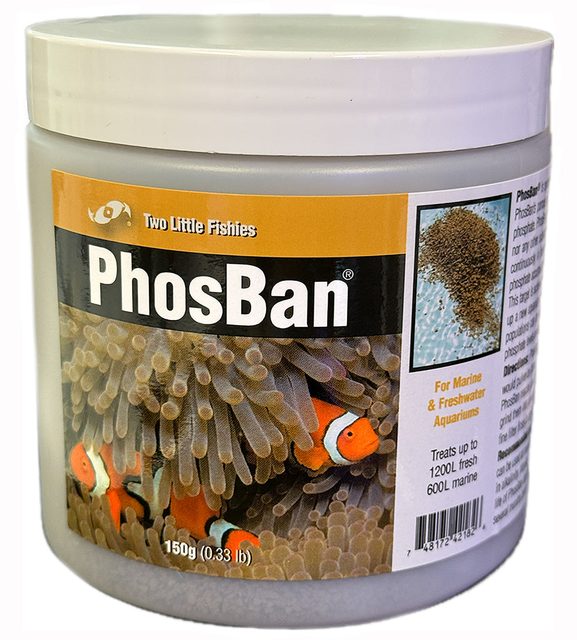
Two Little Fishies describes PhosBan as **synthetic ferric oxide hydroxide** granules intended to adsorb phosphate and silicate from saltwater and freshwater. The manufacturer also states that adsorbed substances are not released back into the water.
For this edition we use the exact **150 g** jar, model **ATLPB2**, UPC **748172421826**. That identity reconciles to Amazon.com ASIN **B000256DW2**. We do not invent a universal replacement interval or aquarium-volume dose where the current public manufacturer page does not provide one.
A clean ferric-media choice with strong identity evidence, scored below ROWAphos because the current public manufacturer documentation is less detailed on dosing and exhaustion.
Check price on Amazon →#3Best explicit safety and dosing instructions
Seachem PhosGuard 100 mL
Best for: reef keepers who prioritize explicit dose, retest and initial-wetting instructions over ferric-media chemistry
What we like
- Seachem identifies PhosGuard as porous alumina oxide rather than GFO
- Current directions publish an 85 mL dose per 200 L / 50 US gallons of saltwater
- Manufacturer explicitly tells users to retest after four days and replace or leave media based on measured phosphate/silicate
- Initial-wetting safety guidance is unusually explicit
- Exact 100 mL / product code 0185 marketplace identity maps to ASIN B00029PO6O
What we don't
- Alumina oxide is a different media chemistry from ferric GFO-style products, so it should not be treated as interchangeable by weight or dose
- Initial wetting may generate heat and requires the manufacturer's freshwater pre-wet procedure
- Seachem warns against overtreating and against reducing phosphate too rapidly in sensitive systems
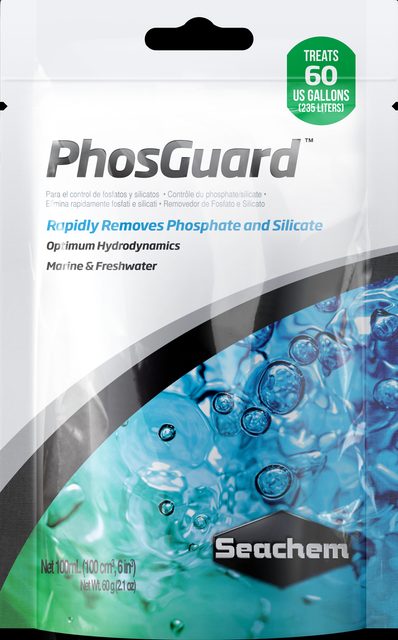
Seachem identifies PhosGuard as **alumina oxide** and publishes a phosphate-binding reference of **0.87 mg/g** in its comparison table. Current saltwater directions use **85 mL** for every 200 L / **50 US gallons**, followed by retesting after four days.
The safety instruction is important: dry PhosGuard **may generate heat** on first contact with water. Seachem instructs users to pre-wet by adding the media to **twice its volume of freshwater**, then rinse it; the company specifically warns against adding marine water to the dry media. Exact manufacturer size code **0185** is the **100 mL** size, and current marketplace identity maps it to Amazon.com ASIN **B00029PO6O**.
The clearest safety/dosing workflow, with a different alumina-oxide chemistry that makes direct gram-for-gram comparisons with ferric media misleading.
Check price on Amazon →A reef phosphate remover is a targeted chemical-filtration tool, not a diagnosis.
Start with the reef phosphate tester guide if the measurement method itself is still uncertain. For the broader filtration context, use the aquarium filter media guide, aquarium maintenance schedule, aquarium water-parameters guide, reef nitrate tester guide, and protein skimmer guide.
How we researched and scored
PetGearReport has not physically tested these phosphate-removal media, run controlled reef aquariums against one another, measured independent adsorption capacity, quantified dust/fines, tested coral response, or laboratory-verified manufacturer performance claims.
The displayed number is a PetGearReport research score, not a hands-on result, Amazon/customer rating or independent laboratory performance score.
- Media chemistry & phosphate-control evidence — 30% — clarity about the adsorbent chemistry and what the manufacturer actually documents it to remove.
- Flow, handling & deployment — 25% — explicit instructions for bag, canister or reactor use and how much flow/tumbling is appropriate.
- Monitoring & exhaustion guidance — 20% — whether the manufacturer explains when to retest and how to determine that the media is spent.
- Safety & compatibility boundaries — 15% — warnings around wetting, dust, over-treatment or system conditions.
- Exact identity & documentation — 10% — exact size/model/SKU/GTIN evidence reconciled to the marketplace ASIN.
| Phosphate remover | Chemistry 30% | Flow/handling 25% | Monitoring 20% | Safety 15% | Identity 10% | Weighted | Score |
|---|---|---|---|---|---|---|---|
| D-D ROWAphos RP50 | 9 | 10 | 9 | 8 | 10 | 9.10 | 9/10 |
| Two Little Fishies PhosBan 150 g | 9 | 8 | 6 | 8 | 10 | 8.10 | 8/10 |
| Seachem PhosGuard 100 mL | 8 | 8 | 10 | 10 | 10 | 8.60 | 8/10 |
The decimal is shown so the weighting is auditable. It does not imply measured laboratory precision.
Media chemistry matters
“Phosphate remover” is a job description, not one chemical.
- ROWAphos is D-D’s ferric-based adsorption media.
- PhosBan is described by Two Little Fishies as synthetic ferric oxide hydroxide.
- PhosGuard is Seachem alumina oxide, not GFO.
That is why dose and handling instructions should not be transferred from one product to another.
Quick decision: choose the media chemistry and deployment before the brand
| Media | Chemistry | Deployment / flow | Best when | Avoid if |
|---|---|---|---|---|
| D-D ROWAphos RP50 | Ferric-based adsorption media | Media bag/canister or reactor with gentle fluidisation; D-D explicitly warns against over-fluidising | You want unusually explicit reactor setup plus reactor outlet versus tank phosphate exhaustion monitoring | You want a simple fixed dose/retest schedule with no flow tuning |
| Two Little Fishies PhosBan 150 g | Synthetic ferric oxide hydroxide | Ferric media that can be used with controlled-flow reactor hardware; keep the flow gentle enough not to grind the media | You want straightforward ferric phosphate media and will manage replacement from measured phosphate trend | You require an explicit dose-by-water-volume and exhaustion schedule on the current product page |
| Seachem PhosGuard 100 mL | Alumina oxide | High-flow bag/chamber/canister placement; Seachem says it must not tumble against itself | You want 85 mL per 200 L / 50 US gallons, four-day retest guidance and a clear first-wetting safety procedure | You specifically want ferric/GFO chemistry or a tumbling reactor workflow |
GFO is not a synonym for every phosphate-removal medium. ROWAphos and PhosBan are ferric-based media; PhosGuard is alumina oxide. Compare the chemistry, deployment instructions and monitoring workflow first, then the brand.
Measurement does not decide the correction
Measurement does not decide the correction.
Before adding or increasing phosphate-removal media:
- repeat an unexpected phosphate result;
- check the test method/reagents and sampling workflow;
- compare the reading with the recent trend;
- review feeding, detritus accumulation, source water and other nutrient inputs;
- review skimming, refugium/export changes and recent media changes;
- only then decide whether a phosphate remover is the right intervention.
Our reef phosphate tester guide explains why range, display resolution and accuracy are separate measurement questions.
There is no single phosphate target for every reef. The appropriate operating range depends on the system, livestock, nutrient strategy and test method. The goal of media is controlled correction toward the aquarium’s chosen operating range, not the lowest number a test can display.
ROWAphos RP50: strongest deployment documentation
D-D identifies RP50 as the 500 mL package.
The manufacturer states that this amount will remove 3 ppm phosphate from approximately 2000 L / 525 US gallons of saltwater. That is useful capacity context, but it is still a manufacturer specification rather than a result PetGearReport independently measured.
D-D documents multiple deployment methods. In a fluidised reactor it instructs users to flush the media with freshwater until the initial brown fines clear, reconnect to saltwater, then increase flow only until the surface begins to move.
The manufacturer’s emphasis is explicit: DO NOT OVER FLUIDISE.
D-D also publishes a practical exhaustion method: compare the tank result with water leaving the reactor. If the tank is above zero and the reactor outlet reads the same, the media is no longer providing measurable phosphate removal and should be replaced.
PhosBan 150 g: straightforward ferric-media identity
Two Little Fishies describes PhosBan as synthetic ferric oxide hydroxide granules with phosphate and silicate adsorption for freshwater and saltwater.
The exact ranked package is:
- 150 g jar;
- model ATLPB2;
- UPC 748172421826;
- Amazon.com ASIN B000256DW2.
The public manufacturer page is less prescriptive than D-D or Seachem about dose-by-water-volume and exhaustion testing. We therefore do not invent a universal replacement interval.
PhosGuard 100 mL: the most explicit safety workflow
Seachem’s current directions are unusually specific.
For saltwater, the manufacturer uses 85 mL per 200 L / 50 US gallons, tells the user to leave the media in place for four days, then retest phosphate or silicate. Seachem’s comparison table lists PhosGuard’s PO4 binding reference at 0.87 mg/g.
The first-wetting instruction matters more than the capacity number.
Dry PhosGuard may generate heat. Seachem instructs the user to add the media to twice its volume of freshwater, then rinse. The company specifically warns against pouring marine water onto the dry product.
Seachem also warns that lowering phosphate too rapidly can stress sensitive invertebrates. That makes conservative dosing and retesting part of the product workflow, not optional fine print.
Reactor flow is product-specific
A common mistake is to treat “use a reactor” as one universal flow setting.
For ROWAphos, D-D recommends gentle fluidisation and warns against over-fluidising.
For PhosGuard, Seachem recommends maximizing water flow through the media without allowing it to tumble against itself.
Those are materially different instructions. Follow the exact media manufacturer, not a generic reactor rule. If you need dedicated hardware for controlled media flow, our reef media reactor guide compares pump, installation and flow-control architectures without turning reactor flow into a universal media setting.
Exact product identity verification
Product identity evidence checked September 25, 2026, without freezing current Amazon price or availability:
- B002NPY6U0 matched D-D ROWAphos RP50 / 500 mL / GTIN 04032974404054. D-D’s current product documentation independently confirms RP50 as the 500 mL size and supplies the current capacity/deployment guidance.
- B000256DW2 matched Two Little Fishies PhosBan 150 g / ATLPB2 / UPC 748172421826. Two Little Fishies remains the primary source for the ferric oxide hydroxide chemistry and saltwater/freshwater use.
- B00029PO6O matched Seachem PhosGuard 100 mL / code 0185 / UPC 000116018500. Seachem independently identifies 0185 as the 100 mL size and publishes the saltwater dose, retest interval and first-wetting safety instructions.
These checks keep the affiliate destinations tied to the intended exact products while separating durable identity and manufacturer instructions from temporary marketplace state. No direct Amazon product-page probe was used for this refresh.
Sources
- D-D The Aquarium Solution — RowaPhos — product codes, sizes and published RP50 capacity context.
- D-D The Aquarium Solution — Fluidising RowaPhos — flushing and gentle-fluidisation guidance.
- Two Little Fishies — PhosBan 150 g — ferric oxide hydroxide chemistry and salt/freshwater use.
- Seachem — PhosGuard — alumina-oxide comparison, saltwater dose, retest interval and first-wetting safety procedure.
- Desertcart — D-D RP50 ROWAphos — public ASIN B002NPY6U0 to RP50 / 500 mL / GTIN 04032974404054 identity evidence.
- ReefSnow — Two Little Fishies PhosBan 150 g — public ASIN B000256DW2 to ATLPB2 / UPC 748172421826 identity evidence.
- Desertcart — Seachem PhosGuard 100 mL — public ASIN B00029PO6O to model 185 / UPC 000116018500 identity evidence.
No Amazon price, stock or availability claim is made because those values can change independently of the editorial comparison.
Frequently asked questions
Should I add phosphate remover after one high reef-tank reading?
No automatic correction follows from one reading. Measurement does not decide the correction. Repeat a surprising result carefully, confirm the tester and reagents, review the recent trend, feeding and nutrient export, then decide whether phosphate-removal media is appropriate.
Is GFO the same as every phosphate-removal media?
No. Ferric media such as PhosBan and ferric-hydroxide products such as ROWAphos differ from Seachem PhosGuard, which Seachem identifies as alumina oxide. Follow the dose, flow and handling instructions for the exact product rather than converting one media's directions to another by weight.
Should phosphate-removal media tumble in a reactor?
It depends on the product. D-D recommends gentle fluidised use for ROWAphos and explicitly says DO NOT OVER FLUIDISE. Seachem says PhosGuard should receive good flow but should not tumble against itself. Do not apply one reactor-flow rule to every media.
How do I know when phosphate media is exhausted?
Use measurement, not a generic calendar interval. D-D describes comparing tank phosphate with the fluidised-reactor outlet; when the outlet no longer improves on the tank result, the media is exhausted. Seachem instructs users to retest after four days and continue monitoring until phosphate begins to rise.
Can phosphate be reduced too quickly?
Yes. Seachem explicitly warns that overtreating or lowering phosphate too rapidly can stress sensitive invertebrates. Use smaller controlled changes, retest, and keep the decision tied to the aquarium's established trend rather than chasing the lowest possible number.