Best Reef Phosphate Testers: 3 Picks by Range, Resolution & Workflow
Reef phosphate testers can look similar while answering very different measurement questions. A digital colorimeter can remove visual color matching but still depends on optical cleanliness, reagent handling and the instrument's published accuracy; a comparator kit can add a reference-validation path while leaving the final color match to the user; a broad-range liquid kit can be useful for detecting larger phosphate changes without offering the same low-range discrimination. We researched three exact marketplace variants using current manufacturer documentation for range, resolution or detectable increments, published accuracy where available, validation/reference options, reagent workflow and exact product identity. PetGearReport has not physically tested these kits, compared them against a laboratory reference method, measured inter-user color-reading error, aged reagents or independently verified manufacturer accuracy claims.
| Rank | Product | Score | Best for | Link |
|---|---|---|---|---|
| #1 | Hanna HI713 Phosphate Low Range Checker HCBest documented digital option | 9 | reef keepers who want a direct digital phosphate result, explicit manufacturer accuracy specification and clean exact marketplace identity | Check price → |
| #2 | Seachem MultiTest PhosphateBest built-in reference validation | 8 | reef keepers who value a manufacturer-provided reference sample and want to validate a color-comparator workflow instead of relying only on an unverified color chart | Check price → |
| #3 | API Phosphate Test KitBest broad-range baseline | 6 | reef or marine users who want a simple broad-range phosphate check and do not need the low-range discrimination of a dedicated colorimeter | Check price → |
#1 · Our PickBest documented digital option
Hanna HI713 Phosphate Low Range Checker HC
Best for: reef keepers who want a direct digital phosphate result, explicit manufacturer accuracy specification and clean exact marketplace identity
What we like
- Direct digital phosphate result from a dedicated colorimeter
- Hanna publishes a 0.00–2.50 ppm range, 0.01 ppm resolution and ±0.04 ppm ±4% of reading accuracy at 25°C / 77°F
- 10 mL sample workflow removes manual color-chart matching from the final readout
- HI713-25 replacement reagent and HI713-11 calibration-check accessories are explicitly documented
- Exact Hanna HI713 marketplace identity maps to ASIN B003IKNJPC
What we don't
- The 0.01 ppm display resolution is smaller than the published ±0.04 ppm ±4% accuracy and must not be treated as equivalent to accuracy
- Its 0–2.50 ppm range is broader than a reef-specific ultra-low-range instrument, so it is not the same tool as Hanna HI774
- Dirty cuvettes, bubbles, fingerprints, incomplete reagent dissolution or timing errors can still affect an optical measurement
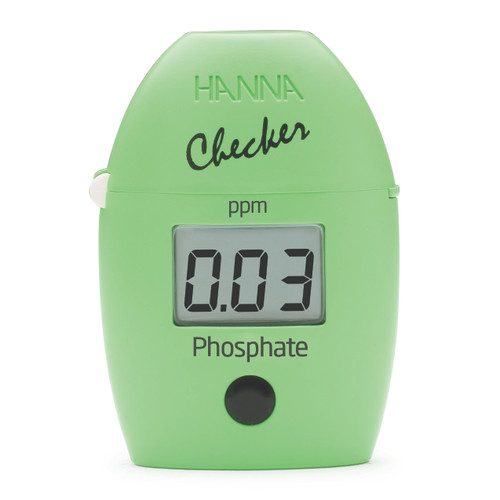
Hanna identifies the HI713 as a low-range phosphate Checker HC using an adaptation of the ascorbic-acid colorimetric method with an LED at 525 nm and silicon photocell. The manufacturer publishes a 0.00–2.50 ppm range, 0.01 ppm resolution and accuracy of ±0.04 ppm ±4% of reading at 25°C / 77°F. The procedure zeros the instrument with a 10 mL untreated sample, then adds the phosphate reagent and reads the reacted sample after the prescribed reaction period.
Hanna documents HI713-25 as the 25-test reagent set and HI713-11 as the calibration-check accessory. Exact Hanna Instruments HI713 marketplace identity reconciles to Amazon.com ASIN B003IKNJPC. The separate reef-focused HI774 is discussed below but is not ranked because its current indexed Amazon identity does not meet the same manufacturer-identity gate.
The strongest exact-identity digital pick in this edition because Hanna documents range, resolution, accuracy, reagents and calibration-check support without requiring a subjective final color match.
Check price on Amazon →#2Best built-in reference validation
Seachem MultiTest Phosphate
Best for: reef keepers who value a manufacturer-provided reference sample and want to validate a color-comparator workflow instead of relying only on an unverified color chart
What we like
- Measures inorganic phosphate to less than 0.05 mg/L according to Seachem
- Manufacturer publishes a 0–3.0 mg/L range with detectable chart changes from 0.001–0.1 mg/L depending on the part of the scale
- Includes a reference sample that can be run through the normal procedure to validate kit performance
- Performs more than 75 tests and supports up to six simultaneous samples in the multi-cavity plate
- Exact Seachem SKU 020620 / model 970 identity maps to ASIN B000255RF6
What we don't
- The final result still depends on matching the sample to a color chart
- Published detectable increments vary across the scale and should not be described as one uniform 0.001 mg/L accuracy claim
- The multi-step plate/reference workflow is more manual than a single-parameter digital readout
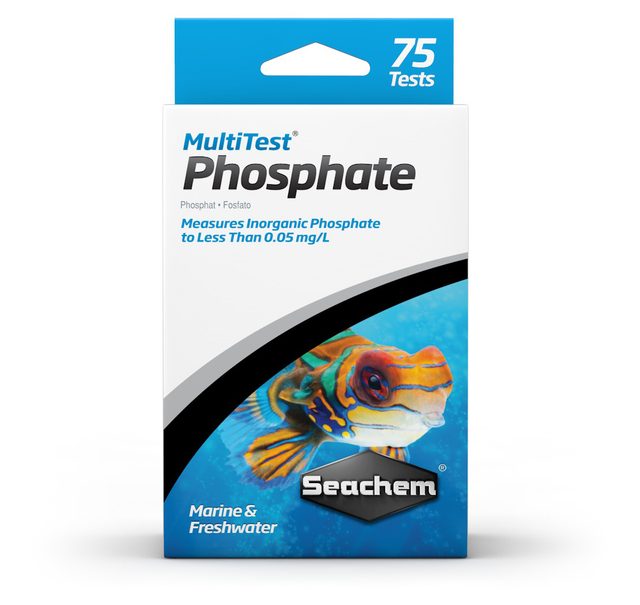
Seachem's MultiTest Phosphate measures inorganic phosphate in marine or freshwater samples. The current manufacturer page states that it measures to less than 0.05 mg/L, covers 0–3.0 mg/L, and uses detectable color-chart changes in increments that vary from 0.001–0.1 mg/L across the scale. That wording matters: detectable chart increments are not the same thing as a universal laboratory accuracy specification.
The differentiator is the included reference sample. Seachem explicitly says a user can substitute the reference for aquarium water and run the normal method when there is reason to question the result. The kit performs over 75 tests and uses an opaque multi-cavity plate with a sliding color chart. Exact SKU 020620 / marketplace model 970 reconciles to Amazon.com ASIN B000255RF6.
The best manual option for built-in validation because the included reference sample lets users check whether the kit is behaving plausibly before acting on an unexpected aquarium result.
Check price on Amazon →#3Best broad-range baseline
API Phosphate Test Kit
Best for: reef or marine users who want a simple broad-range phosphate check and do not need the low-range discrimination of a dedicated colorimeter
What we like
- Dedicated phosphate liquid test for freshwater and saltwater aquariums
- API publishes a broad 0–10.0 ppm measurement range
- Simple two-reagent, test-tube and color-card format
- Useful for detecting clearly elevated phosphate without pretending to be an ultra-low-range reef instrument
- Exact API model 63L / UPC 317163120637 maps to ASIN B0006JDWGY
What we don't
- The broad 0–10.0 ppm scale is not optimized for resolving very small changes in low-phosphate reef systems
- Final interpretation depends on visual color matching
- API does not publish the same numerical low-range accuracy specification or separate calibration-check standard as Hanna
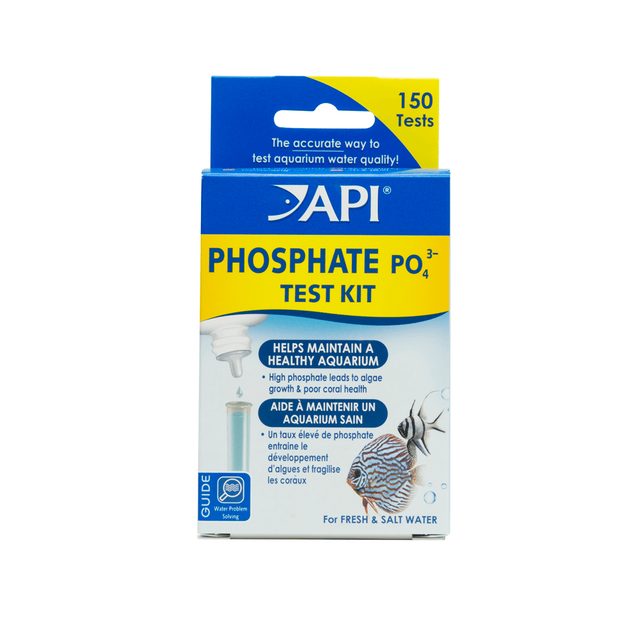
API's current Phosphate Test Kit is documented for fresh and saltwater aquariums and reports phosphate from 0–10.0 ppm. The kit contains two phosphate test solutions, instructions, a capped test tube and color cards. The measurement is therefore a broad-range liquid color test rather than an ultra-low-range reef instrument.
That distinction is useful rather than disqualifying. A broad-range kit can identify clearly elevated phosphate and support trend monitoring, but it should not be presented as equivalent to a 0.01 ppm digital display at the low end. Exact API model 63L, UPC 317163120637, reconciles to Amazon.com ASIN B0006JDWGY.
A practical baseline kit with clean identity and simple workflow, deliberately scored lower because its broad range gives less decision detail at the low concentrations many reef keepers are trying to distinguish.
Check price on Amazon →Phosphate is a nutrient measurement, not a standalone diagnosis. A useful result becomes more valuable when it is interpreted as part of a trend alongside feeding, livestock load, export methods, water changes and the rest of the reef’s chemistry. This page remains reef-focused; for a freshwater-specific comparison built around source-water and algae-diagnosis ranges rather than reef ultra-low nutrient management, use the freshwater phosphate test-kit guide.
For adjacent nutrient monitoring, use the reef nitrate tester guide; for foundation chemistry, use the reef alkalinity tester guide, reef salt mix guide, aquarium water-test-kit guide, aquarium water-parameters guide, and aquarium maintenance schedule.
How we researched and scored
PetGearReport has not physically tested these phosphate testers, compared them against a certified laboratory phosphate method, measured repeatability across different users, quantified color-vision effects, aged reagents or independently verified manufacturer accuracy claims.
The displayed number is a PetGearReport research score, not a hands-on result, Amazon/customer rating or laboratory certification.
- Reef-range resolution & published accuracy — 30% — whether the documented range/step is useful for low phosphate decisions and whether the manufacturer publishes numerical accuracy rather than only a scale.
- Readability & operator dependence — 25% — digital optical readout versus color comparator, including how much interpretation remains with the user.
- Validation/reagent traceability — 20% — calibration-check standards, reference samples, defined reagent sets and validation paths.
- Workflow & repeatability — 15% — sample control, timing, number of manual steps and clarity of the documented procedure.
- Exact identity & documentation — 10% — manufacturer model/SKU/UPC evidence reconciled to the exact marketplace ASIN.
| Phosphate tester | Range/accuracy 30% | Readability 25% | Validation 20% | Workflow 15% | Identity 10% | Weighted | Score |
|---|---|---|---|---|---|---|---|
| Hanna HI713 | 8 | 10 | 10 | 8 | 10 | 9.10 | 9/10 |
| Seachem MultiTest Phosphate | 8 | 7 | 9 | 8 | 10 | 8.15 | 8/10 |
| API Phosphate Test Kit | 5 | 6 | 5 | 8 | 10 | 6.20 | 6/10 |
The decimal makes the weighting auditable. It does not imply laboratory precision.
Digital is not automatically better
A colorimeter replaces the final visual comparison with an optical detector and numerical display. That is helpful when the alternative is deciding whether two similar shades on a chart match.
It does not eliminate measurement error.
For a digital colorimeter, important controls include:
- clean, dry and unscratched cuvettes;
- consistent cuvette orientation where the instructions require it;
- no fingerprints in the optical path;
- no bubbles or undissolved reagent;
- exact sample/reagent volume;
- correct reaction time;
- reagent storage and expiration;
- calibration/check standards when available.
A manual comparator has a different error model: lighting, background, color vision and the user’s choice of the closest chart value matter more.
So digital is not automatically better. Range, accuracy, reference validation and repeatability still decide how useful the result is.
Range, resolution and accuracy are three different things
The Hanna HI713 illustrates the distinction.
- Range: 0.00–2.50 ppm
- Resolution: 0.01 ppm
- Published accuracy at 25°C: ±0.04 ppm ±4% of reading
A display that changes in 0.01 ppm steps is not a claim that the instrument is accurate to ±0.01 ppm.
Seachem documents a 0–3.0 mg/L range and says its chart can show detectable changes from 0.001–0.1 mg/L, depending on where you are on the scale. It also says the kit measures inorganic phosphate to less than 0.05 mg/L. Those are method/scale descriptions, not a universal ±0.001 mg/L accuracy statement.
API’s current dedicated kit covers a much broader 0–10.0 ppm range. That makes it useful for broad screening but less informative when the decision depends on very small low-range changes.
Hanna HI713: digital low-range colorimeter
Hanna’s HI713 uses a dedicated phosphate colorimetric reaction and optical detector.
The core workflow starts with a 10 mL aquarium-water sample in the cuvette. The instrument is zeroed with untreated sample, reagent is added, the reaction is allowed to develop according to the manual, and the same optical path is used for the result.
Consumables and checks are also explicit:
- HI713-25 — replacement reagent set for 25 tests;
- HI713-11 — calibration-check set.
Those accessories make the measurement system more auditable than a device sold without a defined reagent or check-standard path.
The HI713 should not be confused with Hanna’s reef-specific HI774. They are different instruments with different ranges and accuracy specifications.
Seachem MultiTest: reference validation is the differentiator
The Seachem kit is a visual color comparator, but it adds something many simple kits do not: a reference sample.
Seachem explicitly describes using the reference in place of aquarium water and running the normal procedure when you have reason to believe a result may be wrong.
That does not turn a color chart into a laboratory instrument, but it gives the user a practical way to check whether the reagents and procedure can reproduce a known reference response.
The kit performs more than 75 tests, supports up to six simultaneous samples and uses an opaque white multi-cavity plate with a sliding chart.
API: broad-range screening
API’s model 63L dedicated phosphate kit covers 0–10.0 ppm in fresh and saltwater.
It uses two reagent solutions, a capped tube and color cards. That is a straightforward workflow for detecting larger changes and maintaining a simple trend log.
The trade-off is low-end detail. A broad-range color card should not be described as interchangeable with a low-range colorimeter simply because both report “ppm phosphate.”
Reference checks are useful when a result is surprising
An unexpected phosphate result can come from the aquarium, but it can also come from the measurement process.
Before changing husbandry:
- repeat the test with exact sample/reagent volumes;
- inspect reagent condition and storage;
- clean the cuvette/tube/plate;
- use the calibration-check or reference sample if the method provides one;
- compare the new result with the historical trend;
- review recent feeding, livestock, water changes, filtration and nutrient-export changes.
This prevents a measurement problem from becoming a husbandry problem.
Measurement does not decide the correction
Measurement does not decide the correction.
A phosphate result is evidence. It does not automatically tell you to:
- reduce or increase feeding;
- add a phosphate remover;
- change skimming or refugium operation — the protein skimmer vs refugium guide explains why those are different export mechanisms; if choosing between algae-based export formats, use algae scrubber vs refugium; if Chaeto growth has stalled, use the Chaeto refugium troubleshooting guide;
- make a large water change;
- alter carbon dosing or other nutrient-management products.
First confirm the result and the trend, then identify the likely input/export change and make adjustments appropriate to the actual reef system. Avoid chasing a universal phosphate number without considering livestock, system history and the measurement method.
Why HI774 and Red Sea Phosphate Pro are not affiliate picks in this edition
Hanna HI774 is technically attractive for reef work: Hanna documents an ultra-low phosphate range and reef/marine use. The marketplace identity is the blocker. Current indexed evidence maps Amazon ASIN B0D7N8H2LP to WLR Industries, model 774 / “Hanna HI774”, rather than to a clean Hanna Instruments manufacturer identity. We therefore do not convert that listing into a Hanna affiliate recommendation.
Red Sea Phosphate Pro has strong first-party documentation as a reef comparator kit, including product code R21425, EAN 7290100772089, a 0.02 ppm PO4 accuracy claim and a documented comparator procedure. We did not find a current Amazon.com ASIN with identity evidence clean enough to meet the same publishing gate.
Both are not ranked for marketplace identity reasons, not because PetGearReport physically compared them and found them inferior.
No Amazon price, stock or availability claim is made in this guide because those values can change independently of the editorial comparison.
Sources
- Hanna Instruments — HI713 Phosphate Low Range Checker HC — range, resolution, accuracy, method, reagent and calibration-check identifiers.
- Seachem — MultiTest Phosphate — marine/freshwater use, <0.05 mg/L measurement statement, 0–3 mg/L range, chart increments, reference sample and 75+ tests.
- API Fishcare — Phosphate Test Kit — fresh/saltwater use, 0–10 ppm range, kit contents and manufacturer guidance.
- Red Sea — Phosphate Pro support — manufacturer support/manuals for the non-ranked comparator kit.
- Red Sea — Nutrients Management Program — manufacturer-published 0.02 ppm accuracy context for Phosphate Pro.
Frequently asked questions
Is a digital phosphate checker always better for a reef tank?
No. Digital is not automatically better. A digital colorimeter removes the final human color-match step, but its published accuracy, range, reagent handling, cuvette cleanliness and timing still matter. A well-designed comparator kit with an appropriate range and reference sample can also be useful.
What is the difference between resolution and accuracy on a phosphate tester?
Resolution is the smallest displayed or chart step; accuracy describes how close a measurement is expected to be under stated conditions. Hanna HI713 displays 0.01 ppm increments but publishes ±0.04 ppm ±4% of reading accuracy at 25°C. Do not treat a 0.01 display step as proof that every result is accurate to 0.01 ppm.
Why does the test range matter in a reef aquarium?
A broad 0–10 ppm kit can be useful for identifying large phosphate changes, while a lower-range method gives more detail when the decision depends on much smaller differences. Match the measurement range to the aquarium question instead of assuming every phosphate test is interchangeable.
Should I add phosphate remover after one high reading?
Measurement does not decide the correction. Repeat a surprising result carefully, check the tester/reagents, review the recent trend, feeding, water changes and nutrient-export changes, then decide whether husbandry or phosphate remover is appropriate. Avoid making a large correction from one unexplained reading.
Why are Hanna HI774 and Red Sea Phosphate Pro not ranked?
This edition uses an exact Amazon.com identity gate. Current indexed HI774 marketplace evidence maps ASIN B0D7N8H2LP to WLR Industries/model 774 rather than a clean Hanna Instruments identity, so we do not present it as a Hanna affiliate variant. Red Sea Phosphate Pro has strong first-party documentation under R21425 / EAN 7290100772089, but we did not close a sufficiently clean current Amazon.com ASIN. They are excluded for identity evidence, not because PetGearReport tested them and found them technically inferior.