Best Protein Skimmers for Reef Tanks: 5 Picks by Bioload, Sump Fit & Control
A protein skimmer is a marine foam-fractionation tool, not a freshwater surface skimmer and not a substitute for sizing the rest of the filtration system. If you plan to route the skimmer air intake through CO2-absorbent media, the [reef CO2 scrubber guide](/reef-co2-scrubber-guide) explains why added restriction, moisture and recirculation plumbing must be treated as part of the skimmer system. We researched five exact US-market variants using current manufacturer bioload guidance, installation limits, air/water documentation, control architecture, maintenance access and exact product identity. PetGearReport has not physically tested these skimmers, measured skimmate production, air draw, water draw, noise, power use or long-term reliability.
| Rank | Product | Score | Best for | Link |
|---|---|---|---|---|
| #1 | Reef Octopus Classic 150INTBest documented all-round in-sump protein skimmer | 9 | medium reef systems with a sump where the 6–8 in operating depth, 12.4 × 8.7 in footprint and manufacturer bioload envelope fit the actual installation | Check price → |
| #2 | Red Sea REEFER DC Skimmer 300Best smart self-leveling in-sump option | 9 | reefers who want Red Sea's documented self-leveling and variable-flow control and whose sump can maintain the specified 6–8 in operating depth | Check price → |
| #3 | TUNZE Comline DOC Skimmer 9004 DCBest compact in-tank / no-sump option | 9 | nano and small marine systems that do not have a conventional skimmer chamber but can accommodate the documented immersion depth and magnetic in-tank mounting | Check price → |
| #4 | Reef Octopus Classic 100 HOBBest hang-on-back option for tanks without a sump | 9 | marine tanks without a sump where a true hang-on-back foam-fractionation skimmer is required and the 55/75/105 gal bioload envelope fits the display | Check price → |
| #5 | IceCap K1-100Best compact in-sump alternative | 8 | smaller reef systems with a tight sump chamber where the 4.5 × 7.5 in footprint is a harder constraint than advanced electronic control | Check price → |
#1 · Our PickBest documented all-round in-sump protein skimmer
Reef Octopus Classic 150INT
Best for: medium reef systems with a sump where the 6–8 in operating depth, 12.4 × 8.7 in footprint and manufacturer bioload envelope fit the actual installation
What we like
- CoralVue publishes separate 110 gal heavy, 150 gal medium and 210 gal light bioload ratings, excluding sump volume
- 6–8 in recommended sump water height and 12.4 × 8.7 in footprint are documented
- Aquatrance 2000s pump documentation includes 720 L/h maximum air and 198 GPH maximum flow
- Gate-valve water-level control, quick-release cup neck and cup drain are documented
- Exact model CLSC-150INT maps to indexed US ASIN B00N45H3YO
What we don't
- 12.4 × 8.7 in footprint needs more sump floor area than space-saver designs
- Bioload ratings are manufacturer guidance, not a guarantee of nutrient control in every reef
- Published pump air/flow values can vary with the installed aquarium setup
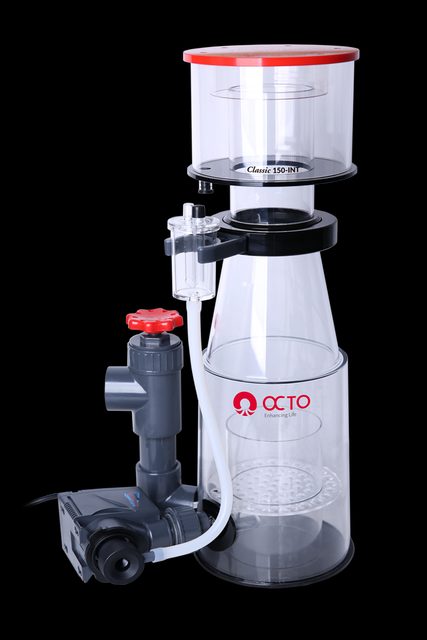
CoralVue identifies the Reef Octopus Classic 150INT as SKU CLSC-150INT and rates it, excluding sump volume, for 110 gal heavy, 150 gal medium and 210 gal light bioload. The current page specifies a 12.4 × 8.7 in footprint, 22 in height and 6–8 in recommended sump water height. Its Aquatrance 2000s pinwheel pump is listed at 18W, up to 720 L/h air and 198 GPH maximum flow, with the manufacturer warning that air and water results vary by aquarium setup.
That combination makes it easier to screen for both biological load and physical fit before buying. The exact CLSC-150INT model is consistently reconciled to Amazon.com ASIN B00N45H3YO in indexed catalog evidence. PetGearReport has not measured its real skimmate production, noise or installed pump performance.
The strongest all-round research pick because CoralVue combines unusually clear bioload tiers, sump-depth guidance, pump data and service-oriented hardware details.
Check price on Amazon →#2Best smart self-leveling in-sump option
Red Sea REEFER DC Skimmer 300
Best for: reefers who want Red Sea's documented self-leveling and variable-flow control and whose sump can maintain the specified 6–8 in operating depth
What we like
- Red Sea publishes separate 80 gal SPS, 160 gal mixed-reef and 240 gal fish-only ratings
- 500 L/h air flow and 1000 L/h water flow are published for the 300 model
- Recommended water height is 6–8 in and listed power is 20W
- Variable flow, self-leveling and ReefBeat integration are current manufacturer features
- Indexed exact-model evidence maps REEFER DC Skimmer 300 to ASIN B0DXV574YT
What we don't
- ReefRun Dual Controller is required and should be budgeted as part of the system
- The 80/160/240 gal ratings are Red Sea's system-specific categories and should not be translated into another brand's bioload scale
- Smart control adds electronics and setup complexity that a simple AC skimmer avoids
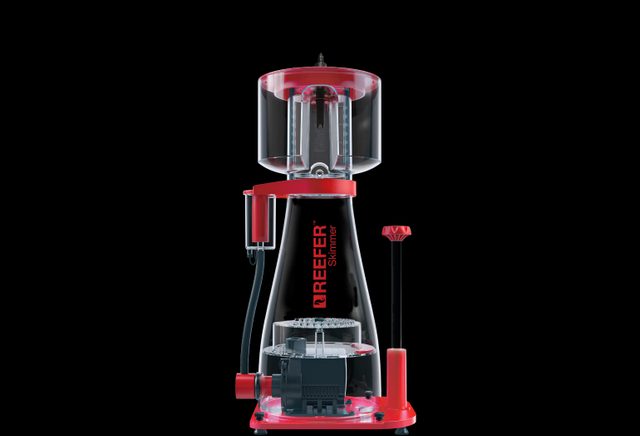
Red Sea's current REEFER DC Skimmer 300 specifications list a PSK DC-1200 Sicce pump, 500 L/h air flow, 1000 L/h water flow, 6–8 in recommended water height, 21 in height and 20W power. Red Sea rates the 300 for 80 gal SPS, 160 gal mixed reef and 240 gal fish-only systems.
The DC platform adds variable flow and self-leveling through the ReefBeat ecosystem, but Red Sea explicitly states that a ReefRun Dual Controller is required. That required controller is part of the ownership boundary, not an optional convenience. Indexed exact-model evidence maps the current REEFER DC Skimmer 300 identity to Amazon.com ASIN B0DXV574YT.
The best control-focused choice here because the manufacturer publishes model-specific air/water flow, coral-system ratings and an explicit self-leveling architecture.
Check price on Amazon →#3Best compact in-tank / no-sump option
TUNZE Comline DOC Skimmer 9004 DC
Best for: nano and small marine systems that do not have a conventional skimmer chamber but can accommodate the documented immersion depth and magnetic in-tank mounting
What we like
- TUNZE rates exact model 9004.001 for 15 to 79 USgal of seawater depending on tank load
- Compact 4.3 × 3.5 × 12 in body mounts inside the aquarium with a magnet holder
- Manufacturer publishes approximately 200 l/h air capacity and about 5W consumption, 10W maximum
- 8.9–9.7 in immersion depth and 0.2 L collection-cup volume are documented
- Exact item 9004.001 maps to indexed US ASIN B01KHWLR2U
What we don't
- The skimmer body remains visible inside the display or rear chamber
- 15–79 USgal is a load-dependent range rather than one universal tank-size recommendation
- 0.2 L collection cup is much smaller than full-size sump skimmer cups
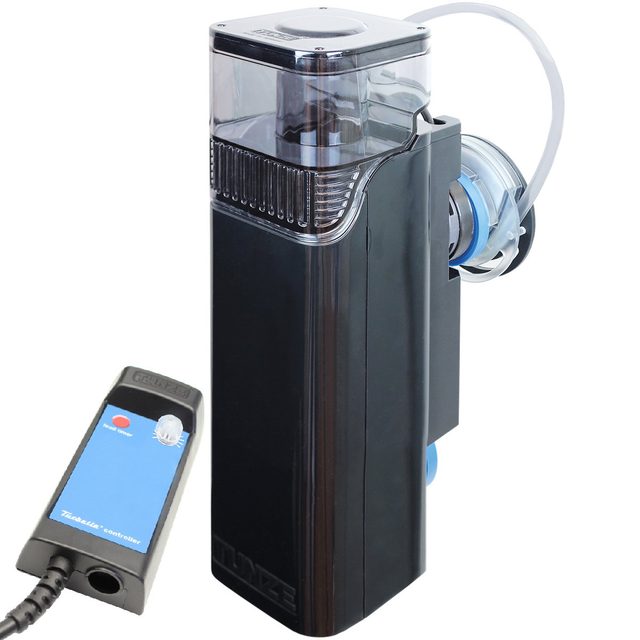
TUNZE's current US page identifies the Comline DOC Skimmer 9004 DC as exact item 9004.001. It is recommended, depending on tank load, for 15 to 79 USgal of seawater, with approximately 200 l/h air capacity, about 5W operating consumption and 10W maximum. The documented dimensions are 4.3 × 3.5 × 12 in, with an 8.9–9.7 in immersion depth and a magnet holder for glass up to 1/2 in.
This is a different installation class from the large sump models. It keeps the skimmer inside the aquarium or compatible rear chamber and uses surface intake as part of its flash-skimming design. Indexed model evidence maps item 9004.001 to Amazon.com ASIN B01KHWLR2U.
The compact architecture specialist: it solves the no-sump problem without pretending its load-dependent 15–79 gallon range is equivalent to full-size in-sump skimmer ratings.
Check price on Amazon →#4Best hang-on-back option for tanks without a sump
Reef Octopus Classic 100 HOB
Best for: marine tanks without a sump where a true hang-on-back foam-fractionation skimmer is required and the 55/75/105 gal bioload envelope fits the display
What we like
- Current CoralVue documentation rates the HOB unit at 55 gallons heavy, 75 gallons medium and 105 gallons light bioload, excluding sump
- No sump is required; the unit mounts on the aquarium back or side
- Aquatrance 1000s documentation lists 420 L/h air draw and 350 L/h / 92 GPH water draw
- 9W 60Hz pump draw, air silencer and serviceable acrylic construction are documented
- Exact CLSC-100HOB identity maps to indexed ASIN B08DWZQR6L
What we don't
- HOB equipment remains visible behind or beside the display and requires adequate rim/wall clearance
- CoralVue's current page contains two different footprint widths in separate sections, so this guide does not normalize them into one invented measurement
- Manufacturer pump air/water results are explicitly setup-dependent
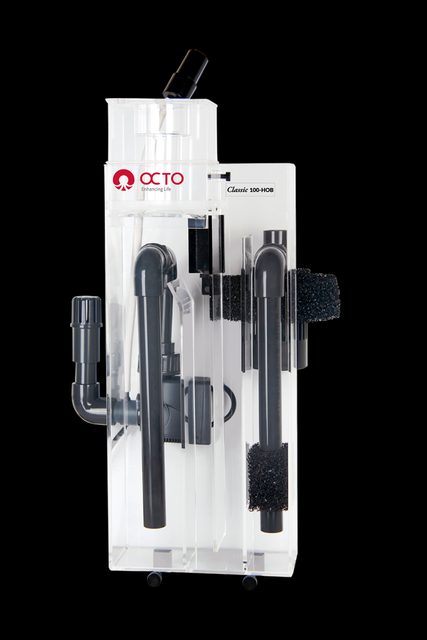
CoralVue's current Classic 100 HOB page identifies exact SKU CLSC-100HOB and rates it, excluding sump volume, at 55 gallons heavy, 75 gallons medium and 105 gallons light bioload. The Aquatrance 1000s pump is listed at 9W for 60Hz, 420 L/h air draw and 350 L/h / 92 GPH water draw, with the usual warning that installed results vary.
The main benefit is architectural: a sump is not required. One current CoralVue section states an 8 × 3.75 in footprint while its technical section states 8 × 3.25 in, so PetGearReport does not silently choose one as the authoritative width. Measure the actual mounting area conservatively. Indexed catalog evidence maps the exact CLSC-100HOB identity to Amazon.com ASIN B08DWZQR6L.
The clearest HOB choice because the manufacturer publishes bioload tiers, pump air/water draw and a no-sump installation path for the exact CLSC-100HOB.
Check price on Amazon →#5Best compact in-sump alternative
IceCap K1-100
Best for: smaller reef systems with a tight sump chamber where the 4.5 × 7.5 in footprint is a harder constraint than advanced electronic control
What we like
- CoralVue publishes 40 gal heavy, 60 gal medium and 80 gal light bioload ratings, excluding sump
- Very small 4.5 × 7.5 in footprint and 19 in height suit tight skimmer chambers
- Recommended sump water height is 6–8 in
- EVair 400 pump documentation lists 400lph air draw, about 100gph water draw and 8W power
- Indexed Amazon.com result for the exact IceCap K1-100 title maps to ASIN B004T7XIVS
What we don't
- In-sump installation only
- No variable-speed control is documented on the current K1-100 product page
- Exact affiliate identity evidence is title-based rather than a manufacturer UPC-to-ASIN reconciliation, so the documentation score is more conservative
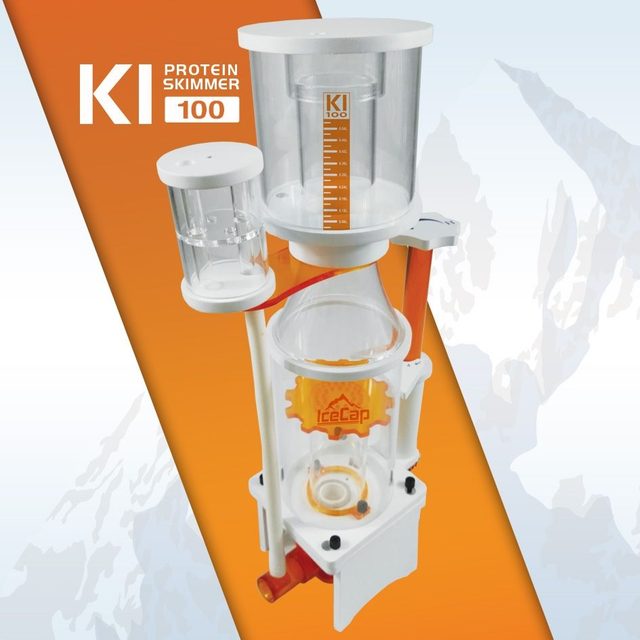
CoralVue's current IceCap K1-100 page identifies SKU IC-K1-100 and rates it, excluding sump volume, for 40 gal heavy, 60 gal medium and 80 gal light bioload. The 4.5 × 7.5 in footprint, 19 in height and 6–8 in recommended sump water height make physical fit easy to screen before purchase. The EVair 400 pump is documented at 8W, 400lph air draw and approximately 100gph water draw.
Current indexed Amazon.com search evidence for the exact IceCap K1-100 product title maps that listing to ASIN B004T7XIVS. Because that identity evidence is not as richly cross-keyed as the model-number mappings for the leading picks, PetGearReport scores documentation more conservatively instead of treating all identity evidence as equal.
A compact in-sump alternative with unusually clear heavy/medium/light ratings and service access, scored more conservatively because the exact marketplace identity evidence is less rich.
Check price on Amazon →A protein skimmer is useful only when it fits both the biological job and the physical system.
That makes the first question more specific than “How many gallons is the tank?” A manufacturer may rate one skimmer for heavy, medium and light bioload, another for SPS/mixed/fish-only systems, and another across a load-dependent volume range. Those labels are not interchangeable.
For size-specific decisions, the 40-gallon breeder protein skimmer guide separates sump, HOB and in-tank layouts at the smaller display size, while the 75-gallon protein skimmer guide applies the same manufacturer load bands to a larger reef.
For the coral-lighting side of the same saltwater system, use the reef aquarium lights guide. For the pump that moves water through the sump, use the aquarium return-pump guide. If the sump also runs GFO, carbon or another compatible chemical medium, the reef media reactor guide separates reactor flow and installation from the chemistry decision. A protein skimmer is not a replacement for any of those jobs.
How we researched and scored
PetGearReport has not physically tested these protein skimmers, measured skimmate mass, dissolved-organic removal, air draw, water draw, sound pressure, electrical consumption or long-term reliability. We compared current manufacturer documentation, installation architecture, published bioload/system guidance, pump information, serviceability and indexed US marketplace identity.
The displayed number is a PetGearReport research score, not a hands-on result, customer rating or laboratory measurement.
- Bioload & system-fit evidence — 30% — how clearly the manufacturer separates load/system types and defines the intended aquarium envelope.
- Installation, footprint & water-depth fit — 25% — sump/HOB/in-tank architecture, footprint, height, immersion or sump-depth guidance and hard fit constraints.
- Pump, control & air/water evidence — 20% — documented pump architecture, air draw, water draw/flow and control features without flattening unlike labels.
- Maintenance & serviceability — 15% — cup/drain access, disassembly, service parts and practical control/cleaning architecture.
- Documentation & exact identity — 10% — current first-party model evidence plus confidence in the exact US Amazon.com variant mapping.
| Protein skimmer | Bioload/system fit 30% | Installation fit 25% | Pump/control evidence 20% | Maintenance 15% | Evidence 10% | Weighted | Score |
|---|---|---|---|---|---|---|---|
| Reef Octopus Classic 150INT | 10 | 8 | 9 | 9 | 9 | 9.05 | 9/10 |
| Red Sea REEFER DC Skimmer 300 | 9 | 9 | 10 | 9 | 9 | 9.20 | 9/10 |
| TUNZE Comline DOC Skimmer 9004 DC | 8 | 10 | 9 | 9 | 10 | 9.05 | 9/10 |
| Reef Octopus Classic 100 HOB | 9 | 10 | 8 | 8 | 9 | 8.90 | 9/10 |
| IceCap K1-100 | 8 | 9 | 8 | 9 | 8 | 8.40 | 8/10 |
The weighted decimals make the method auditable; they do not imply laboratory precision. Amazon price, stock, customer ratings and review counts are not scoring inputs.
Quick comparison: the rating label matters
| Model | Installation | Manufacturer sizing boundary | Water / immersion depth | Pump evidence | Control |
|---|---|---|---|---|---|
| Reef Octopus Classic 150INT | In-sump | 110 heavy / 150 medium / 210 light gal, excluding sump | 6–8 in sump | 720 L/h max air; 198 GPH max flow | Gate valve |
| Red Sea REEFER DC 300 | In-sump | 80 SPS / 160 mixed reef / 240 fish-only gal | 6–8 in sump | 500 L/h air; 1000 L/h water | Variable DC + self-leveling; ReefRun controller required |
| TUNZE 9004 DC | In-tank / rear chamber | 15 to 79 USgal depending on tank load | 8.9–9.7 in immersion | ~200 l/h air | Turbelle controller |
| Reef Octopus Classic 100 HOB | Hang-on-back | 55 heavy / 75 medium / 105 light gallons, excluding sump | HOB architecture | 420 L/h air draw; 350 L/h / 92 GPH water draw | Outlet adjustment |
| IceCap K1-100 | In-sump | 40 heavy / 60 medium / 80 light gal, excluding sump | 6–8 in sump | 400lph air draw; ~100gph water draw | Pipeless output adjustment |
Do not convert these five manufacturer schemes into one synthetic “true gallon rating.” They answer slightly different questions.
There is no universal protein-skimmer oversizing rule
There is no universal rule on this page that says every reef should buy a skimmer rated for 1.5×, 2× or another fixed multiple of display volume.
Reef Octopus and IceCap explicitly publish heavy/medium/light bioload tiers. Red Sea publishes SPS, mixed-reef and fish-only system ratings. TUNZE gives a load-dependent seawater range and explains that more sensitive biotopes can require a smaller effective aquarium volume.
That manufacturer context is more useful than one generic multiplier because a lightly stocked fish system and a heavily fed coral/fish system do not impose the same organic load.
Also check whether the manufacturer says excluding sump. Reef Octopus and IceCap do so on the ranked pages. Do not silently add sump volume to a rating scheme that explicitly excludes it.
Protein skimmer vs surface skimmer: not the same job
A marine protein skimmer uses foam fractionation: air and water are mixed so organics concentrate at bubble surfaces, rise as foam and collect in a cup.
A surface skimmer collects film and floating debris at the air-water interface. That is a different mechanism. TUNZE 9004 DC happens to draw surface water as part of its design, but that does not turn ordinary freshwater surface-skimmer products into protein skimmers.
If the problem is a visible oily or biofilm layer rather than dissolved/fine marine organic export, diagnose the surface problem first instead of buying foam-fractionation hardware for the wrong job.
Sump fit can eliminate a skimmer before gallon rating does
Before comparing controls or pumps, use the protein skimmer sizing calculator if you want a manufacturer-tier and physical-fit check without a generic gallon multiplier. Then measure: After choosing a model, the protein skimmer setup and tuning guide covers water depth, break-in, foam-level tuning and wet/dry collection without importing one brand’s settings into another. For ongoing ownership, the protein skimmer maintenance and cleaning guide covers cup/neck cleaning, venturi restriction and pump/impeller service. If you are deciding between foam fractionation and macroalgae export, the protein skimmer vs refugium guide separates their different jobs and when running both makes sense.
- available floor footprint in the skimmer chamber;
- operating water depth;
- total vertical clearance under the cabinet;
- extra clearance needed to lift the collection cup;
- clearance for air lines, drains, controllers and power connections;
- access required to remove the pump for cleaning.
Classic 150INT needs a documented 12.4 × 8.7 in footprint and 6–8 in sump depth. IceCap K1-100 uses a much smaller 4.5 × 7.5 in footprint at the same published 6–8 in water-height range. Those two products can therefore fit very different sumps even before bioload enters the decision.
A skimmer that cannot be removed for cleaning without dismantling plumbing is a poor ownership fit even when the gallon label looks perfect.
Stable water height matters for in-sump skimmers
Water depth changes how an in-sump skimmer’s internal water level and foam column behave.
The ranked in-sump models publish specific operating-depth guidance:
- Classic 150INT: 6–8 in
- REEFER DC 300: 6–8 in
- IceCap K1-100: 6–8 in
Use a stable skimmer chamber or appropriate stand rather than assuming any sump depth inside the cabinet is equivalent. Follow the exact manufacturer setup instructions instead of using the water-height recommendation from another brand.
TUNZE 9004 DC publishes an 8.9–9.7 in immersion depth, which is a different installation concept because the unit mounts in the aquarium or a compatible chamber.
Air draw and water draw are not one cross-brand performance score
Air and water figures help describe the pump/skimmer architecture, but the labels are not standardized enough to create a simple leaderboard.
For example:
- Classic 150INT lists 720 L/h maximum air and 198 GPH maximum flow for Aquatrance 2000s.
- Red Sea lists 500 L/h air flow and 1000 L/h water flow for REEFER DC 300.
- Classic 100 HOB lists 420 L/h air draw and 350 L/h / 92 GPH water draw.
- IceCap K1-100 lists 400lph air draw and approximately 100gph water draw.
- TUNZE 9004 DC publishes approximately 200 l/h air capacity.
Those figures come from different manufacturer architectures and test contexts. PetGearReport does not turn them into an “air per gallon” score or claim that the highest number automatically removes the most waste.
AC simplicity vs DC control
Electronic control can make a skimmer easier to integrate, but it is not automatically superior.
Red Sea REEFER DC 300 uses variable flow and self-leveling, with ReefBeat integration. The trade-off is explicit: ReefRun Dual Controller required.
TUNZE 9004 DC includes a Turbelle controller and uses a low-power controllable architecture in an in-tank package.
Classic 150INT and Classic 100 HOB use simpler Aquatrance pump architectures with mechanical water-level/output adjustment. IceCap K1-100 uses an EVair 400 pump with a pipeless output control.
Choose the control system you will actually use. A simple skimmer that fits the sump and bioload can be a better decision than a smarter model whose required controller, footprint or operating depth does not fit.
HOB and in-tank skimmers solve the no-sump problem differently
If the aquarium has no sump, the two ranked alternatives are mechanically different.
Reef Octopus Classic 100 HOB hangs on the back or side of the aquarium. It keeps most of the skimmer body outside the display but needs rim/wall clearance and visible external hardware.
TUNZE 9004 DC mounts inside the aquarium or compatible chamber using a magnet holder. That avoids external HOB body clearance but puts the skimmer itself in the wet display/rear-chamber footprint.
Neither architecture should be chosen only by gallon rating. Measure where the equipment will actually live.
A protein skimmer does not replace the return system
The aquarium return pump moves water between the sump and display. The protein skimmer processes water through its own reaction chamber.
These are not the same hydraulic job. Do not size the return pump from the protein skimmer’s air or water-draw figure, and do not assume a larger return rate automatically increases skimmer performance.
If evaporation changes the sump operating level between maintenance checks, an aquarium auto top-off system can automate water-level replacement while keeping that job separate from nutrient export. If you are designing new sump plumbing, the return-pump head-loss calculator can estimate total dynamic head at a target return flow. Keep that calculation separate from the skimmer’s manufacturer operating-depth and pump specifications.
Protein skimming is only one part of water-quality management
A collection cup full of skimmate does not prove every relevant aquarium parameter is in range.
Use the aquarium water-parameters guide to interpret trends instead of treating equipment output as a water test. The aquarium maintenance schedule can help organize recurring checks, cleaning and water-change decisions without imposing one universal calendar.
Skimmer maintenance itself should include the collection cup/neck, air path and pump according to the exact manufacturer instructions. Service access is therefore part of sizing, not an afterthought. If performance becomes unstable, the protein skimmer troubleshooting guide separates overflow, no-foam, microbubble, air-path and pump-maintenance causes before you change hardware.
Product-by-product fit boundaries
Reef Octopus Classic 150INT
This is the broadest conventional in-sump choice in the ranking. CoralVue provides three bioload tiers, a precise sump-depth window, footprint, pump air/flow figures, cup drain and serviceable neck/pump architecture.
Choose it when the sump chamber can comfortably accommodate 12.4 × 8.7 in, the water height can be maintained at 6–8 in, and the correct heavy/medium/light tier covers the system.
Avoid treating 210 gal light bioload as the only rating. A heavily stocked system is listed at 110 gal, which is a materially different boundary.
Red Sea REEFER DC Skimmer 300
This is the control-focused choice. Red Sea publishes the 300 at 80 gal SPS, 160 gal mixed reef and 240 gal fish-only, with 500 L/h air, 1000 L/h water flow and 20W power.
The hard ownership condition is the controller: Red Sea states that the ReefRun Dual Controller is required.
Choose it when those Red Sea system categories map cleanly to the reef you are building and the control/self-leveling features justify the extra ecosystem hardware.
TUNZE Comline DOC Skimmer 9004 DC
TUNZE exact item 9004.001 is recommended from 15 to 79 USgal depending on tank load. It is only 4.3 × 3.5 × 12 in and mounts with a magnet holder.
That makes it the strongest pick here for an aquarium that cannot dedicate a normal sump chamber to a skimmer.
Its 0.2 L cup and in-tank placement are the trade-offs. Compactness is the reason to choose it, not evidence that it replaces a large in-sump unit.
Reef Octopus Classic 100 HOB
Exact SKU CLSC-100HOB provides a true no-sump architecture with published 55/75/105 gallon heavy/medium/light tiers.
CoralVue documents 420 L/h air draw and 350 L/h / 92 GPH water draw. The current page contains a footprint-width discrepancy—8 × 3.75 in in one section and 8 × 3.25 in in another—so this guide does not erase that conflict.
Measure conservatively and confirm the current installation diagram before relying on a tight clearance.
IceCap K1-100
Current CoralVue SKU IC-K1-100 is the smallest conventional in-sump footprint here at 4.5 × 7.5 in, with a 19 in body and 6–8 in recommended water height.
The manufacturer publishes 40 gal heavy, 60 gal medium and 80 gal light ratings, plus 400lph air draw, approximately 100gph water draw and 8W pump power.
This is the compact sump pick when physical floor area is the first constraint and variable electronic control is not required.
Identity verification notes
Technical claims use current manufacturer documentation. Indexed marketplace/catalog evidence is used only to reconcile affiliate identity.
- Reef Octopus Classic 150INT — current CoralVue SKU CLSC-150INT → indexed Amazon.com ASIN B00N45H3YO.
- Red Sea REEFER DC Skimmer 300 — exact current model identity → indexed Amazon.com ASIN B0DXV574YT.
- TUNZE Comline DOC Skimmer 9004 DC — exact item 9004.001 → indexed Amazon.com ASIN B01KHWLR2U.
- Reef Octopus Classic 100 HOB — exact SKU CLSC-100HOB → indexed Amazon.com ASIN B08DWZQR6L.
- IceCap K1-100 — exact current product title / SKU IC-K1-100 → indexed Amazon.com ASIN B004T7XIVS.
The Reef Octopus Regal 150SSS was part of the approved research shortlist but is not ranked here. Current CoralVue documentation for SKU REGAL-150SSS specifies a VarioS 2-S pump, while indexed marketplace records tied to ASIN B00TJ2NM96 still describe a DC 2500S package. That is a material generation/package mismatch, so we excluded the affiliate identity rather than pretend those records describe the same exact current variant.
Direct Amazon product-page probing was not used for this publication pass.
Sources and verification
- CoralVue — Reef Octopus Classic 150INT — CLSC-150INT identity, heavy/medium/light bioload tiers, footprint, sump water height, Aquatrance 2000s air/flow/power and maintenance architecture.
- Red Sea — REEFER DC Skimmer Tech & Specs — DC 300 SPS/mixed/fish-only ratings, air/water flow, water height, power, self-leveling and required ReefRun controller.
- TUNZE — Comline DOC Skimmer 9004 DC — item 9004.001, 15–79 USgal load-dependent guidance, immersion depth, air capacity, power, dimensions and mounting.
- CoralVue — Reef Octopus Classic 100 HOB — CLSC-100HOB identity, no-sump architecture, bioload tiers and Aquatrance 1000s air/water draw.
- CoralVue — IceCap K1-100 — IC-K1-100 identity, 40/60/80 gal bioload tiers, 4.5 × 7.5 in footprint, 6–8 in water height and EVair 400 pump data.
- CoralVue — Reef Octopus Regal 150SSS — current REGAL-150SSS VarioS 2-S configuration used to identify the excluded marketplace mismatch.
No Amazon price, stock or availability claim is made here. Those can change independently of product identity.
Frequently asked questions
How big should a protein skimmer be for my reef tank?
There is no universal PetGearReport oversizing multiplier. Use the exact manufacturer's bioload or reef-type rating first and confirm whether it includes or excludes sump volume. Then verify physical fit, operating water depth, maintenance clearance and pump/control requirements. Do not assume a light-bioload maximum is automatically appropriate for a heavily stocked reef.
Is a protein skimmer the same as an aquarium surface skimmer?
No. A marine protein skimmer uses foam fractionation to move organics into a foam column and collection cup. A surface skimmer draws the air-water interface to collect floating film and debris. Some protein skimmers also use surface intake, but the two equipment classes are not the same.
Do I need a sump for a protein skimmer?
Not always. Traditional in-sump models need a suitable skimmer chamber, but the Reef Octopus Classic 100 HOB mounts on the aquarium and TUNZE 9004 DC mounts in the tank or compatible chamber. Choose architecture before comparing gallon ratings.
Does a bigger protein skimmer always work better?
No. A larger manufacturer rating is not automatic evidence of a better match. Protein skimmers depend on stable foam production and the organic load available to them, while oversized hardware can also create footprint, water-depth and tuning problems. Match the exact manufacturer's intended load range instead of buying the largest unit that fits.
Can a protein skimmer replace a return pump or water testing?
No. A protein skimmer is one nutrient-export and organic-removal device in a marine system. The return pump moves water through the sump loop, while water testing tracks chemistry and trends. Those jobs overlap operationally but are not substitutes for one another.