Best Reef Alkalinity Testers: Digital vs Titration Compared
Reef alkalinity tests can use very different measurement workflows. A digital colorimeter removes manual color-endpoint interpretation but still depends on sample handling, clean optics and reagent quality; a titration kit can be highly sensitive while requiring the user to identify the endpoint consistently. We researched three exact marketplace variants using current manufacturer documentation for method, resolution or accuracy, sample procedure, reagents, calibration/traceability, repeatability and exact product identity. PetGearReport has not physically tested these kits, compared them against a certified laboratory titration, measured inter-user endpoint error, aged reagents, verified manufacturer accuracy claims or established an original alkalinity target for any reef aquarium.
| Rank | Product | Score | Best for | Link |
|---|---|---|---|---|
| #1 | Hanna HI772 Marine Alkalinity (dKH) CheckerBest documented digital colorimeter | 10 | reef keepers who want a direct digital dKH readout, explicit manufacturer accuracy specification and a separate calibration-check path | Check price → |
| #2 | Red Sea KH/Alkalinity Pro Reef Test KitBest fine-resolution manual titration | 9 | reef keepers who prefer manual titration but want a fine published increment, controlled syringe workflow and approximately 75 tests per kit | Check price → |
| #3 | API KH / Carbonate Hardness Test KitBest simple drop-count option | 7 | reef or marine users who want a straightforward low-complexity KH check and accept a coarser 1 dKH drop-count step | Check price → |
#1 · Our PickBest documented digital colorimeter
Hanna HI772 Marine Alkalinity (dKH) Checker
Best for: reef keepers who want a direct digital dKH readout, explicit manufacturer accuracy specification and a separate calibration-check path
What we like
- Direct digital dKH result from a dedicated marine colorimetric method
- Hanna publishes 0.0–20.0 dKH range, 0.1 dKH resolution and ±0.3 dKH ±5% of reading accuracy at 25°C / 77°F
- Dedicated HI772-11 calibration-check set provides a traceable 5.0 dKH reference with certificate of analysis
- HI772-26 replacement reagent is documented for 25 tests and carries lot number and expiration information for traceability
- Exact HI772 marketplace identity maps to ASIN B01G969YA0
What we don't
- Digital is not automatically more accurate if cuvettes are dirty, reagent volume is wrong or bubbles/fingerprints affect the optical path
- Published ±0.3 dKH ±5% accuracy is wider than the 0.1 dKH display resolution
- Requires dedicated reagent, clean matched cuvettes and battery-powered electronics
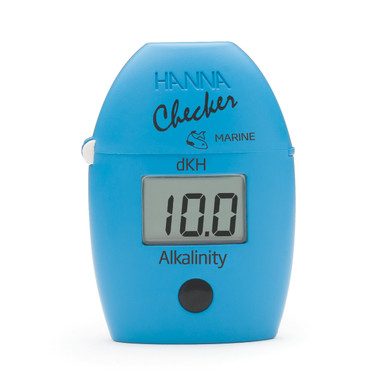
Hanna identifies the HI772 as a marine alkalinity Checker HC using a colorimetric method with an LED at 610 nm and silicon photocell. The manufacturer publishes a 0.0–20.0 dKH range, 0.1 dKH resolution and accuracy of ±0.3 dKH ±5% of reading at 25°C / 77°F. The workflow uses a 10 mL sample to zero the instrument, followed by exactly 1 mL of HI772S reagent and gentle inversion before the final reading.
Hanna also provides unusual traceability for a hobby instrument. HI772-26 replacement reagent is supplied for 25 tests and is marked with lot number and expiration information. The optional HI772-11 calibration-check set uses sealed standards and a certificate of analysis; Hanna describes the reference as 5.0 dKH ±0.3 at 25°C. Exact HI772 marketplace identity reconciles to Amazon.com ASIN B01G969YA0. A separate 2024 listing under B0D7K2B7RW is sold under WLR Industries/model w772 and is deliberately not used as the exact Hanna variant.
The strongest research pick because Hanna documents the full measurement chain: method, range, resolution, accuracy, sample procedure, reagent identity and independent calibration-check accessory.
Check price on Amazon →#2Best fine-resolution manual titration
Red Sea KH/Alkalinity Pro Reef Test Kit
Best for: reef keepers who prefer manual titration but want a fine published increment, controlled syringe workflow and approximately 75 tests per kit
What we like
- Dedicated reef alkalinity titration rather than a broad multi-parameter strip or color-comparison panel
- Red Sea states 0.05 meq/L / 0.14 dKH accuracy for the KH/Alkalinity Pro method
- 10 mL sample and syringe-based titrator provide finer volumetric control than one-drop-per-dKH kits
- Current kit code R21410 and refill code R21411 are documented by Red Sea; current US specialty distribution lists UPC 730773214105
- ARE21410 marketplace identity maps to ASIN B006L48WLI
What we don't
- The user still decides when the sample reaches the color endpoint, so lighting and endpoint consistency matter
- Syringe reading and titrant handling require more manual technique than a direct digital display
- The published method is tied to Red Sea's reagent/titrator workflow rather than being reagent-independent
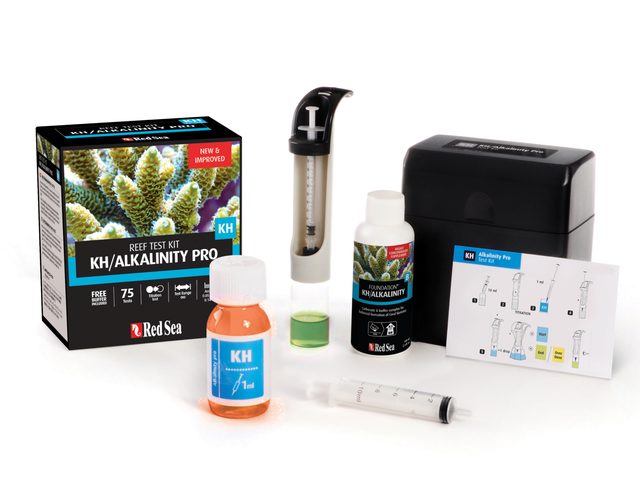
Red Sea's current KH/Alkalinity Pro documentation identifies product code R21410 and refill R21411. Red Sea describes the kit as an advanced reef titration method with accuracy of 0.05 meq/L, equivalent to 0.14 dKH. The procedure uses exactly 10 mL of aquarium water, a 1 mL titration syringe and the supplied titrator. The user adds titrant while swirling and stops at the documented endpoint color, then derives alkalinity from titrant volume.
That is a different error model from Hanna's digital colorimeter. The syringe gives fine volumetric control, but the endpoint remains a visual decision. Red Sea says the kit performs about 75 tests. Current US specialty distribution lists UPC 730773214105 for the kit, while indexed marketplace evidence maps ARE21410 / R21410 to Amazon.com ASIN B006L48WLI.
The strongest manual titration pick: fine manufacturer-stated 0.14 dKH accuracy and a purpose-built titrator, with the main limitation being human endpoint recognition.
Check price on Amazon →#3Best simple drop-count option
API KH / Carbonate Hardness Test Kit
Best for: reef or marine users who want a straightforward low-complexity KH check and accept a coarser 1 dKH drop-count step
What we like
- Simple drop-count titration with one KH reagent bottle and one test tube
- API explicitly documents use for carbonate hardness in fresh and saltwater aquariums and notes marine/reef relevance
- Standard procedure uses a 5 mL sample and a blue-to-yellow endpoint
- Each reagent drop corresponds to 1 dKH / 17.9 ppm KH in the documented method
- Exact API model 59 marketplace identity maps to ASIN B003SNDDAU
What we don't
- 1 dKH per drop is substantially coarser than Hanna's 0.1 dKH display resolution or Red Sea's stated 0.14 dKH titration accuracy
- Drop size depends on holding the bottle vertically and following the exact technique
- Color endpoint remains visual and there is no comparable published calibration-check standard
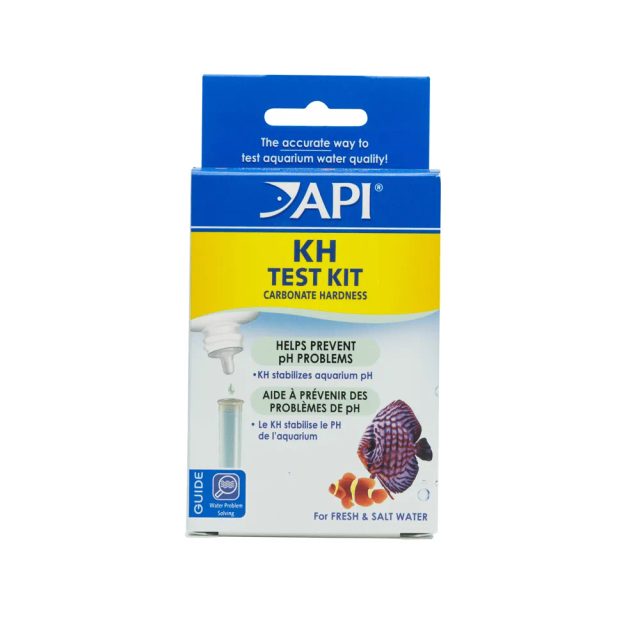
API identifies this dedicated product as the KH / Carbonate Hardness Test Kit and documents it for freshwater and saltwater aquariums, including marine systems where carbonate hardness matters to reef husbandry. The procedure uses a 5 mL sample. Reagent is added one vertical drop at a time, with inversion after each drop, until the color changes from blue to yellow. The drop count is the result; the documented conversion is one drop = 1 dKH = 17.9 ppm KH.
That coarse step can be entirely adequate for a simple trend check, but it should not be presented as having the same granularity as a 0.1 dKH digital display or a fine syringe titration. Exact API model 59 identity reconciles to Amazon.com ASIN B003SNDDAU.
The simple baseline option: easy to understand and identity-clean, but intentionally scored lower because the method resolves alkalinity in much larger 1 dKH steps.
Check price on Amazon →Alkalinity is one of the measurements that can directly affect how a reef keeper interprets water changes and supplementation, but the test itself is only one part of that control loop.
Use the reef salt mix guide to understand what alkalinity the replacement water may introduce, the reef calcium tester guide and reef magnesium tester guide for paired foundation-chemistry measurement decisions, the reef phosphate tester guide and reef nitrate tester guide for separate nutrient measurement decisions, the aquarium dosing-pump guide for repeatable delivery after demand is established, the aquarium water-parameters guide for broader chemistry context, the aquarium water-test-kit guide for general panels, and the aquarium maintenance schedule for a repeatable logging routine.
How we researched and scored
PetGearReport has not physically tested these alkalinity testers, compared results against a certified laboratory method, measured repeatability across different users, quantified endpoint-reading error, aged reagents or independently verified manufacturer accuracy claims.
The displayed number is a PetGearReport research score, not a hands-on result, Amazon/customer rating or laboratory certification.
- Measurement resolution & published accuracy — 30% — manufacturer-stated range, resolution/increment and accuracy where published.
- Endpoint/readability & operator dependence — 25% — how much the method depends on subjective color-endpoint interpretation, optical handling or drop counting.
- Reagent/calibration traceability — 20% — reagent identification, lot/expiration traceability and calibration/check standards where available.
- Workflow & repeatability — 15% — sample-volume control, number of manual steps and how clearly the manufacturer constrains technique.
- Exact identity & documentation — 10% — model/product code/UPC evidence reconciled to the exact marketplace ASIN.
| Alkalinity tester | Resolution/accuracy 30% | Endpoint/readability 25% | Reagent/calibration 20% | Workflow 15% | Identity 10% | Weighted | Score |
|---|---|---|---|---|---|---|---|
| Hanna HI772 | 10 | 10 | 10 | 9 | 10 | 9.85 | 10/10 |
| Red Sea KH/Alkalinity Pro | 9 | 8 | 9 | 9 | 10 | 8.85 | 9/10 |
| API KH / Carbonate Hardness | 6 | 6 | 6 | 9 | 10 | 7.05 | 7/10 |
The decimal makes the weighting auditable. It does not imply laboratory precision.
Digital is not automatically more accurate
Hanna replaces the human color endpoint with an optical detector and digital result. That reduces one source of interpretation error, but it does not remove sample-preparation error.
A colorimeter can still be affected by:
- dirty, scratched or fingerprinted cuvettes;
- bubbles or inconsistent cuvette orientation;
- wrong sample or reagent volume;
- expired or contaminated reagent;
- incomplete mixing;
- instrument/check-standard issues.
Manual titration has a different limitation: the operator decides when the endpoint has been reached. A well-controlled syringe titration can use fine volumetric increments even though the final color decision is visual.
So digital is not automatically more accurate. The correct comparison is published accuracy, method, endpoint behavior, consumable traceability and repeatability.
Resolution and accuracy are different
Hanna’s HI772 is the clearest example.
The display resolution is 0.1 dKH. The manufacturer accuracy specification is ±0.3 dKH ±5% of reading at 25°C / 77°F.
Those are not the same claim.
Red Sea states 0.05 meq/L / 0.14 dKH accuracy for KH/Alkalinity Pro. API’s drop-count workflow changes in 1 dKH increments because each drop corresponds to one degree of carbonate hardness.
That difference matters if the purpose is to detect small day-to-day consumption in a reef rather than simply identify a broad low/normal/high trend.
Hanna HI772: digital colorimetric workflow
The HI772 uses a colorimetric reaction. Hanna documents an LED at 610 nm and a silicon photocell.
The sequence is tightly defined:
- place 10 mL of untreated sample in a clean cuvette;
- insert it and zero the Checker;
- remove it and add exactly 1 mL of HI772S alkalinity reagent;
- cap and gently invert five times;
- return the cuvette to the instrument for the result.
The dedicated HI772-26 replacement reagent set covers 25 tests. Hanna states the reagent is marked with a lot number and expiration information.
For instrument verification, Hanna sells the HI772-11 calibration-check set. It includes sealed standards and a certificate of analysis with lot, reference value and expiration information. This is a check of the instrument’s response; it is not a replacement for correct reagent/sample technique.
Red Sea: fine manual titration
Red Sea KH/Alkalinity Pro uses a controlled syringe titration.
The manufacturer procedure starts with a 10 mL sample, fills the 1 mL titration syringe and adds titrant while the sample is mixed. Near the endpoint, titrant is added more slowly until the specified color endpoint is reached.
The syringe scale and calculation table provide much finer measurement than a one-drop-per-dKH method. Red Sea states accuracy of 0.05 meq/L / 0.14 dKH and approximately 75 tests per kit.
The remaining limitation is operator dependence: lighting, color vision, overshooting the endpoint and syringe reading can still alter the reported result.
API: simple 1 dKH drop counting
API’s dedicated model 59 KH / Carbonate Hardness Test Kit is intentionally simpler.
The test uses a 5 mL sample. Hold the reagent bottle vertically, add one drop at a time, invert after each drop and count until the sample reaches the yellow endpoint.
Each drop represents 1 dKH / 17.9 ppm KH.
That is easy to explain and useful for broad monitoring, but it is a much coarser step than the other two methods. This guide therefore does not score API as if “liquid reagent” alone implied high resolution.
Reagents are part of the measurement system
A tester is not just the meter, syringe or vial.
For Hanna, reagent age and volume directly affect the colorimetric reaction. Lot and expiration traceability are therefore useful.
For Red Sea and API, dropper/titrant condition, bottle orientation, contamination and storage can affect repeatability.
General safeguards:
- use the exact reagent intended for the kit;
- observe expiration/storage instructions;
- rinse and dry equipment as directed;
- do not return used/contaminated sample to reagent containers;
- replace damaged syringes, tips, vials or cuvettes;
- repeat an implausible result before making a large chemistry correction.
Measurement does not decide the dose
An alkalinity tester tells you what the method measured. Measurement does not decide the dose.
To adjust a reef responsibly, combine repeated measurements with:
- the aquarium’s normal alkalinity trend;
- livestock and husbandry guidance;
- the alkalinity of newly mixed saltwater;
- water-change volume and frequency;
- calcium reactor, kalkwasser or two-part inputs;
- measured demand over time.
Our reef dosing methods guide compares two-part, all-in-one, kalkwasser and calcium-reactor control trade-offs after demand is established. If a CO2 reactor is the chosen architecture, the reef calcium reactor guide keeps reactor capacity, effluent control and monitoring separate from the chemistry target. The dosing-pump guide then keeps automation separate from the chemistry decision. A dosing pump can repeat a wrong instruction just as consistently as a correct one. Once two comparable alkalinity readings establish a real decline, the reef dosing calculator can normalize that measured consumption and scale the exact supplement label potency without choosing a target for you.
If you change salt mix, water-change volume or supplementation strategy, re-establish measured demand rather than assuming the old dose remains correct.
Why Salifert and NYOS are not affiliate picks in this edition
Both deserve mention on technical grounds.
Salifert KH/Alk has current manufacturer documentation describing a 0.1 meq/L / 0.3 dKH measurement step and approximately 100–200 tests. The affiliate identity is the problem: current indexed US evidence splits between B001EJ3DOG (with GTIN 8714079130354) and a separate current US ASIN B079ZK1XW1 for the same nominal product. We are not treating those as interchangeable without a cleaner current variant reconciliation.
NYOS Alkalinity has strong current first-party documentation: seawater-specific titration, approximately 50 tests, calibrated dropper, reagent QC and a direct syringe/KH workflow. We did not find a current Amazon.com ASIN with enough exact identity evidence to meet the same gate.
They are not ranked because of marketplace identity evidence, not because PetGearReport tested them and found them worse.
No Amazon price, stock or availability claim is made in this guide because those values can change independently of the editorial comparison.
Sources
- Hanna Instruments — HI772 Marine Alkalinity Checker — range, resolution, accuracy, colorimetric method, ordering information and reagent/calibration accessories.
- Hanna Instruments — HI772 manual — 10 mL sample, 1 mL reagent procedure and instrument specifications.
- Hanna Instruments — HI772-26 reagent — 25-test reagent set, lot and expiration traceability.
- Hanna Instruments — HI772-11 calibration-check set — 5.0 dKH reference and certificate-of-analysis traceability.
- Red Sea — How to use KH/Alkalinity Pro — titration method and 0.05 meq/L / 0.14 dKH manufacturer accuracy statement.
- Red Sea — KH/Alkalinity Pro SDS — product codes R21410 and R21411.
- API Fishcare — KH / Carbonate Hardness Test Kit — current product use, fresh/saltwater context, kit contents and 5 mL workflow.
- Salifert — KH/Alk — 0.1 meq/L / 0.3 dKH step and approximate test count; reference only, not ranked.
- NYOS — Alkalinity Test Kit — current seawater titration/QC documentation; reference only, not ranked.
Frequently asked questions
Is a digital alkalinity checker always more accurate than a titration kit?
No. Digital is not automatically more accurate. Hanna HI772 publishes a numerical accuracy specification and removes manual endpoint reading, but optical cleanliness, reagent volume, bubbles and sample handling still matter. Red Sea's manual titration publishes a fine 0.14 dKH accuracy figure but requires the user to identify the color endpoint. Compare the entire measurement method, not the display format.
What is the difference between resolution and accuracy?
Resolution is the smallest increment displayed or resolved by the method; accuracy describes how close the result is expected to be under specified conditions. Hanna shows 0.1 dKH resolution but publishes ±0.3 dKH ±5% accuracy at 25°C. A smaller displayed step does not automatically mean the measurement is accurate to that same step.
How often should I replace alkalinity test reagents?
Follow the exact reagent label and manufacturer storage/expiration instructions. Hanna HI772-26 reagent includes lot number and expiration information for traceability. Do not assume a reagent remains valid indefinitely just because the bottle still contains liquid.
Should I change my alkalinity dose immediately after one surprising reading?
A measurement does not decide the dose. If a result is surprising, repeat the test carefully, inspect the kit/instrument and reagents, and consider recent salt mix, water changes and dosing events before making a large correction. Dosing should follow confirmed testing and measured demand rather than a single unexplained result.
Why are Salifert and NYOS not ranked here?
This edition uses an exact Amazon.com identity gate for affiliate picks. Salifert's KH/Alk product has strong manufacturer documentation, but current indexed US-market evidence splits across ASIN B001EJ3DOG and B079ZK1XW1 without a clean enough current variant reconciliation for our standard. NYOS has strong current manufacturer documentation for its seawater alkalinity kit but we did not find sufficiently clean current Amazon.com ASIN evidence. They are not ranked for identity reasons, not because PetGearReport found them technically inferior.