Best Reef Salt Mixes: 4 Picks by Alkalinity, Mixing & Chemistry
The best reef salt mix is not the one with the highest alkalinity, calcium or magnesium number. It is the one whose chemistry profile, mixing procedure and salinity reference fit the reef system you are actually maintaining. We researched four exact marketplace variants using current manufacturer documentation, published mixing instructions, chemistry ranges, package/yield information, quality-control disclosures and exact product identity. PetGearReport has not physically tested these salts, mixed independent batches, sent samples for laboratory analysis, measured residue, verified dissolution time, or independently verified manufacturer chemistry or quality-control claims.
| Rank | Product | Score | Best for | Link |
|---|---|---|---|---|
| #1 | Tropic Marin Pro-Reef 10 kgBest documented balanced-profile pick | 10 | reef keepers who want a well-documented lower-alkalinity profile, clear 25°C salinity reference and a salt that can fit systems already maintained near that chemistry | Check price → |
| #2 | Aquaforest Reef Salt 22 kgBest batch-transparency pick | 10 | reef keepers who prioritize salinity-specific chemistry tables and unusually visible manufacturer batch-analysis/QC information | Check price → |
| #3 | Red Sea Coral Pro Salt 22 kg / 175 galBest high-alkalinity option | 9 | reef systems intentionally operated around a high-alkalinity chemistry strategy where the replacement water is meant to land close to that established range | Check price → |
| #4 | Instant Ocean Reef Crystals 160 galBest straightforward enriched mix | 8 | reef keepers who prefer a straightforward established enriched reef mix and are comfortable verifying the finished chemistry themselves | Check price → |
#1 · Our PickBest documented balanced-profile pick
Tropic Marin Pro-Reef 10 kg
Best for: reef keepers who want a well-documented lower-alkalinity profile, clear 25°C salinity reference and a salt that can fit systems already maintained near that chemistry
What we like
- Tropic Marin publishes a 32–35 ppt mixing range and explicit 25°C / 77°F specific-gravity reference
- Manufacturer material around Pro-Reef documents a lower-alkalinity reef profile near 7.5 dKH with 440 ppm calcium and 1350 ppm magnesium
- 10 kg package identity is explicit as article 10551 / UPC 619106105511
- Container guidance publishes a 250–300 L / 66–80 US-gal preparation range rather than one context-free yield number
- Exact 10551 marketplace identity maps to ASIN B000WDT5GU
What we don't
- The published chemistry numbers should be treated as manufacturer targets/context, not an independent guarantee for every bucket
- Lower alkalinity is not automatically better for every reef any more than higher alkalinity is
- Users still need to verify finished salinity and relevant reef chemistry before a significant water change
Tropic Marin identifies the 10 kg Pro-Reef bucket as article 10551; indexed marketplace identity for that exact package includes UPC 619106105511 and Amazon.com ASIN B000WDT5GU. The current Pro-Reef instructions call for 37–40 g per liter, or roughly 140–150 g per US gallon, to prepare 32–35 ppt seawater under circulation. The manufacturer says the solution can be used once the salt is completely dissolved and clear, and gives a 1.025–1.027 specific-gravity reference at 25°C / 77°F.
Tropic Marin has also published a reef-system target profile described as similar to Pro-Reef: 7.5 dKH alkalinity, 440 ppm calcium and 1350 ppm magnesium. We use those figures as manufacturer chemistry context, not as a PetGearReport batch guarantee. The key fit question is whether that lower-alkalinity profile is close to the aquarium's established operating range and dosing strategy.
Our top research pick because the current documentation is unusually complete across chemistry context, mixing concentration, salinity reference, container yield and exact package identity.
Check price on Amazon →#2Best batch-transparency pick
Aquaforest Reef Salt 22 kg
Best for: reef keepers who prioritize salinity-specific chemistry tables and unusually visible manufacturer batch-analysis/QC information
What we like
- Aquaforest publishes salinity-specific alkalinity, calcium and magnesium ranges instead of one chemistry number without context
- At 35 ppt the manufacturer guide lists 7.7–8.3 dKH, 440–460 ppm calcium and 1360–1420 ppm magnesium
- Current instructions specify demineralized water near 24°C / 75°F and about 15 minutes of vigorous mixing
- Aquaforest states that each production batch is sampled and analyzed with two ICP-OES instruments and publishes batch results
- Exact 22 kg identity 5902026730150 maps to ASIN B0168K0ERY
What we don't
- The current step-by-step mixing recipe is centered on 33 ppt, while the chemistry table also publishes values at 30, 33 and 35 ppt, so users must keep the reference salinity straight
- Manufacturer batch-analysis claims have not been independently verified by PetGearReport
- Amino-acid/vitamin formulation differences may not matter equally to every reef-management approach
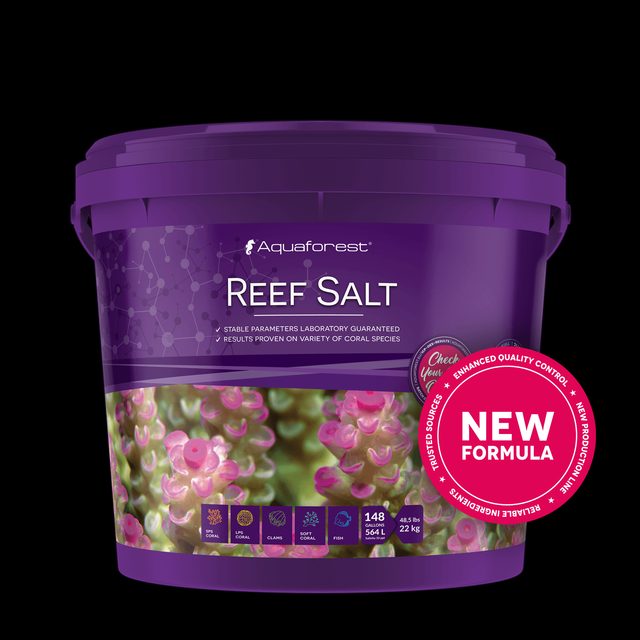
Aquaforest's current Reef Salt page covers multiple package sizes including 22 kg, and indexed marketplace identity for the 22 kg package maps manufacturer identifier 5902026730150 to Amazon.com ASIN B0168K0ERY. The manufacturer instructs users to start with demineralized water around 24°C / 75°F, add about 390 g to 10 L for 33 ppt, stir vigorously for about 15 minutes until clear, and verify salinity with a refractometer. Aquaforest also says stored mixed saltwater should have salinity rechecked before use.
The manufacturer's reef-salt table publishes, at 35 ppt, alkalinity of 7.7–8.3 dKH, calcium of 440–460 ppm and magnesium of 1360–1420 ppm. Aquaforest further states that it takes three samples from each 600 kg production batch and analyzes micro- and macro-elements using two ICP-OES spectrometers, with results made available online. PetGearReport has not independently verified that laboratory process or the result of any specific batch.
Nearly tied for first: the strongest QC/transparency evidence in this group, with a small scoring deduction only because the main mixing recipe and the 35 ppt chemistry table require careful reference matching.
Check price on Amazon →#3Best high-alkalinity option
Red Sea Coral Pro Salt 22 kg / 175 gal
Best for: reef systems intentionally operated around a high-alkalinity chemistry strategy where the replacement water is meant to land close to that established range
What we like
- Red Sea explicitly positions Coral Pro as its high-alkalinity reef salt rather than implying one salt profile fits every tank
- Current product documentation centers the formula around approximately 12 dKH alkalinity
- The current manual publishes chemistry ranges separately at 34 and 35 ppt
- Red Sea says the current formula takes about 20 minutes from bucket to tank when mixed as directed
- Exact 22 kg / 175-gal model 306004 / UPC 730773112302 maps to ASIN B000YJ2XCU
What we don't
- A 12 dKH profile can create an unnecessarily large alkalinity change in a reef normally maintained much lower
- High foundation-element levels should not be used as a substitute for measuring the aquarium before and after water changes
- Manufacturer coral-growth claims are not treated as independent PetGearReport performance evidence
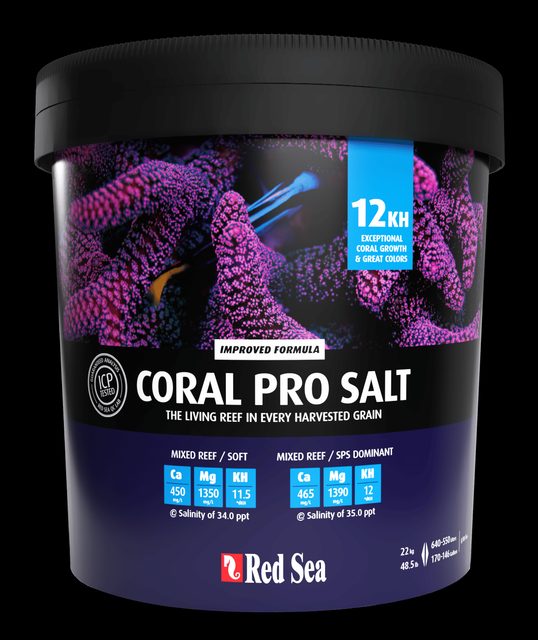
Red Sea currently describes Coral Pro as its premium high-alkalinity salt and states an alkalinity of 12 dKH. Its current manual gives, for an SPS-dominant mixed reef at 35 ppt, 11.5–12.5 dKH alkalinity, 450–480 mg/L calcium and 1350–1430 mg/L magnesium. The product page says the improved formula takes about 20 minutes from bucket to tank when prepared according to its procedure.
The exact 22 kg / 175-gallon marketplace package is model 306004, UPC 730773112302, mapped to Amazon.com ASIN B000YJ2XCU. This higher chemistry profile is a use-case distinction, not an automatic advantage. A large water change with replacement water far above the display's normal alkalinity can move the system in a direction the keeper did not intend.
The deliberate high-alk pick, not a universal winner: excellent documentation and mixing guidance, but chemistry fit matters more than the magnitude of the numbers.
Check price on Amazon →#4Best straightforward enriched mix
Instant Ocean Reef Crystals 160 gal
Best for: reef keepers who prefer a straightforward established enriched reef mix and are comfortable verifying the finished chemistry themselves
What we like
- Instant Ocean explicitly formulates Reef Crystals for reef aquariums and describes extra calcium, trace elements and vitamins relative to its base sea-salt approach
- Manufacturer provides a simple small-batch starting instruction of one-half cup per US gallon
- Manufacturer says the solution may be used immediately after mixing but suggests aeration until oxygen/carbon-dioxide equilibrium
- Exact 160-gal package model AQ-RC1160P-10 / UPC 051378017060 maps to ASIN B000HCLNQG
- Long-established exact package identity is easy to reconcile
What we don't
- Current first-party public documentation is less explicit about alkalinity/calcium/magnesium numeric ranges than the other three picks
- A 160-gallon package label does not guarantee 160 gallons at every chosen target salinity
- Users who need a narrowly defined chemistry profile should measure the finished mix instead of inferring it from the enriched-formulation description
Instant Ocean's current Reef Crystals page describes an enriched reef formulation with extra calcium, trace elements and vitamins. For small quantities, the manufacturer starts with one-half cup per US gallon, instructs users to stir vigorously, and notes that the solution can be used immediately while suggesting aeration until oxygen/carbon-dioxide equilibrium.
The exact 160-gallon marketplace package is model AQ-RC1160P-10, UPC 051378017060, mapped to Amazon.com ASIN B000HCLNQG. We do not infer a guaranteed alkalinity, calcium or magnesium value where the current manufacturer page does not publish one. The package yield is a preparation label, not proof of the exact volume produced at every salinity target.
A practical documented option with strong identity and simple instructions, ranked lower because current first-party chemistry/QC disclosure is less quantitative than the leading salts.
Check price on Amazon →A reef salt mix is part of the aquarium’s chemistry-control system, not merely a way to make freshwater salty.
The dry mix determines the chemistry of newly prepared seawater. A water change then blends that new water with the display. That is why two salts mixed to the same 35 ppt salinity can still create different alkalinity, calcium and magnesium inputs.
For the preparation chain, use an aquarium RO/DI system for suitable base water, follow the reef saltwater mixing guide for the step-by-step preparation sequence, use the reef phosphate tester guide when low-range nutrient measurement is part of the post-mix reef monitoring plan, a calibrated aquarium salinity tester for the finished concentration, the reef refractometer calibration guide when checking that instrument, the aquarium water-parameters guide for interpreting chemistry, the aquarium dosing-pump guide when measured demand justifies automated supplements, and the aquarium maintenance schedule to keep actual water changes separate from evaporation top-off. If two salt products publish different salinity-reference units, salinity vs specific gravity explains ppt/PSU/SG conventions before you compare their chemistry tables.
How we researched and scored
PetGearReport has not physically tested these salts, mixed independent production lots, measured dissolution residue, sent samples for ICP analysis, measured long-term storage changes or verified manufacturer chemistry claims against an external laboratory.
The displayed number is a PetGearReport research score, not a hands-on result, customer rating or laboratory result.
- Chemistry/profile fit — 30% — clarity of alkalinity, calcium, magnesium and intended reef use without rewarding high numbers merely for being high.
- Mixing/reference procedure — 25% — explicit water temperature, dry-salt ratio, mixing/circulation time or endpoint, and instructions for when the mix is ready.
- Salinity/yield documentation — 20% — clear salinity or specific-gravity reference plus package/yield context that can be interpreted rather than copied blindly.
- QC/transparency — 15% — manufacturer disclosure around raw materials, batch testing, analysis or other quality controls; these remain manufacturer claims unless independently verified.
- Exact identity — 10% — package SKU/model/UPC/EAN reconciled to the exact marketplace ASIN.
| Reef salt | Chemistry 30% | Mixing 25% | Salinity/yield 20% | QC 15% | Identity 10% | Weighted | Score |
|---|---|---|---|---|---|---|---|
| Tropic Marin Pro-Reef 10 kg | 10 | 10 | 10 | 9 | 10 | 9.85 | 10/10 |
| Aquaforest Reef Salt 22 kg | 10 | 10 | 9 | 10 | 10 | 9.80 | 10/10 |
| Red Sea Coral Pro 22 kg | 9 | 10 | 10 | 9 | 10 | 9.45 | 9/10 |
| Instant Ocean Reef Crystals 160 gal | 7 | 8 | 8 | 6 | 10 | 7.60 | 8/10 |
The decimals make the scoring method auditable. They do not imply lab precision.
Higher alkalinity is not automatically better
A salt around 12 dKH is not automatically more advanced than one around 7.5 dKH.
The relevant question is: what happens when the new water is blended into this aquarium?
If a reef normally runs close to 7–8 dKH, a large water change made with a much higher-alkalinity mix can move the display upward. If a system is intentionally operated at a higher alkalinity, lower-alkalinity replacement water can move it the other way.
The same logic applies to calcium and magnesium. A salt’s chemistry profile should work with:
- the display’s current measured parameters;
- the target range chosen for the actual livestock and husbandry method;
- water-change size and frequency;
- calcium/alkalinity/magnesium dosing or reactor input;
- the exact salt manufacturer’s intended salinity.
Our aquarium dosing-pump guide explains why automated dosing should follow measured demand. Changing salt profile can change that demand.
Published chemistry only makes sense with a salinity reference
Comparing dKH or calcium numbers while ignoring salinity is misleading.
For example:
- Tropic Marin publishes Pro-Reef preparation around 32–35 ppt and has published a target profile similar to Pro-Reef of about 7.5 dKH, 440 ppm calcium and 1350 ppm magnesium.
- Aquaforest publishes separate chemistry ranges by salinity; at 35 ppt its Reef Salt table lists 7.7–8.3 dKH, 440–460 ppm calcium and 1360–1420 ppm magnesium.
- Red Sea identifies Coral Pro around 12 dKH, while its current manual gives 11.5–12.5 dKH for the 35 ppt SPS-dominant reference.
Those numbers are not interchangeable batch guarantees. They are manufacturer-published chemistry context under the specified preparation conditions.
Instant Ocean’s current Reef Crystals product page emphasizes an enriched formulation but does not publish the same current numeric alkalinity/calcium/magnesium table. We therefore score it lower on chemistry transparency rather than inventing values from old forum posts or retailer copy.
Mixing procedure matters as much as the formula
A reef-salt comparison should not reduce preparation to “add salt until 35 ppt.”
Tropic Marin Pro-Reef
Current Tropic Marin instructions use approximately 37–40 g/L under circulation for a 32–35 ppt target and say the water is usable when the salt is fully dissolved and clear. The manufacturer gives a specific-gravity reference of 1.025–1.027 at 25°C / 77°F.
Aquaforest Reef Salt
Aquaforest says to start with demineralized water near 24°C / 75°F, use about 390 g per 10 L for a 33 ppt reference, mix vigorously for about 15 minutes until clear, then verify salinity. If mixed water is stored, Aquaforest says to recheck salinity before use.
Red Sea Coral Pro
Red Sea’s current Coral Pro page says the current formula takes about 20 minutes from bucket to tank when mixed according to its procedure. The current manual ties its chemistry table to specific salinities and dry-salt mixing ratios.
Instant Ocean Reef Crystals
Instant Ocean gives a small-batch starting point of 1/2 cup per US gallon, says to stir vigorously, and notes that the solution may be used immediately while suggesting aeration until oxygen/carbon-dioxide equilibrium.
Follow the exact product instructions. A different salt’s mixing time, temperature, storage recommendation or dry-mix ratio is not transferable just because both products target reef aquariums.
Yield is not a universal gallons-per-bucket guarantee
“160 gallons” or “175 gallons” is useful package context, but yield does not guarantee the same finished volume at every target salinity.
Tropic Marin makes the relationship visible by giving its 10 kg package as roughly 250–300 L / 66–80 US gallons while also documenting a 32–35 ppt preparation range.
Red Sea labels the exact Coral Pro package here as 22 kg / 175 gallons, and Reef Crystals is sold in the exact 160-gallon package. The actual amount of dry salt used per unit of source water still depends on the intended concentration and product instructions.
Use the label to estimate purchasing needs. Use an actual salinity tester to decide whether the finished batch reached the target salinity.
Product notes
Tropic Marin Pro-Reef 10 kg — B000WDT5GU
Exact package identity:
- article 10551;
- UPC 619106105511;
- indexed Amazon.com ASIN B000WDT5GU.
This is the strongest all-around documentation set in the group. It combines explicit concentration guidance, a 25°C specific-gravity reference, container-yield ranges and manufacturer chemistry context around a lower-alkalinity reef profile.
The important qualification is that 7.5 dKH / 440 ppm / 1350 ppm should be treated as manufacturer context around Pro-Reef, not a PetGearReport certificate for the exact bucket on your floor.
Aquaforest Reef Salt 22 kg — B0168K0ERY
Exact package identity:
- manufacturer/EAN-style identifier 5902026730150;
- indexed Amazon.com ASIN B0168K0ERY.
Aquaforest is the transparency leader here. The company says each salt production batch is sampled and analyzed with two ICP-OES spectrometers and that results are made available online.
That is unusually useful disclosure, but PetGearReport does not independently verify the manufacturer laboratory process or any individual batch result.
Red Sea Coral Pro Salt 22 kg / 175 gal — B000YJ2XCU
Exact package identity:
- model 306004;
- UPC 730773112302;
- indexed Amazon.com ASIN B000YJ2XCU.
Coral Pro is intentionally the high-alkalinity option. Red Sea’s own product family distinguishes its moderate-alkalinity salt from Coral Pro at roughly 12 dKH.
That distinction is why Coral Pro belongs in this comparison, but it is also why it should not be recommended simply because its alkalinity number is larger.
Instant Ocean Reef Crystals 160 gal — B000HCLNQG
Exact package identity:
- model AQ-RC1160P-10;
- UPC 051378017060;
- indexed Amazon.com ASIN B000HCLNQG.
Reef Crystals has a straightforward current manufacturer procedure and exact identity evidence. Its lower score reflects the current public documentation: Instant Ocean does not give the same detailed contemporary alkalinity/calcium/magnesium table or batch-QC disclosure shown by the three products above.
That is an evidence difference, not a hands-on claim that the salt performs worse.
A safe preparation workflow
A repeatable reef water-change workflow is:
- prepare suitable source water; if you make it yourself, the RO/DI systems guide explains source-water and monitoring boundaries;
- measure the source-water volume rather than guessing from container markings when precision matters;
- add the exact salt according to that manufacturer’s procedure;
- mix at the temperature and for the time/endpoint specified by the product;
- verify finished salinity with a maintained, calibrated method;
- when the water change is large or the salt profile is new, verify relevant alkalinity/calcium/magnesium rather than assuming a label value;
- compare the new-water chemistry with the display before making a large change;
- review dosing after meaningful changes in water-change chemistry or frequency.
No Amazon price, stock or availability claim is made in this guide because those values can change independently of the editorial comparison.
Sources
- Tropic Marin — Pro-Reef product information — preparation ratio, 32–35 ppt reference, readiness endpoint, 25°C specific-gravity reference and package sizes.
- Tropic Marin — Optimum Water Parameters — manufacturer reef-system target values described as similar to Pro-Reef.
- Aquaforest — Reef Salt — 24°C preparation, 33 ppt recipe, 15-minute mixing, salinity verification, storage guidance and ICP-OES batch-testing disclosure.
- Aquaforest — Product Guide — Reef Salt alkalinity/calcium/magnesium ranges by salinity.
- Red Sea — Coral Pro Salt — high-alkalinity positioning, 12 dKH context, current mixing-time claim and package sizes.
- Red Sea — Coral Pro Salt manual — chemistry ranges and dry-salt ratios by salinity.
- Instant Ocean — Reef Crystals — enriched formulation and current mixing/aeration instructions.
Frequently asked questions
Is higher alkalinity reef salt better?
No. Higher alkalinity is not automatically better. A salt near 12 dKH can be a deliberate fit for a reef operated around that profile, while a lower-alkalinity mix can better match another system. The safer decision is to minimize unintended chemistry swings by matching replacement water to the aquarium's established strategy.
Should I mix reef salt directly in the aquarium?
Follow the exact salt manufacturer's instructions. These products are documented around preparation in a separate container with source water, mixing or circulation and salinity verification before use. Do not use a roundup as a substitute for the instructions printed for the exact salt you purchased.
Does the gallon number on a salt bucket tell me exactly how much water it will make?
Treat the gallon figure as package-yield context, not a guarantee at every target salinity. The amount of dry mix needed per gallon changes with the intended salinity and the manufacturer's formulation. Verify the final salinity rather than assuming the label alone defines the finished concentration.
Do I still need to test salinity if I weigh the salt?
Yes. Weighing or measuring the dry mix improves repeatability, but the finished solution should still be checked according to the manufacturer's procedure. Source-water volume, measurement error, residual water in a container and evaporation can all change the final concentration.
How does reef salt interact with dosing?
A water change imports alkalinity, calcium, magnesium and other ions, so replacement-water chemistry can affect the measured demand that a dosing program is trying to replace. Keep dosing based on testing and measured consumption; do not assume the old dose is automatically correct after a meaningful change in salt profile or water-change routine.