Best Activated Carbon for Aquariums: 4 Picks by Format & Maintenance
Activated carbon is optional chemical media, not a requirement for every aquarium. We researched four current carbon products by documented media form, filter or bag fit, rinsing and replacement instructions, medication compatibility, evidence quality and exact Amazon.com identity. PetGearReport has not physically tested these products or measured adsorption capacity, odor removal, discoloration removal, phosphate release, flow resistance or service life.
| Rank | Product | Score | Best for | Link |
|---|---|---|---|---|
| #1 | Seachem MatrixCarbon 500 mLBest overall | 9 | Aquarists who want loose carbon with strong documentation for form, flow placement, rinsing and condition-dependent replacement | Check price → |
| #2 | Fluval Carbon A1440 (100 g, 3-Pack)Best pre-bagged canister option | 9 | Canister-filter owners who prefer ready-to-place 100 g bags and a simple manufacturer-defined monthly service schedule | Check price → |
| #3 | API SUPER ACTIVATED CARBON Filtration Pouch (1-Count, 729A)Best treatment-guidance clarity | 9 | Owners who want a single ready-to-use pouch with unusually explicit medication and replacement instructions | Check price → |
| #4 | Aquatic Experts Premium Activated Carbon (3 lb + Fine Mesh Bag)Best bulk loose-carbon kit | 8 | Multiple filters or larger refill needs where bulk loose carbon plus a suitable fine mesh bag is more practical than individual pouches | Check price → |
#1 · Our PickBest overall
Seachem MatrixCarbon 500 mL
Best for: Aquarists who want loose carbon with strong documentation for form, flow placement, rinsing and condition-dependent replacement
What we like
- Spherical bituminous-coal carbon has unusually detailed manufacturer documentation
- Seachem specifies filter-bag use, rinsing before use and placement in a high-flow area
- 500 mL is a current documented manufacturer size
- Manufacturer gives condition-dependent service-life guidance rather than one fixed calendar
- Exact Amazon.com 500 mL child was independently verified live
What we don't
- Loose media requires a suitable filter bag or retained chemical-media chamber
- Seachem performance comparisons are manufacturer claims, not PetGearReport test results
- The longer published service window should not be copied to other carbon brands
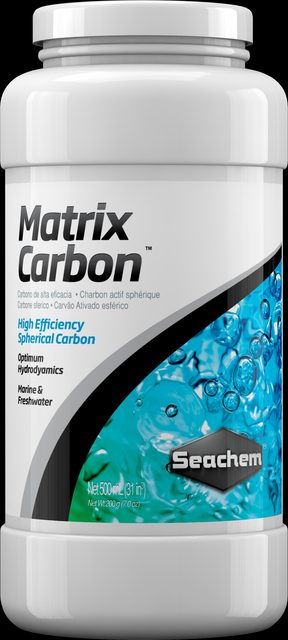
Seachem identifies MatrixCarbon as a spherical, bituminous-coal-based macroporous carbon. The company says the spherical form is intended to limit compacting and channeling and recommends placing the media where water flow through it is maximized. We treat those performance statements as manufacturer claims, not independent PetGearReport measurements. Directions specify using a filter bag and rinsing before use. Seachem says 250 mL can treat 100 US gallons for several months, while its FAQ emphasizes that actual life depends on initial water conditions and can vary widely. That product-specific variability is more useful than pretending all activated carbon shares one replacement schedule. Choose the 500 mL child when you have a secure chemical-media bag or chamber and want flexible loose media. Do not infer that its service-life guidance applies to Fluval, API or Aquatic Experts carbon.
Our strongest general-purpose research pick because its physical form and care instructions are documented more clearly than most loose carbon products.
Check price on Amazon →#2Best pre-bagged canister option
Fluval Carbon A1440 (100 g, 3-Pack)
Best for: Canister-filter owners who prefer ready-to-place 100 g bags and a simple manufacturer-defined monthly service schedule
What we like
- Current Fluval product identity is item A1440
- Three 100 g nylon bags reduce loose-media handling
- Fluval lists compatibility with all canister filters
- Current media instructions call for thorough rinsing and monthly replacement
- Exact Amazon.com child was independently verified live
What we don't
- Pre-bagged portions offer less dose flexibility than loose bulk carbon
- Monthly replacement is Fluval's product guidance, not a universal carbon rule
- Canister compatibility still does not override the exact filter's tray and flow instructions
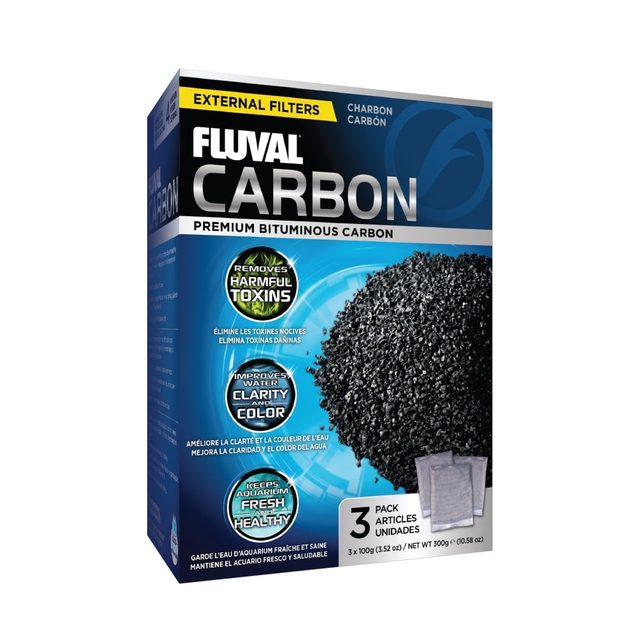
Fluval's current US page identifies A1440 as a 3-pack of 100 g carbon bags and lists compatibility with all canister filters. The manufacturer describes the carbon as low-ash and porous chemical media for selected dissolved contaminants, odors and discoloration. Fluval's filter-media instructions say to rinse carbon thoroughly before use and recommend a monthly change. That clarity is useful, but the schedule belongs to this product family; it is not evidence that every carbon product exhausts at four weeks. Choose A1440 when pre-bagged handling and predictable service steps matter more than custom dosing. Follow the exact canister's media-loading diagram so the bag sits in the intended water path without obstructing flow.
The easiest documented pre-bagged choice in this shortlist, with current A1440 identity, canister compatibility and explicit maintenance instructions.
Check price on Amazon →#3Best treatment-guidance clarity
API SUPER ACTIVATED CARBON Filtration Pouch (1-Count, 729A)
Best for: Owners who want a single ready-to-use pouch with unusually explicit medication and replacement instructions
What we like
- Pre-dosed pouch avoids measuring loose carbon
- API explicitly documents removal during fish-remedy dosing
- Manufacturer says to rinse the pouch, place it in the filter's water path and replace monthly or sooner when conditions warrant
- Freshwater, saltwater and reef use is documented
- Exact Amazon.com 729A child was independently verified live
What we don't
- One pouch is less flexible than bulk media for unusual chamber sizes
- Monthly replacement is API-specific guidance
- Carbon can remove dosed remedies, so treatment instructions take priority over routine filtration
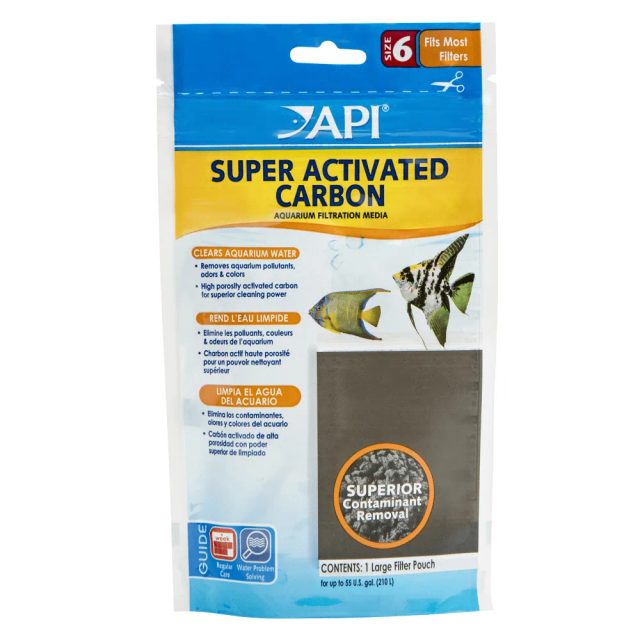
API's current documentation positions SUPER ACTIVATED CARBON as a pre-dosed filtration pouch. The directions say to rinse the pouch to remove loose dust, put it in the filter's flow path and replace it monthly or sooner when stocking or color/odor conditions justify earlier service. The strongest differentiator is medication guidance. API explicitly notes that adsorptive filter media can remove dosed fish remedies and tells users to remove such media while dosing. That makes the product easier to use safely around a treatment plan, provided the treatment label remains authoritative. Choose the 729A pouch when clear instructions and minimal loose-carbon handling are priorities. Carbon is not a disease treatment, and a filtration guide is not a substitute for diagnosis or veterinary/aquatic-health advice when fish are ill.
The clearest treatment-sensitive option because API directly tells users to remove adsorptive media while dosing fish remedies and documents when to reinstall or replace it.
Check price on Amazon →#4Best bulk loose-carbon kit
Aquatic Experts Premium Activated Carbon (3 lb + Fine Mesh Bag)
Best for: Multiple filters or larger refill needs where bulk loose carbon plus a suitable fine mesh bag is more practical than individual pouches
What we like
- Exact Amazon.com child includes 3 lb of carbon plus a fine mesh bag
- Manufacturer explains that the small granules require fine mesh retention
- Aquatic Experts says to rinse briefly before use because shipping can create dust
- Bulk format is useful when several filters or repeated refills need loose carbon
- Current manufacturer FAQ explains bag compatibility and preparation
What we don't
- Small granules need careful containment in a sufficiently fine bag
- Manufacturer documentation does not give the same clear replacement interval as Fluval or API
- Bulk quantity is unnecessary for owners who only need one small pre-bagged portion
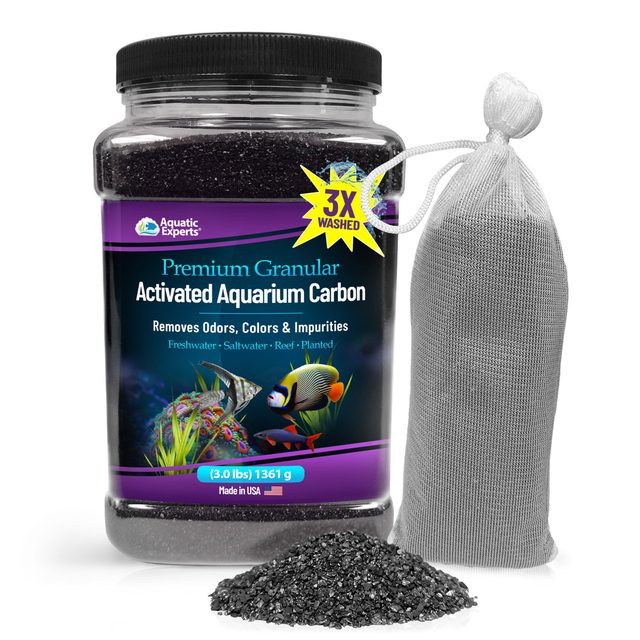
Aquatic Experts describes its premium carbon as intentionally small granules and says a very fine mesh media bag is required. The exact B07577R4S9 Amazon.com child combines a 3-lb bulk quantity with a fine mesh bag, which makes the format meaningfully different from the pre-bagged Fluval and API picks. The manufacturer also says carbon dust can develop as pieces rub during shipping and recommends a short rinse before use. Its FAQ gives useful bag-selection guidance, but we did not find an equally explicit product-specific replacement interval on the current page. Choose this kit when bulk refill flexibility is the main requirement and the filter has room for a securely closed fine-mesh bag. Do not pack the bag so tightly or place it so poorly that water simply bypasses the media.
The bulk-format specialist: good preparation and containment guidance, but weaker product-specific replacement timing keeps it behind the first three.
Check price on Amazon →How we researched and scored
PetGearReport has not physically tested these activated-carbon products, measured adsorption capacity, real-world odor or discoloration removal, phosphate release, installed flow resistance, dust generation or service life. We compared current manufacturer documentation, exact Amazon.com product identity, media format, bag/filter fit, rinsing and replacement instructions, medication guidance and use-case differentiation. Current Amazon prices, star ratings, review counts and popularity are not scoring inputs.
The four exact Amazon.com variants represented here were directly checked on September 13, 2026. The displayed 1-10 number is a PetGearReport research score, rounded from the same weighted categories for each product:
- Chemical-media role & documentation — 30%: clarity about what the carbon is, how the manufacturer intends it to be used and which claims are product-specific.
- Format, bag/filter fit & flow practicality — 25%: loose versus pre-bagged format, retention needs and how clearly the product can be placed in a real filter path.
- Maintenance & replacement clarity — 20%: rinsing, replacement and service-life instructions without assuming one calendar fits every carbon.
- Use-case differentiation — 15%: whether the product solves a distinct buying problem such as flexible loose media, ready-made bags, treatment-sensitive use or bulk refill.
- Exact product identity & evidence quality — 10%: current first-party documentation plus independently checked Amazon.com child identity.
| Product | Role/doc 30% | Fit 25% | Maintenance 20% | Differentiation 15% | Identity 10% | Weighted result | Published score |
|---|---|---|---|---|---|---|---|
| Seachem MatrixCarbon 500 mL | 10 | 9 | 9 | 9 | 10 | 9.40 | 9/10 |
| Fluval A1440 3-pack | 9 | 10 | 10 | 8 | 10 | 9.35 | 9/10 |
| API 729A pouch | 9 | 9 | 10 | 9 | 10 | 9.30 | 9/10 |
| Aquatic Experts 3-lb kit | 8 | 9 | 7 | 10 | 9 | 8.45 | 8/10 |
The decimals make the method auditable; they are not laboratory performance measurements. A higher research score means the buying decision is better documented under this method, not that PetGearReport measured greater adsorption capacity.
Quick decision table
| Pick | Format | Manufacturer service guidance | Best fit | Main caution |
|---|---|---|---|---|
| Seachem MatrixCarbon 500 mL | Loose spherical carbon | Rinse; service life varies with conditions | Flexible bag/chamber use | Needs secure loose-media retention |
| Fluval A1440 | Three pre-bagged 100 g portions | Rinse thoroughly; monthly change recommended | Canister filters | Less custom dose flexibility |
| API 729A | One pre-dosed pouch | Rinse; monthly or sooner if conditions warrant | Simple treatment-aware workflow | Remove when remedy instructions require it |
| Aquatic Experts 3-lb kit | Fine loose granules + mesh bag | Brief rinse; fine-mesh containment | Bulk refills / multiple filters | Replacement timing is less explicit |
Carbon is optional, not a core requirement
Our aquarium filter media guide separates mechanical, biological and chemical filtration. If you are deciding between carbon and a regenerable synthetic adsorbent, start with Purigen vs activated carbon. If loose chemical media needs controlled active flow instead of a passive bag, our reef media reactor guide compares pump, flow-control and installation architectures. Activated carbon belongs in the targeted chemical-media category. It can be useful for selected dissolved organics, odors, discoloration or post-treatment cleanup, but it does not replace biological filtration and it does not make an uncycled aquarium safe.
If the core biological stage is the decision you are making, use our best biological filter media guide. A mature biofilter and carbon solve different problems.
Medication and treatment instructions come first
Activated carbon can adsorb some aquarium medications. During a treatment course, the medication label and treatment instructions take priority over your normal filter routine. API explicitly instructs users to remove adsorptive media while dosing fish remedies, and carbon may be reintroduced for cleanup only when the treatment directions permit it.
Do not use carbon as a disease treatment. If fish are sick and the correct treatment or filtration setup is unclear, consult a veterinarian or qualified aquatic-health professional rather than guessing from a carbon replacement schedule.
There is no universal replacement schedule
The four products illustrate why one calendar is misleading. Fluval recommends monthly replacement for its carbon media. API also publishes monthly-or-sooner guidance for the 729A product. Seachem says MatrixCarbon life depends heavily on starting water conditions and gives a much wider typical window. Aquatic Experts provides preparation and containment guidance but less explicit replacement timing on its current product page.
Follow the exact product instructions. Carbon’s finite adsorption capacity is not visible simply because the granules still look black.
Loose carbon vs pre-bagged carbon
Loose media gives more control over quantity and chamber shape, but it needs a bag fine enough to retain the granules and a filter location that sends water through rather than around the media. MatrixCarbon and the Aquatic Experts bulk kit suit this approach for different reasons: Seachem emphasizes spherical flow geometry, while Aquatic Experts supplies a large quantity with a fine mesh bag.
Pre-bagged products reduce handling. Fluval A1440 divides the media into three 100 g nylon bags, while API uses one pre-dosed pouch. The trade-off is less control over the exact quantity and shape inside a small or unusual media chamber.
Rinse carbon before use when directed
All four product families publish rinsing guidance. The reason is practical: handling and shipping can create carbon fines. Follow the exact instructions rather than assuming every product needs to be rinsed until the water is perfectly clear.
Place chemical media where the filter manufacturer intends it and preserve useful flow. Mechanical media upstream can help keep solids from packing into a carbon bag; our aquarium filter pads & floss guide covers that separate mechanical-media job.
Carbon is not a substitute for water changes
Activated carbon can help with selected dissolved compounds, but it is not a substitute for water changes, debris export, appropriate feeding, stocking control or correcting a filter problem. If aquarium water repeatedly becomes cloudy, yellowed or odorous, identify the source rather than treating carbon as an unlimited cleanup cartridge.
Our aquarium water clarity guide helps separate suspended particles, biological cloudiness and maintenance problems. For routine servicing, the aquarium maintenance schedule keeps filter checks in context with water changes and water testing.
Which pick makes the most sense?
Choose Seachem MatrixCarbon 500 mL when you want flexible loose media and the strongest product-specific documentation. Choose Fluval A1440 when three pre-bagged canister portions and a simple monthly service instruction fit your workflow. Choose API 729A when explicit fish-remedy compatibility guidance is the priority. Choose the Aquatic Experts 3-lb kit when bulk loose carbon plus a suitable fine mesh bag is more practical than individual pouches.
None of these choices changes the underlying need for an established biological filter, adequate circulation, testing and routine maintenance.
Sources
PetGearReport used current manufacturer documentation and direct Amazon.com identity checks. We did not use temporary prices, customer ratings, review counts or marketplace popularity as evidence.
- Seachem — MatrixCarbon — form, source material, rinsing, bag/high-flow placement and condition-dependent service-life guidance.
- Fluval USA — Carbon A1440 and Fluval filter-media instructions — current item identity, 100 g 3-pack format, canister compatibility, rinsing and monthly replacement guidance.
- API Fishcare — SUPER ACTIVATED CARBON — pouch use, rinsing, water-flow placement, monthly-or-sooner replacement and fish-remedy compatibility guidance.
- Aquatic Experts — Premium Activated Carbon and FAQ — fine-granule containment, rinsing and media-bag guidance.
The exact Amazon.com children were directly checked on September 13, 2026: Seachem MatrixCarbon 500 mL B0002A5VHU, Fluval Carbon A1440 100 g 3-pack B0002AQKIO, API SUPER ACTIVATED CARBON 729A one-count pouch B001EUL1R6, and Aquatic Experts Premium Activated Carbon 3 lb with fine mesh bag B07577R4S9.
Frequently asked questions
Do I need activated carbon in my aquarium filter all the time?
No. Activated carbon is optional chemical media. Many established aquariums use mechanical and biological filtration as their core stages and add carbon only for a defined dissolved-organic, odor, discoloration or post-treatment cleanup goal.
How often should aquarium activated carbon be replaced?
There is no universal replacement schedule. Fluval and API publish roughly monthly guidance for the products represented here, while Seachem gives condition-dependent guidance for MatrixCarbon that can be much longer. Follow the exact carbon manufacturer's instructions rather than importing another brand's interval.
Should activated carbon be removed during fish medication?
Often yes when the medication label says carbon or other adsorptive media would remove the active treatment. API explicitly warns that filter media can remove dosed fish remedies. Follow the medication and treatment instructions first, and ask a veterinarian or qualified aquatic-health professional when the treatment plan is unclear.
Does activated carbon replace biological filtration?
No. Activated carbon targets selected dissolved compounds through adsorption; it does not replace biological filtration, cycling, oxygenation or routine water-quality testing.
Can activated carbon replace aquarium water changes?
No. Carbon can adsorb selected dissolved compounds, but it is not a substitute for water changes, waste export, substrate maintenance or correcting the source of poor water quality.