Best Biological Filter Media for Aquariums: 4 Picks by Filter Fit & Maintenance
The best biological filter media is not the product with the largest surface-area number on a label. We researched four current media products against manufacturer documentation and exact Amazon.com variants, focusing on physical form, filter fit, maintenance/reuse instructions, use-case versatility and evidence quality. PetGearReport has not physically tested these media, measured colonization, ammonia conversion, nitrate reduction, clogging resistance or long-term durability. Choose the medium that fits the water path and chamber you actually have, then preserve established biofilm instead of treating mature media as a disposable consumable.
| Rank | Product | Score | Best for | Link |
|---|---|---|---|---|
| #1 | Seachem Matrix 1 LBest overall | 9 | Aquarists who want a reusable loose biological medium with unusually clear maintenance guidance and broad basket/canister compatibility | Check price → |
| #2 | EHEIM SUBSTRATpro 1 LBest for canister baskets | 9 | Canister-filter owners who want a reusable sintered-glass medium that packs efficiently into a defined basket volume | Check price → |
| #3 | Fluval BIOMAX 500 gBest ceramic-ring format | 8 | Filters with a conventional media basket where a simple porous ceramic-ring format is easy to retain and service | Check price → |
| #4 | sera siporax mini Professional 1 L / 270 gBest for compact filter chambers | 8 | Smaller filter compartments where a compact sintered-glass medium is easier to retain than larger loose pieces or bulky rings | Check price → |
#1 · Our PickBest overall
Seachem Matrix 1 L
Best for: Aquarists who want a reusable loose biological medium with unusually clear maintenance guidance and broad basket/canister compatibility
What we like
- Seachem identifies Matrix as an inert, porous inorganic biological medium
- Current manufacturer guidance says it does not chemically exhaust and generally does not need replacement
- Approximately 10 mm pieces suit many loose-media baskets and bags
- Manufacturer supports both aerobic and anaerobic bacterial colonization
- Exact Amazon.com 1 L child was independently verified
What we don't
- Loose irregular pieces need a chamber or media bag that keeps them away from pumps and bypass gaps
- Seachem's published surface-area figure should not be treated as directly comparable with another brand's test method
- Existing biological media should not be replaced wholesale just to switch brands
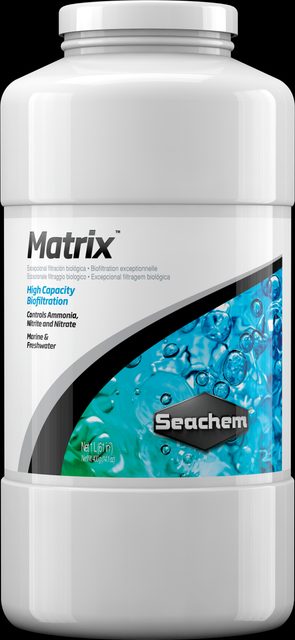
Seachem describes Matrix as a porous inorganic solid with pieces around 10 mm in diameter. The company publishes a greater-than-approximately-700 m²/L surface-area claim and says the internal macroporous structure supports both nitrifying and denitrifying bacteria. We treat those as Matrix-specific manufacturer claims, not a cross-brand performance benchmark.
The maintenance guidance is more decision-useful than the headline surface number. Seachem says Matrix is inert, does not exhaust and should not normally need replacement, although detritus and slime can require rinsing during filter maintenance. That makes it a good fit when the goal is to preserve an established biological bed instead of replacing media on a calendar.
Choose Matrix when the filter has a secure loose-media basket or suitable media bag and water can pass through the bed without bypassing it. Avoid switching out healthy mature media simply because Matrix is ranked first here; a stable existing biofilter is more important than brand substitution.
Our strongest general-purpose research pick because the exact 1 L variant combines flexible physical form with explicit no-routine-replacement guidance and unusually detailed manufacturer documentation.
Check price on Amazon →#2Best for canister baskets
EHEIM SUBSTRATpro 1 L
Best for: Canister-filter owners who want a reusable sintered-glass medium that packs efficiently into a defined basket volume
What we like
- Pearl-shaped sintered-glass form is designed for high bulk density in filter baskets
- EHEIM explicitly lists freshwater and marine compatibility
- Washable and reusable according to current manufacturer guidance
- EHEIM advises partial cleaning rather than cleaning or changing all biological media together
- Exact Amazon.com 1 L child was independently verified
What we don't
- Small spherical pieces need a basket or bag that retains them safely
- A dense basket is useful only if flow remains adequate through the media
- Not a reason to discard established sponge or other mature biological media
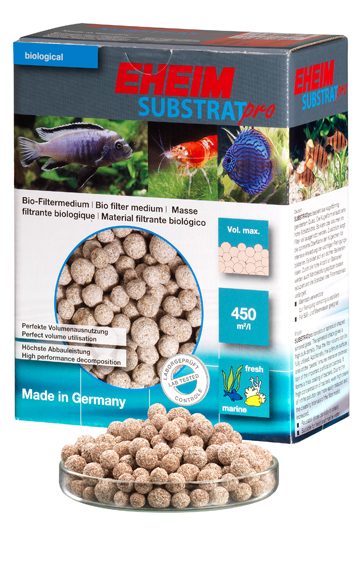
EHEIM describes SUBSTRATpro as pearl-shaped sintered glass. The spherical form is intended to create high bulk density so a filter basket or module can use its available volume efficiently while retaining colonization surface for purification bacteria.
The current documentation lists SUBSTRATpro for both fresh and marine water and says the media is washable and reusable. EHEIM also gives an important service warning: do not clean or change all biological media in one operation and do not clean it too rigorously, because that can remove too much established bacterial culture at once.
Choose SUBSTRATpro when a canister basket or retained chamber suits the small spherical media. Its advantage here is physical fit plus clear reuse guidance, not a claim that its advertised surface specifications can be compared directly with another manufacturer's laboratory method.
The most basket-oriented pick: EHEIM's spherical sintered-glass format is explicitly designed to use filter-basket volume efficiently and its maintenance guidance favors careful reuse.
Check price on Amazon →#3Best ceramic-ring format
Fluval BIOMAX 500 g
Best for: Filters with a conventional media basket where a simple porous ceramic-ring format is easy to retain and service
What we like
- Current Fluval 500 g product is item A1456 / UPC 015561114561
- Porous ring format leaves open water paths around and through the media
- Fluval explicitly positions BIOMAX as biological filter media
- Straightforward fit for many baskets designed around ring media
- Exact Amazon.com 500 g child was independently verified
What we don't
- Ring size and basket openings still need to match the exact filter
- Bulk 500 g product documentation is less maintenance-specific than Matrix or SUBSTRATpro guidance
- Do not infer that a familiar ring shape is automatically better than established sponge or other mature media
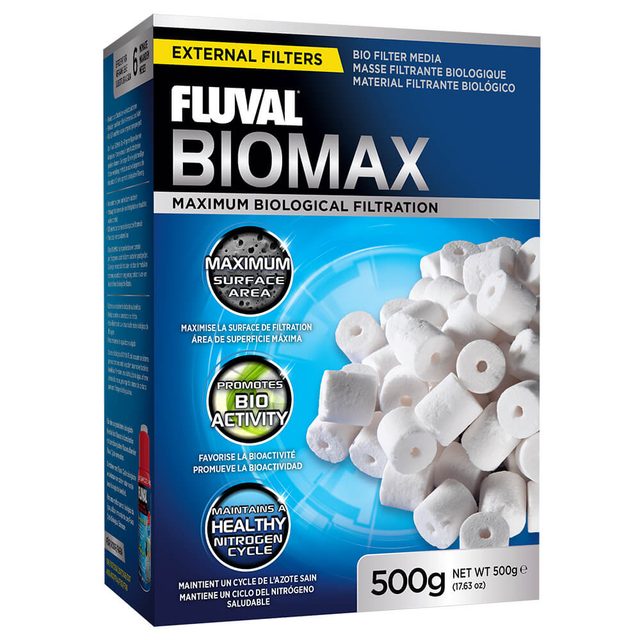
Fluval's current US page identifies the 500 g BIOMAX package as item A1456 with UPC 015561114561. Fluval describes the rings as having a complex porous design that increases contact time as water passes by and supports beneficial bacteria growth.
The ring format is the practical differentiator. It is easy to see how water can move around and through a bed of rings, and many canister and HOB baskets are already designed to hold this style of medium. That physical familiarity does not remove the need to inspect the exact basket openings and flow path.
Choose BIOMAX when you want a conventional retained ring format and the filter gives it reliable flow. If you already have mature biological media that is stable and cleanable, do not replace the whole bed just because this product is easier to buy or recognize.
The straightforward ring-media option: easy to understand physically, backed by a current manufacturer identity, and well suited to baskets that are already designed around ceramic-style media.
Check price on Amazon →#4Best for compact filter chambers
sera siporax mini Professional 1 L / 270 g
Best for: Smaller filter compartments where a compact sintered-glass medium is easier to retain than larger loose pieces or bulky rings
What we like
- sera developed the Mini format specifically for smaller filter units
- Current 1,000 ml / 270 g package is item 08476
- Manufacturer lists the 1 L quantity for up to 200 L / 53 US gal
- Sintered-glass format is intended to provide biological surface in a compact shape
- Exact Amazon.com 270 g child was independently verified
What we don't
- The manufacturer's quantity guidance is not a substitute for testing ammonia and nitrite in the actual aquarium
- Compact media still needs a chamber or bag that prevents pieces from escaping
- Manufacturer performance language should not be converted into a cross-brand surface-area score
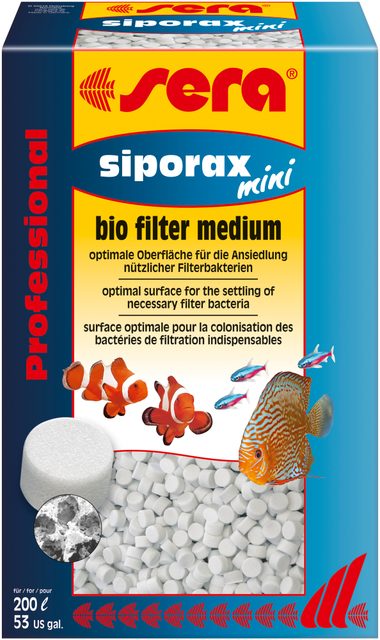
sera says siporax mini Professional was developed especially for smaller aquariums and smaller filter units. The manufacturer describes a compact sintered-glass shape intended to increase settlement area for purification bacteria while fitting tighter filtration spaces.
For the exact 1,000 ml / 270 g package, sera lists item 08476 and associates that quantity with 200 L / 53 US gallons. Treat that as manufacturer quantity guidance, not proof that the medium alone makes a 53-gallon aquarium biologically safe. Actual cycle status, oxygenation, flow, stocking and measured ammonia/nitrite still matter.
Choose siporax mini when the physical constraint is a smaller filter chamber. It ranks fourth only because its niche is narrower than the first three; the compact geometry can be the best fit in the filter it was designed to serve.
The compact-space specialist: sera's Mini format is explicitly designed for smaller filters, with a current 1 L / 270 g package and clearly published quantity guidance.
Check price on Amazon →How we researched and scored
PetGearReport has not physically tested these biological filter media, measured colonization speed, ammonia or nitrite conversion, nitrate reduction, clogging resistance, real surface area or long-term durability. We compared current manufacturer documentation, physical media form, maintenance/reuse instructions, freshwater/marine compatibility where documented, filter-fit implications and exact Amazon.com child identity. Temporary pricing, Amazon customer stars, review counts and popularity are not scoring inputs.
The displayed 1–10 number is a PetGearReport research score, rounded to the nearest whole number from the same weighted categories for every product:
- Filter fit & physical form — 25%: how clearly the shape, size and intended filter use can be matched to a real basket, chamber or media bag.
- Maintenance & reuse — 20%: clarity of rinse, reuse or replacement guidance and whether the product supports preserving established media rather than unnecessary disposal.
- Use-case versatility — 20%: how broadly the format can fit common aquarium-filter architectures and documented freshwater/marine use.
- Documentation & exact-product identity — 20%: current manufacturer product identity, model/package details and independently checked Amazon child identity.
- Claim clarity / evidence quality — 15%: how well the manufacturer separates product facts from broad performance language and gives actionable care guidance.
| Product | Filter fit 25% | Maintenance 20% | Versatility 20% | Documentation 20% | Claim clarity 15% | Weighted result | Published score |
|---|---|---|---|---|---|---|---|
| Seachem Matrix 1 L | 9 | 10 | 9 | 10 | 8 | 9.20 | 9/10 |
| EHEIM SUBSTRATpro 1 L | 9 | 9 | 10 | 9 | 9 | 9.20 | 9/10 |
| Fluval BIOMAX 500 g | 8 | 7 | 8 | 10 | 8 | 8.15 | 8/10 |
| sera siporax mini 1 L | 9 | 8 | 7 | 9 | 8 | 8.25 | 8/10 |
The decimals make the method auditable; they are not laboratory measurements. A 9.20 research score does not prove that one medium will cycle a specific aquarium faster than an 8.25 product.
Quick decision table
| Pick | Physical form | Maintenance signal | Strongest fit | Avoid if |
|---|---|---|---|---|
| Seachem Matrix 1 L | Irregular porous pieces, about 10 mm | Manufacturer says non-exhausting; rinse detritus as needed | General loose-media baskets and suitable bags | Your chamber cannot securely retain loose pieces |
| EHEIM SUBSTRATpro 1 L | Pearl-shaped sintered glass | Washable/reusable; EHEIM recommends partial, gentle cleaning | Canister baskets where dense volume use matters | Tiny openings can let spherical media escape |
| Fluval BIOMAX 500 g | Porous ring media | Follow exact Fluval/filter care guidance | Conventional baskets designed around ceramic rings | The basket cannot retain the rings or water bypasses the bed |
| sera siporax mini 1 L | Compact sintered-glass media | Preserve established biological bed during service | Smaller filter units and compact chambers | You have ample space and no need for the Mini format |
Why we do not rank biological media by surface-area claims alone
Surface area sounds like the perfect universal metric, but it is not an apples-to-apples performance measurement across brands unless the materials and measurement methods are genuinely comparable.
Seachem publishes a greater-than-approximately-700 m²/L figure for Matrix. EHEIM describes the optimized surface and high bulk density of SUBSTRATpro, while sera emphasizes the three-dimensional pore structure of siporax. Fluval describes a complex porous ring design intended to improve water contact. Those statements are useful for understanding each manufacturer’s product, but they do not establish one standardized independent test across all four products.
That is why this guide does not award points to whichever label shows the largest surface number. A medium still has to fit the chamber, receive usable flow, stay retained, tolerate maintenance and preserve a stable biological bed.
For the broader distinction between mechanical, biological and chemical stages, use our aquarium filter media guide. It explains why media function and actual water-flow direction matter more than a rigid universal stack diagram.
Match the media to the filter architecture
Canister filters
Canisters usually offer the most freedom for loose biomedia because dedicated trays or baskets can retain a large volume outside the aquarium. Matrix, SUBSTRATpro and BIOMAX can all make sense here when the exact basket retains the pieces and the filter’s flow path reaches them properly.
If the external-filter architecture is still undecided, our best aquarium canister filters guide compares media capacity and service design across current exact models. If you are deciding whether a canister is worth the hoses and cabinet space at all, use the canister filter vs HOB comparison.
HOB filters
A HOB can range from a flexible media basket to a tight cartridge slot. That difference determines whether loose biomedia is practical. Do not remove a required structural component or pack loose pieces where they can reach an impeller simply to copy a canister-media layout.
Our best aquarium HOB filters guide focuses on basket volume, media flexibility and service access. Pick the filter architecture first, then the biomedia that fits its actual chamber.
Sponge filters
A sponge is already biological media as well as mechanical media. It provides wetted surface for biofilm while also catching suspended debris. A mature sponge filter therefore does not automatically need a separate chamber full of ceramic or sintered material.
Our best aquarium sponge filters guide is the better starting point for fry, shrimp and gentle-flow setups where the sponge itself is the core biological surface.
When you do not need more biological media
Adding another bag of porous material is not automatically an upgrade.
If ammonia and nitrite remain at the expected safe readings for a mature, properly stocked aquarium, flow is stable, the filter is not clogging and the existing biological media can be serviced without wholesale replacement, more media may add complexity without solving a real problem. Use our aquarium water parameters guide to interpret the measurements rather than judging biological capacity by media volume alone.
New media is especially unlikely to solve:
- an uncycled aquarium — fresh media still needs colonization; follow our guide to cycling a new aquarium;
- chronic overfeeding or overstocking — reduce the load instead of expecting more porous material to erase it;
- poor oxygenation or restricted flow — biofilm depends on the water reaching it;
- a clogged mechanical stage — restore the flow path before adding downstream media;
- a sudden ammonia or nitrite problem — test, identify the cause and protect the established biological filter rather than swapping all media.
The decision question is not “How much biomedia can I fit?” It is “What problem would more biological surface solve in this aquarium?”
Cleaning biological media without throwing away the biofilter
The safest general principle is to remove accumulated debris while preserving as much established biological capacity as practical. The exact method still comes from the product and filter manufacturer.
Seachem says Matrix does not chemically exhaust and normally should not need replacement, but it can be rinsed when detritus or slime accumulates. EHEIM says SUBSTRATpro is washable and reusable and explicitly warns against cleaning or changing all filter media at once. These are stronger maintenance signals than a generic calendar saying to replace all biological media every few weeks.
If you need to introduce new media, stage the change where practical instead of discarding every established biological surface in one service. Keep adequate flow through both old and new media while the newer material develops biofilm. Avoid replacing all established biological media at once unless the exact manufacturer guidance, contamination event or treatment procedure requires it.
What each pick is really best at
Seachem Matrix: strongest general-purpose documentation
Matrix wins our general-purpose rank because Seachem publishes unusually specific details about form, maintenance and intended biological function. Its irregular roughly 10 mm pieces can work in many loose-media trays or bags, and the no-routine-replacement guidance makes the long-term workflow easy to understand.
The limitation is the same flexibility: loose pieces need secure retention. In a tiny cartridge slot, a purpose-built compact medium or a reusable sponge may make more sense.
EHEIM SUBSTRATpro: strongest canister-basket fit
SUBSTRATpro’s spherical sintered-glass form is designed around basket volume. EHEIM specifically highlights high bulk density and reusable gentle cleaning. If the filter already has a substantial external basket, that physical design is easy to match to the available space.
Do not compress the media so tightly that practical flow is compromised, and do not treat reusable as indestructible. Inspect the filter, retain the pieces securely and follow the filter’s own service instructions.
Fluval BIOMAX: straightforward ring-media choice
BIOMAX is the least conceptually complicated pick. It is a porous biological ring from a manufacturer with broad filter support, and the current 500 g bulk product has a clear manufacturer identity. The open ring shape is easy to retain in many baskets while leaving visible paths for water around the bed.
Its lower research score reflects less product-specific maintenance detail on the current bulk-product page, not evidence that the media performs poorly.
sera siporax mini: compact-filter specialist
siporax mini is the most deliberately niche product here. sera says the Mini format was developed for smaller filters and publishes a current 1,000 ml / 270 g package. That makes it especially relevant when chamber dimensions, not total available aquarium space, are the constraint.
Manufacturer quantity guidance is not a cycle guarantee. Confirm the aquarium’s actual ammonia and nitrite behavior instead of assuming a stated liter/gallon association proves sufficient biological capacity in every stocking scenario.
Sources
PetGearReport used current manufacturer documentation and direct Amazon.com identity checks for this guide. We did not use Amazon customer ratings, temporary prices or marketplace popularity as product evidence.
- Seachem — Matrix — media form, manufacturer surface-area claim, biological-use description, inert/non-exhausting guidance and maintenance FAQ.
- EHEIM — SUBSTRATpro — sintered-glass form, basket-volume rationale, freshwater/marine suitability and reusable/partial-cleaning guidance.
- Fluval USA — BIOMAX 17.63 oz / 500 g — item A1456, UPC 015561114561, porous-ring description and biological-media positioning.
- sera — siporax mini Professional — compact-filter positioning, sintered-glass description and 1,000 ml / 270 g item 08476 quantity guidance.
The four exact Amazon.com children were directly checked on September 13, 2026: Seachem Matrix 1 L B0002A5VIO, EHEIM SUBSTRATpro 1 L B0002JEL0O, Fluval BIOMAX 500 g B000HHSG5M, and sera siporax mini Professional 1 L / 270 g B004HFX1CS.
Frequently asked questions
What is the best bio filter media for a freshwater aquarium?
There is no universal winner independent of the filter. A strong choice fits the chamber securely, receives consistent oxygenated flow, has clear maintenance guidance and can be serviced without needlessly discarding established biofilm. Matrix is our most flexible general-purpose research pick, while SUBSTRATpro, BIOMAX and siporax mini have clearer advantages in specific basket or compact-filter layouts.
Do I need to replace biological filter media regularly?
Follow the exact product instructions. Seachem says Matrix does not exhaust and generally does not need routine replacement; EHEIM describes SUBSTRATpro as washable and reusable. Other media can have their own schedules. Avoid replacing all established biological media at once unless a specific manufacturer, contamination or treatment instruction requires it.
Can new biological media instantly cycle an aquarium?
No. Fresh porous media provides surface for biofilm but is not the same as a mature biological filter. Confirm cycle status with ammonia and nitrite testing and use an established cycling process rather than assuming a new bag of media makes the aquarium ready for livestock.
Should I choose biological media by advertised surface area?
Not by that number alone. Manufacturers can describe surface area using different materials, pore definitions and test methods, so the figures are not automatically comparable. Filter fit, water flow, maintenance guidance, media retention and preservation of established biofilm are more defensible cross-product decision factors.