Best Aquarium Heaters for 125-Gallon Tanks: 3 Picks for Single & Dual-Heater Setups
At 125 gallons, the most useful heater question is no longer just wattage: it is whether the exact manufacturer documents a single heater, a dual-heater configuration, or an adjustable-power system for this tank size. We researched three current configurations by exact manufacturer range, room-to-target guidance where published, controls, safety protections, physical placement and marketplace identity. PetGearReport has not physically tested these heaters, measured recovery time, thermostat drift, installed temperature gradients or long-term durability.
| Rank | Product | Score | Best for | Link |
|---|---|---|---|---|
| #1 | 2 × Aqueon Pro Adjustable Heater 200WBest manufacturer-documented 125g setup | 9 | 125-gallon aquariums where you want the clearest current manufacturer-specific sizing instruction and are comfortable managing two independent heaters | Check price → |
| #2 | EHEIM Jager TruTemp 250W Aquarium HeaterBest single-heater conventional option | 8 | 125-gallon owners who prefer one calibratable conventional heater and whose installation fits EHEIM's documented 400–600 L range | Check price → |
| #3 | hygger HG152 400W/800W Adjustable-Power Aquarium HeaterBest adjustable-power external-controller option | 9 | 125-gallon freshwater or saltwater aquariums where adjustable power, an external controller and digital status information fit the installation better than a conventional heater | Check price → |
#1 · Our PickBest manufacturer-documented 125g setup
2 × Aqueon Pro Adjustable Heater 200W
Best for: 125-gallon aquariums where you want the clearest current manufacturer-specific sizing instruction and are comfortable managing two independent heaters
What we like
- Aqueon's current 120/125-gallon row specifies 2 × 200W at +5°F, +10°F and +15°F above a 68–72°F room
- Exact Pro 200 model 100532086 is documented up to 75 gallons per unit
- Two heaters can distribute heat across a long aquarium when placed in useful circulation
- Adjustable 68–88°F electronic thermostats
- Thermal shatterproof plastic housings with over-temperature shut-off
What we don't
- This recommendation requires two separate heaters, outlets and thermostat points
- A single Pro 200 is not a 125-gallon heater; the evidence is specifically Aqueon's two-unit configuration
- Two devices create two possible failure points and require deliberate placement
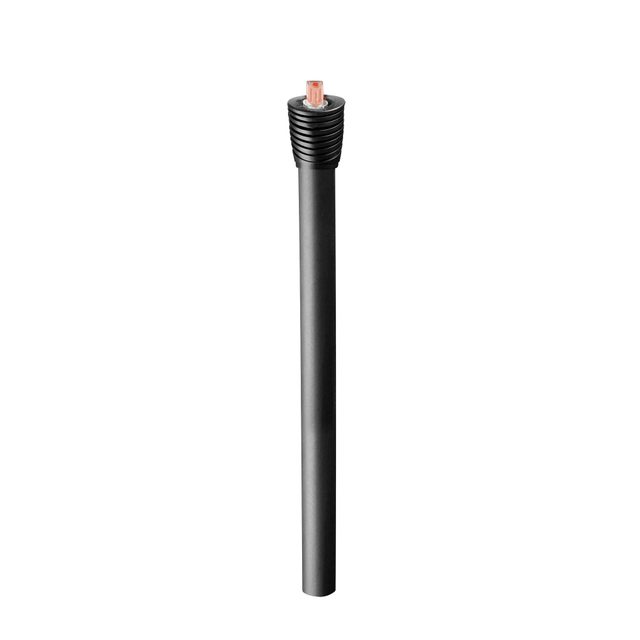
Aqueon's 2025 catalog identifies Pro 200 as SKU 100532086 / UPC 015905000604, 200W, for aquariums up to 75 gallons per unit. Safe indexed marketplace metadata maps model 100532086 to ASIN B07L1M7454. The 125-gallon case is not based on stretching one 200W heater beyond that ceiling. Aqueon's current heater guide, based on a standard room temperature of 68–72°F, lists the 120/125-gallon row as 2 × 200W at +5°F, 2 × 200W at +10°F and 2 × 200W at +15°F above room temperature. That makes the dual-heater architecture an explicit Aqueon recommendation rather than a generic PetGearReport rule. Each Pro 200 uses an adjustable electronic thermostat, shatterproof thermal-plastic housing and automatic over-temperature shut-off. Two units can also help distribute heat in a long aquarium, but they need deliberate placement, independent temperature verification and a plan for what happens if one unit stops heating or remains on.
Our strongest documented starting point because Aqueon explicitly specifies two 200W units for 120/125 gallons across all three room-temperature-rise columns in its current guide.
Check price on Amazon →#2Best single-heater conventional option
EHEIM Jager TruTemp 250W Aquarium Heater
Best for: 125-gallon owners who prefer one calibratable conventional heater and whose installation fits EHEIM's documented 400–600 L range
What we like
- EHEIM documents thermocontrol 250 for approximately 400–600 L / 106–159 US gallons
- 125 US gallons is about 473 L and sits inside the manufacturer envelope
- 18–34°C adjustable range
- Manufacturer publishes ±0.5°C control accuracy and recalibration
- Thermo Safety Control provides automatic dry-run shut-off
What we don't
- Long roughly 452 mm / 17.8-inch glass body needs unobstructed submerged space
- No digital water-temperature display
- A single-heater layout concentrates heating and thermostat control in one device
- Published control accuracy is a manufacturer specification, not a PetGearReport measurement
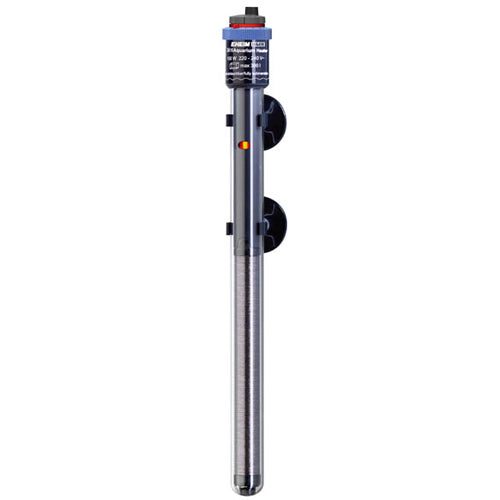
EHEIM's current thermocontrol 250 documentation lists product number 3618010 / EAN 4011708361221, 250W and an approximate 400–600 L range. North American Jager/TruTemp records identify the 250W model as 3618090, and indexed ASIN-specific records map that 250W variant to B004I6U23C. One hundred twenty-five US gallons is roughly 473 L, comfortably inside EHEIM's 400–600 L manufacturer envelope. That does not mean every 250W heater is suitable for 125 gallons; it means this exact model has a published range that includes the tank. EHEIM documents an 18–34°C setting range, recalibration, a ±0.5°C manufacturer control specification, full submersion and Thermo Safety Control for dry-run protection. The roughly 452 mm / 17.8-inch body is long, so physical placement and circulation need to be confirmed before choosing a single-heater layout.
The cleanest single-heater counterpoint to Aqueon's dual layout: EHEIM explicitly places its 250W thermocontrol inside a 400–600 L envelope that contains a 125-gallon tank.
Check price on Amazon →#3Best adjustable-power external-controller option
hygger HG152 400W/800W Adjustable-Power Aquarium Heater
Best for: 125-gallon freshwater or saltwater aquariums where adjustable power, an external controller and digital status information fit the installation better than a conventional heater
What we like
- Manufacturer HG152 chart lists the 400W/800W configuration for 80–132 gallon aquariums
- 125 gallons remains inside the exact published range
- External digital controller displays current temperature, set temperature, operating power and error codes
- Selectable 400W or 800W operating power
- Off-water, high-temperature and low-temperature warning/protection functions
What we don't
- 125 gallons sits near the upper end of the 80–132 gallon range
- More available wattage is not automatically better; power setting still needs to match actual conditions
- External controller and cables add installation complexity
- Newer model has less long-running documentation history than the Aqueon or EHEIM families
hygger identifies this product family as model HG152 and publishes the 400W/800W configuration for 80–132 gallon aquariums. Safe indexed marketplace evidence maps the exact 400W/800W configuration to ASIN B0FVM277WB. A 125-gallon aquarium is inside that range but relatively close to the upper boundary. The HG152 uses an external digital controller that displays current water temperature, target temperature, current operating power, selected power and error codes. hygger documents selectable 400W/800W operation, a 59–93°F setting range, off-water automatic power-off, a high-temperature shutdown/warning and a low-temperature warning. Those features make it a flexible large-tank option, not proof that 800W should always be selected. Start from the exact 80–132 gallon manufacturer range, then choose operating power around actual room-to-target demand and verify the installed aquarium with an independent thermometer.
A current high-capacity alternative with a manufacturer-published 80–132 gallon envelope, but its selectable 800W ceiling should be treated as conditional capacity rather than a reason to maximize power.
Check price on Amazon →How we researched and scored
PetGearReport has not physically tested these heaters, measured recovery time, thermostat drift, installed temperature gradients or long-term durability. We compared current manufacturer documentation, exact identifiers, indexed marketplace identity, documented 125-gallon fit, system architecture, controls, safety features, physical placement and service documentation. Current Amazon prices, stock, star ratings, review counts and popularity were not scoring inputs.
Each product receives a PetGearReport research score, not a hands-on or customer rating:
- 125-gallon fit & system headroom — 30%
- Temperature control & monitoring — 25%
- Safety protections — 20%
- Physical fit & circulation — 15%
- Documentation & exact identity — 10%
| Heater configuration | 125-gal fit 30% | Control 25% | Safety 20% | Fit/circulation 15% | Docs/identity 10% | Weighted | Score |
|---|---|---|---|---|---|---|---|
| 2 × Aqueon Pro 200W | 10 | 8 | 9 | 8 | 10 | 9.00 | 9/10 |
| EHEIM thermocontrol 250 | 9 | 9 | 8 | 5 | 10 | 8.30 | 8/10 |
| hygger HG152 400W/800W | 9 | 10 | 9 | 8 | 8 | 9.00 | 9/10 |
The score does not reward raw wattage or automatically favor one heater count. Aqueon scores strongly because its current guide explicitly documents a two-heater 125-gallon layout. hygger scores strongly on monitoring and safety architecture, while EHEIM provides a simpler manufacturer-documented single-heater envelope.
Quick decision: choose the architecture before chasing wattage
| Situation | Best fit here | Why |
|---|---|---|
| Clearest current manufacturer-specific 125g instruction | 2 × Aqueon Pro 200W | Current 120/125-gallon row explicitly specifies two 200W units at all three listed room-temperature rises |
| Prefer one calibratable conventional heater | EHEIM thermocontrol 250 | Exact 400–600 L / 106–159 gallon range contains a 125-gallon tank |
| Prefer adjustable power + external digital controller | hygger HG152 400W/800W | Exact configuration is documented for 80–132 gallons and exposes power/status data externally |
If you have not calculated the coldest room-to-target difference yet, use our aquarium heater size guide first. You can also use the aquarium heater size calculator to calculate the delta and check current Aqueon published rows without interpolating a generic wattage. For broader heater architectures, compare the best aquarium heaters. The 90-gallon heater guide shows how the same brands can lead to different choices one tank size down.
Aqueon makes the dual-heater recommendation explicit at 120/125 gallons
Aqueon’s current heater guide uses a standard room temperature of 68–72°F. For 120/125 gallons, the table specifies 2 × 200W at +5°F, 2 × 200W at +10°F and 2 × 200W at +15°F above room temperature.
That is materially different from saying a single Aqueon Pro 200 covers 125 gallons. The 2025 catalog lists each Pro 200, model 100532086, for aquariums up to 75 gallons. The evidence for 125 gallons is specifically the manufacturer’s two-unit recommendation.
It is also not a universal dual-heater rule. EHEIM and hygger publish different exact-model envelopes that include 125 gallons with a single heater assembly. Manufacturer guidance defines the comparison; heater count alone does not.
Single-heater and dual-heater setups fail differently
A dual-heater layout can distribute heat across a long aquarium and may preserve some heating capacity if one unit stops. It also creates two thermostats, two cords and two devices that can fail. If one remains on when it should not, the second heater does not automatically protect the tank.
A single-heater layout reduces the number of heating devices and can simplify placement, but it concentrates the primary heating function in one unit. The right architecture depends on the exact product documentation, circulation pattern, available mounting space and how you plan to monitor temperature.
Do not generalize Aqueon’s two-heater recommendation to every 125-gallon system, and do not assume a single heater is automatically safer because it uses fewer components.
Physical fit becomes a real design constraint at 125 gallons
Aqueon’s Pro 200 body is about 12.75 inches, so two units need two useful submerged locations rather than simply two empty patches of glass. EHEIM lists thermocontrol 250 at about 452 mm / 17.8 inches, making unobstructed body length a significant constraint. hygger lists the HG152 heater body at about 11.2 inches, plus its external controller and cabling.
Place heaters where normal circulation can distribute heat through the aquarium, within each manufacturer’s installation instructions. For a large tank, a separate thermometer positioned away from the heating element or control probe is especially useful because it can reveal temperature differences across the system.
The filtration side is a separate sizing problem. Our 125-gallon aquarium filter guide compares flow and media capacity; filter gallon ratings do not automatically validate heater capacity for the same tank.
Adjustable power is useful only when it is used deliberately
The hygger HG152 400W/800W configuration covers 80–132 gallons according to the manufacturer. Its ability to switch between 400W and 800W can help adapt the heating system to different room conditions, but the higher setting is not automatically the better setting.
Use the coldest realistic room temperature, target water temperature and manufacturer instructions to decide how much capacity the tank actually needs. More available power changes both recovery capability and the consequences of a control failure, which is another reason independent monitoring matters.
Always verify with an independent thermometer
A heater thermostat, built-in display or external control probe is part of the same heating system. It is not an independent audit of water elsewhere in a 125-gallon aquarium. Use a separate thermometer away from the heater or probe so you can detect a meaningful mismatch or uneven circulation.
Our aquarium thermometer guide compares monitoring formats. Add the temperature check to the aquarium maintenance schedule so seasonal room changes and heater behavior are more likely to be noticed early.
Sources
- Aqueon — Setting Up a Freshwater Aquarium — current 120/125-gallon 2 × 200W row and 68–72°F room baseline.
- Aqueon — 2025 Product Catalog — Pro 200 model 100532086 / UPC 015905000604, 200W, 75-gallon per-unit ceiling and dimensions.
- Aqueon — Pro Adjustable Heater — Pro-family adjustment range, thermostat, housing and over-temperature protection.
- EHEIM — thermocontrol 250 — product 3618010 / EAN 4011708361221 and current thermocontrol family information.
- EHEIM — current thermocontrol technical catalog — 250W, 400–600 L range and 17.8-inch body length.
- hygger — HG152 Adjustable Aquarium Heater — 400W/800W 80–132 gallon configuration, controller display, adjustable power and safety functions.
Frequently asked questions
How many watts do I need for a 125-gallon aquarium?
There is no one cross-brand wattage answer. Aqueon's current guide specifies 2 × 200W for its 120/125-gallon row, EHEIM documents thermocontrol 250 at 250W for approximately 400–600 L / 106–159 US gallons, and hygger documents HG152 400W/800W for 80–132 gallons. Follow the exact model's manufacturer guidance rather than one universal watts-per-gallon formula.
Should I use one heater or two heaters in a 125-gallon tank?
Either architecture can be defensible when the exact manufacturer supports it. Aqueon explicitly recommends two 200W heaters for 120/125 gallons, while EHEIM documents one 250W thermocontrol for a range that includes 125 gallons. Do not generalize Aqueon's dual-heater rule to every brand or assume one heater is automatically simpler or safer.
Is a 250W heater enough for a 125-gallon aquarium?
For the exact EHEIM thermocontrol 250, the manufacturer publishes an approximate 400–600 L / 106–159 US gallon range, which includes about 473 L / 125 US gallons. That is product-specific evidence, not a statement that any 250W heater is suitable for 125 gallons.
Is an 800W heater too large for 125 gallons?
Do not judge by the maximum selectable wattage alone. hygger documents its HG152 400W/800W configuration for 80–132 gallons and lets the user select 400W or 800W. Use the exact manufacturer instructions and actual room-to-target demand rather than assuming the higher setting is automatically better.
Do I need a separate thermometer with a 125-gallon heater setup?
Yes. Whether you use one heater, two heaters or an external-controller system, the heater's own thermostat or probe is part of the heating system. Use an independent thermometer elsewhere in the aquarium to verify temperature distribution and catch control or circulation problems.