Best Aquarium Salinity Testers: 5 Picks by Method, Calibration & Accuracy
Salinity testers do not all measure seawater the same way. We researched five exact marketplace variants spanning conductivity, digital refractive-index measurement, analog seawater refractometers and a mechanical hydrometer. The comparison prioritizes published accuracy, calibration/reference method, temperature handling, reef-range resolution/readability, maintenance and exact product identity. PetGearReport has not physically tested these instruments, compared them against laboratory standards, measured calibration drift, verified manufacturer accuracy claims or established an original salinity target for any aquarium.
| Rank | Product | Score | Best for | Link |
|---|---|---|---|---|
| #1 | Hanna HI98319 Marine Salinity TesterBest documented conductivity tester | 10 | marine and reef keepers who want a compact digital conductivity method with explicit working-range calibration and unusually complete manufacturer accuracy documentation | Check price → |
| #2 | Milwaukee MA887 Digital Salinity RefractometerBest fast digital refractometer | 9 | saltwater users who prioritize quick digital readout, easy repeatable workflow and multiple salinity display formats over the tighter published ppt accuracy of the top conductivity tester | Check price → |
| #3 | VEE GEE STX-3 Seawater RefractometerBest documented analog seawater refractometer | 9 | reef and marine users who prefer a durable analog instrument and want explicit seawater calibration plus a published ±1 ppt salinity specification | Check price → |
| #4 | Red Sea Seawater RefractometerBest reef-range seawater scale | 9 | reef keepers who specifically want a seawater-calibrated analog scale centered on the 0–40 ppt range and understand the 25°C reference model | Check price → |
| #5 | Fluval Sea HydrometerBest simple mechanical reference option | 7 | users who want a simple no-electronics specific-gravity/salt-level reference and accept the maintenance and temperature limitations of a mechanical hydrometer | Check price → |
#1 · Our PickBest documented conductivity tester
Hanna HI98319 Marine Salinity Tester
Best for: marine and reef keepers who want a compact digital conductivity method with explicit working-range calibration and unusually complete manufacturer accuracy documentation
What we like
- Measures conductivity (EC) and converts the result to marine salinity outputs rather than using an optical scale
- Hanna publishes 0.1 ppt resolution and ±1 ppt accuracy from 0.0–40.0 ppt
- Automatic single-point calibration uses a 35.00 ppt standard close to common marine working range
- Automatic temperature compensation is documented from 5 to 50°C with an integrated temperature sensor
- Exact HI98319U marketplace identity maps to ASIN B07SW89GVP
What we don't
- Electronic conductivity measurement requires clean sensors and correct calibration rather than becoming reference-free
- Published ±1 ppt accuracy is not the same thing as 0.1 ppt resolution
- Battery-powered electronics add a failure mode that optical/manual instruments do not have
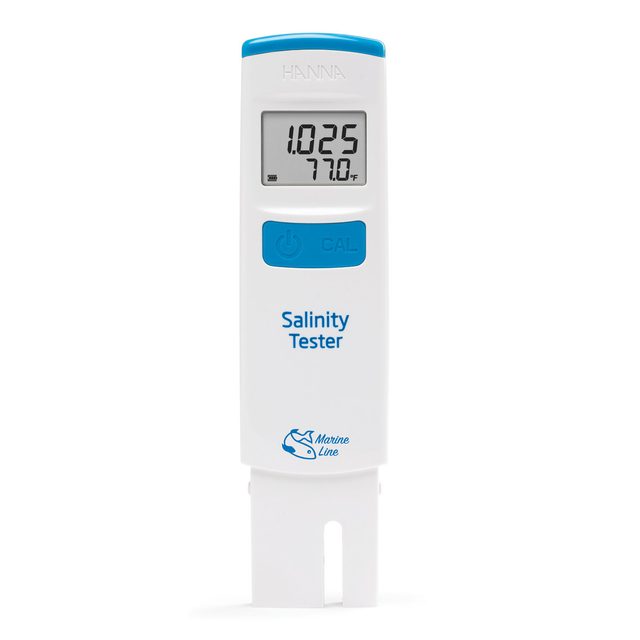
Hanna identifies the current US product as SKU HI98319U. The HI98319 measures conductivity (EC) to determine salinity in natural or artificial seawater and can display ppt, PSU or specific gravity. Hanna publishes a 0.0–70.0 ppt range, 0.1 ppt resolution and ±1 ppt accuracy from 0.0–40.0 ppt, changing to ±2 ppt above 40 ppt. Automatic single-point calibration uses a 35.00 ppt standard, and temperature compensation is automatic from 5 to 50°C.
The distinction between resolution and accuracy matters: a 0.1 ppt display step does not mean the manufacturer claims ±0.1 ppt accuracy. Hanna also documents graphite sensors intended to reduce polarization and oxidation effects. Exact HI98319U identity reconciles to indexed Amazon.com ASIN B07SW89GVP.
The strongest research pick because Hanna publishes the clearest complete chain from measurement method through 35 ppt calibration, temperature compensation, resolution and working-range accuracy.
Check price on Amazon →#2Best fast digital refractometer
Milwaukee MA887 Digital Salinity Refractometer
Best for: saltwater users who prioritize quick digital readout, easy repeatable workflow and multiple salinity display formats over the tighter published ppt accuracy of the top conductivity tester
What we like
- Digital refractive-index method removes subjective visual boundary-line reading
- Milwaukee publishes approximately 1.5-second measurement time and 100 µL minimum sample volume
- Displays PSU, ppt, specific gravity and temperature
- Automatic temperature compensation is documented from 10 to 40°C and one-point calibration uses distilled or deionized water
- Exact MA887 / UPC 810666006007 maps to ASIN B007Z4ITWU
What we don't
- Milwaukee publishes ±2 ppt accuracy, so the digital display should not be mistaken for tighter analytical accuracy
- One-point zero calibration uses distilled/DI water rather than a near-reef salinity reference
- Sample well and prism still require cleaning between measurements
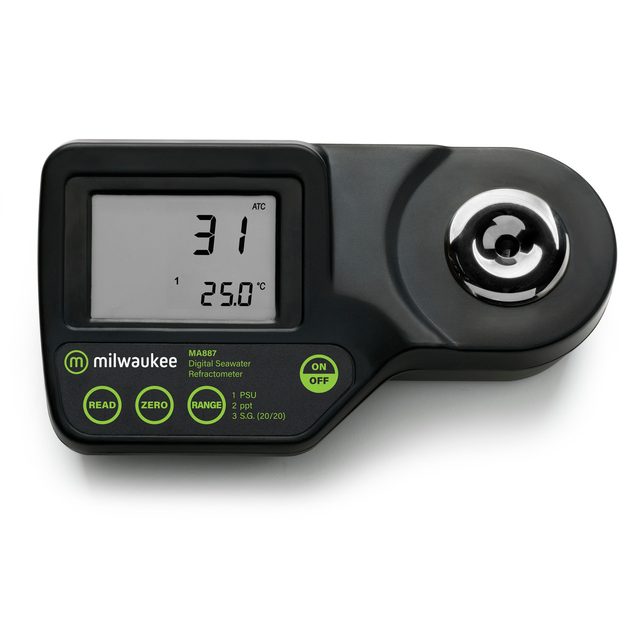
Milwaukee's current MA887 page identifies a digital seawater refractometer that measures refractive index and converts it to PSU, ppt or S.G. The manufacturer publishes 1 ppt resolution, ±2 ppt accuracy, approximately 1.5-second measurement time and automatic temperature compensation from 10 to 40°C. Its single-point calibration uses distilled or deionized water.
Digital readout reduces the visual judgement involved in an analog boundary line, but digital is not automatically more accurate. The published ±2 ppt specification is wider than Hanna's 0–40 ppt ±1 ppt claim and VEE GEE's STX-3 ±1 ppt claim. Exact model MA887 / UPC 810666006007 reconciles to Amazon.com ASIN B007Z4ITWU.
The workflow pick: fast digital optical measurement and excellent readability, with a deliberate score penalty because Milwaukee's published salinity accuracy is ±2 ppt.
Check price on Amazon →#3Best documented analog seawater refractometer
VEE GEE STX-3 Seawater Refractometer
Best for: reef and marine users who prefer a durable analog instrument and want explicit seawater calibration plus a published ±1 ppt salinity specification
What we like
- STX-3 is calibrated for seawater salinity rather than only sodium-chloride brine
- Manufacturer publishes 0–100 ppt range, 1 ppt resolution and ±1 ppt accuracy
- Specific-gravity scale is documented at 1.000–1.070 with ±0.001 accuracy
- Automatic temperature compensation is documented over 10 to 30°C
- Exact model STX-3 / catalog 43036 maps to ASIN B004WDW70M
What we don't
- Analog boundary-line reading depends on lighting, focus and operator interpretation
- 1 ppt resolution is coarser than Hanna's 0.1 ppt display resolution
- Prism cleanliness, complete sample coverage and calibration remain necessary before trusting the reading
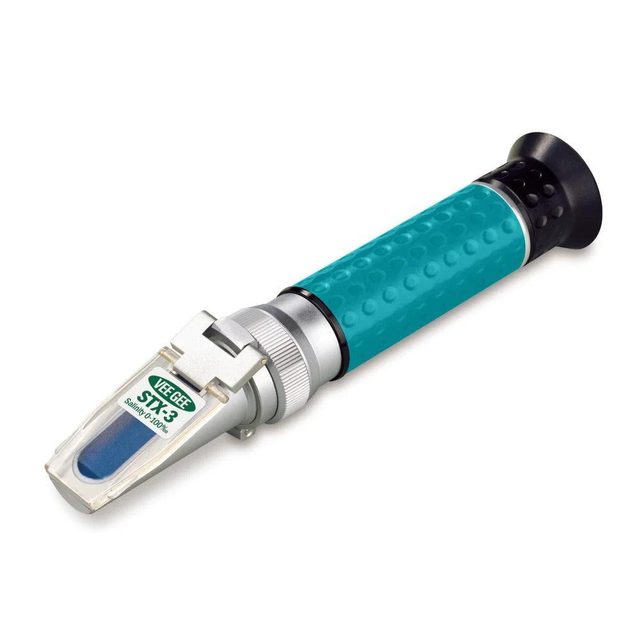
VEE GEE identifies the exact salinity refractometer as STX-3, catalog number 43036. The current specification is 0–100 ppt, 1 ppt resolution, ±1 ppt accuracy, specific gravity from 1.000–1.070 with ±0.001 accuracy, and ATC from 10 to 30°C. VEE GEE's own FAQ says the STX-3 is the seawater-salinity model, while its SX-2 is calibrated only for sodium chloride.
That makes the measurement model clearer than generic refractometers marketed simply as 'salinity' instruments. It remains an analog refractometer: sample coverage, light source, focus, prism cleanliness and calibration can all affect the observed boundary line. Exact STX-3 / 43036 identity maps to Amazon.com ASIN B004WDW70M.
The strongest analog research pick because VEE GEE explicitly distinguishes STX-3 seawater calibration from its NaCl model and publishes both salinity and specific-gravity accuracy.
Check price on Amazon →#4Best reef-range seawater scale
Red Sea Seawater Refractometer
Best for: reef keepers who specifically want a seawater-calibrated analog scale centered on the 0–40 ppt range and understand the 25°C reference model
What we like
- Red Sea calibrates the scale for seawater ionic composition rather than generic NaCl brine
- Scale is focused on the reef-relevant range up to 40 ppt for easier visual reading
- Manufacturer calibrates the seawater conversion at 25°C / 77°F
- Integrated ATC is paired with explicit guidance on sample/instrument temperature equilibration
- Exact Seawater Refractometer marketplace identity maps to ASIN B00V9R4JOQ
What we don't
- Red Sea does not publish the same simple ±ppt instrument accuracy specification shown by Hanna or VEE GEE
- Analog reading still depends on a sharp boundary line, clean prism and suitable light
- ATC only compensates within its intended ambient relationship; it does not convert every reading to the aquarium's actual temperature
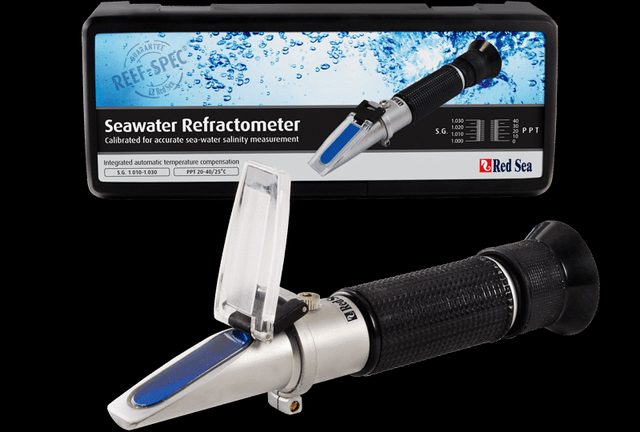
Red Sea designed this refractometer around natural-seawater ionic composition and a 25°C / 77°F reference rather than a generic sodium-chloride brine scale. The display is focused on salinity up to 40 ppt. Red Sea states that using a brine-calibrated refractometer for seawater can create approximately 1.5 ppt of deviation in the salinity reading.
The manual also gives an important ATC boundary: allow the water sample and instrument to equilibrate, and do not assume ATC converts the reading to the aquarium temperature. Red Sea explains that ATC compensates limited ambient/instrument temperature differences around the refractometer's calibrated reference. Exact current marketplace evidence maps the Red Sea Seawater Refractometer to ASIN B00V9R4JOQ.
A reef-specific optical option with excellent seawater/temperature explanation, scored below STX-3 because the current Red Sea page is less explicit about a single ±ppt instrument-accuracy figure.
Check price on Amazon →#5Best simple mechanical reference option
Fluval Sea Hydrometer
Best for: users who want a simple no-electronics specific-gravity/salt-level reference and accept the maintenance and temperature limitations of a mechanical hydrometer
What we like
- No battery, app or optical focus is required
- Fluval documents exact item 14356 / UPC 015561143561
- Manufacturer states that it can be used as a portable tester or installed in the aquarium for ongoing visual reference
- Large markings and highlighted marine range simplify basic reading
- Exact item 14356 maps to ASIN B007MM0YUU
What we don't
- Fluval publishes a 75°F / 24°C calibration temperature but not the same ±ppt accuracy specification provided by the top instruments
- Air bubbles on the moving arm can distort the reading and must be dislodged
- Salt/mineral buildup and mechanical freedom of movement require cleaning and inspection
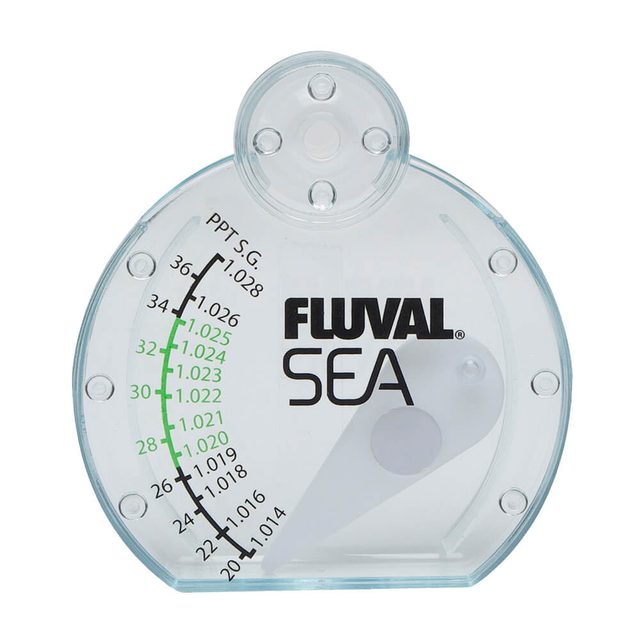
Fluval identifies the current Sea Hydrometer as item 14356 and UPC 015561143561. The manufacturer says it measures salt level and specific gravity in marine aquariums, can be used portable or mounted in the aquarium, and is calibrated at 75°F / 24°C. Fluval's support guidance specifically warns that trapped air bubbles on the armature can drive the reading high and recommends tapping the unit to release them.
A hydrometer is a different measurement method from conductivity or refractive-index instruments. It should not receive an invented precision advantage simply because it is mechanically simple. Exact item 14356 / UPC 015561143561 maps to Amazon.com ASIN B007MM0YUU.
The simple mechanical alternative, ranked conservatively because its documentation is strong on identity and use but much thinner on quantitative accuracy than the dedicated meters and refractometers.
Check price on Amazon →A salinity number is only useful when you know how the instrument produced it.
Marine aquarium testers in this guide use four different measurement methods:
- conductivity — Hanna HI98319 measures EC and converts it to marine salinity units;
- digital refractive-index measurement — Milwaukee MA887 optically measures refractive index and displays a calculated value;
- analog refractometer — VEE GEE STX-3 and Red Sea use an optical boundary line on a salinity/specific-gravity scale;
- hydrometer — Fluval uses buoyancy/mechanical specific-gravity measurement.
These are different measurement methods, not merely different displays for the same sensor.
For the unit definitions behind ppt, PSU, conductivity and SG, see salinity vs specific gravity.
Use the aquarium water-parameters guide for chemistry interpretation, the aquarium water-test-kit guide for broader parameter testing and the aquarium maintenance schedule for a repeatable verification routine. For model-specific calibration procedures, use the reef refractometer calibration guide.
How we researched and scored
PetGearReport has not physically tested these salinity testers, compared them against a laboratory reference, verified manufacturer accuracy claims, measured calibration drift, quantified operator reading error or established an original safe salinity range.
The displayed number is a PetGearReport research score, not a hands-on result, customer rating or laboratory measurement.
- Measurement method & published accuracy — 30% — explicit method plus a manufacturer-published accuracy specification where available.
- Calibration/reference & temperature handling — 25% — calibration point/reference, ATC or temperature-compensation range, and clarity about equilibration.
- Reef-range resolution/readability — 20% — usable scale/display resolution and readability around common marine working ranges without treating resolution as accuracy.
- Maintenance & usability — 15% — cleaning, sample handling, sensor/prism/mechanical maintenance and repeatability of the routine.
- Exact identity & documentation — 10% — exact SKU/model/catalog/UPC evidence reconciled to the ranked marketplace variant.
| Salinity tester | Method/accuracy 30% | Calibration/temp 25% | Resolution/readability 20% | Maintenance/usability 15% | Identity 10% | Weighted | Score |
|---|---|---|---|---|---|---|---|
| Hanna HI98319 | 10 | 10 | 10 | 9 | 10 | 9.85 | 10/10 |
| Milwaukee MA887 | 8 | 9 | 9 | 10 | 10 | 8.95 | 9/10 |
| VEE GEE STX-3 | 9 | 9 | 8 | 8 | 10 | 8.75 | 9/10 |
| Red Sea Seawater Refractometer | 8 | 10 | 9 | 7 | 9 | 8.65 | 9/10 |
| Fluval Sea Hydrometer | 6 | 7 | 7 | 7 | 10 | 7.00 | 7/10 |
The weighted order follows the published evidence. The decimals make the method auditable; they do not imply laboratory precision.
Digital is not automatically more accurate
A digital display can make a reading easier to repeat because the user is not deciding where a blue/white boundary crosses a scale. That is a workflow advantage, not proof of superior analytical accuracy.
Compare the current manufacturer specifications:
- Hanna HI98319: 0.1 ppt resolution, but ±1 ppt accuracy from 0–40 ppt;
- Milwaukee MA887: 1 ppt resolution and ±2 ppt accuracy;
- VEE GEE STX-3: 1 ppt resolution and ±1 ppt accuracy.
The number of digits on a screen is therefore not an accuracy ranking.
A well-calibrated analog instrument can publish a tighter salinity accuracy than a digital refractometer. Conversely, a digital instrument can be easier to read and less sensitive to visual interpretation. Choose by the whole measurement system.
Conductivity versus refractive index versus specific gravity
Conductivity
Salt ions increase water’s electrical conductivity. Hanna’s HI98319 measures conductivity (EC) and uses that measurement to calculate salinity outputs such as ppt, PSU and S.G.
Conductivity changes with temperature, which is why Hanna integrates a temperature sensor and publishes an automatic compensation range.
Refractive index
Dissolved material changes the refractive index of water. Milwaukee measures this optically and performs the conversion digitally; VEE GEE and Red Sea put the converted relationship on an analog optical scale.
The conversion model matters because seawater is not pure sodium-chloride brine.
Hydrometer / specific gravity
A hydrometer uses density/buoyancy rather than EC or refractive index. Specific gravity also depends on the reference temperature and instrument design.
Fluval states that item 14356 is calibrated at 75°F / 24°C. That temperature statement is not decoration: it is part of understanding what the scale means.
Seawater calibration is not the same as generic NaCl brine
Red Sea explicitly calls out a common refractometer problem: many instruments use a brine (NaCl) algorithm while reef aquariums contain seawater with multiple dissolved salts.
Red Sea says using a brine-calibrated refractometer for seawater can produce a deviation of approximately 1.5 ppt. Its own instrument is calibrated for seawater at 25°C / 77°F and focuses the display on 0–40 ppt.
VEE GEE makes a similar product distinction. The manufacturer identifies STX-3 as the seawater-salinity model and SX-2 as the sodium-chloride model.
This does not mean every generic instrument is unusable. It means the conversion scale and calibration model must match the liquid and purpose you are measuring.
ATC does not make temperature disappear
ATC means automatic temperature compensation, but the implementation and valid range belong to the exact instrument.
Examples:
- Hanna HI98319: automatic salinity temperature compensation from 5 to 50°C;
- Milwaukee MA887: automatic compensation from 10 to 40°C;
- VEE GEE STX-3: ATC from 10 to 30°C;
- Red Sea: integrated ATC, with the refractometer designed around a 25°C seawater reference.
Red Sea’s manual makes the conceptual boundary especially clear: ATC does not adjust the PPT reading to the aquarium temperature. The instrument and sample should be allowed to equilibrate according to the manual before reading.
Avoid moving a cold calibration solution, warm aquarium sample and room-temperature refractometer through a measurement routine as if ATC erases every thermal difference instantly.
Calibration point matters
Calibration should follow the exact manufacturer rather than one universal aquarium rule.
Hanna HI98319: 35.00 ppt reference
Hanna uses automatic, single-point 35.00 ppt calibration. That is useful evidence because the calibration reference is near common marine working salinity rather than only at zero conductivity.
Hanna also supplies calibration sachets and documents the procedure for this instrument.
Milwaukee MA887: distilled or DI water zero
Milwaukee specifies a one-point calibration using distilled or deionized water.
That is a different calibration design from Hanna’s 35 ppt standard. Do not substitute another product’s method without manufacturer support.
VEE GEE STX-3: zero plus documented liquid-standard capability
VEE GEE documents distilled-water zero calibration and also lists a liquid standard as the custom-calibration option.
The practical rule is simple: use the calibration material and method intended for the exact device and verify the device again when readings become surprising.
Product-by-product fit
Hanna HI98319 Marine Salinity Tester
Exact manufacturer SKU: HI98319U. Marketplace ASIN: B07SW89GVP.
Hanna publishes:
- conductivity-based marine salinity measurement;
- 0.0–70.0 ppt range;
- 0.1 ppt resolution;
- ±1 ppt accuracy from 0.0–40.0 ppt;
- ±2 ppt above 40.0 ppt;
- automatic 35.00 ppt single-point calibration;
- automatic temperature compensation from 5–50°C;
- graphite sensing elements.
That is the most complete current measurement specification in the shortlist.
Milwaukee MA887 Digital Salinity Refractometer
Exact model: MA887, UPC 810666006007, ASIN B007Z4ITWU.
Milwaukee publishes:
- digital refractive-index measurement for natural/artificial seawater;
- 1 ppt resolution;
- ±2 ppt accuracy;
- approximately 1.5-second measurement;
- 100 µL minimum sample;
- automatic compensation from 10–40°C;
- one-point distilled/DI-water calibration.
Its strength is fast, unambiguous digital readout. Its limitation is equally explicit: the screen being digital does not make the ±2 ppt specification disappear.
VEE GEE STX-3
Exact model STX-3, catalog 43036, ASIN B004WDW70M.
VEE GEE publishes a seawater-specific 0–100 ppt scale, 1 ppt resolution, ±1 ppt accuracy and 10–30°C ATC.
The manufacturer explicitly distinguishes this model from its NaCl-only SX-2, which is useful evidence that the salinity scale is designed around seawater rather than generic sodium chloride.
Red Sea Seawater Refractometer
Exact marketplace ASIN: B00V9R4JOQ.
Red Sea focuses its analog scale on seawater up to 40 ppt and bases the scale on seawater at 25°C / 77°F. Its documentation is especially strong for explaining brine-versus-seawater algorithms and ATC limitations.
We score it below STX-3 because Red Sea’s current material does not publish the same simple ±1 ppt instrument-accuracy figure that VEE GEE provides.
Fluval Sea Hydrometer
Exact item 14356, UPC 015561143561, ASIN B007MM0YUU.
Fluval says the hydrometer measures marine salt level and specific gravity, can be mounted or used as a portable tester and is calibrated at 75°F / 24°C.
The manufacturer also gives a practical failure clue: air bubbles on the armature can force the reading high. Salt/mineral deposits or a sticking arm are additional reasons to keep the unit clean and mechanically free.
Salinity, RO/DI and salt mixing are different steps
An aquarium RO/DI system produces preparation water. In a reef workflow, that purified water is then mixed with marine salt according to the salt manufacturer’s instructions before salinity is verified. Our reef salt mix guide compares how four exact salts differ in alkalinity profile, mixing procedure, yield documentation and QC transparency.
RO/DI product-water TDS and finished saltwater salinity are different measurements.
Do not use a salinity tester to judge RO/DI membrane/DI purity, and do not use a TDS meter as a substitute for checking the finished salt mix.
ATO protects salinity by replacing evaporated freshwater
Routine evaporation removes water while leaving dissolved salts behind. That is why a marine auto top-off system normally replaces evaporated volume with appropriate freshwater rather than saltwater.
A salinity tester helps verify whether the system is actually staying near the intended target; the ATO does not make the measurement unnecessary.
An unexpected salinity trend should trigger a check of evaporation/top-off operation, leaks, water-change mixing and the tester itself before making a large correction.
Confirm surprising results before correcting the aquarium
If the salinity result looks implausible:
- clean the sensor, prism or hydrometer;
- inspect for bubbles or incomplete optical sample coverage;
- confirm calibration with the exact manufacturer method;
- let the sample/instrument reach the required temperature conditions;
- repeat the reading;
- use a second trustworthy method if the discrepancy remains;
- then investigate the aquarium process that could have changed salinity.
This prevents a bad measurement from becoming a real husbandry problem through an unnecessary large correction.
Sources and verification
- Hanna Instruments — HI98319 Marine Salinity Tester — conductivity method, graphite sensors, range, resolution, accuracy, 35 ppt calibration and temperature compensation.
- Milwaukee Instruments — MA887 Digital Salinity Refractometer — optical method, calibration, ±2 ppt accuracy, resolution, measurement time and ATC range.
- VEE GEE Scientific — Handheld Salinity Refractometer — STX-3 range, resolution, ±1 ppt accuracy, ATC and construction.
- VEE GEE Scientific — Refractometer FAQ — STX-3 seawater calibration versus SX-2 sodium-chloride calibration.
- Red Sea — Seawater Refractometer — seawater vs brine scale, 25°C reference, 0–40 ppt display and ATC explanation.
- Red Sea — Seawater Refractometer manual — equilibration, cleaning, light-source and ATC operating guidance.
- Fluval — Hydrometer — exact item/UPC, marine use, 24°C calibration and air-bubble troubleshooting.
No Amazon price, stock or availability claim is made here. Those are dynamic and are not part of the research score.
Frequently asked questions
Is a digital salinity tester always more accurate than a refractometer?
No. Digital is not automatically more accurate. Accuracy depends on the exact instrument, measurement method, calibration, temperature handling, sample preparation and manufacturer specification. For example, Milwaukee's MA887 has a digital display but publishes ±2 ppt salinity accuracy, while VEE GEE publishes ±1 ppt for its analog STX-3.
What is the difference between salinity resolution and accuracy?
Resolution is the smallest display or scale step the instrument shows; accuracy describes how close the result is expected to be under the manufacturer's specified conditions. Hanna displays 0.1 ppt increments but publishes ±1 ppt accuracy from 0–40 ppt. Do not treat a finer display digit as proof of equivalent accuracy.
Should I calibrate a reef refractometer with RO/DI water or a salinity standard?
Follow the exact instrument manufacturer. Milwaukee specifies distilled or deionized water for MA887 one-point calibration; Hanna HI98319 uses a 35.00 ppt calibration standard; VEE GEE STX-3 supports zero calibration with distilled water and also documents liquid-standard calibration. Do not substitute a different procedure just because another salinity instrument uses it.
Does ATC make sample temperature irrelevant?
No. ATC is not a universal conversion to the aquarium temperature. It compensates according to the exact instrument's design and range. Red Sea specifically instructs users to let the sample and refractometer equilibrate and explains that ATC does not adjust the PPT reading to the aquarium's temperature.
Why can a seawater refractometer read differently from a brine refractometer?
Natural seawater contains multiple dissolved salts, while a generic brine scale may be based on sodium chloride (NaCl). Red Sea says a brine-calibrated refractometer used on seawater can deviate by about 1.5 ppt, and VEE GEE separately identifies STX-3 for seawater salinity while SX-2 is a sodium-chloride instrument.