Best Aquarium Auto Top-Off Systems: 5 Picks by Failsafe, Sensor & Pump
An automatic top-off system replaces evaporated water; it does not perform a water change and it cannot make an aquarium flood-proof. We researched five exact marketplace variants by sensor architecture, independent backup behavior, pump and head limits, siphon-control hardware, setup/serviceability and exact product identity. PetGearReport has not physically tested these ATO systems, measured sensor response, pump flow, alarm timing, siphon behavior, long-term reliability or real-world overflow prevention.
| Rank | Product | Score | Best for | Link |
|---|---|---|---|---|
| #1 | Red Sea ReefATO+Best smart reef ATO | 9 | reef and marine systems where seawater-only compatibility is appropriate and buyers want integrated level sensing, leak detection, pump control and ReefBeat monitoring | Check price → |
| #2 | Kamoer ATO One 2 SEBest straightforward redundant-sensor option | 9 | reef or freshwater aquariums that prioritize a simple primary optical sensor plus a physically separate high-water backup sensor | Check price → |
| #3 | XP Aqua Duetto² ATOBest compact dual-optical ATO | 9 | compact reef or freshwater setups where a small dual-optical sensor body, documented pump envelope and controller overfill logic fit the installation | Check price → |
| #4 | TUNZE Osmolator® 3 nano 3151.000Best nano / simple documented ATO | 8 | nano and smaller aquariums where compact optical control, explicit dosing-duration limits and strong manufacturer documentation matter more than a second independent sensor | Check price → |
| #5 | FZONE 580P Auto Top-OffBest value dual-optical option | 8 | freshwater or saltwater aquariums seeking dual optical sensing and controller timeout protection at a simpler system level | Check price → |
#1 · Our PickBest smart reef ATO
Red Sea ReefATO+
Best for: reef and marine systems where seawater-only compatibility is appropriate and buyers want integrated level sensing, leak detection, pump control and ReefBeat monitoring
What we like
- Solid-state EC water-level sensor uses titanium probes rather than a moving float
- Separate leak detector adds an independent water-on-floor signal
- Variable-flow serviceable pump is documented at up to 300 L/h / 75 GPH and 2.5 m / 8 ft head
- Complete kit includes a siphon breaker and ReefBeat monitoring/control
- Exact model AEELDPRE0030000 maps to indexed marketplace ASIN B0CBQ8TXNZ
What we don't
- Red Sea specifies ReefATO+ for seawater aquariums only
- App-connected architecture adds setup and electronics beyond a simple standalone ATO
- Leak detection and controller logic reduce risk but do not make the system flood-proof
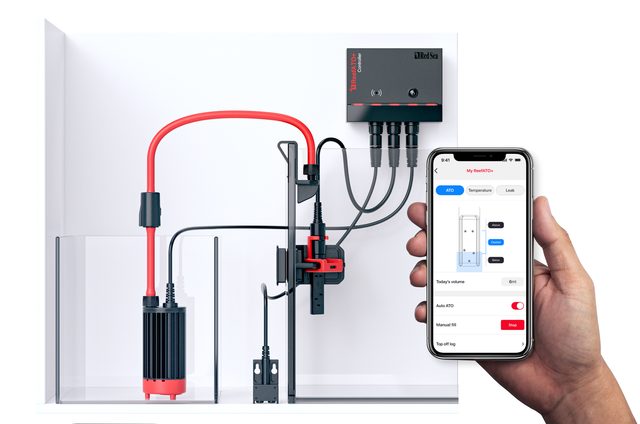
Red Sea's current ReefATO+ documentation identifies the complete kit as model AEELDPRE0030000 and specifies it for seawater aquariums only. The system combines a solid-state EC water-level sensor with titanium probes, a separate leak detector and a variable-flow serviceable pump. Red Sea lists the pump at up to 300 L/h / 75 GPH with a maximum head of 2.5 m / 8 ft, and the kit includes a siphon breaker. ReefBeat provides setup, status and alert functions.
That is a strong layered architecture, but it is not a guarantee against every installation error, siphon path, stuck condition or plumbing problem. Exact model AEELDPRE0030000 reconciles to marketplace ASIN B0CBQ8TXNZ in indexed catalog evidence.
The strongest all-round research pick because it combines a dedicated level sensor, leak detector, controlled pump, siphon-break hardware and unusually explicit current documentation.
Check price on Amazon →#2Best straightforward redundant-sensor option
Kamoer ATO One 2 SE
Best for: reef or freshwater aquariums that prioritize a simple primary optical sensor plus a physically separate high-water backup sensor
What we like
- Primary optical refill sensor is backed by a separate high-water overflow sensor
- 12V submersible pump and controller are included as one ATO system
- Buzzer/status alarms and timeout behavior add controller-level safeguards
- Current distributor documentation lists a siphon break and up to 2 m pump head
- Exact ATO One 2 SE identity with EAN 6970719750098 maps to ASIN B09QCDFK1V
What we don't
- Optional reservoir-low sensor is not part of every standard package
- Pump/head figures should be checked against the exact current package and installation height
- Multiple sensors still require clean mounting surfaces and periodic inspection
Current ATO One 2 SE documentation identifies a blue optical refill sensor and a separate red high-water sensor used as overflow protection. The controller works with an included 12V submersible pump and provides audible/status warnings and timeout behavior. Current distributor documentation also lists a siphon break and maximum pump head of about 2 m for the current kit.
The product identity is unusually clean: ATO One 2 SE with EAN 6970719750098 reconciles to ASIN B09QCDFK1V. The optional reservoir sensor should not be assumed to be included unless the exact package says so.
A strong conventional ATO because the refill and overflow functions are separated across two sensors and backed by controller alarms rather than relying on one sensing point.
Check price on Amazon →#3Best compact dual-optical ATO
XP Aqua Duetto² ATO
Best for: compact reef or freshwater setups where a small dual-optical sensor body, documented pump envelope and controller overfill logic fit the installation
What we like
- Exact model DATO-202P uses dual optical sensing in a compact magnetic sensor assembly
- Secondary sensor and QST programming provide two documented overfill-protection layers
- Included pump is documented at 280 L/h / 74 GPH with up to 250 cm / 8.2 ft head
- Magnetic mounting supports glass up to 12.7 mm / 1/2 in
- Exact DATO-202P identity maps to ASIN B0BWL74PD4
What we don't
- XP Aqua warns that microbubbles and direct light can interfere with optical sensing
- Compact dual sensors are still in one local water-level area rather than an independently placed floor leak sensor
- Correct tubing/outlet placement remains necessary to prevent unintended siphoning
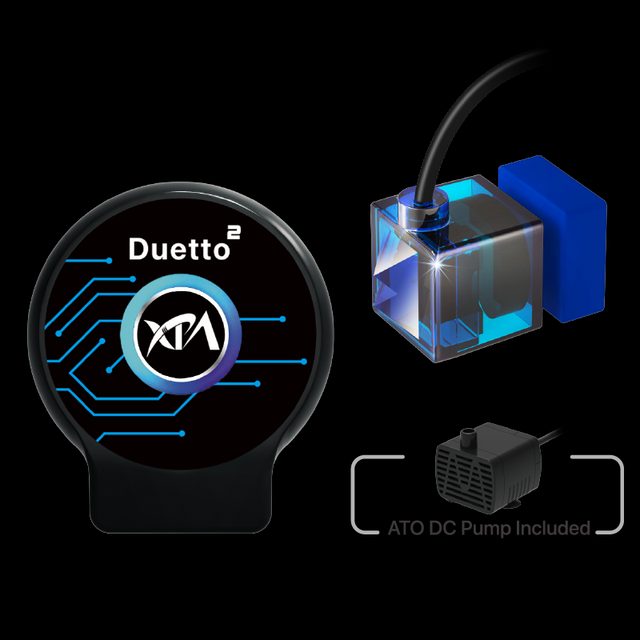
XP Aqua identifies the Duetto² as model DATO-202P. The official specification lists dual optical sensing, a secondary sensor plus QST programming for overfill protection, an included pump rated at 280 L/h / 74 GPH, maximum head of 250 cm / 8.2 ft and magnetic mounting through glass up to 12.7 mm / 1/2 in.
XP Aqua also warns against sensor exposure to microbubbles and direct light. Those are installation constraints, not minor footnotes: an optical sensor can only make good decisions when its sensing surface sees the intended water level. Exact DATO-202P identity maps to ASIN B0BWL74PD4.
The compact specialist: dual optical sensing and QST protection fit tight sumps and rear chambers without pretending the small sensor package eliminates installation risk.
Check price on Amazon →#4Best nano / simple documented ATO
TUNZE Osmolator® 3 nano 3151.000
Best for: nano and smaller aquariums where compact optical control, explicit dosing-duration limits and strong manufacturer documentation matter more than a second independent sensor
What we like
- TUNZE documents exact item 3151.000 for aquariums up to about 250 L / 66 US gal
- Optical level sensor has documented approximately 0.5 mm regulation accuracy
- Included low-voltage pump and 3 m hose create a complete basic top-off path
- Two selectable maximum dosing-duration levels add a controller timeout boundary
- Exact item 3151.000 / EAN 4025167485008 maps to ASIN B0DNGDR83C
What we don't
- TUNZE's own comparison identifies no independent safety sensor on the Nano
- Single primary sensing architecture provides less sensor redundancy than the top three picks
- Timeout protection must still be configured and cannot correct a bad siphon path
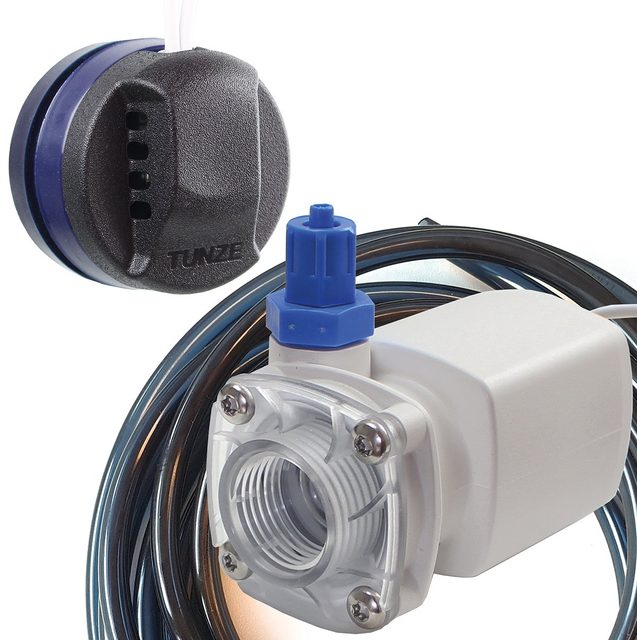
TUNZE's current US documentation identifies the Osmolator® 3 nano as item 3151.000 and positions it for aquariums up to approximately 250 L / 66 US gal. It uses one optical sensor with approximately 0.5 mm regulation accuracy, includes a low-voltage pump and 3 m hose, and supports two selectable maximum dosing-duration levels.
The limitation is explicit in TUNZE's own comparison: the Nano does not have the independent safety sensor used on the larger Osmolator 3. That is why it ranks below the redundant-sensor systems even though its exact identity evidence is strong. Item 3151.000 / EAN 4025167485008 maps to ASIN B0DNGDR83C.
The clearest simple/nano option, with a deliberate score penalty because TUNZE documents one optical sensor and no independent safety sensor on this Nano model.
Check price on Amazon →#5Best value dual-optical option
FZONE 580P Auto Top-Off
Best for: freshwater or saltwater aquariums seeking dual optical sensing and controller timeout protection at a simpler system level
What we like
- Current FZ-580P / ATO-580P uses dual optical sensors
- Manufacturer documents saltwater and freshwater compatibility
- Included pump is listed at 74 GPH with up to 2 m lift
- Controller adds alarms and shuts down after abnormal extended refill behavior
- Exact FZ-580P / ATO-580P identity maps to ASIN B0C68N3WK9
What we don't
- Failsafe documentation is less detailed than Red Sea's current system-level documentation
- Dual optical sensing still depends on correct placement and clean sensing surfaces
- Value positioning does not remove the need to verify siphon geometry and reservoir capacity
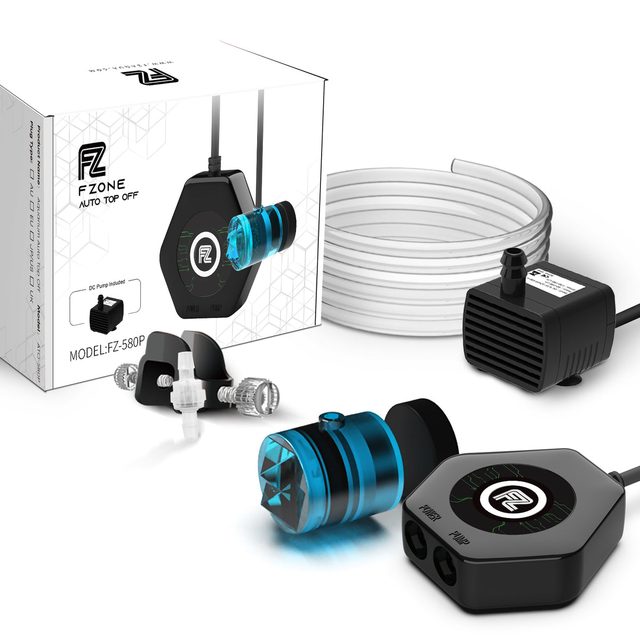
FZONE's current 580P page identifies model FZ-580P / ATO-580P for both saltwater and freshwater aquariums. It documents dual optical sensors, an included 74 GPH pump with up to 2 m lift, controller alerts and shutdown logic for abnormal refill duration, including the manufacturer's six-times-EFTT protection logic.
Those controller features improve the failure envelope, but they do not make reservoir size, tubing route or sensor cleaning optional. Exact FZ-580P / ATO-580P identity maps to ASIN B0C68N3WK9.
A capable value pick with dual optical sensors and documented controller protection, ranked more conservatively because the evidence around independent failsafe architecture is less extensive.
Check price on Amazon →An ATO solves a narrow but important problem: water level falls as water evaporates.
In a reef aquarium, that water loss can change salinity because evaporation removes water, not salt. A correctly configured ATO restores fresh top-off water to the system. It does not remove old water, dissolved waste or accumulated nutrients, so it does not replace a water change.
An ATO is also not a dosing pump. This guide evaluates level-control systems, not equipment for metering alkalinity, calcium, trace elements, medication or plant fertilizer. For that separate workflow, our aquarium dosing pump guide compares calibration evidence, channel scheduling, dose range and tubing/service boundaries.
For the rest of a reef equipment stack, use our protein skimmer guide, aquarium return-pump guide and reef aquarium lights guide. The aquarium water-parameters guide covers chemistry interpretation rather than water-level automation.
For reef systems considering kalkwasser through top-off, the reef dosing methods guide separates evaporation replacement from measured calcium/alkalinity demand and compares that workflow with two-part, all-in-one and calcium-reactor methods. If the method is already justified, the kalkwasser reactor guide compares the mixing hardware and its timer/feed/failure boundaries.
How we researched and scored
PetGearReport has not physically tested these ATO systems, measured pump curves, timed shutdown logic, simulated stuck sensors, quantified leak-detector response, created siphons or run unattended overflow trials. We compared current manufacturer documentation, sensor and backup architecture, pump/head limits, siphon-control provisions, setup/serviceability and exact marketplace identity.
The displayed number is a PetGearReport research score, not a hands-on result, customer rating or laboratory measurement.
- Failsafes & overflow protection — 35% — independent high-water/leak sensing, timeout logic, abnormal-run shutdowns and other documented layers.
- Sensor architecture — 20% — sensing method, redundancy, placement constraints and clarity of manufacturer documentation.
- Pump, head & siphon integration — 20% — included pump, maximum head where documented, flow envelope and explicit siphon-control provisions.
- Setup & serviceability — 15% — mounting, tubing, cleaning access, controller workflow and routine verification.
- Exact identity & documentation — 10% — model/SKU/GTIN evidence reconciled to the ranked marketplace variant.
| ATO system | Failsafes 35% | Sensors 20% | Pump/siphon 20% | Setup 15% | Identity 10% | Weighted | Score |
|---|---|---|---|---|---|---|---|
| Red Sea ReefATO+ | 10 | 9 | 10 | 9 | 10 | 9.65 | 9/10 |
| Kamoer ATO One 2 SE | 9 | 9 | 9 | 8 | 9 | 8.85 | 9/10 |
| XP Aqua Duetto² | 9 | 9 | 9 | 8 | 9 | 8.85 | 9/10 |
| TUNZE Osmolator 3 nano | 7 | 8 | 9 | 9 | 10 | 8.15 | 8/10 |
| FZONE 580P | 8 | 9 | 8 | 7 | 8 | 8.05 | 8/10 |
The weighted decimals make the method auditable; they do not imply laboratory precision. TUNZE remains narrowly ahead of FZONE because its current model, sensing limits, timeout controls and exact item identity are documented more explicitly, while FZONE earns stronger raw sensor-redundancy points.
No ATO is flood-proof
A manufacturer can add backup sensors, leak detection, pump timers and abnormal-run shutdowns. Those layers reduce specific failure modes; none can guarantee protection from every possible plumbing, mounting, reservoir or user error.
No ATO is flood-proof.
A useful pre-purchase checklist is:
- Identify the primary level sensor and what can interfere with it.
- Identify whether the backup is a separate high-water sensor, leak detector, controller timeout, or some combination.
- Check the pump’s real vertical lift against its documented head limit.
- Route the outlet so water cannot continue through an unintended siphon after the pump stops.
- Use any supplied siphon breaker exactly as the manufacturer instructs.
- Keep the top-off reservoir no larger than the system can tolerate under a credible failure scenario.
- Leave adequate sump/display freeboard for normal operating changes.
- Include sensor cleaning and a functional test in routine maintenance.
The aquarium maintenance schedule already separates evaporation replacement from water changes; an ATO automates only that top-off job.
Sensor architecture: primary sensing vs independent backup
Two products can both advertise “dual sensors” while implementing different failure layers.
Red Sea ReefATO+ uses a solid-state EC level sensor plus a separate floor/leak detector. The leak detector is not simply a second copy of the primary water-level reading; it watches a different failure consequence.
Kamoer ATO One 2 SE uses an optical refill sensor plus a separate high-water sensor. That creates a direct primary/overflow hierarchy.
XP Aqua Duetto² packages dual optical sensing into a compact assembly and combines the secondary sensor with QST controller logic.
TUNZE Osmolator 3 nano deliberately takes a simpler route: one optical sensor plus selectable maximum dosing duration. TUNZE’s own comparison says the Nano does not have the independent safety sensor found on the larger Osmolator 3.
FZONE 580P uses dual optical sensors with controller timeout/abnormal-run logic.
The important buying question is not merely “How many sensors?” It is what independent failure each layer can detect.
Reservoir size is part of the safety system
The reservoir is not passive storage. It is the maximum volume an ATO can potentially move before the reservoir is empty.
A larger reservoir reduces refill frequency, but it also increases the amount of water available if a sensor sticks, a controller fails, the outlet siphons or the installation is wrong. In a marine system, excessive freshwater addition can also drive salinity down.
There is no universal PetGearReport reservoir-size formula because safe freeboard, sump operating range, aquarium volume and trip duration differ. Use the smallest practical reservoir that meets the intended unattended interval while keeping the possible failure volume within a limit the system can safely contain.
Pump head matters more than headline flow
The ATO pump must lift water from the reservoir to the outlet. If the outlet is substantially above the reservoir, a pump’s zero-head flow label does not tell you whether it will work reliably.
Current manufacturer documentation gives useful boundaries:
- Red Sea ReefATO+ — up to 300 L/h / 75 GPH and 2.5 m / 8 ft maximum head.
- XP Aqua Duetto² — 280 L/h / 74 GPH and up to 250 cm / 8.2 ft head.
- FZONE 580P — 74 GPH and up to 2 m lift.
- Kamoer ATO One 2 SE — current distributor documentation lists up to about 2 m head for the included pump.
- TUNZE 3151.000 — includes its low-voltage metering pump and hose; use TUNZE’s installation envelope rather than substituting another pump’s rating.
Maximum head is a shutoff boundary, not the flow delivered at every lift. Keep the reservoir and outlet geometry within the exact system’s instructions.
Siphon control is not optional
A pump can stop while water keeps moving if the tubing arrangement creates a siphon.
Red Sea includes a dedicated siphon breaker in the ReefATO+ kit. Current Kamoer kit documentation also lists a siphon break. Other systems still depend on correct outlet placement and tubing route.
Never solve a siphon problem by assuming the controller will stop it: the controller can stop the pump, but gravity can continue moving water through a siphon. Follow the exact manufacturer instructions for outlet height, siphon-break placement and tubing.
Saltwater vs freshwater compatibility
The ranked systems do not all have the same intended water type.
Red Sea explicitly specifies ReefATO+ for seawater aquariums only. FZONE explicitly documents the 580P for both saltwater and freshwater. Kamoer, XP Aqua and TUNZE are used as aquarium top-off systems across common sump/display architectures, but always follow the exact current manufacturer package and installation instructions.
For reef systems, remember the chemistry distinction: evaporation leaves dissolved salt behind. Routine ATO replenishment therefore uses appropriate freshwater. If you prepare that freshwater at home, our aquarium RO/DI systems guide compares source-water fit, chloramine pretreatment, pressure and DI monitoring. Use the aquarium salinity tester guide when you need an independent way to verify whether the marine system is actually holding the intended salinity. An ATO is not an automatic saltwater-change system. If the reef is already outside its intended salinity range, use the reef salinity correction guide before repurposing routine top-off water as a correction method.
Product-by-product fit
Red Sea ReefATO+
Choose ReefATO+ when the aquarium is marine and the priority is layered monitoring rather than minimum hardware.
The AEELDPRE0030000 system combines its EC level sensor, independent leak detector, temperature monitoring, variable-flow serviceable pump, siphon breaker and ReefBeat integration. Red Sea publishes a 300 L/h / 75 GPH maximum pump flow and 2.5 m / 8 ft maximum head.
It is explicitly not the freshwater pick in this guide: Red Sea specifies seawater only.
Exact model AEELDPRE0030000 maps to B0CBQ8TXNZ.
Kamoer ATO One 2 SE
The ATO One 2 SE separates normal refill sensing from high-water detection.
Its main optical sensor triggers top-off, while the independent high-level sensor is positioned as the overflow backup. Controller alarms and timeout behavior add another layer. The exact current product identity uses EAN 6970719750098.
Check whether the optional low-reservoir sensor is actually included in the package you are buying; do not infer it from photos of accessory-complete setups.
EAN 6970719750098 maps to B09QCDFK1V.
XP Aqua Duetto² ATO
The Duetto² is the compact dual-optical option.
Exact model DATO-202P is documented with a 280 L/h / 74 GPH pump, 250 cm / 8.2 ft maximum head and magnetic mounting through glass up to 12.7 mm / 1/2 in. XP Aqua combines the secondary optical sensor with QST programming for two layers of overfill protection.
The optical-sensor warnings matter: XP Aqua specifically calls out microbubbles and direct light. Install the sensor where it can read the intended water level cleanly.
DATO-202P maps to B0BWL74PD4.
TUNZE Osmolator® 3 nano
The Nano is the deliberately simpler choice.
Exact item 3151.000 is rated by TUNZE for aquariums up to approximately 250 L / 66 US gal and uses one optical sensor with about 0.5 mm regulation accuracy. A low-voltage pump and 3 m hose are included, and the controller offers two selectable maximum dosing-duration levels.
TUNZE also documents the trade-off: this Nano does not have the independent safety sensor of the full-size Osmolator 3. Buyers wanting independent high-water sensing should not treat the two products as equivalent.
Item 3151.000 / EAN 4025167485008 maps to B0DNGDR83C.
FZONE 580P
The FZ-580P / ATO-580P is the value-oriented dual-optical option.
FZONE documents saltwater and freshwater use, dual optical sensors, a 74 GPH pump with up to 2 m lift and abnormal-run protection that can stop the pump after extended refill behavior. The controller also provides status/alarm feedback.
That is meaningful protection, but it does not replace correct reservoir sizing or siphon-safe tubing placement.
FZ-580P / ATO-580P maps to B0C68N3WK9.
Why three provisional products were not ranked
Three technically relevant ATO systems were researched but excluded from this publication roster because their current exact Amazon.com identity could not be reconciled to PetGearReport’s publication standard in this pass:
- Neptune ATKv2
- TUNZE Osmolator 3 3154
- AutoAqua SATO-120P
This is an identity/evidence exclusion, not a claim that those systems are technically worse than the five ranked products. If exact current marketplace identity becomes defensible later, they can be reevaluated without changing the scoring methodology.
Identity verification notes
- Red Sea ReefATO+ — exact model AEELDPRE0030000 → ASIN B0CBQ8TXNZ.
- Kamoer ATO One 2 SE — EAN 6970719750098 → ASIN B09QCDFK1V.
- XP Aqua Duetto² ATO — exact model DATO-202P → ASIN B0BWL74PD4.
- TUNZE Osmolator® 3 nano — item 3151.000, EAN 4025167485008 → ASIN B0DNGDR83C.
- FZONE 580P — exact model FZ-580P / ATO-580P → ASIN B0C68N3WK9.
Direct Amazon product-page probing was not used as a release gate.
Sources and verification
- Red Sea — ReefATO+ — seawater-only compatibility, sensor architecture, leak detector, temperature monitoring, pump limits, siphon breaker and ReefBeat integration.
- Kamoer ATO One 2 SE — current product documentation via J&L Aquatics — exact EAN, primary/overflow optical sensors, pump/controller package and current accessory boundaries.
- XP Aqua — Duetto² DATO-202P — dual optical sensing, QST overfill protection, pump flow/head, glass thickness and optical-sensor placement warnings.
- TUNZE — Osmolator® 3 nano 3151.000 — exact item identity, aquarium range, optical sensing, dosing-duration controls, pump/hose package and Nano safety-sensor boundary.
- FZONE — 580P Auto Top-Off — exact model family, dual optical sensors, salt/freshwater compatibility, pump/head figures and controller protection.
No Amazon price, stock or availability claim is made here. Those are dynamic and are not part of the research score.
Frequently asked questions
What does an aquarium auto top-off system actually do?
An ATO replaces water lost to evaporation and maintains a chosen water level. In a marine aquarium, evaporation removes water, not salt, so the replacement is fresh top-off water appropriate for the system rather than routine saltwater replacement. An ATO does not replace a water change because it does not export nitrate, dissolved waste or other accumulated material.
Can an ATO flood an aquarium or sump?
Yes, a failure or bad installation can add too much water. No ATO is flood-proof. Risk depends on sensor redundancy, controller timeouts, reservoir volume, freeboard, pump capacity, tubing placement and whether a siphon can continue after the pump stops. Follow the exact manufacturer instructions and test failure modes conservatively before leaving the system unattended.
Can I use an ATO as a dosing pump?
No. This guide treats an ATO as evaporation-replacement equipment, not a dosing pump. Evaporation varies with room conditions, airflow and aquarium operation, so tying supplements directly to top-off volume can make dosing track evaporation rather than the aquarium's measured chemical demand.
Do ATO sensors need cleaning?
Yes. Optical, conductivity and other level sensors can be affected by deposits, algae, salt creep, bubbles, debris or mounting changes. Inspect and clean the sensing surfaces on a schedule appropriate to the aquarium and the manufacturer instructions, and verify the backup sensor or timeout behavior after service.
Should a reef ATO reservoir contain saltwater?
Routine evaporation leaves dissolved salts behind, so normal reef top-off replaces the lost water with appropriate fresh water, not additional premixed saltwater. Correcting an abnormal salinity condition is a separate husbandry decision and should not be hidden inside routine ATO operation.