Best Aquarium Vacuums for Sand: 3 Picks for Gentle Surface Cleaning
Sand changes the vacuuming decision. Instead of treating the substrate like coarse gravel, the priority is removing surface debris without continuously pulling sand into the hose or powered intake. We researched three exact US-market products that represent manual siphon and powered sand-cleaning workflows. PetGearReport has not physically tested these vacuums, measured their suction, or observed them on different sand grain sizes. This is a sand-specific child guide; for the broader choice between faucet, bucket-siphon and powered water-change systems, use our general aquarium gravel vacuum guide.
| Rank | Product | Score | Best for | Link |
|---|---|---|---|---|
| #1 | Laifoo Aquarium Siphon Vacuum Cleaner (5 ft)Best manual siphon for sand | 9 | Aquariums where a simple bucket siphon, short hose and deliberate surface-hover technique fit the sand-cleaning workflow | Check price → |
| #2 | hygger HG-955-AC 360GPH 5-in-1 Aquarium CleanerBest powered sand-washing option | 8 | Larger or deeper aquariums where a powered cleaner is useful and the substrate matches hygger's documented grain-size guidance | Check price → |
| #3 | Tetra Water Cleaner Gravel SiphonBest simple broad-use manual siphon | 8 | Aquarists who want a straightforward manual siphon with a documented 2–55 gallon range and can control sand pickup through intake position | Check price → |
#1 · Our PickBest manual siphon for sand
Laifoo Aquarium Siphon Vacuum Cleaner (5 ft)
Best for: Aquariums where a simple bucket siphon, short hose and deliberate surface-hover technique fit the sand-cleaning workflow
What we like
- Exact listing identifies use for both gravel and sand
- 5-ft hose keeps the manual setup compact
- Siphon ball provides controlled hand-pump priming
- Detachable filter screen inside the sinkable gravel tube adds an intake barrier
What we don't
- No current standalone Laifoo manufacturer page was located for deeper technical verification
- Five feet of hose requires a nearby lower drain container
- Manual flow control depends on positioning and siphon height rather than a powered speed setting

The exact ranked variant is the Laifoo 5ft Aquarium Siphon Vacuum Cleaner, ASIN B07DBJ9YVB. Current indexed marketplace records identify a 5-ft hose, siphon ball, sinkable gravel tube and detachable filter screen, and explicitly position the tool for gravel and sand cleaning.
For sand, the useful feature is not a claim of extreme suction. It is the simple gravity-siphon architecture: keep the tube just above the substrate so lighter waste can enter while heavier sand falls back, and interrupt or reduce the siphon if grains begin travelling continuously up the tube. That surface-hover technique is an editorial use recommendation based on substrate physics, not a Laifoo performance claim.
Documentation depth is the main limitation. We did not locate a current standalone Laifoo manufacturer product page, so this guide does not invent flow rates, tank-size limits or material-performance claims beyond the exact listing attributes.
Our strongest sand-first manual pick because the exact listing explicitly covers gravel and sand while keeping the workflow simple enough to control by tube position and siphon height.
Check price on Amazon →#2Best powered sand-washing option
hygger HG-955-AC 360GPH 5-in-1 Aquarium Cleaner
Best for: Larger or deeper aquariums where a powered cleaner is useful and the substrate matches hygger's documented grain-size guidance
What we like
- Manufacturer documents sand washing as a core function
- HG-955-AC is documented at up to 360 GPH
- 45-degree corner inlet is documented for cleaning fine sand during water changes
- Powered system can either export water or run filtration/recirculation workflows
- Adjustable extension tubes support different tank depths
What we don't
- Manufacturer also recommends sand be larger than 0.2in, which limits how broadly the sand-washing claim should be applied
- More attachments and flow create more ways to disturb light substrate than a simple siphon
- Recirculation mode does not perform the water-export role of a partial water change

hygger identifies the AC version as model HG-955-AC, a 15W cleaner with flow up to 360 GPH. The manufacturer documents water changing, fish-waste cleaning and sand washing, plus a 45-degree corner suction inlet whose stated use includes cleaning fine sand while helping block landscape sand during a water change.
The important caveat is on the same current product page: hygger says it is recommended that the sand be larger than 0.2in. That is unusually coarse for material many aquarists call fine sand, so this guide does not use the fine-sand attachment language to erase the explicit grain-size recommendation. If your substrate is substantially finer, verify compatibility before relying on the powered sand-washing mode.
The powered architecture also separates cleaning modes. When water is filtered and returned to the aquarium, that is recirculation. When the outlet sends old aquarium water outside the tank, that is water export. Only the latter contributes to the actual replacement-water step of a partial water change.
The powered specialist here: hygger explicitly documents sand washing and a fine-sand inlet, but its separate grain-size recommendation means the exact substrate still needs to be checked before treating it as universal.
Check price on Amazon →#3Best simple broad-use manual siphon
Tetra Water Cleaner Gravel Siphon
Best for: Aquarists who want a straightforward manual siphon with a documented 2–55 gallon range and can control sand pickup through intake position
What we like
- Tetra identifies the exact tool as Product No. 78358
- Manufacturer documents use across 2–55 gallons
- Shorter intake is specifically documented for aquariums 10 gallons and under
- Priming bulb starts the siphon without mouth-priming
- Bucket clip helps secure the drain hose
What we don't
- Tetra markets this as a general water cleaner rather than a dedicated sand vacuum
- No manufacturer grain-size range is published
- Dirty water still requires a lower bucket or drain container and refill is a separate step
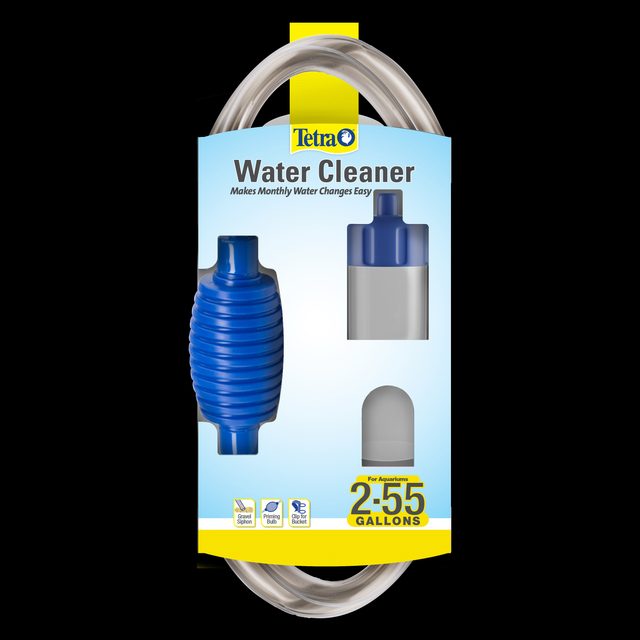
Tetra identifies this Water Cleaner as Product No. 78358 and states that it works on aquariums from 2–55 gallons, with a shorter intake intended to work on aquariums 10 gallons and under. The exact marketplace identity used here is ASIN B091D3DTWS.
Unlike hygger, Tetra does not publish a dedicated sand-washing mode or sand grain-size range. Its role here is therefore a controlled manual siphon option rather than a specialized sand tool. Hover the intake above the sand surface and let loose waste rise into the flow instead of repeatedly plunging the tube deep into fine substrate.
The priming bulb and bucket clip support a conventional gravity workflow: old water and debris leave together for a lower container. Replacement water remains a separate step and should be conditioned or prepared according to the aquarium's source-water needs.
The conservative general-purpose choice: Tetra documents the size range and siphon hardware clearly, but we do not relabel it as a purpose-built sand cleaner when the manufacturer does not.
Check price on Amazon →Sand changes the cleaning technique
The general aquarium gravel vacuum guide compares whole maintenance workflows: faucet-connected drain/refill systems, bucket siphons and powered cleaners. This page answers the narrower question of what changes when the substrate is sand.
With coarse gravel, a vacuum tube can often be pushed down between larger pieces while waste lifts away. Fine sand behaves differently. Repeatedly burying the intake can remove substrate, create a suspended cloud and disturb rooted areas. Start with the tube hovering above the sand surface, watch what enters the flow, and move closer only when the grains remain mostly in place.
Surface debris is the primary target. Work in short sections, keep the intake visible, and stop or reduce flow when shrimp, fry or other small livestock approach. A screen or strainer can add a physical barrier, but it does not remove the need to watch the intake.
Sand retention decision map
Manufacturer pages checked September 23, 2026. The table below is a troubleshooting and technique map, not a claim that one vacuum can be assigned a universal safe grain size or suction setting. PetGearReport has not physically tested these cleaners on different substrates, measured substrate loss, or measured intake suction.
| What you observe | What it usually tells you about the setup | Conservative adjustment |
|---|---|---|
| Sand continuously travels up the tube | The intake is too close, the siphon/pump is too aggressive for that substrate, or both | raise the intake and reduce or interrupt flow before continuing |
| Waste stays put while the sand remains stable | The intake may be too high or flow too weak to lift the debris | move slightly closer while keeping the sand bed visible and stop if grains begin travelling continuously |
| Fine substrate clouds aggressively | The tube/nozzle is disturbing the bed faster than debris can be removed | stop deep plunging and return to a surface-hover technique |
| Shrimp or fry approach the intake | The livestock-protection risk is now more important than cleaning speed | pause, let livestock move away, and use an appropriate intake barrier where the cleaner design allows one |
| Filtered water returns to the aquarium | Solids may be captured, but old water is not leaving the system | Treat it as recirculation, not as the water-export step of a partial water change |
| Debris and old water leave for a bucket/drain | The cleaner is performing water export as well as solids removal | Track the removed volume and refill with appropriately prepared replacement water |
The adjustment sequence is deliberately reversible: change intake height or flow first, observe the substrate response, then continue. It is safer than assuming that a product’s maximum flow or marketing term such as “sand washing” is appropriate for every sand bed.
Exact compatibility evidence for the three picks
hygger HG-955-AC. The current manufacturer page specifies 15W, 360 GPH maximum flow and 4.92 ft maximum head. It describes sand washing and a 45-degree corner suction inlet for water changes and cleaning fine sand, but the same specification also says it is recommended that the sand be larger than 0.2in. That is about 5.1 mm. Arithmetic unit conversion only: 0.2 inch × 25.4 mm/inch = 5.08 mm. This is not a PetGearReport substrate test, and it does not erase the manufacturer’s own wording or turn 5.1 mm into a measured performance threshold.
That combination of statements is exactly why the powered hygger stays conditional in this guide. A feature description can mention fine-sand cleaning while a separate specification still imposes a coarse-looking grain-size recommendation. Check the actual substrate rather than relying on one phrase.
Tetra Water Cleaner. Tetra identifies this tool as Product No. 78358, documents use across 2–55 gallons, and says its shorter intake works on aquariums 10 gallons and under. Tetra does not publish a sand grain-size range for this product on the current page, so we use it here as a controllable general siphon and do not invent a fine-sand compatibility limit.
Laifoo 5-ft siphon. The exact marketplace listing represented by ASIN B07DBJ9YVB identifies gravel-and-sand use, a siphon ball and a detachable filter screen. However, no current standalone Laifoo manufacturer product page was located for an equally strong technical source trail. For that reason, this guide keeps Laifoo claims narrow and does not assign an unsupported flow rate, grain-size threshold or suction-performance figure.
For the broader maintenance workflow, the aquarium maintenance schedule explains when substrate cleaning is useful, the aquarium volume and water-change calculator helps estimate replacement-water volume, and the aquarium water-change guide covers the drain/refill/conditioner workflow. The broader aquarium gravel vacuum guide remains the parent comparison for faucet-connected, bucket-siphon and powered systems.
Manual siphon versus powered sand cleaning
A gravity siphon gives you relatively simple control: intake height, hose height and any pinch/stop method determine how aggressively material enters the tube. That simplicity is why the Laifoo ranks first for this specific use case.
A powered cleaner can maintain stronger flow independent of gravity and may support specialized attachments. That can be useful in deep tanks or when you want filtration/recirculation between water changes, but higher powered flow also makes substrate compatibility more important.
The hygger HG-955-AC illustrates the trade-off. Its manufacturer documents sand washing, a 45-degree inlet for cleaning fine sand and up to 360 GPH flow. The same page also says it is recommended that sand be larger than 0.2in. Treat the explicit grain-size note as a compatibility constraint, not a footnote to ignore.
Recirculation is not the same as water export
A vacuum can remove visible debris without completing a partial water change. In recirculation mode, water passes through a filter and returns to the aquarium. In a water-export setup, old aquarium water leaves the tank for a bucket, drain or other destination.
If your maintenance plan calls for replacing part of the water, make sure the cleaner is configured for actual water export. Use the aquarium volume and water-change calculator when you need to convert measured tank dimensions into estimated net volume and common change quantities.
Replacement tap water should be treated according to the actual water supply and product label. Our aquarium water conditioner guide covers chlorine/chloramine handling without assuming every aquarium uses the same source water or dose.
Match the cleaner to the actual sand
“Sand” covers a wide range of grain sizes and densities. A tool that behaves well over coarse sand can be too aggressive on very fine material. Check the substrate manufacturer’s grain-size information when available, then compare it with the cleaner’s documented limits instead of assuming all sand is interchangeable.
The exact hygger documentation is a good example of why this matters: its accessory description mentions cleaning fine sand, while the product specification separately recommends sand larger than 0.2in. We keep both statements visible because omitting either one would make the buying advice less accurate.
Tetra does not publish a sand grain-size range for Product No. 78358, so we do not invent one. Laifoo’s exact listing says the tool is for gravel and sand, but current technical documentation is thinner than hygger’s or Tetra’s. For both manual options, technique and observation therefore matter more than an unsupported universal grain-size promise.
Use the tank’s maintenance evidence, not a sand-cleaning calendar
Vacuum when settled waste, feeding load, measured water quality and the aquarium’s established routine indicate that substrate cleaning is useful. The aquarium maintenance schedule explains how to adjust routine work from those signals rather than imposing one interval on every tank.
If the reason you are vacuuming is cloudy or particle-filled water, diagnose the source rather than treating every visible particle as a substrate problem. Our aquarium water-clarity guide separates disturbed substrate and visible debris from bacterial blooms, algae and chemistry problems that need a different response.
How we researched and scored
PetGearReport has not physically tested these aquarium vacuums, measured suction at the intake, compared substrate loss, or observed them with shrimp or fry. We compared exact product identities, current manufacturer documentation where available, current indexed exact-listing attributes, workflow limits and the specific risks created by sand. The scores are PetGearReport research scores, not hands-on test results.
Every product uses the same weighted framework:
- Sand control & substrate retention — 35%
- Debris removal & water-export workflow — 25%
- Suction & priming control — 15%
- Tank/reach/setup fit — 15%
- Documentation & exact identity — 10%
| Vacuum | Sand control 35% | Workflow 25% | Control 15% | Fit 15% | Docs 10% | Weighted result | Published score |
|---|---|---|---|---|---|---|---|
| Laifoo 5 ft | 9 | 8 | 9 | 8 | 7 | 8.45 | 9/10 |
| hygger HG-955-AC | 7 | 9 | 8 | 9 | 9 | 8.15 | 8/10 |
| Tetra Water Cleaner | 8 | 8 | 8 | 8 | 9 | 8.10 | 8/10 |
The decimals make the weighting auditable; they are not laboratory measurements. Ranking also considers the intended sand-cleaning use case, so a small score difference should not be read as a measured performance gap.
Sources and verification notes
Primary/current documentation used for this guide:
- hygger 5-in-1 Electrical Fish Tank Cleaning Tool Set for HG-955-AC, 360 GPH flow, sand-washing functions, the 45-degree fine-sand inlet and the manufacturer’s separate sand-size recommendation.
- Tetra Water Cleaner, Product No. 78358 for the 2–55 gallon range, shorter intake guidance and the general siphon-cleaning workflow.
- The exact Laifoo marketplace identity
B07DBJ9YVBwas cross-checked against current indexed product records for the 5-ft hose, siphon ball, detachable filter screen and gravel/sand positioning. A current standalone Laifoo manufacturer product page was not located, so claims stop at those exact attributes.
The same three ASINs were already identity-verified in PetGearReport’s broader aquarium gravel vacuum comparison; this page reuses those exact variants rather than introducing unverified alternatives.
For the broader maintenance context, use the aquarium maintenance schedule. If you are calculating replacement-water quantity, use the aquarium volume calculator; if suspended debris or cloudiness persists after cleaning, use the water-clarity troubleshooting guide before assuming the substrate is still the cause.
Frequently asked questions
How do you vacuum aquarium sand without sucking it up?
Start with the intake hovering just above the sand rather than burying it. Loose waste is usually lighter and can enter the flow while heavier grains fall back. If sand begins travelling continuously up the tube, raise the intake or reduce or interrupt the siphon. Grain size, siphon height and powered flow all affect how aggressive the pickup is.
Can I deep-vacuum sand like aquarium gravel?
Not as a default technique. Deep plunging can pull fine sand into the cleaner, disturb rooted areas and release more suspended particles. Clean the visible surface deliberately and use a deeper intervention only when the substrate system and husbandry need justify it.
Does a powered sand cleaner replace a water change?
Only when it is configured to export old aquarium water. A powered cleaner that traps debris and returns water to the tank is operating in recirculation mode. That can remove solids, but it does not perform the water-export step of a partial water change.
Is the hygger 360GPH cleaner safe for very fine sand?
Do not assume so from the fine-sand inlet description alone. hygger's current HG-955-AC page also recommends sand be larger than 0.2in. Because those two manufacturer statements need to be read together, verify your actual substrate grain size before using the powered sand-washing mode.