Best Aquarium Gravel Vacuums: 5 Picks by Tank Size & Water-Change Method
The best aquarium gravel vacuum is the one that matches your water-change workflow: where dirty water will go, how replacement water returns, how far the drain or faucet is from the tank, and how carefully the intake must be controlled around substrate and livestock. We researched five current faucet-connected, manual bucket-siphon, and powered options. PetGearReport has not physically tested these products. We compared manufacturer documentation, current indexed product identities, published setup limits, and the maintenance job each design can actually perform. The scores below are PetGearReport research scores, not hands-on results.
Quick decision table: match the vacuum to your water-change workflow
Start with the water path, not suction claims. A tank-size range is useful only when the hose reach, drain destination, refill method and substrate technique also fit your setup.
| Product | Type | Documented tank fit | Hose / reach | Dirty-water destination | Refill workflow | Substrate fit | Best for | Avoid if |
|---|---|---|---|---|---|---|---|---|
| Python No Spill Clean and Fill Aquarium Maintenance System (25 ft) | Faucet-connected gravel vacuum and water changer | No gallon range published; fit depends on faucet compatibility and practical hose reach | 25-ft hose system; exact listing identifies a 10-inch gravel tube | Compatible sink/faucet drain | Can reverse the faucet-connected workflow for refill when source water and treatment plan allow it | Best matched to gravel; fine sand needs controlled surface-level technique | Medium or large freshwater setups where a compatible faucet can handle drain and refill | Replacement water must be prepared separately, including many remineralized RODI workflows |
| Tetra Water Cleaner Gravel Siphon | Manual gravity siphon with priming bulb | Tetra documents 2–55 gallons for Product No. 78358 | Bucket clip; shorter intake specifically documented for aquariums 10 gallons and under | Lower bucket or drain container | Separate refill step | Gravel-focused siphon; hover rather than plunge over fine sand | Broad-use manual siphoning when a bucket workflow fits | You want direct faucet refill or need a long remote-drain hose system |
| Aqueon Siphon Vacuum Aquarium Gravel Cleaner (Medium 9 in) | Manual self-priming gravity siphon | Aqueon maps the Medium 9-inch model to 15–35 gallons | 6-ft flexible hose with bucket clip | Lower bucket or drain container | Separate refill step | Designed for gravel; fine sand requires surface-hover control | 15–35 gallon tanks where a six-foot bucket siphon fits the room layout | The drain is farther than the hose allows or the aquarium sits outside the documented size envelope |
| Laifoo Aquarium Gravel Cleaner Siphon Kit (5 ft) | Manual gravity siphon with squeeze-ball start | No manufacturer gallon range located for the exact 5-ft listing | 5-ft hose with sinkable gravel tube and detachable filter screen | Lower bucket or drain container | Separate refill step | Exact indexed listing positions it for gravel and sand | Compact bucket-based cleaning where hand-pump priming and a short hose fit | You need a distant drain, a faucet refill workflow, or deeper manufacturer documentation |
| hygger Electric Aquarium Gravel Vacuum (360GPH, 5-in-1) | Powered 5-in-1 cleaner / water changer | No gallon range published for the 15W 360GPH configuration | Manufacturer HG955AC documentation lists 11.4–40.5 in adjustable tube length | External discharge in water-change mode, or back to the tank in filtration/recirculation mode | Separate refill step | Manufacturer documents gravel cleaning, sand washing and fine-sand water-change attachment use | Powered spot cleaning or water export when the selected mode matches the maintenance job | You want the simplest siphon or might mistake recirculation for an actual water change |
| Rank | Product | Score | Best for | Link |
|---|---|---|---|---|
| #1 | Python No Spill Clean and Fill Aquarium Maintenance System (25 ft)Best faucet-connected workflow | 9 | Medium or large freshwater setups within practical reach of a compatible faucet and using a direct-refill workflow | Check price → |
| #2 | Tetra Water Cleaner Gravel SiphonBest broad-use manual siphon | 9 | Freshwater keepers who want one documented manual siphon design spanning small through larger home aquariums | Check price → |
| #3 | Aqueon Siphon Vacuum Aquarium Gravel Cleaner (Medium 9 in)Best documented mid-size fit | 8 | 15–35 gallon aquariums where a straightforward bucket siphon and 6-ft hose suit the maintenance layout | Check price → |
| #4 | Laifoo Aquarium Gravel Cleaner Siphon Kit (5 ft)Best hand-pump start | 8 | Bucket-based gravel or sand cleaning when a compact 5-ft hose and squeeze-ball priming method fit the setup | Check price → |
| #5 | hygger Electric Aquarium Gravel Vacuum (360GPH, 5-in-1)Best powered multi-function pick | 7 | Powered spot cleaning, sand washing or circulation-oriented maintenance where the electric multi-function workflow is specifically useful | Check price → |
#1 · Our PickBest faucet-connected workflow
Python No Spill Clean and Fill Aquarium Maintenance System (25 ft)
Best for: Medium or large freshwater setups within practical reach of a compatible faucet and using a direct-refill workflow
What we like
- 25-ft system can drain to and refill from a compatible faucet
- Exact listing includes a 10-inch gravel tube and faucet pump
- Avoids carrying drain and refill buckets when the faucet workflow fits
- Python documents replacement adapters and parts for the system
What we don't
- Requires a compatible faucet or an appropriate adapter
- Faucet-driven draining uses tap water to create suction
- Poor fit when refill water must be prepared separately, including many RODI workflows
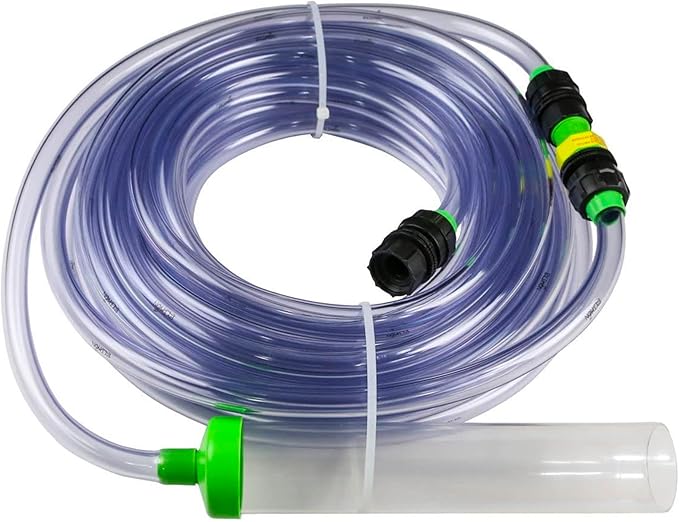
The exact ranked variant is the Python No Spill Clean and Fill 25-ft system, ASIN B000255NXC. Its current exact product listing identifies a 25-ft hose system with a 10-inch gravel tube, faucet pump, switch, hose connectors and brass faucet adapter. Python's own documentation confirms that the No Spill Clean and Fill is designed around a faucet connection and publishes adapter guidance for faucets that do not fit the standard supplied adapter.
That architecture is why it ranks first here. It can combine substrate vacuuming, dirty-water export and direct refilling in one hose workflow, so it addresses the entire water-change path rather than only debris pickup. This is a workflow advantage inferred from the documented design, not a PetGearReport observation of cleaning speed or suction performance.
Avoid it when the faucet cannot be connected safely, when the aquarium is so small that the hose-and-faucet workflow is unnecessarily cumbersome, or when replacement water must be prepared separately before entering the tank. That last point matters for aquariums using remineralized RODI water or other prepared-water routines: a direct faucet refill can conflict with the required water-preparation step.
Our highest-ranked research pick for whole-water-change workflow: the exact 25-ft system combines gravel vacuuming, draining and faucet-connected refilling when the plumbing and refill method are compatible.
Check price on Amazon →#2Best broad-use manual siphon
Tetra Water Cleaner Gravel Siphon
Best for: Freshwater keepers who want one documented manual siphon design spanning small through larger home aquariums
What we like
- Tetra documents compatibility across 2–55 gallons
- Priming bulb starts the siphon without mouth-priming
- Bucket clip helps secure the drain hose
- Shorter intake is documented for aquariums 10 gallons and under
What we don't
- Dirty water still drains to a bucket or other lower container
- Refill is a separate step
- Tetra's branded maintenance cadence should not be treated as a universal schedule
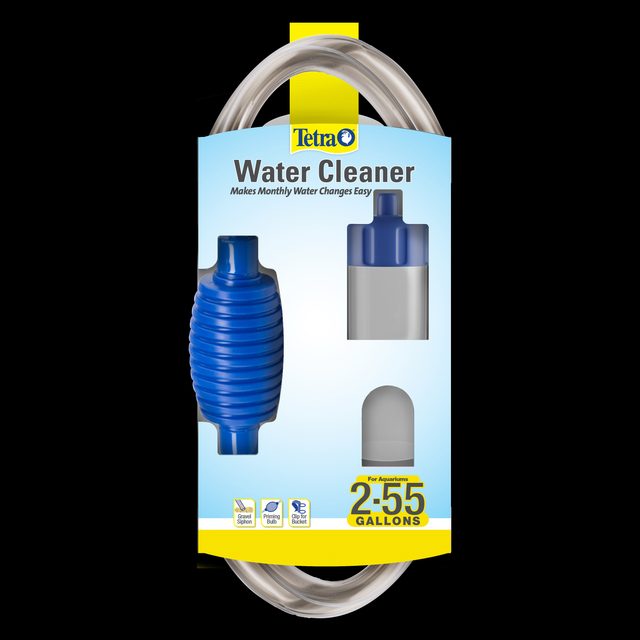
Tetra identifies this Water Cleaner as Product No. 78358, and the current manufacturer page states that it works with aquariums from 2–55 gallons. The exact ASIN B091D3DTWS is the Tetra Water Cleaner Gravel Siphon and includes a priming bulb plus a clip for the bucket.
The main distinction from the Python is the destination of the dirty water. The Tetra is a conventional gravity siphon: debris and aquarium water leave the tank and flow to a lower bucket or container, while replacement water is handled separately. The priming bulb makes the startup method explicit and removes the need for mouth-priming.
Tetra also publishes its own branded water-change cadence with this product. We do not generalize that cadence into PetGearReport advice because maintenance frequency depends on stocking, feeding, measured water quality, substrate condition and the wider system. Use the siphon when the tank's maintenance evidence indicates that debris removal and water export are needed.
A strong manual-siphon choice because Tetra documents a priming bulb, bucket clip and unusually broad 2–55 gallon fit for Product No. 78358.
Check price on Amazon →#3Best documented mid-size fit
Aqueon Siphon Vacuum Aquarium Gravel Cleaner (Medium 9 in)
Best for: 15–35 gallon aquariums where a straightforward bucket siphon and 6-ft hose suit the maintenance layout
What we like
- Exact Medium 9-inch variant is documented for 15–35 gallons
- Aqueon documents an up-and-down self-priming motion
- 6-ft hose and bucket clip are documented for the siphon-vacuum family
- Dirty water and loosened debris leave the aquarium together
What we don't
- Requires a lower drain bucket or container
- Six feet of hose can constrain placement in some rooms
- The Medium 9-inch fit should not be extrapolated beyond its documented aquarium range

The exact ranked variant is Aqueon's Medium 9-inch Siphon Vacuum Aquarium Gravel Cleaner, ASIN B004RK1WBK. Aqueon's product-family documentation describes the up-and-down intake-tube motion used to prime water flow, dirty-water removal while vacuuming gravel, and a 6-ft flexible hose with a bucket clip. Aqueon's catalog mapping identifies the Medium 9-inch version for 15–35 gallons.
That gives this pick a narrower but clearer fit than a generic one-size recommendation. The 6-ft hose means the drain container must be close enough and lower than the aquarium for gravity flow, and the separate bucket workflow means refill water is handled independently.
Choose it because the documented tank range, hose length and manual siphon workflow match the setup, not because a 9-inch intake tube is automatically better for every substrate. Fine sand, planted areas, shrimp and fry can require gentler positioning or intake protection regardless of the vacuum's nominal tank range.
A well-documented mid-size manual option: Aqueon's Medium 9-inch variant maps to 15–35 gallons, with the product family using an up-and-down self-priming workflow and 6-ft drain hose.
Check price on Amazon →#4Best hand-pump start
Laifoo Aquarium Gravel Cleaner Siphon Kit (5 ft)
Best for: Bucket-based gravel or sand cleaning when a compact 5-ft hose and squeeze-ball priming method fit the setup
What we like
- Exact listing identifies a 5-ft hose
- Siphon ball provides hand-pump priming
- Listing documents a sinkable gravel tube with detachable filter screen
- Exact product is listed for gravel and sand cleaning
What we don't
- Five feet of hose requires the drain container to remain close to the tank
- Still depends on gravity and a lower drain destination
- Manufacturer documentation is less extensive than the larger aquarium brands in this comparison

The exact ranked Laifoo variant is ASIN B07DBJ9YVB, listed as the 5-ft Aquarium Siphon Vacuum Cleaner for gravel and sand. The current listing identifies a 5-ft hose, a sinkable gravel tube with detachable filter screen and a siphon ball that is squeezed several times to begin water flow.
Those are the attributes we use for the ranking. The hand-pump start is a practical alternative to an up-and-down priming motion, while the 5-ft hose defines the physical reach between aquarium and drain container. We are not assigning it durability, longevity or material-quality advantages that the available documentation cannot substantiate.
For fine substrate or small livestock, the important issue is still control at the intake. Keep the tube positioned so that debris is removed without unnecessarily pulling substrate or animals into the flow, and stop the siphon if shrimp, fry or other small livestock approach the intake.
A simple hand-pump siphon whose exact listing supports the useful selection details: 5-ft hose, squeeze-ball start, gravel tube and gravel/sand use.
Check price on Amazon →#5Best powered multi-function pick
hygger Electric Aquarium Gravel Vacuum (360GPH, 5-in-1)
Best for: Powered spot cleaning, sand washing or circulation-oriented maintenance where the electric multi-function workflow is specifically useful
What we like
- Exact listing identifies a 360GPH powered cleaner
- Manufacturer documents gravel cleaning, sand washing, filtration and water-change functions
- Adjustable extension-tube design suits different tank depths
- Powered pump does not depend on a gravity siphon to move water
What we don't
- Filtration or recirculation mode returns water to the aquarium instead of exporting it
- More parts and functions create more setup choices than a simple siphon
- A powered debris-cleaning pass does not by itself perform the water-quality role of exported water

The exact ranked ASIN B08JCLST5B is the hygger 360GPH electric 5-in-1 aquarium gravel cleaner. Current hygger documentation for this cleaner family describes a powered pump, sand washing, debris cleaning, filtration, water changing and adjustable extension tubes, with published flow up to 360GPH.
The important buying distinction is where the water goes. In a water-change configuration, the powered pump can move aquarium water out of the tank. In filtration or recirculation mode, debris can be trapped while water is returned to the aquarium. Those are different maintenance outcomes even when the same motor and attachments are involved.
A powered cleaner does not automatically replace a partial water change. If the goal is to export old aquarium water because testing, husbandry or the maintenance plan calls for replacement water, configure the tool to discharge outside the aquarium rather than assuming a recirculation pass performs the same job.
The powered specialist: hygger documents up to 360GPH flow and multiple cleaning modes, but its recirculation and filtration functions must be distinguished from actually exporting old aquarium water.
Check price on Amazon →Start with one question: where does the dirty water go?
The first decision is not suction power. It is the destination of the water you remove.
A faucet-connected system such as the Python sends aquarium water toward a compatible sink and can reverse the workflow for refilling. A manual Tetra, Aqueon or Laifoo siphon relies on gravity and sends water to a lower bucket or drain container. The hygger uses an electric pump, so it can either discharge water from the aquarium or run cleaning/filtering functions that return water to the tank.
That distinction matters because visible debris removal and partial-water-change export are not the same outcome. If your maintenance plan calls for replacement water, the tool must export old aquarium water, not only trap solids and return the same water by recirculation.
Decide how you will refill before choosing the cleaner
Drain and refill are one workflow. The Python is strongest when a compatible faucet can serve both ends of that workflow. It is a weaker fit when the replacement water must be prepared separately before it reaches the aquarium.
For bucket or prepared-water workflows, our aquarium volume and water-change calculator can turn the tank’s measured dimensions into estimated net volume and common change quantities before you decide how many containers or how much prepared replacement water the workflow requires.
Whatever tool you use, source-water treatment should match the actual water supply and the exact conditioner label. Our aquarium water conditioners guide explains chlorine/chloramine handling and why concentration should be treated as a dosing question rather than a fixed retail-price claim.
If your refill decisions depend on pH, GH, KH, ammonia, nitrite or nitrate, use the aquarium water parameters guide for species- and system-specific interpretation rather than universal target numbers.
Then check tank size, reach and setup compatibility
The exact ranked products have materially different physical constraints:
- Python 25 ft: current exact listing identifies the 25-ft system, a 10-inch gravel tube and faucet pump. Faucet compatibility and refill method decide whether the architecture fits.
- Tetra Water Cleaner, Product No. 78358: Tetra documents 2–55 gallons, a priming bulb and bucket clip.
- Aqueon Medium 9-inch: Aqueon’s product documentation maps this exact size to 15–35 gallons and documents a 6-ft hose plus up-and-down self-priming for the siphon-vacuum family.
- Laifoo 5 ft: the exact listing documents a 5-ft hose, siphon ball and detachable-screen gravel tube.
- hygger powered cleaner: current documentation identifies 360GPH flow for the 5-in-1 powered cleaner family and adjustable tube length.
Published tank ranges are a starting constraint, not evidence that one cleaner is automatically right for every aquarium within the range. Check hose routing, drain height, faucet geometry, tank depth and access around the stand before buying.
Match the technique to the substrate and livestock
Coarse gravel can tolerate a deeper vacuuming motion than many fine-sand or planted layouts. With sand, the objective is often to lift loose debris without continuously drawing substrate into the tube. Around rooted plants, avoid unnecessarily disturbing the root zone.
If sand is your primary substrate, use our sand-specific aquarium vacuum guide for a narrower comparison built around surface-hover technique, substrate retention, grain-size caveats and powered recirculation versus water export.
Shrimp, fry and very small fish deserve extra intake control. Keep the intake visible, work in short deliberate sections and stop or reduce flow when animals approach. A flow-control feature can help when present, but careful positioning remains necessary even with a gentler cleaner.
For a wider maintenance framework, use our aquarium maintenance schedule. It ties cleaning decisions to waste accumulation, stocking, feeding, measured water quality and substrate rather than prescribing one universal vacuum interval. For the actual removal/refill sequence, conditioner and equipment-safety steps, use the aquarium water change guide.
Priming and control come after the workflow constraints
Once drain destination, refill method, reach and livestock safety are solved, priming method becomes useful for separating otherwise suitable products.
Tetra uses a priming bulb. Aqueon documents an up-and-down intake-tube motion to start the siphon. Laifoo uses a squeeze siphon ball. Python relies on its faucet-connected pump architecture. The hygger uses an electric pump rather than a gravity-only siphon.
Do not mouth-prime an aquarium siphon. Use the designed priming method and keep the discharge end lower than the tank for gravity siphons.
Powered cleaning and siphon water changes are different jobs
The hygger is useful precisely because one powered tool can be configured for more than one task. That versatility also creates the easiest misunderstanding in this category: a powered cleaner does not automatically replace a partial water change.
If the unit is filtering debris and returning water, the aquarium is in a recirculation workflow. If it is pumping dirty water out of the aquarium, it is performing water export. Choose the configuration based on what the maintenance task actually requires.
If cloudy water is the reason you are reaching for a vacuum, diagnose the cause first with our guide to keeping aquarium water clear. Substrate debris may be relevant, but bacterial blooms, suspended fines, algae or water-chemistry issues can require a different response.
How we researched and scored
PetGearReport has not physically tested these gravel vacuums. This comparison is research-based. We verified exact product identities where current marketplace detail pages were available, then compared current manufacturer documentation, published specifications, setup requirements, system limitations and the maintenance job each design can actually perform. We did not convert Amazon/customer ratings into PetGearReport scores and did not assign points for temporary price or availability.
The PetGearReport research scores use these weights:
- Water-change workflow & debris removal — 30%
- Flow/control & substrate/livestock handling — 20%
- Tank fit, hose reach & setup compatibility — 20%
- Priming, servicing & usability — 15%
- Documentation, limitations & accessory support — 15%
Each category is scored on a 10-point editorial scale, multiplied by its weight and summed. The published score is the weighted result rounded to the nearest whole point. These are research judgments about documented fit and decision usefulness, not laboratory measurements or hands-on performance results.
| Product | Workflow 30% | Control 20% | Fit 20% | Usability 15% | Documentation 15% | Weighted result | Published score |
|---|---|---|---|---|---|---|---|
| Python No Spill 25 ft | 10 | 8 | 9 | 8 | 9 | 8.95 | 9/10 |
| Tetra Water Cleaner | 9 | 8 | 9 | 9 | 9 | 8.80 | 9/10 |
| Aqueon Medium 9-inch | 8 | 8 | 8 | 8 | 9 | 8.15 | 8/10 |
| Laifoo 5 ft | 8 | 8 | 7 | 9 | 7 | 7.80 | 8/10 |
| hygger 360GPH 5-in-1 | 7 | 7 | 8 | 7 | 7 | 7.20 | 7/10 |
Sources and verification notes
Primary/manufacturer documentation used for this refresh:
- Python Products product range and Python No Spill Clean and Fill FAQ for faucet-system operation and adapter limitations.
- Tetra Water Cleaner, Product No. 78358 for the 2–55 gallon range, shorter intake guidance, priming bulb and bucket clip.
- Aqueon Siphon Vacuum Gravel Cleaners for the up-and-down priming method, 6-ft hose and siphon workflow; Aqueon’s product-catalog size table identifies the Medium 9-inch model for 15–35 gallons.
- hygger 5-in-1 Electrical Fish Tank Cleaning Tool Set for the powered cleaner’s 360GPH flow, sand-washing, filtration, water-change and adjustable-length functions.
- The exact Laifoo marketplace listing for ASIN
B07DBJ9YVBwas cross-checked for the 5-ft hose, siphon ball, detachable filter screen and gravel/sand positioning. A current standalone Laifoo manufacturer product page was not located, so we do not extend the claims beyond the exact listing attributes.
Exact ASIN identity was also cross-checked against current indexed marketplace records without directly probing Amazon product pages: Python B000255NXC, Tetra B091D3DTWS, Aqueon B004RK1WBK, Laifoo B07DBJ9YVB, and hygger B08JCLST5B.
For filtration decisions that sit alongside substrate cleaning, see the aquarium filter media guide and best aquarium filters guide.
Frequently asked questions
How often should I vacuum aquarium substrate?
There is no universal gravel-vacuum interval that fits every aquarium. Base the decision on visible waste accumulation, stocking and feeding, substrate type, plant coverage, measured water quality and the maintenance needs of the particular system. Our aquarium maintenance schedule explains how to use those signals without imposing one cadence on every tank.
Can a gravel vacuum suck up shrimp or fry?
Small livestock can be drawn toward an intake, especially when flow is strong relative to the animal's size. Work slowly, keep the intake in view, reduce or interrupt flow when livestock approaches, and use an appropriate intake guard where the cleaner design allows it. Substrate type also matters because the technique for coarse gravel is different from hovering above fine sand.
Can I use a gravel vacuum on sand or planted substrate?
Use a technique that matches the substrate. With sand or planted areas, aggressive plunging can remove substrate or disturb roots, so surface-level debris pickup may be more appropriate. The exact method depends on grain size, planting, livestock and the cleaner's intake control rather than a single rule for every tank.
Does an electric gravel cleaner replace a water change?
Not automatically. A powered cleaner can filter or recirculate aquarium water while trapping debris, or it can be configured to pump water out of the aquarium. Only the water-export workflow actually removes old aquarium water for replacement. Use water testing and the tank's maintenance plan to decide when a partial water change is needed.