Best Hang-on-Back Aquarium Filters (HOB): 5 Picks by Tank Fit
Hang-on-back filters share a rim-mounted format, but their media systems, flow controls and restart behavior differ substantially. We researched five exact US affiliate product identities against current manufacturer documentation. PetGearReport has not physically tested these HOB filters, measured their flow, noise or debris capture, or observed their long-term durability. The recommendations below keep each manufacturer's hydraulic label in context and focus on tank fit, media architecture, maintenance access and livestock compatibility.
| Rank | Product | Score | Best for | Link |
|---|---|---|---|---|
| #1 | Seachem Tidal 55 Power FilterTop pick | 9 | Mid-size aquariums that benefit from an open basket, adjustable intake split and built-in surface skimming | Check price → |
| #2 | Fluval AC110 Power FilterBest large open basket | 9 | Large aquariums where an accessible open HOB basket is preferred over external canister plumbing | Check price → |
| #3 | Marineland Penguin PRO 275 Power FilterBest BIO-Wheel design | 8 | Aquariums where Marineland's cartridge workflow and separate BIO-Wheel biological stage are a deliberate fit | Check price → |
| #4 | Fluval C4 Power FilterBest staged media access | 8 | Owners who want clearly separated media stages and quick access without moving to a canister filter | Check price → |
| #5 | Tetra Whisper IQ 45 Power FilterBest cartridge self-primer | 8 | Owners who prioritize self-priming restart and a familiar cartridge workflow with adjustable flow | Check price → |
#1 · Our PickTop pick
Seachem Tidal 55 Power Filter
Best for: Mid-size aquariums that benefit from an open basket, adjustable intake split and built-in surface skimming
What we like
- Seachem rates the Tidal 55 for aquariums up to 55 US gallons
- Manufacturer publishes a 250 US GPH flow rate and 1.2 L filter volume
- Open media basket ships with Matrix biomedia instead of requiring a cartridge
- Built-in surface skimmer and adjustable underwater intake split
- Self-priming pump and maintenance alert simplify restart and service
What we don't
- Bare intake can need a suitable pre-filter for fry or very small shrimp
- Three-inch wall clearance is required behind the aquarium
- Surface-skimmer intake adds another adjustment to set correctly
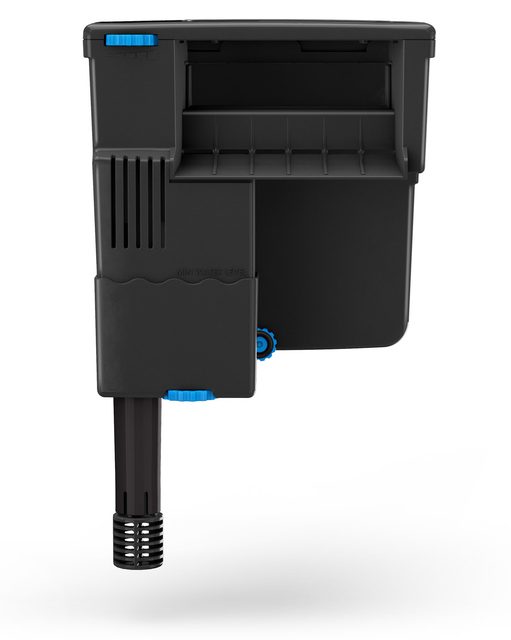
Seachem specifies the Tidal 55 for aquariums up to 55 US gallons / 200 L, with a 250 US GPH / 1000 L/h Flow Rate, 1.2 Liters of filter volume and 6W power draw at 120V. Those are manufacturer specifications, not PetGearReport measurements.
Its main differentiator is the system around that flow number. Water moves bottom-to-top through a removable open basket, the intake can be divided between a surface skimmer and submerged intake, and the front control reduces pump flow when the aquarium needs less current. Seachem also documents a self-priming submerged pump and a mechanical maintenance alert that rises when clogged media redirects water.
The exact affiliate identity used here is ASIN B01M6Z59E9 for Seachem Tidal 55. Choose the Tidal 55 when those controls and the open basket fit the aquarium; do not choose it simply because 250 GPH looks larger than another filter's differently labeled hydraulic figure.
The most complete documented HOB architecture here: open media, 250 GPH flow, self-priming restart, surface skimming and a maintenance alert in one 55-gallon model.
Check price on Amazon →#2Best large open basket
Fluval AC110 Power Filter
Best for: Large aquariums where an accessible open HOB basket is preferred over external canister plumbing
What we like
- Fluval documents a 60-110 US Gal aquarium range
- Published Max. Flow Rate is 500 US GPH / 1892 LPH
- Large open media basket supports separate mechanical, chemical and biological media
- Flow adjustment lets output be reduced for the setup
- Current manufacturer documentation lists 14W at 120V
What we don't
- Large 13.6-inch body needs substantial rim and rear clearance
- Maximum-flow labeling should not be compared directly with another brand's filter-circulation figure
- Open basket still needs a deliberate media-service routine
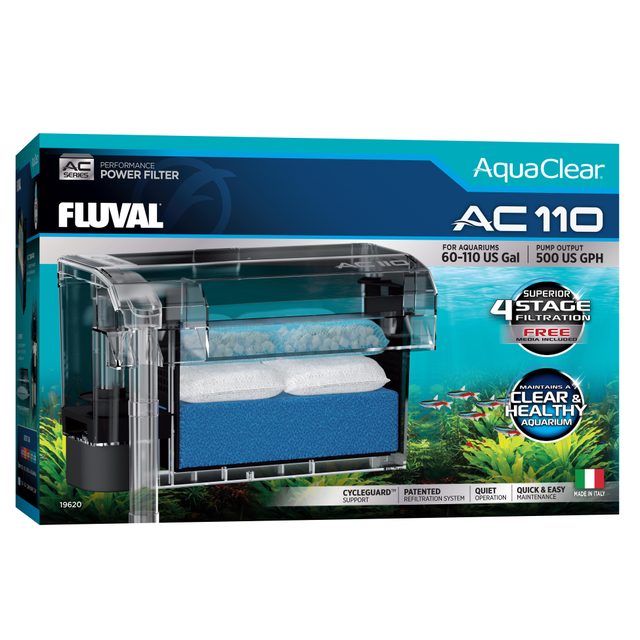
Fluval's current AC Series documentation lists the AC110 for 60-110 US Gal / 227-416 L aquariums, with a Max. Flow Rate of 500 US GPH / 1892 LPH and 14W power draw at 120V. The exact affiliate identity used here is ASIN B000260FV6 for Fluval AC110.
The AC architecture is attractive when you want a large, accessible basket rather than a sealed cartridge path. Mechanical foam, optional chemical media and biological media can be serviced separately, which makes the filter more configurable than a fixed cartridge workflow.
The trade-off is physical size and strong nominal output. Verify rim clearance, space behind the tank and livestock current tolerance before choosing the largest model. Treat 500 GPH as Fluval's Max. Flow Rate label, not as a universal real-world performance measurement directly interchangeable with every other number in this guide.
The large-tank open-basket choice: 60-110 gallons and a documented 500 GPH maximum-flow label, with more media flexibility than cartridge-first designs.
Check price on Amazon →#3Best BIO-Wheel design
Marineland Penguin PRO 275 Power Filter
Best for: Aquariums where Marineland's cartridge workflow and separate BIO-Wheel biological stage are a deliberate fit
What we like
- Marineland documents the Penguin PRO 275 at 275 GPH for aquariums up to 50 gallon
- BIO-Wheel provides a dedicated wet/dry biological stage
- Mechanical and chemical filtration use the Rite-Size cartridge path
- Flow control is built into the PRO line
- Exact Amazon.com variant identity is already established on PetGearReport
What we don't
- Cartridge workflow is less configurable than an open media basket
- BIO-Wheel must remain able to rotate as intended
- Wet/dry wheel architecture adds a component that needs inspection during maintenance

Marineland's current Penguin PRO documentation lists the 275 model at 275 GPH and for aquariums up to 50 gallon capacity. The PRO architecture combines mechanical, chemical and biological filtration, with the rotating BIO-Wheel providing the wet/dry biological stage.
That architecture creates a clear trade-off. The Rite-Size cartridge path makes mechanical and chemical replacement straightforward, but it is less freely configurable than the Tidal or AC open baskets. The BIO-Wheel is also part of the intended biological system, so it should remain wet and able to rotate rather than being treated as decorative hardware.
The exact affiliate identity used here is ASIN B07YXHVWRZ for Marineland Penguin PRO 275. This guide deliberately uses the PRO 275 rather than extrapolating from a larger model whose current manufacturer page contains inconsistent hydraulic text.
The distinctive wet/dry option: 275 GPH, an up to 50 gallon envelope and a BIO-Wheel stage rather than an open-basket media system.
Check price on Amazon →#4Best staged media access
Fluval C4 Power Filter
Best for: Owners who want clearly separated media stages and quick access without moving to a canister filter
What we like
- Fluval rates the C4 for aquariums up to 70 US Gal / 265 L
- Current 120V Filter Circulation specification is 264 US GPH / 900 LPH
- Five-stage architecture separates mechanical, chemical and biological media
- Cleaning indicator signals when the mechanical pad needs attention
- Patented refiltration system can reduce output while increasing dwell time
What we don't
- More media stages create more components to service than a simple cartridge HOB
- Filter Circulation is Fluval's label and is not interchangeable with another product's maximum-flow label
- Specialized media layout is less open-ended than a large empty basket
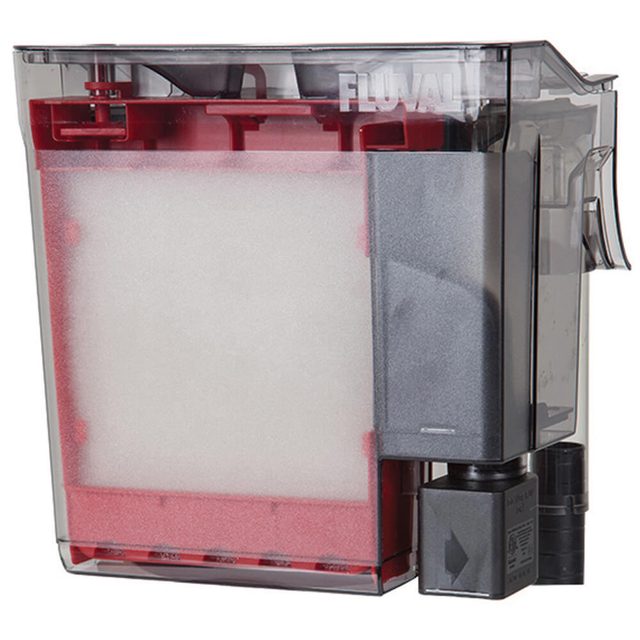
Fluval specifies the C4 for aquariums up to 70 US Gal / 265 L. Its current US page lists Filter Circulation at 264 US GPH / 900 LPH for 120V operation and a 5W power draw. It also documents a 5-stage path with mechanical foam/poly, activated carbon, BIOMAX and a Bio-Screen wet/dry stage.
The C4's advantage is organized media access rather than maximum configurability. The mechanical section slides out for rinsing, the chemical basket has a draw tab, and a cleaning indicator rises when the mechanical pad needs service. Fluval also documents a refiltration mode that can reduce water output while increasing dwell time through the filter.
The exact affiliate identity used here is ASIN B003SJXTIU for Fluval C4. Compare its 264 GPH Filter Circulation label only in the context Fluval provides; it should not be converted into a direct performance verdict against Seachem's Flow Rate or AquaClear's Max. Flow Rate.
The structured-media choice: a 70-gallon HOB with 264 GPH documented Filter Circulation, five stages and a service indicator.
Check price on Amazon →#5Best cartridge self-primer
Tetra Whisper IQ 45 Power Filter
Best for: Owners who prioritize self-priming restart and a familiar cartridge workflow with adjustable flow
What we like
- Tetra publishes the Whisper IQ 45 at 215 GPH
- Self-priming submerged motor starts without manually filling the filter body
- Flow control can reduce output for feeding, plants or lower-flow livestock
- BioGrid provides a permanent biological surface separate from the cartridge
- Large Bio-Bag cartridge size is widely documented across the IQ line
What we don't
- Cartridge-first workflow offers less media freedom than an open basket
- Tetra's sound claims are manufacturer claims, not PetGearReport measurements
- Routine cartridge use creates an ongoing consumable requirement
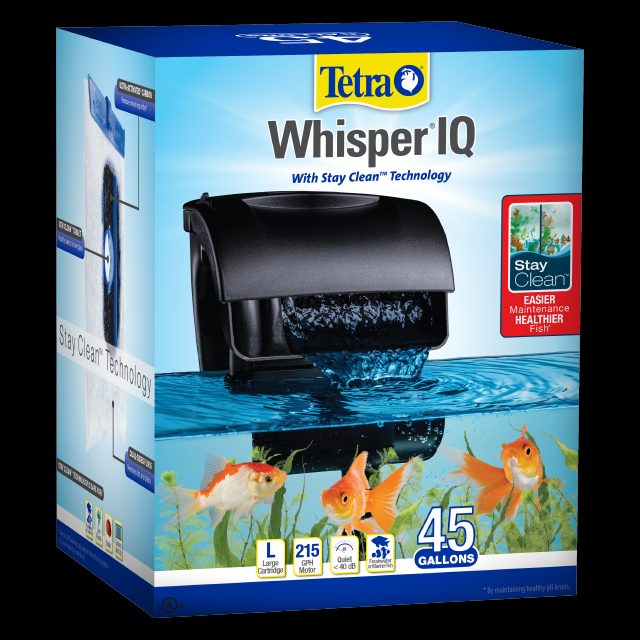
Tetra's current Whisper IQ product page lists the IQ 45 at 215 GPH and identifies it as one of the self-priming, flow-adjustable models in the line. Tetra also documents a BioGrid biological surface plus Large Bio-Bag cartridge compatibility for the IQ 20, 30, 45 and 60.
This is a different ownership model from the Tidal or AquaClear. The cartridge handles much of the replaceable mechanical/chemical work, while the BioGrid is the permanent biological stage. That can make routine service straightforward, but it gives you less freedom to build a custom basket from separate media.
The exact affiliate identity used here is ASIN B01MZI5N6R for Tetra Whisper IQ 45. Tetra publishes acoustic design claims for Whisper IQ, but PetGearReport has not measured this filter's sound level and does not score it as independently verified quiet performance.
The simpler self-priming cartridge choice: 215 GPH, adjustable flow and a permanent BioGrid biological stage in the 45-gallon IQ format.
Check price on Amazon →How we researched and scored
PetGearReport has not physically tested these HOB filters, measured their water flow, noise, priming reliability, debris capture or long-term durability. We compared current manufacturer documentation, exact model identity, aquarium-capacity guidance, hydraulic labels, media architecture, flow controls, installation requirements, maintenance access, restart behavior and current public product-identity evidence. Amazon pricing, availability snapshots and customer-star ratings were not scoring inputs.
The displayed 1–10 number is a PetGearReport research score, rounded to the nearest whole number from the same five weighted categories for every filter:
- Tank fit & hydraulic documentation — 25%: exact aquarium range, clarity of the published hydraulic label and how well the documentation defines the model’s intended operating envelope.
- Media architecture & flexibility — 25%: usable mechanical/biological/chemical stages, basket freedom, permanent biological surfaces and cartridge dependence.
- Flow control & livestock fit — 20%: output adjustment, intake design, surface-skimmer controls and ability to adapt to lower-flow livestock.
- Maintenance & restart workflow — 15%: media access, clog/service indicators, self-priming behavior and the number of components that need routine handling.
- Documentation & parts support — 15%: current official specifications, manuals, replacement media/parts information and exact model traceability.
| Product | Tank fit / hydraulics 25% | Media architecture 25% | Flow / livestock fit 20% | Maintenance / restart 15% | Documentation / parts 15% | Weighted result | Published score |
|---|---|---|---|---|---|---|---|
| Seachem Tidal 55 | 9 | 9 | 10 | 9 | 9 | 9.20 | 9/10 |
| Fluval AC110 | 9 | 10 | 8 | 8 | 9 | 8.90 | 9/10 |
| Marineland Penguin PRO 275 | 9 | 7 | 8 | 8 | 8 | 8.00 | 8/10 |
| Fluval C4 | 9 | 8 | 8 | 8 | 8 | 8.25 | 8/10 |
| Tetra Whisper IQ 45 | 8 | 7 | 9 | 9 | 9 | 8.25 | 8/10 |
The weighted decimals make the method auditable; they are not precise measurements of real-world filter performance. Editorial rank also considers use-case breadth, so two products with similar rounded scores can appear in a different order.
Quick decision: choose the HOB architecture before the GPH number
| Model | Manufacturer tank guidance | Published hydraulic label | Best when | Avoid if |
|---|---|---|---|---|
| Seachem Tidal 55 | Up to 55 US gal / 200 L | Flow Rate — 250 US GPH | You want an open basket, self-priming restart and built-in surface skimming with adjustable intake/output behavior | three-inch rear clearance is unavailable, or you do not want a surface-skimmer intake to tune |
| Fluval AC110 | 60–110 US gal / 227–416 L | Max. Flow Rate — 500 US GPH | You need a large open basket for 60–110 US gal systems and prefer rim-level media access over canister plumbing | The 13.6-inch body or rear/rim clearance is a poor fit, or the aquarium does not need this size class |
| Marineland Penguin PRO 275 | Up to 50 gallon | 275 GPH flow rate | You specifically want a BIO-Wheel wet/dry biological stage with a cartridge-led service workflow | You want an open reusable-media basket with maximum freedom over the media stack |
| Fluval C4 | Up to 70 US gal / 265 L | Filter Circulation — 264 US GPH | You want separated five-stage media access, a cleaning indicator and refiltration control | You prefer one large open basket or the simplest possible media-service path |
| Tetra Whisper IQ 45 | Up to 45 gallon | 215 GPH | You want a self-priming cartridge workflow with adjustable flow and a permanent BioGrid stage | You want open-basket media freedom or to minimize recurring cartridge dependence |
This is a fit-and-ownership shortcut, not a GPH leaderboard. The manufacturers use different hydraulic labels, and each design changes media access, restart behavior, clearance requirements and livestock-fit controls. Start by eliminating models outside the documented tank fit or physical installation constraints, then choose the architecture you can maintain correctly.
HOB filters are not one interchangeable category
A hang-on-back filter places the main filter body on the aquarium rim, but that shared mounting style hides major differences in how water is moved and how media is managed. The Tidal 55 and AC110 emphasize open baskets. The Penguin PRO uses a cartridge plus a rotating BIO-Wheel. The C4 divides media into multiple accessible stages. Whisper IQ combines a replaceable Bio-Bag with a permanent BioGrid.
That architecture matters because the filter you can service correctly and consistently is usually a better fit than one chosen from a single GPH number. If you are still deciding between rim-mounted and external plumbing, use our canister filter vs HOB filter comparison. Our best aquarium canister filters guide then compares exact canister models once that architecture is the better fit.
For a broader view across filter types, start with the best aquarium filters.
Flow Rate, Max. Flow Rate and Filter Circulation are not interchangeable
Manufacturers do not use one standardized label across every HOB filter. Seachem publishes Flow Rate for the Tidal 55. Fluval labels the AC110 specification Max. Flow Rate. Fluval’s C Series page instead labels the C4 number Filter Circulation. Marineland and Tetra publish model GPH figures in their own product-line context.
Those numbers help size models inside their documented ranges, but they are not interchangeable measurements of installed aquarium performance. Media loading, intake restriction, reduced-flow settings, water level and the filter’s internal path can all affect what happens in a real setup.
Our aquarium filter size guide explains how to use manufacturer ranges and hydraulic labels without turning a generic turnover ratio into a universal rule. If the tank is exactly 40 gallons and canister filtration is still in the decision, the 40-gallon filter guide compares the AC50/AC70 HOB overlap against 207/307 canister alternatives using each manufacturer’s own range and hydraulic label.
Open baskets versus cartridge-led media paths
Open baskets make it easier to keep reusable mechanical and biological media in service while changing only the stage that actually needs attention. The Tidal 55 ships with foam and Matrix biomedia, while the AC line supports separate foam, chemical media and BioMax-style biological media. That flexibility is useful when you want to tune the filter around the aquarium rather than replace one combined cartridge on a fixed calendar.
Cartridge-led designs are not automatically inferior. The Penguin PRO and Whisper IQ use a more prescribed path that can make routine mechanical/chemical servicing straightforward, while permanent biological structures remain separate. The trade-off is less freedom over the media stack and an ongoing consumable component.
The Fluval C4 sits between those approaches by separating several stages into dedicated removable sections. For more detail on mechanical, biological and optional chemical media roles, see our aquarium filter media guide. If your HOB has a reusable basket and you are choosing the biological stage itself, our best biological filter media for aquariums compares current loose-media options by physical fit and maintenance.
Flow control and intake safety matter for livestock
A manufacturer tank range only tells part of the story. A filter can be within its nominal aquarium range and still create more local current than slow-swimming fish, fry or small shrimp tolerate comfortably.
The Tidal 55 and Whisper IQ both provide flow adjustment, while the Tidal also lets you change the balance between its submerged intake and surface skimmer. Fluval’s C Series refiltration control is designed to reduce output while continuing to move water through the media path. These controls are useful because they let the same basic filter architecture adapt to different layouts and livestock needs.
For very small livestock, inspect the intake itself. A correctly fitted pre-filter sponge can reduce intake risk on compatible models, but it also adds resistance and becomes another surface that needs cleaning. Our best aquarium pre-filter sponges guide explains how to measure the intake and compare OEM versus universal-fit foam. If gentle intake is the primary requirement, compare the sponge filter vs HOB guide and our best aquarium sponge filters.
Restart behavior and maintenance are ownership features
Power interruption and water-change restart behavior can be important on a rim-mounted filter. Seachem documents the Tidal 55 as self-priming, and Tetra documents the Whisper IQ line as using a submerged self-priming motor. The Tidal also adds a maintenance alert, while the C4 uses a cleaning indicator for its mechanical stage.
Those features reduce guesswork, but none removes routine inspection. Watch the actual return flow, inspect intakes and media loading, and follow the exact impeller and media-service instructions. A filter that is easy to reach but allowed to clog is not benefiting from that accessibility.
When a HOB is the wrong architecture
A HOB is attractive when you want the filter body and media accessible at the rim without hoses running to a cabinet. It can be a poor fit when the tank has no safe rear clearance, the rim or lid conflicts with the filter body, the display needs hidden external plumbing, or the aquarium requires more media volume than the chosen HOB provides.
For those cases, compare our best aquarium canister filters. If low current and intake safety matter more than powered turnover, use the sponge filter vs HOB comparison. The broader architecture decision is covered in our canister filter vs HOB guide.
For planted aquariums, compare the HOB trade-off against externally plumbed returns in our best filters for planted tanks guide, which keeps return geometry and surface agitation separate from unsupported CO₂-loss claims.
Exact product identity verification
Product identity evidence checked September 24, 2026: B01M6Z59E9 matched Seachem Tidal 55; B000260FV6 matched Fluval AC110; B07YXHVWRZ matched Marineland Penguin PRO 275; B003SJXTIU matched Fluval C4; and B01MZI5N6R matched Tetra Whisper IQ 45. These mappings keep the affiliate destinations tied to the intended products without freezing current Amazon price or availability. No direct Amazon product-page probe was used for this refresh.
Sources
Technical claims on this page prioritize current manufacturer documentation. Public product-catalog evidence is used only to reconcile exact marketplace identity, not as the source of performance claims or a claim about current Amazon price or availability.
- Seachem — Tidal 55 — up to 55 US gallons, 250 US GPH Flow Rate, 1.2 L filter volume, 6W power, open basket, surface skimmer, flow controls, self-priming pump and maintenance alert.
- Fluval — AC Series Aquarium Filters — AC110 60-110 US Gal range, 500 US GPH Max. Flow Rate, 14W power and current model dimensions/media architecture.
- Marineland — Penguin PRO Power Filter — Penguin PRO 275, 275 GPH, up to 50 gallon aquariums, BIO-Wheel biological stage and flow-control documentation.
- Fluval — C4 Power Filter — up to 70 US Gal, 264 US GPH Filter Circulation at 120V, 5W power, five-stage media path, cleaning indicator and refiltration system.
- Tetra — Whisper IQ Power Filter — IQ 45 at 215 GPH, BioGrid/Bio-Bag architecture and current model family documentation.
- Tetra — Whisper IQ overview — self-priming motor, adjustable intake, flow control and SoundShield design claims.
Use this page for HOB-only product selection. For a smaller cross-brand head-to-head, use Tidal 55 vs AquaClear 50; for the next size step, see our Tidal 55 vs AquaClear 70 comparison; for the same-family sizing steps, start with Tidal 35 vs 55, then compare Tidal 55 vs 75 and Tidal 75 vs 110; for the mid-size cross-brand step, use Tidal 75 vs AquaClear 70; for the larger 110-gallon class, use our Tidal 110 vs AquaClear 110 comparison. For same-family Fluval sizing, start with AquaClear 20 vs 30 for the 10–20 gallon overlap, then use AquaClear 30 vs 50 for the 20–30 gallon overlap, AquaClear 50 vs 70 for the 40–50 gallon overlap, then AquaClear 70 vs 110 for the 60–70 gallon overlap. For cross-architecture sizing, media setup and filtration trade-offs, continue with the aquarium filter size guide, filter media guide and best aquarium filters roundup.
For a species-specific use case, the goldfish filter guide compares HOB and canister options while keeping fancy-goldfish current tolerance separate from headline GPH. The discus filter guide shows where a deeply adjustable HOB can compete with canisters when gentle localized current is the key constraint. For medium and large cichlids, the cichlid filter guide shows when a large open-basket HOB can be a practical alternative to canister plumbing.
Frequently asked questions
How do I size a HOB filter for my aquarium?
Start with the exact manufacturer's aquarium-capacity range, then check what its published flow number actually represents, whether the return current suits the livestock, and whether the filter physically fits the rim and rear clearance. A universal turnover ratio should not override model-specific documentation, media loading, tank layout or livestock tolerance.
Is an open media basket better than a cartridge filter?
Not universally. An open basket gives you more freedom to retain reusable foam and biological media or add a targeted chemical medium. A cartridge system can make routine replacement simpler and more standardized. Choose the architecture you can maintain consistently and preserve established biological media according to the exact manufacturer's instructions.
Do HOB filters need to be primed after a power outage?
It depends on the exact design. Seachem documents the Tidal 55 as self-priming, and Tetra documents the Whisper IQ line as using a self-priming submerged motor. Other HOB designs may require the filter body to be filled before startup. Follow the exact model manual rather than assuming every rim-mounted filter restarts the same way.
Are HOB filters safe for shrimp and fry?
A bare intake can draw in very small livestock. If you keep fry or small shrimp, check whether the exact intake can accept an appropriately fitted pre-filter sponge and whether the resulting flow remains suitable. A sponge filter may be a better primary architecture when gentle intake is the highest priority.