Best Aquarium Canister Filters: Flow, Media Capacity & Maintenance
A canister filter is not just a GPH number. We researched five exact affiliate product identities against current Fluval, OASE and Penn-Plax documentation, comparing tank ranges, manufacturer-labeled hydraulic figures, media architecture, service access and installation requirements. PetGearReport has not physically tested these filters, measured loaded flow, noise or long-term durability. The key rule is to keep unlike manufacturer flow metrics in context rather than treating every GPH label as the same measurement.
| Rank | Product | Score | Best for | Link |
|---|---|---|---|---|
| #1 | Fluval 307 Performance Canister FilterTop pick | 9 | 40–70 gallon setups that want clearly documented hydraulic metrics, configurable media and a conventional below-tank canister layout | Check price → |
| #2 | OASE BioMaster 2 350 Canister FilterBest for pre-filter service | 9 | Owners who prioritize routine pre-filter access and a documented 90-gallon ceiling over a traditional full-canister service workflow | Check price → |
| #3 | Fluval 407 Performance Canister FilterBest for 75–100 gallon range | 9 | Aquariums in the 50–100 gallon manufacturer range that need more documented media space and circulation than the 307 provides | Check price → |
| #4 | Fluval FX2 High Performance Canister FilterBest high-capacity compact canister | 9 | Larger aquariums that fit Fluval's up-to-175-gallon envelope and need substantially more media and documented circulation than the 07 Series | Check price → |
| #5 | Penn-Plax Cascade 1500 Canister FilterLarge configurable alternative | 8 | Larger aquariums within the manufacturer's up-to-200-gallon envelope where five configurable media baskets are useful | Check price → |
#1 · Our PickTop pick
Fluval 307 Performance Canister Filter
Best for: 40–70 gallon setups that want clearly documented hydraulic metrics, configurable media and a conventional below-tank canister layout
What we like
- Fluval documents a 40–70 US gal / 90–330 L aquarium range
- Separates 303 GPH pump output from 206 GPH filter circulation
- 3.1 L basket volume plus vertical mechanical pre-filter
- 16W at 120V/60Hz
- Current 07 Series documentation includes parts, setup and service guidance
What we don't
- Below-tank canister needs hose and cabinet clearance
- 206 GPH filter circulation is not directly comparable with another brand's maximum-flow label
- Larger 407 provides more media and circulation for tanks that fit its range
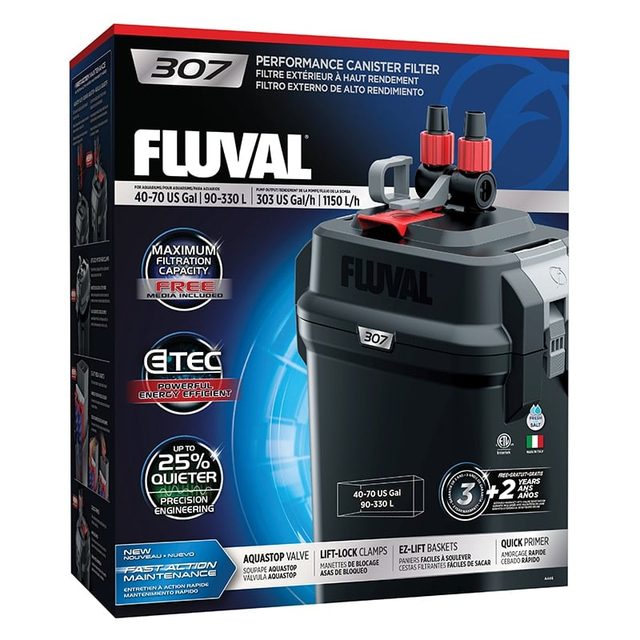
Fluval specifies the 307 for 40–70 US gallons / 90–330 L. Its current US documentation lists 303 GPH pump output and, separately, 206 GPH filter circulation. That distinction is central to this guide: pump output and complete-filter circulation are different manufacturer labels and should not be collapsed into one generic GPH score.
The 307 also has a documented 803 cm² vertical pre-filter, 3.1 L basket volume, 4.5 L total chamber volume and 7.3 L canister volume. The architecture sends incoming water through the vertical mechanical stage before the media trays, which gives debris interception a defined place before later media stages.
Choose the 307 when its 40–70 gallon envelope fits the aquarium and you want strong documentation around media space and hydraulics. PetGearReport has not measured its real installed flow, sound level or durability.
Our strongest general-purpose research pick because Fluval publishes both complete-filter circulation and detailed media/canister specifications for the exact 307.
Check price on Amazon →#2Best for pre-filter service
OASE BioMaster 2 350 Canister Filter
Best for: Owners who prioritize routine pre-filter access and a documented 90-gallon ceiling over a traditional full-canister service workflow
What we like
- Current US model is documented for aquariums up to 90 gallons / 350 L
- EasyClean pre-filter can be removed separately from the main filter
- OASE publishes 295 GPH max. gallons per hour and 5.6 L filter volume
- Detachable aquastop and adjustable outlet flow
- Freshwater and saltwater compatible with current US documentation
What we don't
- 295 GPH is OASE's maximum-flow label, not Fluval-style filter circulation
- External canister still needs below-tank space and hose routing
- Optional heater integration adds another compatibility decision if used
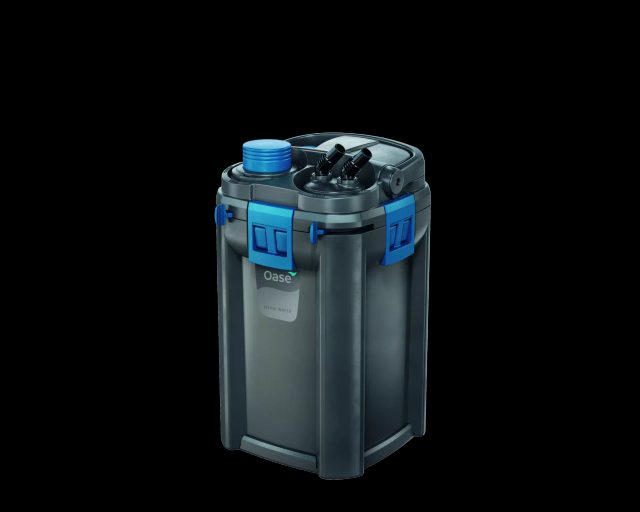
OASE's current US page identifies the BioMaster 2 350 as SKU 94710 for aquariums up to 90 gallons / 350 L. It publishes 295 GPH max. gallons per hour, 5.6 L filter volume, 0.50 L pre-filter volume, 16W power consumption and a 4.6-foot maximum head height.
Its most meaningful architectural difference is the EasyClean pre-filter. OASE says this module can be removed separately from the rest of the filter, while the detachable aquastop lets the canister be moved without dismantling the tubing setup. That can make routine mechanical-media service less disruptive than opening the entire main filter body.
The 295 GPH figure is a maximum-flow specification, not the same metric as Fluval's published filter circulation. We therefore score the BioMaster on its documented tank fit, media/service design and manufacturer support rather than pretending the two labels are interchangeable.
The maintenance-focused alternative: OASE's separate EasyClean pre-filter and detachable aquastop reduce how much of the main canister must be disturbed for routine debris service.
Check price on Amazon →#3Best for 75–100 gallon range
Fluval 407 Performance Canister Filter
Best for: Aquariums in the 50–100 gallon manufacturer range that need more documented media space and circulation than the 307 provides
What we like
- Fluval documents a 50–100 US gal / 150–500 L aquarium range
- 383 GPH pump output and 245 GPH filter circulation are published separately
- 4.2 L basket volume and 6.0 L total chamber volume
- 1074 cm² vertical pre-filter
- 7 ft / 2.25 m maximum head pressure
What we don't
- Larger body than the 307 requires more cabinet height
- 23W at 120V/60Hz versus 16W for the 307
- More capacity is not automatically better for livestock that prefer gentler current
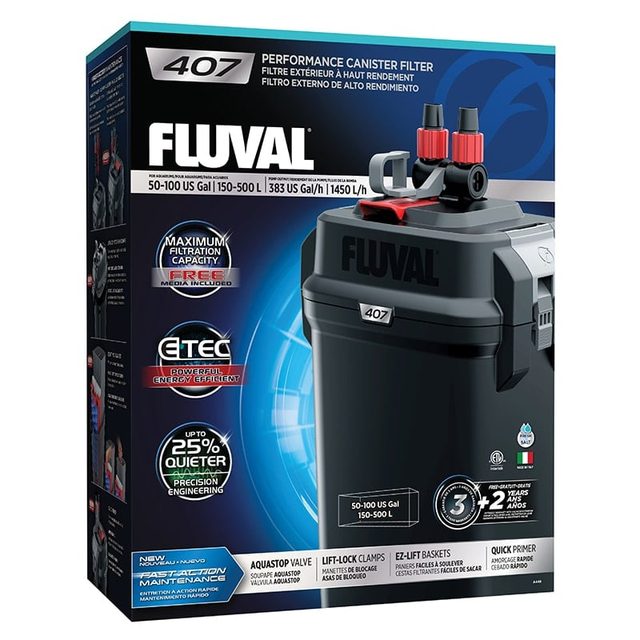
Fluval lists the 407 for 50–100 US gallons / 150–500 L. Current specifications separate 383 GPH pump output from 245 GPH filter circulation, alongside a 4.2 L basket volume, 6.0 L total chamber volume and 9.2 L canister volume.
Compared with the 307, the 407 adds documented media space, pre-filter area and circulation, but it also grows to 19.3 inches tall and draws 23W at 120V/60Hz. Those are practical installation differences, not proof that the 407 is the better choice for every tank that overlaps both model ranges.
Use the exact tank range, livestock flow tolerance, cabinet dimensions and desired media capacity to decide whether the step up is justified.
The higher-capacity 07 Series pick: more basket volume, pre-filter area and documented filter circulation while retaining the same evidence-rich architecture.
Check price on Amazon →#4Best high-capacity compact canister
Fluval FX2 High Performance Canister Filter
Best for: Larger aquariums that fit Fluval's up-to-175-gallon envelope and need substantially more media and documented circulation than the 07 Series
What we like
- Fluval documents use up to 175 US gal / 750 L
- 475 GPH pump output and 343 GPH filter circulation are published separately
- 10.6 L canister volume with 3.9 L biological volume
- 1150 cm² mechanical area
- 27W at 120V/60Hz
What we don't
- Larger footprint and plumbing than the 07 Series
- High-capacity design can be unnecessary for modest tanks
- 343 GPH filter circulation still needs to be matched to livestock and layout rather than treated as a universal target
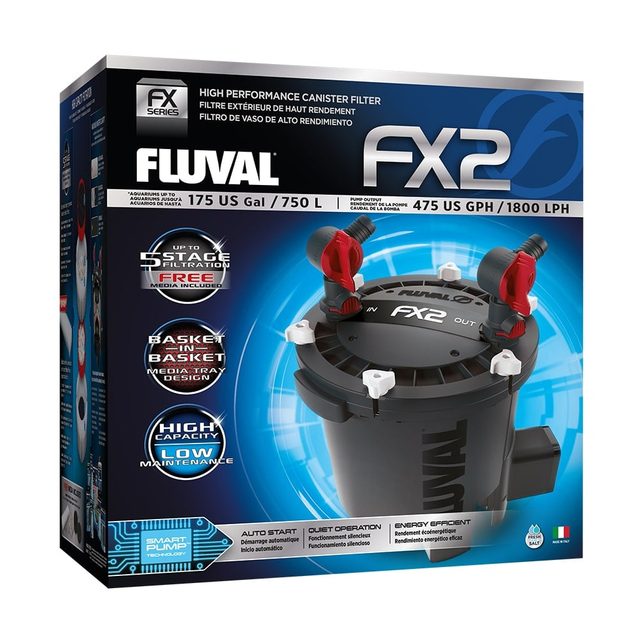
Fluval's current FX2 page lists the model for aquariums up to 175 US gallons / 750 L, with 475 GPH pump output and 343 GPH filter circulation. It also publishes 10.6 L canister volume, 3.9 L biological volume and 1150 cm² of mechanical area.
Those figures make the FX2 a materially different class from the 307 and 407, but they do not make it an automatic upgrade for every tank. The 13.4-by-13.4-inch footprint, larger hoses and higher documented circulation need to fit both the cabinet and the livestock.
Choose it when the aquarium genuinely benefits from the larger media and hydraulic envelope. PetGearReport has not measured loaded flow or verified Fluval's performance figures independently.
The large-system Fluval pick when a 07 Series model no longer provides the desired capacity: substantially more canister volume and circulation in a shorter, wider body.
Check price on Amazon →#5Large configurable alternative
Penn-Plax Cascade 1500 Canister Filter
Best for: Larger aquariums within the manufacturer's up-to-200-gallon envelope where five configurable media baskets are useful
What we like
- Penn-Plax documents Cascade 1500 / CCF5UL at 350 GPH
- Manufacturer positions the model for aquariums up to 200 gallons / 757 L
- Five media baskets support separated media stages
- Current Penn-Plax support includes instruction sheets and replacement-parts paths
- Exact affiliate ASIN maps to Cascade 1500 / CCF5UL
What we don't
- Penn-Plax does not publish a Fluval-style complete-filter circulation figure for direct comparison
- Five baskets create more media to inspect and service
- Large canister and hose system need suitable cabinet space

Penn-Plax's current equipment catalog identifies CCF5UL as the Cascade 1500, publishes 350 GPH and positions it for aquariums up to 200 gallons / 757 L. Product identity evidence checked September 25, 2026: B0002DJ9PW matched Penn-Plax Cascade 1500 / CCF5UL / UPC 030172015960, without freezing current Amazon price or availability.
Its main differentiator is five media baskets. That gives you room to separate mechanical, biological and optional chemical media, but it also increases the amount of media and hardware involved in a full service. Penn-Plax maintains current Cascade instruction sheets and a replacement-parts path, which strengthens the serviceability evidence.
We do not compare the 350 GPH label directly with Fluval filter circulation. Penn-Plax does not present it as the same complete-filter measurement, so the research score keeps that hydraulic uncertainty visible.
A large configurable alternative with five media baskets and strong current parts/support visibility, scored conservatively because its 350 GPH label is not a Fluval-style filter-circulation metric.
Check price on Amazon →How we researched and scored
PetGearReport has not physically tested these canister filters, measured installed flow, sound level, priming time, leak resistance or long-term durability. We compared current manufacturer documentation, exact model identity, current public product-identity evidence, tank ranges, hydraulic labels, media architecture, service access, installation requirements, power specifications and parts/support information. We did not use Amazon customer stars, temporary pricing or popularity as scoring inputs.
The displayed 1–10 number is a PetGearReport research score, rounded to the nearest whole number from the same five weighted categories for every canister filter:
- Tank fit & hydraulic documentation — 25%: exact aquarium range, clarity of published flow labels, head guidance and how well the manufacturer separates unlike hydraulic metrics.
- Media capacity & architecture — 25%: documented media volume, basket/chamber design, pre-filtration and ability to separate media stages.
- Maintenance & serviceability — 20%: priming, shutoff/valve architecture, access to mechanical stages and the amount of the filter that must be disturbed for routine service.
- Installation & control — 15%: cabinet footprint, hose routing, head limits, flow adjustment and compatibility with the intended aquarium layout.
- Documentation & parts support — 15%: current manuals, spare-parts paths, exact model identification and manufacturer support resources.
| Product | Tank fit & hydraulics 25% | Media 25% | Maintenance 20% | Installation 15% | Documentation 15% | Weighted result | Published score |
|---|---|---|---|---|---|---|---|
| Fluval 307 | 9 | 9 | 8 | 9 | 10 | 8.95 | 9/10 |
| OASE BioMaster 2 350 | 9 | 9 | 10 | 9 | 9 | 9.20 | 9/10 |
| Fluval 407 | 9 | 10 | 8 | 8 | 10 | 9.05 | 9/10 |
| Fluval FX2 | 9 | 10 | 9 | 7 | 10 | 9.15 | 9/10 |
| Penn-Plax Cascade 1500 | 7 | 9 | 8 | 7 | 8 | 7.85 | 8/10 |
The decimals make the method auditable; they are not laboratory measurements or a claim that a 9.20 product is measurably better in every aquarium than an 8.95 product. Editorial rank also reflects the intended use case. The Fluval 307 stays first because it is the most balanced general-purpose fit in this shortlist, while OASE is the stronger maintenance-oriented choice and FX2 serves a much larger system class.
Do not sort canister filters by one GPH column
Canister-filter specifications often look directly comparable when they are not.
Fluval publishes both pump output and filter circulation for the 07 Series and FX2. The 307, for example, is listed at 303 GPH pump output and 206 GPH filter circulation; the 407 at 383 and 245 GPH; the FX2 at 475 and 343 GPH. Those paired numbers make it clear that the pump-only label is not the same as the complete-filter circulation figure. OASE publishes the BioMaster 2 350 at 295 GPH max. gallons per hour, while Penn-Plax publishes the Cascade 1500 at 350 GPH. Neither manufacturer labels those figures as Fluval-style filter circulation. These numbers are useful inside their own documentation, but they are not interchangeable performance measurements.
That is why this guide does not award points simply to the largest GPH number. Start with the manufacturer’s aquarium range and understand the hydraulic label before comparing it with another product.
For a deeper sizing framework, our aquarium filter size guide explains why pump output, circulation, media loading and tank layout should not be reduced to one universal turnover rule.
Media capacity changes what the filter can do — and what you must maintain
A canister is both a pump system and a media-management system.
The Fluval 307 provides 3.1 L of basket volume and the 407 provides 4.2 L. For smaller 07 Series systems, our Fluval 107 vs 207 comparison focuses on the 20–30 gallon overlap, shared footprint and height trade-off. If the smaller 207 is also a finalist, our Fluval 207 vs 307 comparison focuses on their 40–45 gallon overlap, cabinet footprint and media-capacity step. If a rim-mounted filter is still an alternative at that size, the 40-gallon filter guide provides a 40-gallon mixed-architecture shortlist covering both HOB and canister options. If those two 07 Series models are your finalists, our Fluval 307 vs 407 comparison breaks down their shared 50–70 gallon overlap, filter circulation, cabinet height and head-pressure differences. Both place a vertical mechanical pre-filter before the tray section. If the 407 and OASE BioMaster 2 350 are your cross-brand finalists, our Fluval 407 vs OASE BioMaster 2 350 comparison separates hydraulic labels, pre-filter service and cabinet geometry. If you already want the OASE platform but are choosing whether to bundle the heater, our BioMaster 2 350 vs Thermo 350 comparison separates filtration from heater sizing. If the decision is specifically between the top 07 Series model and the entry FX model, our Fluval 407 vs FX2 comparison separates cabinet geometry, circulation and non-equivalent media metrics. The FX2 moves into a larger class with a 10.6 L canister volume and 3.9 L of documented biological volume. If the FX series is already the target, our Fluval FX2 vs FX4 comparison shows what the larger FX4 actually adds beyond FX2; if FX4 is being compared with OASE’s larger BioMaster platform, Fluval FX4 vs OASE BioMaster 2 600 separates the cross-brand flow labels, cabinet geometry and EasyClean service trade-off; if FX4 and FX6 are the finalists, the Fluval FX4 vs FX6 comparison separates media capacity, head pressure and cabinet height.
OASE takes a different route. The BioMaster 2 350 lists 5.6 L total filter volume plus a separate 0.50 L EasyClean pre-filter chamber. That removable pre-filter is important because routine debris removal can be handled without opening the entire main media stack.
Penn-Plax documents five media baskets in the Cascade 1500. More baskets increase configuration options, but they also create more media to inspect, rinse or replace according to the exact media instructions.
Our aquarium filter media guide covers mechanical, biological and optional chemical media by function. Do not fill every basket simply because space exists; use each stage for a defined filtration job.
Maintenance architecture matters as much as capacity
A filter that is awkward to service is easier to postpone servicing. Compare how the exact design handles the routine jobs you will actually perform.
The OASE BioMaster 2 350 has the clearest dedicated pre-filter workflow in this shortlist. OASE documents a separately removable EasyClean pre-filter, automatic shut-off system, safety valve and detachable aquastop. That architecture is specifically designed to let you clean the high-debris stage without dismantling the full filter. Fluval’s 07 Series uses its vertical pre-filter to intercept debris before water reaches the media trays. The FX2 uses a different internal path and larger foam/mechanical area. Penn-Plax provides a conventional multi-basket service workflow with current instruction sheets and a replacement-parts channel.
There is no universal cleaning interval. Inspect observed flow, debris loading, hoses, impeller and the exact media condition; follow the manufacturer’s instructions for seals, impellers and consumables. Avoid replacing all established biological media at once simply because a calendar date arrives. If the canister is already chosen and you are selecting the reusable biological stage, our best biological filter media for aquariums compares four current loose-media options by basket fit and maintenance guidance.
Cabinet space, hose routing and head limits are part of sizing
Canister filters live outside the aquarium, so physical installation matters before any water flows.
The Fluval 307 is about 9.5 × 7 × 16.5 inches and the 407 is about 9.5 × 7 × 19.3 inches. The FX2 is shorter but wider at roughly 13.4 × 13.4 × 16.5 inches. OASE lists the BioMaster 2 350 at about 9.4 × 9.4 × 16.7 inches.
Maximum head also differs. Fluval documents 5.75 ft for the 307, 7 ft for the 407 and 6.9 ft for the FX2. OASE documents 4.6 ft for the BioMaster 2 350. Use the exact model’s installation rules and avoid assuming that a longer hose run or greater vertical rise leaves the published flow unchanged.
Measure cabinet opening height, internal width/depth, hose path and the distance between the canister and aquarium water level before ordering. Leave enough access to disconnect valves and lift the motor head or pre-filter module during service. If you are adding an inline UV chamber to a canister return, our best aquarium UV sterilizers & clarifiers guide explains why the UV unit’s own flow and plumbing limits must be checked instead of assuming the canister headline GPH is automatically correct.
Match the canister to livestock and intake risk
A manufacturer tank range is a starting boundary, not proof that the return flow suits every animal in that volume.
Fish that prefer calmer water, shrimp, fry or animals vulnerable to intake suction may need a gentler return pattern, flow adjustment or an appropriate intake guard. Do not improvise intake restrictions that conflict with the filter instructions or starve the pump of water.
If gentle current and intake safety dominate the decision, compare our sponge filter vs canister guide. For the broader architecture choice between a below-tank canister and a rim-mounted powered filter, use our canister filter vs HOB comparison.
When a canister is the right architecture
A canister becomes especially attractive when you want configurable media outside the aquarium, flexible intake/return placement and more media volume than a compact rim filter typically provides. It is less attractive when cabinet space is limited, quick top-access service matters most, or very gentle air-driven filtration is the primary goal.
For a tank-size-specific large-system decision, our 125-gallon filter guide compares five current canisters whose manufacturer ranges actually include 125 gallons, including FX2/FX4/FX6, BioMaster 2 600 and Cascade 1500.
Our broader best aquarium filters guide compares canister and HOB designs in one architecture-neutral shortlist. If the rim-mounted alternative is now the better fit, move to our best aquarium HOB filters guide; use the broader page if you have not yet chosen an architecture. For goldfish specifically, the goldfish filter guide compares canister and HOB choices by tank fit, media access and current control instead of treating larger canister flow as automatically better. For axolotls, the axolotl filter guide focuses on gentle return control, intake safety and debris handling, including manufacturer-supported flow reduction and spray-bar options.
If the canister decision is specifically for an aquascape, our best filters for planted tanks guide compares BioMaster and Fluval canisters with a HOB and nano sponge option by flow distribution, media service and planted-display integration. For aquatic-turtle habitats, the turtle-tank filter guide adds veterinary filtration guidance, actual water-volume sizing and solid-waste serviceability. For discus, the discus filter guide prioritizes gentle localized current, stable water quality and serviceable media over raw maximum flow. For medium and large cichlids, the cichlid filter guide compares canister and HOB options by debris handling, media capacity and service access.
If a correctly sized canister still leaves low-movement zones because of tank length, plants or hardscape, our aquarium wavemaker and circulation pump guide covers supplemental freshwater flow as a separate decision from filtration capacity.
Exact product identity verification
Product identity evidence checked September 25, 2026, without freezing current Amazon price or availability:
- B07JH4JHTC matched Fluval 307 model A446. Fluval identifies the current 307 as item A446 / UPC 015561104463.
- B0F3LPPPHH matched OASE BioMaster 2 350 / UPC 706759947107. OASE identifies the current non-Thermo BioMaster 2 350 as SKU 94710.
- B07JFY2QW6 matched Fluval 407 / item A449 / UPC 015561104494.
- B0BM9NBRW1 matched Fluval FX2 / item A213 / UPC 015561102131.
- B0002DJ9PW matched Penn-Plax Cascade 1500 / CCF5UL / UPC 030172015960.
The Fluval 307 evidence is intentionally anchored at model A446: public marketplace catalog data does not reproduce the current Fluval UPC consistently, while Fluval’s current manufacturer table independently identifies item A446 / UPC 015561104463. The OASE identity is likewise kept auditable by treating the public ASIN/UPC mapping and OASE’s current SKU 94710 as separate evidence legs. No direct Amazon product-page probe was used for this refresh.
Sources
Technical claims on this page prioritize current manufacturer documentation. Public catalog evidence is used only to keep each affiliate ASIN tied to the intended product identity; temporary Amazon price, availability and customer-star data are not used as editorial evidence.
- Fluval — 307 Canister Filter — aquarium range, pump output, filter circulation, pre-filter area, media/canister volumes, head height and wattage.
- Fluval — 407 Canister Filter — 50–100 US gal range and current 07 Series hydraulic/media specifications.
- Fluval — FX2 High Performance Canister Filter — up-to-175-gallon guidance, pump output, filter circulation, canister/biological volume, mechanical area, head and wattage.
- OASE — BioMaster 2 350 US — SKU 94710, 90-gallon ceiling, 295 GPH maximum flow, filter/pre-filter volume, EasyClean architecture, aquastop, head height, wattage and freshwater/saltwater compatibility.
- Penn-Plax — current aquarium equipment catalog — CCF5UL / Cascade 1500, 350 GPH and up-to-200-gallon manufacturer guidance.
- Penn-Plax — Cascade instruction sheets and replacement parts — current service/support paths for the Cascade line.
- PriceHistory — Fluval 307 product record — public ASIN B07JH4JHTC to model A446 identity evidence; the current manufacturer UPC is kept separate because marketplace UPC/GTIN fields are inconsistent.
- Device.report — OASE BioMaster 2 350 specifications — public ASIN B0F3LPPPHH to BioMaster 2 350 / UPC 706759947107 identity evidence.
- Device.report — Fluval A449 specifications — public ASIN B07JFY2QW6 to Fluval 407 / A449 / UPC 015561104494 identity evidence.
- Desertcart — Fluval FX2 listing — public ASIN B0BM9NBRW1 to A213 / UPC 015561102131 identity evidence.
- Desertcart — Penn-Plax Cascade 1500 listing — public ASIN B0002DJ9PW to Cascade 1500 / CCF5UL / UPC 030172015960 identity evidence.
Frequently asked questions
How do I size a canister filter for my aquarium?
Begin with exact models whose current manufacturer aquarium range includes your tank, then check what the published flow number actually represents. Account for livestock flow tolerance, waste load, media loading, hose/head constraints and the filter's media capacity. Do not use one universal turnover ratio as a substitute for the exact model documentation.
Is higher GPH always better for a canister filter?
No. Higher published flow is not automatically better, and two GPH figures may describe different test conditions. Fluval, for example, publishes pump output and separate filter-circulation figures, while OASE and Penn-Plax use their own flow labels. The useful number is the one understood in its manufacturer context and matched to the aquarium and livestock.
How often should I clean a canister filter?
There is no single calendar for every canister. Service frequency depends on debris load, observed flow, pre-filter loading and the exact media. Follow the manufacturer's instructions, inspect the system routinely, and clean when performance or loading indicates it rather than replacing all established biological media on an arbitrary schedule.
Can I use a canister filter on a shrimp or fry tank?
Possibly, but intake safety and current matter. A canister intake can draw in very small animals unless the exact setup includes appropriate intake protection, and a high-flow return may need to be positioned or adjusted carefully. Compare the intake and flow architecture with a gentler sponge-filter option when livestock safety is the priority.