Best Protein Skimmers for 75-Gallon Reef Tanks: 3 Picks by Bioload & Sump Fit
A 75-gallon display is large enough that protein-skimmer sizing cannot be reduced to one gallon label. We researched three exact US-market variants whose current manufacturer guidance can be interpreted responsibly for a 75-gallon reef: an in-sump model with substantial heavy-bioload headroom, a hang-on-back model whose medium-bioload rating lands exactly at 75 gallons, and a compact in-tank model that places 75 gallons near the top of its published range. PetGearReport has not physically tested these skimmers, measured skimmate production, air draw, water draw, noise, power use or long-term reliability.
| Rank | Product | Score | Best for | Link |
|---|---|---|---|---|
| #1 | Reef Octopus Classic 150INTBest in-sump pick for a 75-gallon reef | 9 | 75-gallon reef systems with a sump, especially heavier feeding or stocking where the manufacturer heavy-bioload boundary and physical fit both provide comfortable headroom | Check price → |
| #2 | Reef Octopus Classic 100 HOBBest no-sump medium-bioload match | 9 | 75-gallon no-sump reefs that fit CoralVue's medium-bioload category and have enough external clearance for a true hang-on-back protein skimmer | Check price → |
| #3 | TUNZE Comline DOC Skimmer 9004 DCBest compact in-tank option near the 75-gallon ceiling | 8 | 75-gallon systems that cannot use a conventional sump skimmer and have a lighter, compatible load plus the required in-tank or rear-chamber space | Check price → |
#1 · Our PickBest in-sump pick for a 75-gallon reef
Reef Octopus Classic 150INT
Best for: 75-gallon reef systems with a sump, especially heavier feeding or stocking where the manufacturer heavy-bioload boundary and physical fit both provide comfortable headroom
What we like
- CoralVue rates the exact CLSC-150INT at 110 gal heavy / 150 gal medium / 210 gal light, excluding sump volume
- A 75-gallon display remains below even the published heavy-bioload ceiling
- 6–8 in recommended sump water height and 12.4 × 8.7 in footprint are documented
- Aquatrance 2000s documentation includes 720 L/h maximum air and 198 GPH maximum flow
- Exact CLSC-150INT identity maps to Amazon.com ASIN B00N45H3YO
What we don't
- Requires a sump with enough floor space and cup-removal clearance
- Its extra published capacity is not evidence that every 75-gallon reef needs this much skimmer
- Manufacturer pump air/flow values can vary with the installed aquarium setup
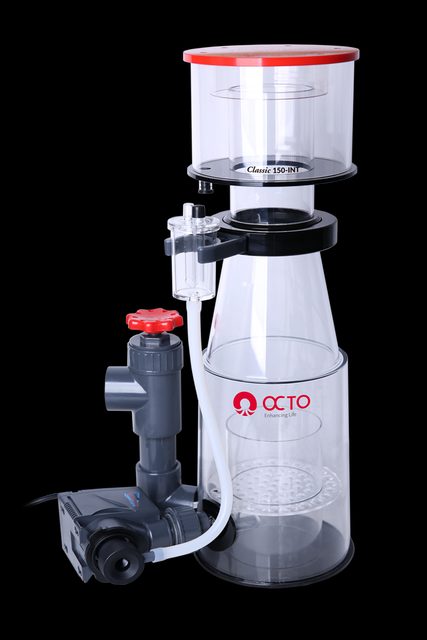
CoralVue identifies the Reef Octopus Classic 150INT as exact SKU CLSC-150INT and rates it, excluding sump volume, at 110 gal heavy / 150 gal medium / 210 gal light. For a 75-gallon display, that means the tank is below even the manufacturer's heavy-bioload ceiling rather than merely fitting a light-load maximum.
The current manufacturer page specifies a 12.4 × 8.7 in footprint, 22 in height and 6–8 in recommended sump water height. Its Aquatrance 2000s pinwheel pump is listed at 18W, up to 720 L/h air and 198 GPH maximum flow, with the manufacturer warning that installed air and water results vary by aquarium setup.
That documented headroom does not make the 150INT automatically superior in every 75-gallon reef. It still needs a suitable sump chamber, stable water depth and enough vertical space to remove and service the cup. Exact CLSC-150INT marketplace identity maps to Amazon.com ASIN B00N45H3YO.
The strongest documented in-sump fit for this use case because a 75-gallon display sits below CoralVue's heavy-bioload ceiling while installation depth, footprint and pump evidence are unusually clear.
Check price on Amazon →#2Best no-sump medium-bioload match
Reef Octopus Classic 100 HOB
Best for: 75-gallon no-sump reefs that fit CoralVue's medium-bioload category and have enough external clearance for a true hang-on-back protein skimmer
What we like
- Current CoralVue guidance rates exact CLSC-100HOB at 55 gal heavy / 75 gal medium / 105 gal light, excluding sump volume
- The 75-gallon medium-bioload rating is an exact nominal match for this guide's display size
- No sump is required; it mounts on the aquarium back or side
- Aquatrance 1000s documentation lists 420 L/h air draw and 350 L/h / 92 GPH water draw
- Exact CLSC-100HOB identity maps to Amazon.com ASIN B08DWZQR6L
What we don't
- A heavily stocked 75-gallon reef exceeds the manufacturer's 55-gallon heavy-bioload tier
- HOB hardware needs rim, wall and service clearance behind or beside the display
- CoralVue's current page contains two different footprint widths, so tight installations should be measured conservatively
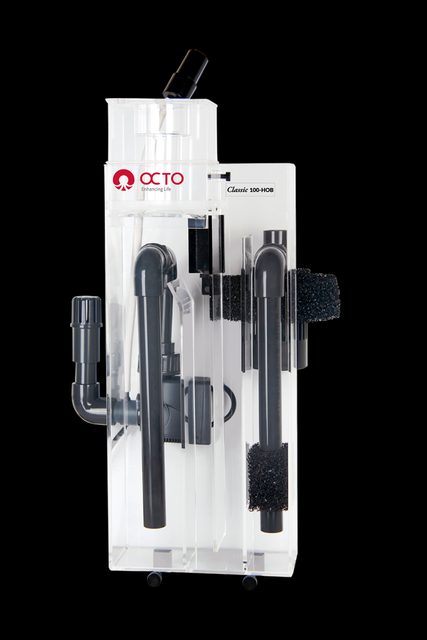
CoralVue identifies the Classic 100 HOB as exact SKU CLSC-100HOB and rates it, excluding sump volume, at 55 gal heavy / 75 gal medium / 105 gal light. That makes 75 gallons an exact match only for the manufacturer's medium-bioload category. A heavily stocked or heavily fed 75-gallon reef should not be treated as covered merely because 75 appears in the middle tier.
The HOB architecture solves a different installation problem from an in-sump skimmer: no sump is required. CoralVue lists an Aquatrance 1000s pump at 9W, 420 L/h air draw and 350 L/h / 92 GPH water draw. The current product page contains a footprint-width discrepancy—8 × 3.75 in in one section and 8 × 3.25 in in another—so PetGearReport does not invent one corrected width. Measure the available clearance conservatively.
Exact CLSC-100HOB marketplace identity maps to Amazon.com ASIN B08DWZQR6L. Choose this model because the no-sump architecture and the correct bioload tier fit, not because its 105-gallon light-load maximum sounds larger.
The clearest no-sump choice when a 75-gallon reef is genuinely medium bioload, because the manufacturer publishes an exact 75-gallon medium tier instead of forcing a generic oversizing rule.
Check price on Amazon →#3Best compact in-tank option near the 75-gallon ceiling
TUNZE Comline DOC Skimmer 9004 DC
Best for: 75-gallon systems that cannot use a conventional sump skimmer and have a lighter, compatible load plus the required in-tank or rear-chamber space
What we like
- TUNZE exact item 9004.001 is documented for 15 to 79 USgal of seawater depending on tank load
- Compact 4.3 × 3.5 × 12 in body can work where a conventional sump skimmer cannot
- Manufacturer publishes approximately 200 l/h air capacity and about 5W operating consumption, 10W maximum
- 8.9–9.7 in immersion depth and 0.2 L cup volume are documented
- Exact item 9004.001 maps to Amazon.com ASIN B01KHWLR2U
What we don't
- A 75-gallon display is near the top of its published range, so load and husbandry need conservative screening
- The skimmer body remains inside the aquarium or a compatible rear chamber
- Its 0.2 L cup is much smaller than a conventional full-size sump skimmer cup
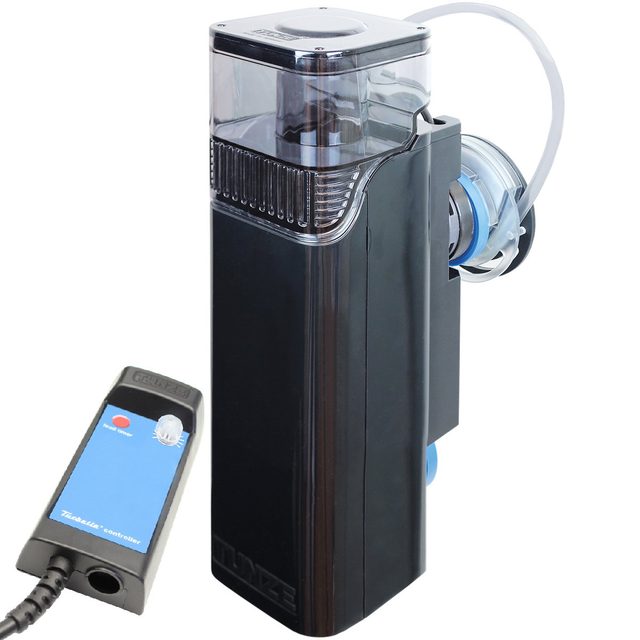
TUNZE identifies the Comline DOC Skimmer 9004 DC as exact item 9004.001 and recommends it, depending on tank load, for 15 to 79 USgal of seawater. A 75-gallon display is therefore near the top of its published range. That is a materially different fit from the Classic 150INT, which keeps 75 gallons below its published heavy-bioload ceiling.
TUNZE documents a 4.3 × 3.5 × 12 in body, 8.9–9.7 in immersion depth, 0.2 L collection cup, approximately 200 l/h air capacity, about 5W operating consumption and 10W maximum. It mounts in the aquarium or a compatible chamber with a magnet holder rather than requiring a conventional skimmer section in a sump.
Exact item 9004.001 maps to Amazon.com ASIN B01KHWLR2U. For a 75-gallon tank, compact installation is the reason to consider it; the upper-end volume position is a reason to screen bioload carefully rather than assume the nominal 79-gallon maximum is universal.
A compact architectural alternative, not a high-bioload default: 75 gallons is near the top of its published range, so its value is solving the no-sump footprint problem when the load also fits.
Check price on Amazon →How we researched and scored
PetGearReport has not physically tested these protein skimmers, measured skimmate production, dissolved-organic removal, air draw, water draw, sound pressure, power use, installed restriction or long-term reliability. We compared current manufacturer documentation, exact model identifiers, published bioload guidance, installation architecture, service constraints, pump evidence and current marketplace identity.
The displayed number is a PetGearReport research score, not a hands-on result, customer rating or laboratory measurement. Current Amazon price, stock, star ratings, review counts and popularity are not scoring inputs.
- 75-gallon fit evidence — 35% — how directly the manufacturer’s load guidance supports a 75-gallon display, including whether 75 sits below, at or near a documented limit.
- Installation & service fit — 25% — sump/HOB/in-tank architecture, footprint, operating depth, cup-removal clearance and practical maintenance access.
- Pump, air/water & control evidence — 20% — documented air/water information and control architecture without converting unlike specifications into one synthetic performance metric.
- Maintenance & ownership evidence — 10% — service access, cup/drain design, mounting and known installation boundaries.
- Exact identity & evidence quality — 10% — current first-party model evidence plus confidence in the exact Amazon.com variant mapping.
| Protein skimmer | 75-gal fit 35% | Installation 25% | Pump/control 20% | Maintenance 10% | Identity 10% | Weighted | Score |
|---|---|---|---|---|---|---|---|
| Reef Octopus Classic 150INT | 10 | 8 | 9 | 9 | 10 | 9.20 | 9/10 |
| Reef Octopus Classic 100 HOB | 9 | 10 | 8 | 8 | 10 | 9.05 | 9/10 |
| TUNZE Comline DOC Skimmer 9004 DC | 7 | 10 | 8 | 8 | 10 | 8.35 | 8/10 |
The score rewards documented fit for this specific 75-gallon decision. It does not reward the largest nominal gallon number. The TUNZE score is intentionally more conservative because a 75-gallon display is close to the top of its load-dependent range.
Quick decision for a 75-gallon display
| 75-gallon setup | Best fit here | Why |
|---|---|---|
| Sump + heavy bioload or substantial feeding | Reef Octopus Classic 150INT | 75 gallons remains below the published 110-gallon heavy-bioload ceiling |
| No sump + medium bioload | Reef Octopus Classic 100 HOB | CoralVue publishes an exact 75-gallon medium-bioload tier |
| No conventional sump chamber + lighter compatible load | TUNZE 9004 DC | Compact in-tank/rear-chamber architecture, but 75 gallons is near the top of the 79-USgal range |
What 75 gallons means against each published boundary
| Model | Relevant manufacturer boundary | 75-gallon position | Installation consequence |
|---|---|---|---|
| Reef Octopus Classic 150INT | 110 gal heavy / 150 gal medium / 210 gal light, excluding sump volume | 35 gallons below the 110-gallon heavy-bioload ceiling | Capacity evidence leaves documented heavy-load headroom, but the 12.4 × 8.7 in footprint and 6–8 in sump depth still have to fit |
| Reef Octopus Classic 100 HOB | 55 gal heavy / 75 gal medium / 105 gal light, excluding sump volume | exactly matches the 75-gallon medium-bioload tier and is 20 gallons above the 55-gallon heavy-bioload ceiling | Appropriate only when the aquarium really fits the medium-load category and has sufficient rim/wall/service clearance |
| TUNZE Comline DOC Skimmer 9004 DC | 15 to 79 USgal depending on tank load | 4 gallons below the 79-US-gallon upper limit | Treat 75 gallons as an upper-end, load-dependent fit; compact installation is the reason to consider it, not capacity headroom |
These deltas are arithmetic distance to manufacturer-published boundaries, not a cross-brand performance margin. They do not normalize unlike rating systems, air draw, reaction-chamber design or installed skimming performance.
For a smaller breeder-format reef, the 40-gallon breeder protein skimmer guide compares the same installation classes where 40 gallons can land exactly on a heavy-bioload boundary.
For operating problems after installation, the protein skimmer troubleshooting guide separates overflow, no-foam, microbubble, venturi and pump-maintenance causes.\n\nFor broader model choices beyond this exact tank size, use the protein skimmer guide. If you plan to route the skimmer’s air through absorbent media, read the reef CO2 scrubber guide before changing the venturi air path. The aquarium return-pump guide covers the separate job of moving water through the sump, while the reef aquarium lights guide covers the display’s lighting decision.
A 75-gallon display is not one bioload category
Two aquariums can both hold a nominal 75 gallons and impose very different organic loads on a protein skimmer.
Feeding rate, fish biomass, livestock type, export methods and husbandry all affect the job. That is why CoralVue publishes heavy, medium and light bioload tiers instead of one capacity number for these Reef Octopus models.
For the Classic 150INT, current CoralVue guidance is 110 gal heavy / 150 gal medium / 210 gal light, excluding sump volume. A 75-gallon display therefore remains below even the heavy-bioload ceiling.
For the Classic 100 HOB, the current tiers are 55 gal heavy / 75 gal medium / 105 gal light, excluding sump volume. A 75-gallon display is an exact medium-bioload match, but it is above the 55-gallon heavy tier.
Those are not contradictory recommendations. They describe different skimmer capacities and different load categories.
There is no universal protein-skimmer oversizing multiplier
PetGearReport uses no universal protein-skimmer oversizing multiplier for a 75-gallon reef.
A fixed cross-brand formula would erase the manufacturers’ actual rating systems. It would also encourage buyers to treat a light-bioload maximum as interchangeable with a heavy-bioload limit.
Use this order instead:
- identify the likely bioload category and feeding intensity;
- read the exact manufacturer’s rating language;
- check whether the rating includes or excludes sump volume;
- confirm the skimmer architecture fits the actual aquarium;
- verify operating water depth or immersion depth;
- measure footprint, height and cup-removal clearance;
- confirm the air path, plumbing and service access.
A larger published ceiling is useful evidence only when the rest of the system fits. The protein skimmer sizing calculator turns those checks into a manufacturer-tier and installation worksheet without inventing a cross-brand multiplier.
Sump fit can eliminate the Classic 150INT before capacity does
The Classic 150INT has the clearest 75-gallon heavy-bioload headroom here, but it is an in-sump skimmer.
CoralVue specifies a 12.4 × 8.7 in footprint, 22 in height and 6–8 in recommended sump water depth. The sump therefore needs enough floor area, stable water height and vertical clearance not only for the skimmer body but also for collection-cup removal and pump service.
A 75-gallon display with a compact sump may fail those physical requirements even though the bioload rating looks generous.
Do not solve a space problem by assuming the skimmer can simply run in a different water depth. Follow the exact manufacturer’s installation range.
No sump: HOB and in-tank designs solve different problems
A no-sump 75-gallon reef still has two materially different installation paths in this shortlist.
Reef Octopus Classic 100 HOB hangs on the back or side of the aquarium. That keeps the skimmer body largely outside the display, but it needs external rim/wall clearance and service access. Its 55/75/105 gallon heavy/medium/light tiers make the medium-bioload boundary especially easy to interpret at this tank size.
TUNZE 9004 DC mounts inside the aquarium or compatible rear chamber. It is much more compact, but TUNZE’s 15 to 79 USgal range depends on tank load. At 75 gallons the tank is near the top of its published range, so this is not the default for a heavy bioload.
Choose the architecture that physically works, then confirm the load fits the exact manufacturer’s envelope.
Stable water depth and service access are part of sizing
Protein-skimmer sizing is not finished when the gallon number fits.
For the Classic 150INT, the recommended sump water height is 6–8 in. For the TUNZE 9004 DC, the documented immersion depth is 8.9–9.7 in. These are different architectures and should not borrow each other’s setup rules.
Measure:
- sump or chamber operating depth;
- footprint at normal plumbing positions;
- cabinet height;
- cup-removal clearance;
- access to the pump and air intake;
- clearance for drain tubing or controllers;
- room to clean the unit without dismantling unrelated plumbing.
The easiest skimmer to buy is not always the easiest one to service.
Keep the return pump and skimmer jobs separate
A return pump moves water from the sump back to the display and must overcome plumbing head. A protein skimmer mixes air and water inside its own reaction chamber.
The aquarium return-pump guide explains why zero-head GPH is not the installed sump return rate. Do not size the return pump from a skimmer’s published air/water draw, and do not force excessive sump turnover in an attempt to make the skimmer “work harder.”
For a 75-gallon display with a sump, design the return loop and the skimmer chamber as related but separate subsystems.
A CO2 scrubber changes the protein-skimmer air path
If indoor CO2 is materially suppressing reef pH, a scrubber can route the protein skimmer air intake through CO2-absorbent media.
That adds tubing, media and potentially moisture to the venturi path. Restriction can alter air draw, foam production and skimmer behavior.
The reef CO2 scrubber guide covers diagnosis, open-window comparison, media exhaustion, recirculation moisture and airflow restrictions. Do not add a scrubber just because a 75-gallon reef has a pH number you dislike; confirm the air-side problem first.
Product-by-product 75-gallon boundaries
Reef Octopus Classic 150INT
This is the strongest conventional in-sump choice here when a 75-gallon system has a heavy bioload or the owner wants documented capacity headroom.
CoralVue’s current 110/150/210 gallon heavy/medium/light tiers all sit above a 75-gallon display, while the 6–8 in water-depth window and 12.4 × 8.7 in footprint make installation screening concrete.
Avoid it when the sump cannot provide stable depth, floor area or cup-removal clearance. Extra capacity does not compensate for an installation that does not fit.
Reef Octopus Classic 100 HOB
This is the cleanest no sump match when the reef is genuinely medium bioload. The current 55/75/105 gallon heavy/medium/light tiers place 75 exactly in the middle category.
That same table also creates the avoid-if boundary: a heavy 75-gallon reef exceeds the 55-gallon heavy tier. Do not substitute the 105-gallon light-load maximum.
The current CoralVue page contains two footprint widths in separate sections. PetGearReport preserves that conflict instead of choosing one unsupported value.
TUNZE Comline DOC Skimmer 9004 DC
The TUNZE solves a compact installation problem. Exact item 9004.001 mounts in-tank or in a compatible chamber and uses a small 4.3 × 3.5 × 12 in body.
But a 75-gallon display is near the top of its published range of 15 to 79 USgal depending on tank load. That means the 9004 DC is not our heavy-bioload recommendation for this tank size.
Use it when compact/no-sump architecture is the overriding constraint and the livestock/feeding load remains compatible with TUNZE’s guidance.
Exact product identity verification
Product identity evidence checked September 25, 2026, without freezing current Amazon price or availability:
- B00N45H3YO matched Reef Octopus Classic 150INT / CLSC-150INT. CoralVue independently identifies the current exact model as CLSC-150INT and remains the primary source for bioload, footprint, water-depth and pump specifications.
- B08DWZQR6L matched the Reef Octopus 100 HOB product identity. CoralVue separately identifies the current SKU as CLSC-100HOB and remains the primary source for the 55/75/105-gallon bioload tiers and pump data. The marketplace-to-product identity and manufacturer SKU are stated as separate evidence legs rather than inventing a stronger cross-key.
- B01KHWLR2U matched TUNZE Comline DOC Skimmer 9004 DC / item 9004.001. TUNZE independently confirms item 9004.001 and its current 15–79 USgal load-dependent range, dimensions, immersion depth, air capacity and power data.
Marketplace evidence is used only to reconcile the exact affiliate product; current manufacturer documentation remains authoritative for technical specifications. No direct Amazon product-page probe was used for this refresh.
Sources and methodology
- CoralVue — Reef Octopus Classic 150INT — CLSC-150INT identity, 110/150/210 gallon heavy/medium/light tiers excluding sump, footprint, water height, pump air/flow and service features.
- CoralVue — Reef Octopus Classic 100 HOB — CLSC-100HOB identity, 55/75/105 gallon heavy/medium/light tiers excluding sump, no-sump architecture and Aquatrance 1000s data.
- TUNZE — Comline DOC Skimmer 9004 DC — exact item 9004.001, 15–79 USgal load-dependent range, immersion depth, air capacity, dimensions, cup capacity, power and mounting.
- Device.report — Reef Octopus CLSC-150INT — public ASIN B00N45H3YO to Classic 150INT / CLSC-150INT identity evidence.
- Device.report — Reef Octopus 100 HOB — public ASIN B08DWZQR6L to Reef Octopus 100 HOB product-identity evidence; CoralVue supplies the current CLSC-100HOB SKU separately.
- Device.report — TUNZE 9004.001 — public ASIN B01KHWLR2U to Comline DOC Skimmer 9004 DC / item 9004.001 identity evidence.
Frequently asked questions
What size protein skimmer should I use for a 75-gallon reef tank?
There is no universal protein-skimmer oversizing multiplier. Use the exact manufacturer's bioload or system guidance and installation limits. In this guide, CoralVue rates the Classic 150INT at 110/150/210 gallons for heavy/medium/light bioload, the Classic 100 HOB at 55/75/105 gallons, and TUNZE rates the 9004 DC from 15 to 79 USgal depending on load.
Is a Reef Octopus Classic 150INT too large for a 75-gallon reef?
Not automatically. CoralVue's current guidance puts 75 gallons below the Classic 150INT's 110-gallon heavy-bioload ceiling, excluding sump volume. The more important checks are whether your bioload justifies the headroom and whether the 12.4 × 8.7 in footprint, 6–8 in operating depth and service clearance fit your sump.
Can I use a protein skimmer on a 75-gallon tank without a sump?
Yes, if the exact installation and bioload fit. The Reef Octopus Classic 100 HOB is a true hang-on-back design and is rated by CoralVue at 75 gallons for medium bioload. TUNZE 9004 DC mounts in the aquarium or a compatible chamber, but 75 gallons is near the top of its 15–79 USgal load-dependent range.
Does a sump make the 75-gallon tank size larger for skimmer ratings?
Do not assume so. CoralVue explicitly states that the Classic 150INT and Classic 100 HOB bioload ratings exclude sump volume. Preserve the manufacturer's wording rather than silently adding sump gallons to the display and applying a different formula.
Can I add a CO2 scrubber to the skimmer on a 75-gallon reef?
Potentially, but a CO2 scrubber becomes part of the protein-skimmer air path. Extra tubing, wet media or restrictive fittings can change venturi air draw and skimmer behavior. Diagnose indoor CO2 first and monitor the skimmer after any air-path change.