Best Aquarium Return Pumps: 5 Picks by Head Height, Flow & Sump Setup
A return pump should be chosen for the flow it can actually deliver through your sump plumbing, not for the maximum GPH printed on the box. We researched five exact US-market variants using current manufacturer documentation for maximum head, flow range, controls, plumbing and installation limits, then separated those facts from system-level head-loss decisions. PetGearReport has not physically tested these pumps, measured installed flow, noise, vibration, power draw or long-term reliability.
| Rank | Product | Score | Best for | Link |
|---|---|---|---|---|
| #1 | SICCE Syncra SDC 6.0Best documented all-round controllable return pump | 9 | sump systems that need a well-documented controllable DC pump and can use the published curve to check delivered flow at the planned head | Check price → |
| #2 | Current USA eFlux 6009 1050 GPHBest mid-range controllable pump with explicit flow range | 9 | medium sump systems that want a broad controllable flow range, documented 10.5 ft shutoff head and clear plumbing dimensions | Check price → |
| #3 | AquaIllumination Axis 40Best compact smart return pump for AIO and smaller sump systems | 9 | AIO and smaller sump systems where compact dimensions, calibration and a 400 GPH class pump fit the plumbing | Check price → |
| #4 | hygger HG-915-4000 1060 GPHBest value controllable DC option | 8 | budget-conscious sump builds that want DC speed control and can keep the controller dry while sizing conservatively from the available hydraulic evidence | Check price → |
| #5 | SICCE Syncra Silent 3.0Best simple AC alternative | 8 | aquarists who prefer a simpler AC return pump and whose required delivered flow fits the 714 GPH / 9.9 ft hydraulic envelope | Check price → |
#1 · Our PickBest documented all-round controllable return pump
SICCE Syncra SDC 6.0
Best for: sump systems that need a well-documented controllable DC pump and can use the published curve to check delivered flow at the planned head
What we like
- Current SICCE US documentation lists up to 1,450 GPH with an 11.5 ft maximum head
- Published 10–40W operating range and 24V architecture
- Wet/dry installation, variable speed and ContrALL app/controller support are documented
- SICCE publishes a performance chart rather than only a headline GPH number
- Indexed US catalog evidence maps exact model SDC 6.0 to ASIN B08RHB1BQP
What we don't
- Maximum flow and maximum head are endpoint specifications, not simultaneous operating performance
- Wi-Fi/app features add complexity if simple plug-and-run operation is preferred
- Actual delivered flow still depends on vertical rise, fittings, valves and pipe diameter
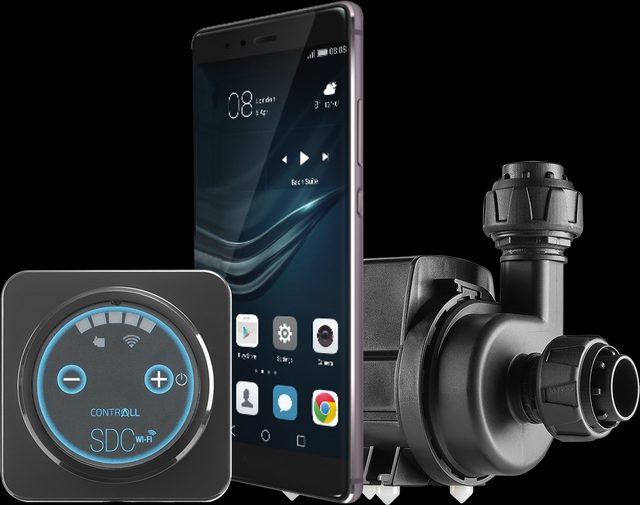
SICCE's current US Syncra SDC page identifies the 6.0 at up to 1,450 GPH, 11.5 ft maximum head and 10–40W, with 24V operation, wet/dry installation, an included controller and ContrALL app support. SICCE also publishes a performance chart for the family.
That chart matters more than the headline GPH. The 1,450 GPH value is not what a sump necessarily receives after vertical lift and plumbing restriction. Exact model SDC 6.0 is consistently mapped by indexed US catalog evidence to Amazon.com ASIN B08RHB1BQP. PetGearReport has not measured its installed flow or acoustics.
The strongest all-round research pick because current SICCE documentation combines controllability, wet/dry installation and unusually clear hydraulic evidence.
Check price on Amazon →#2Best mid-range controllable pump with explicit flow range
Current USA eFlux 6009 1050 GPH
Best for: medium sump systems that want a broad controllable flow range, documented 10.5 ft shutoff head and clear plumbing dimensions
What we like
- Current USA publishes a 210–1,050 GPH controllable range instead of only maximum flow
- Maximum head is 10.5 ft / 3.2 m
- Published draw is 6–30W
- Manufacturer documents sump or inline external installation plus hose/PVC fitting details
- Exact model 6009 maps to ASIN B01MSISWRQ in indexed US catalog evidence
What we don't
- LOOP controller architecture is less universal than a simple standalone dial
- A 1,050 GPH zero-head ceiling can be insufficient for high-head or multi-device manifolds
- Manufacturer energy-savings claims are not used as PetGearReport scoring evidence
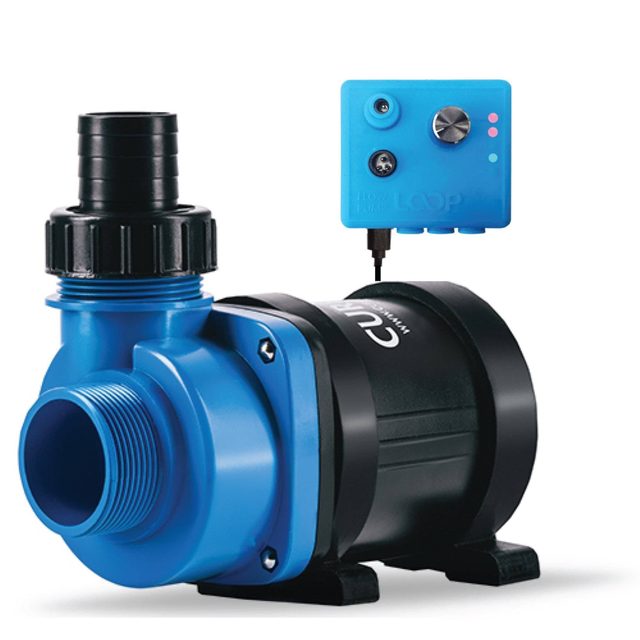
Current USA identifies eFlux model 6009 as a controllable 24V DC return pump with a published 210–1,050 GPH flow range, 6–30W draw and 10.5 ft / 3.2 m maximum head. Its current product page documents sump or inline external installation, a 1.25-inch inlet-hose size, 0.75- and 1-inch outlet hose fittings and PVC adapters.
The manufacturer also publishes the 6009 curve alongside the larger eFlux models, so the correct decision is to compare your planned operating head with that curve rather than assume 1,050 GPH reaches the display. Indexed US catalog evidence ties model 6009 to ASIN B01MSISWRQ.
A practical mid-range option because Current USA publishes both the adjustable flow envelope and a model-specific flow chart for real plumbing decisions.
Check price on Amazon →#3Best compact smart return pump for AIO and smaller sump systems
AquaIllumination Axis 40
Best for: AIO and smaller sump systems where compact dimensions, calibration and a 400 GPH class pump fit the plumbing
What we like
- Current AquaIllumination documentation lists about 400 GPH flow and about 9 ft maximum head
- Variable power is documented at 20W maximum
- Manufacturer guidance lists systems up to about 40 gallons
- Schedule, Feed and Calibrate modes plus Mobius/myAI control are documented
- Exact 400 GPH Axis 40 identity maps to ASIN B0D3QSB1X5 in indexed US marketplace evidence
What we don't
- 400 GPH maximum flow limits use in larger or highly restrictive sump loops
- App-based control is unnecessary overhead for buyers who only need fixed flow
- Manufacturer tank-size guidance is a screening boundary, not a substitute for checking delivered flow
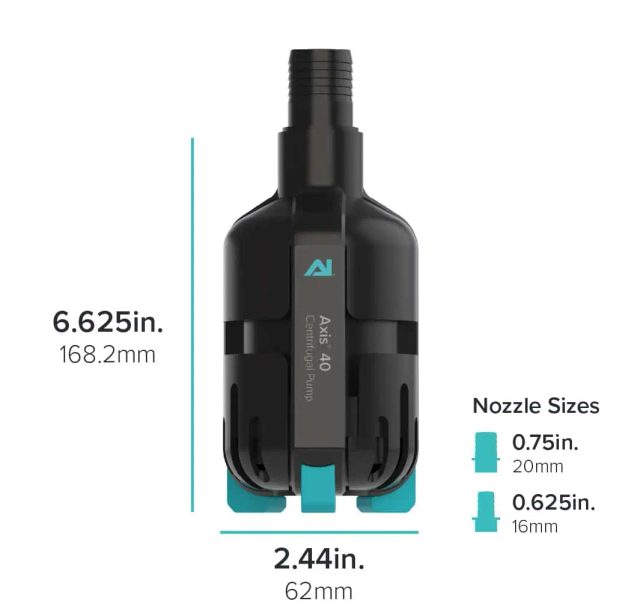
AquaIllumination's current Axis page lists the Axis 40 at approximately 400 GPH / 1,500 LPH, approximately 9 ft / 2.8 m maximum head, 20W maximum variable power and recommended use up to approximately 40 gallons. The manufacturer also documents Schedule, Feed and Calibrate modes and 0.625-inch / 16 mm and 0.75-inch / 20 mm barbed nozzles.
Those features make it attractive where cabinet or rear-chamber space is limited, but its 400 GPH maximum still has to cover the actual head loss. Indexed US marketplace evidence maps the exact Axis 40 400 GPH configuration to ASIN B0D3QSB1X5.
The compact specialist here: strong control features and a 9 ft maximum-head ceiling in a smaller form factor, but not a large-system replacement.
Check price on Amazon →#4Best value controllable DC option
hygger HG-915-4000 1060 GPH
Best for: budget-conscious sump builds that want DC speed control and can keep the controller dry while sizing conservatively from the available hydraulic evidence
What we like
- Current hygger documentation lists 1,060 GPH maximum flow for the 33W model
- Maximum head is 13.1 ft
- External LED controller provides 30–100% adjustment
- Manufacturer documents internal or external use and freshwater/saltwater compatibility
- Exact HG-915-4000 identity maps to ASIN B07W141HYD in indexed catalog evidence
What we don't
- The external controller is not waterproof and must be kept away from splash zones
- Manufacturer documentation is less detailed about pump-curve points than SICCE or Current USA
- The 1,060 GPH and 13.1 ft numbers are separate endpoint limits, not simultaneous output
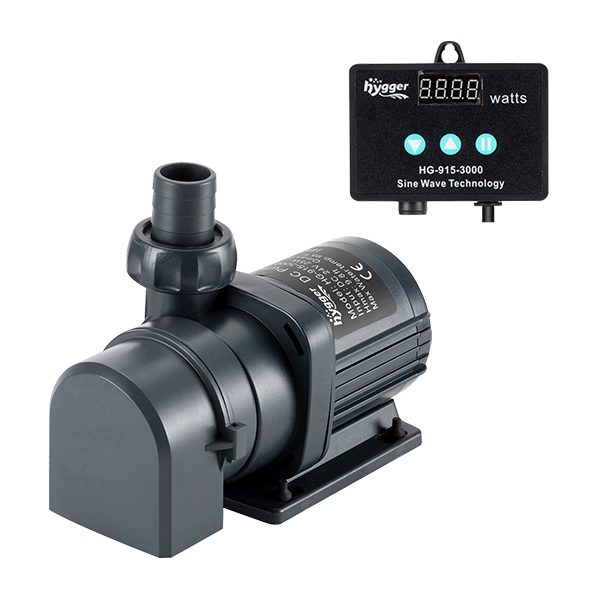
hygger's current DC water-pump documentation lists the 33W version at 1,060 GPH maximum flow and 13.1 ft maximum head, with 24V output and external LED speed control. The current support material identifies the HG-915 family for aquarium circulation and return-pump use, while indexed product evidence resolves the 33W / 1,060 GPH variant to exact model HG-915-4000.
The controller can adjust output from 30% to 100%, but the controller itself is not waterproof. That installation boundary belongs in the buying decision for a wet sump cabinet. Exact HG-915-4000 maps to Amazon.com ASIN B07W141HYD.
A credible value pick with clear maximum flow, head and control boundaries, scored below the leaders because curve documentation is less complete.
Check price on Amazon →#5Best simple AC alternative
SICCE Syncra Silent 3.0
Best for: aquarists who prefer a simpler AC return pump and whose required delivered flow fits the 714 GPH / 9.9 ft hydraulic envelope
What we like
- Current SICCE manual lists the 120V Syncra Silent 3.0 at 714 GPH maximum flow
- Published 120V maximum head is 9.9 ft
- Published power is 48W
- Wet or dry use and mechanical flow adjustment avoid app/controller dependency
- Exact Syncra Silent 3.0 identity maps to ASIN B004ZJDNI8 in indexed catalog evidence
What we don't
- No electronic speed controller or app scheduling
- Higher listed input than similarly sized DC options should be considered in continuous-duty use
- Mechanical throttling does not provide the same control architecture as variable-speed DC models
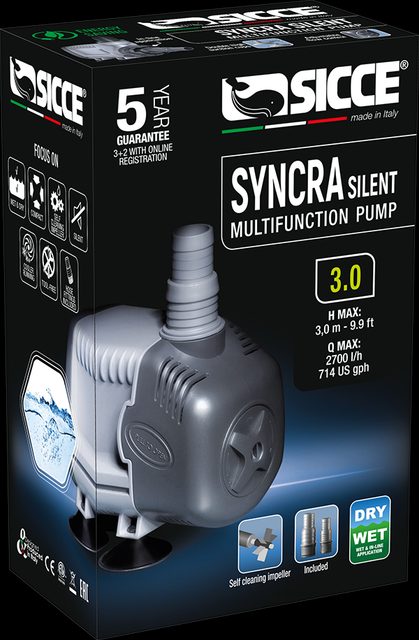
SICCE's current Syncra Silent manual lists the 120V 3.0 at 714 US GPH maximum flow, 48W and 9.9 ft maximum head. SICCE documents the family for submerged or inline use, with mechanical flow adjustment rather than a separate electronic speed controller.
That simplicity can be a feature when the sump does not need schedules, app control or variable-speed automation. It does not change the hydraulic rule: 714 GPH and 9.9 ft are endpoint limits, and the actual return rate must be read from the pump's performance behavior at the system's operating head. Indexed catalog evidence maps Syncra Silent 3.0 to ASIN B004ZJDNI8.
The straightforward alternative when smart control is not required and the planned plumbing fits its documented AC performance boundaries.
Check price on Amazon →A return pump has one job that a headline GPH number does not describe: move the required amount of water from the sump back to the display after the plumbing takes its share of pressure.
That makes return-pump shopping a hydraulic problem. The useful number is not maximum flow at almost no head and it is not maximum head at almost no flow. The useful number is the pump’s delivered flow at your operating head.
If you are still estimating the system’s real water volume, use the aquarium volume calculator. Volume helps define the system, but it does not replace the pump curve.
Return-pump hydraulic evidence map
Manufacturer pages rechecked September 23, 2026. The key distinction is simple: endpoint specifications are not an operating point. Maximum or low-head flow, maximum/shutoff head, controller range and a pump curve answer different questions.
The table below records what the current primary documentation actually gives us for the five ranked models. It deliberately separates Published model/family curve, Published adjustable flow envelope, and Endpoint-only evidence so missing curve data does not get filled with invented estimates.
| Ranked pump | Current published hydraulic/control evidence | Evidence class | What you may safely conclude |
|---|---|---|---|
| SICCE Syncra SDC 6.0 | 530–1,450 US GPH controlled flow range, 3.5–11.5 ft head range across its control envelope, 10–40W, plus SICCE performance-chart evidence | Published model/family curve + Published adjustable flow envelope | Use the exact SICCE curve with the system’s estimated TDH; do not treat 1,450 GPH and 11.5 ft as one simultaneous point |
| Current USA eFlux 6009 | 210–1,050 GPH adjustable range, 10.5 ft max head, 6–30W, plus a manufacturer flow chart | Published model/family curve + Published adjustable flow envelope | Compare the target operating point with the model 6009 curve and keep its controller/plumbing limits intact |
| AquaIllumination Axis 40 | ≈400 GPH max flow, ≈9 ft max head, 20W max, with Schedule/Feed/Calibrate control | Endpoint-only evidence on the current product page | The two maxima screen fit, but they do not provide an intermediate delivered-flow point by themselves |
| hygger HG-915-4000 | 1,060 GPH max flow, 13.1 ft max head, 33W, controller adjustable 30–100% | Endpoint-only evidence plus speed control | Use conservative headroom; controller percentage is not a published GPH-at-head curve |
| SICCE Syncra Silent 3.0 | 714 US GPH max flow, 9.9 ft max head, 48W, mechanical flow adjustment | Endpoint-only evidence in the current technical table used here | Keep the two endpoints separate and use manufacturer performance data if a specific operating-point decision depends on it |
This distinction matters because a pair of endpoints cannot tell you the shape of a centrifugal pump’s performance curve. Do not linearly interpolate between maximum flow and maximum head, and do not manufacture a curve from maximum flow and maximum head. A halfway head value is not evidence of halfway flow.
Calculator → TDH → manufacturer curve workflow
Use the site’s aquarium return-pump head-loss calculator for the system side of the decision, then use first-party pump documentation for the pump side:
- Define a target return flow that the sump, overflow and equipment design can actually use.
- Enter the real vertical rise, pipe inside diameter, run length and representative fittings to estimate TDH at that target flow.
- Carry the target-flow / estimated TDH pair to the exact manufacturer pump curve when one is published.
- Look for a practical intersection: the pump must be able to deliver at least the target flow at approximately that system head while retaining sensible control margin.
- Recheck overflow/drain capacity so the chosen return rate does not exceed what the drain system can safely carry.
- Check inline equipment separately. UV units, chillers, reactors and manifolds can have their own permitted flow or pressure-loss constraints.
- After installation, verify real operation rather than treating the estimate as a field measurement.
If an exact pump has only endpoint data and no usable manufacturer curve, the defensible conclusion is narrower: the endpoints can reject obviously unsuitable candidates, but they cannot prove delivered GPH at an intermediate TDH.
Keep sump return and display circulation as two targets
The return-flow target answers how much water should move through the sump loop after plumbing resistance. The display-circulation target answers how water should move around rockwork, plants, corals and sheltered areas inside the display.
Those jobs can overlap, but they are not interchangeable and there is no universal sump-turnover multiplier that solves both. Size the return loop from sump/overflow/equipment constraints; then use a wavemaker or circulation pump only when the display still needs additional directional movement.
How we researched and scored
PetGearReport has not physically tested these return pumps, measured installed flow, sound pressure, cabinet vibration, heat transfer, electrical consumption or long-term reliability. We compared current manufacturer documentation, published hydraulic limits, control architecture, plumbing details, maintenance information and indexed US marketplace identity.
The displayed number is a PetGearReport research score, not a hands-on result, customer rating or laboratory measurement.
- Hydraulic fit & head-pressure evidence — 30% — quality of flow/head documentation, availability of a pump curve and usefulness of the published operating envelope.
- Flow control & system integration — 25% — electronic speed control, calibration/feed functions and how easily the pump can be matched to the sump.
- Plumbing & installation fit — 20% — wet/dry support, inlet/outlet sizes, included fittings and physical-use boundaries.
- Maintenance & operating boundaries — 15% — controller exposure, access, service information and documented electrical limits.
- Documentation & exact identity — 10% — current first-party model evidence plus confidence in the exact US Amazon.com variant mapping.
| Return pump | Hydraulic evidence 30% | Control/integration 25% | Plumbing/install 20% | Maintenance/boundaries 15% | Evidence 10% | Weighted | Score |
|---|---|---|---|---|---|---|---|
| SICCE Syncra SDC 6.0 | 9 | 10 | 9 | 9 | 9 | 9.25 | 9/10 |
| Current USA eFlux 6009 | 9 | 9 | 10 | 8 | 9 | 9.00 | 9/10 |
| AquaIllumination Axis 40 | 8 | 10 | 8 | 8 | 9 | 8.60 | 9/10 |
| hygger HG-915-4000 | 8 | 9 | 8 | 8 | 9 | 8.35 | 8/10 |
| SICCE Syncra Silent 3.0 | 8 | 5 | 8 | 9 | 9 | 7.50 | 8/10 |
The weighted decimals make the method auditable; they do not imply laboratory precision. Current Amazon price, stock, star ratings and review counts are intentionally excluded.
Quick comparison: maximum numbers are only the endpoints
| Model | Published maximum flow | Published maximum head | Power | Control | Best fit |
|---|---|---|---|---|---|
| SICCE Syncra SDC 6.0 | 1,450 GPH | 11.5 ft | 10–40W | Variable DC + app/controller | Best documented all-round DC choice |
| Current USA eFlux 6009 | 1,050 GPH | 10.5 ft | 6–30W | Variable DC / LOOP | Mid-range sump with explicit range |
| AquaIllumination Axis 40 | ~400 GPH | ~9 ft | 20W max | Smart calibration/feed/schedule | Compact/AIO and smaller sump |
| hygger HG-915-4000 | 1,060 GPH | 13.1 ft | 33W | 30–100% DC controller | Value controllable option |
| SICCE Syncra Silent 3.0 | 714 GPH | 9.9 ft | 48W | AC / mechanical adjustment | Simple non-smart setup |
Do not read the maximum-flow and maximum-head columns as one operating point. They are opposite ends of the hydraulic curve.
Start with static head, then add plumbing resistance
Static head is the vertical elevation the pump must overcome. For a normal sump return, measure the vertical distance from the sump’s operating water level to the point where the return discharges into the display.
That is only the beginning. Real plumbing adds dynamic resistance through:
- total pipe or hose length;
- pipe diameter;
- elbows and tees;
- check valves and ball/gate valves;
- unions and reducers;
- split returns;
- manifolds;
- UV sterilizers, chillers or other inline devices.
A vertical rise of 4 ft does not automatically mean the system has exactly 4 ft of total dynamic head. Conversely, adding every horizontal foot directly to the vertical rise is also not a correct universal shortcut.
An aquarium auto top-off system solves a different sump problem: replacing evaporated water to maintain the chosen operating level. It does not change the return pump curve or replace correct head-loss sizing.\n\nThe correct method is to estimate the system resistance, then use the pump curve for the exact model. Our aquarium return-pump head-loss calculator estimates static, straight-pipe and representative fitting losses at a target flow so you can carry a transparent TDH point to that curve. SICCE and Current USA publish performance information that makes this much more defensible than buying from the zero-head GPH label alone.
Maximum GPH and maximum head cannot happen at the same time
This is the most important return-pump distinction.
A centrifugal pump normally produces its highest flow when resistance is low. As head pressure rises, delivered flow falls. At the pump’s published maximum head, useful flow approaches zero.
So a pump labeled 1,450 GPH / 11.5 ft max head does not deliver 1,450 GPH at 11.5 ft. Those numbers describe two endpoints.
That is why the SICCE SDC 6.0 ranks first here: the manufacturer supplies a performance chart. Current USA likewise publishes a model-specific eFlux flow chart. Where documentation is less granular, we score hydraulic evidence more conservatively rather than inventing a curve.
There is no universal sump-turnover rule
There is no universal return-pump turnover target on this page.
A reef sump carrying a protein skimmer, refugium and heater can have a different useful return rate from a simple freshwater sump. The protein skimmer vs refugium guide separates the two export mechanisms before you decide how much sump space each deserves. For a new refugium, the reef refugium setup guide separates chamber flow from total sump turnover. If the plumbing plan may feed a contained macroalgae reactor instead of an open chamber, macroalgae reactor vs refugium separates the device-loop and service trade-offs. If macroalgae is trapping detritus or growth has stalled, the Chaeto refugium troubleshooting guide separates flow, light and nutrient checks. If the display is a nominal 75 gallons, the 75-gallon protein skimmer guide keeps skimmer bioload and fit separate from this return-pump hydraulic calculation. Overflow capacity, drain noise, sump contact time, plumbing geometry and equipment limits all matter. Some inline devices also publish their own permitted flow range. If a return manifold feeds chemical filtration, use the reef media reactor guide to keep reactor-media flow control separate from total sump return flow.
Use tank/system volume as context, but do not multiply gallons by one magic number and assume the pump is solved.
If your main question is filtration capacity rather than sump hydraulics, use the aquarium filter size guide. Filter sizing and return-pump sizing overlap, but they are not the same calculation.
Return flow is not the same as display circulation
A return pump moves water through the sump loop. A wavemaker or circulation pump moves water inside the display.
Trying to make the return pump provide all display circulation can force unnecessarily high water through the overflow and sump. It can also increase drain noise and make equipment flow harder to control.
If the display needs more movement after the sump return is correct, use the aquarium wavemaker guide. That lets you add directional circulation without pretending every extra GPH must pass through the overflow.
This separation is especially useful in reef layouts, long tanks and hardscape-heavy aquariums where the desired in-tank flow pattern is not the same as the desired sump throughput.
DC vs AC return pumps
A DC return pump commonly provides electronic speed adjustment. The Syncra SDC 6.0, eFlux 6009, Axis 40 and hygger HG-915-4000 all provide some form of electronic control.
That can help when:
- the exact delivered flow is hard to predict before the plumbing is wet;
- the overflow has a narrow comfortable operating window;
- feed or calibration modes are useful;
- the system may later add an inline device or manifold.
A simple AC pump such as the Syncra Silent 3.0 avoids an external electronic speed controller. That can be attractive when the hydraulic requirement is already well defined and simplicity matters more than app or schedule features.
Do not turn motor type into a quality score. A correctly sized AC pump can be a better fit than an oversized smart DC pump, and vice versa.
Plumbing diameter can erase pump capacity
A pump can only move what the plumbing allows.
Reducing outlet diameter, adding multiple tight elbows or forcing flow through restrictive fittings increases resistance. A powerful pump connected to undersized plumbing may deliver much less than the label suggests and may consume the margin you expected to have for future equipment.
Match the manufacturer’s outlet architecture first. Current USA, for example, publishes hose and PVC fitting information for the eFlux 6009. AquaIllumination publishes two Axis 40 barb sizes. SICCE documents fittings for its pump families.
Avoid reducing pipe diameter immediately at the pump unless the system design requires it and the manufacturer allows the configuration.
Inline UV and chillers make pump sizing a system problem
Return pumps are often asked to feed more than the display return.
An external aquarium UV sterilizer may require a specific flow range for the intended use. An aquarium chiller can also impose a minimum/maximum flow window. If either device is placed directly in the main return path, its restriction and permitted flow become part of the return-pump design.
A manifold can separate equipment branches, but every split changes the hydraulic system. Do not add branch flow numbers to the main return requirement without checking what the pump can actually deliver at the combined operating point.
Power belongs in the decision, but not as a fake cost claim
A return pump can run continuously, so published input power matters.
The five ranked variants span from a 20W maximum on Axis 40 to 48W on the 120V Syncra Silent 3.0, with the other DC models using variable or model-specific input ranges.
A basic electricity estimate is:
energy (kWh) = input power (kW) × operating hours
For variable-speed pumps, actual draw depends on the selected setting. PetGearReport has not measured real wall power for these pumps, so we do not publish a fabricated monthly cost.
Also remember that submerged pumps can contribute some heat to the water. If temperature control is already marginal, the return pump belongs in the broader heat-load plan.
Compact systems have a different constraint: chamber fit
A small AIO or compact sump can eliminate pumps before hydraulic capacity does.
AquaIllumination lists Axis 40 at approximately 2.44 inches wide and 6.625 inches tall. That narrow footprint is part of why it is included here: a larger pump that cannot physically fit the rear chamber is irrelevant even if its flow curve looks better.
Measure the pump chamber, service clearance, hose bend radius and the space needed to remove the pump for cleaning before purchase.
Installation checklist before buying
Record these values before choosing a return pump:
- Actual system volume — display plus sump at normal operating level.
- Desired sump-through flow — a system decision, not a universal turnover target.
- Static head — vertical rise from sump operating water level to discharge point.
- Pipe/hose diameter — including any planned reductions.
- Total run length — horizontal and vertical routing.
- Elbows and tees — count major restrictions.
- Valves and unions — especially check valves and partially throttled valves.
- Inline equipment — UV, chiller, reactor or manifold branches.
- Pump curve — delivered flow at the estimated operating head.
- Overflow/drain capacity — do not choose a pump that the drain system cannot manage.
- Cabinet/chamber fit — pump body, controller and service clearance.
- Electrical location — keep non-waterproof controllers and connections out of splash zones.
- Maintenance access — the pump should be removable without dismantling the whole sump.
- Independent display circulation — decide separately whether a wavemaker is needed.
If a candidate fails a hard plumbing, head, overflow or physical-fit boundary, remove it before comparing softer features.
Product-by-product operating boundaries
SICCE Syncra SDC 6.0
SICCE’s current US page lists 1,450 GPH maximum flow, 11.5 ft maximum head and 10–40W for the SDC 6.0. It supports wet/dry installation and variable control through the included controller and ContrALL ecosystem.
Choose it when the published curve contains a sensible operating point for your system and you value electronic adjustment. Avoid choosing it purely because 1,450 GPH is the largest number among the mid-sized ranked pumps.
Current USA eFlux 6009
Current USA publishes a 210–1,050 GPH adjustable range, 10.5 ft maximum head and 6–30W for model 6009. It also publishes plumbing dimensions and a family flow chart.
This is the clearest mid-range choice when you want a documented minimum/maximum controllable envelope and the curve still provides enough return flow after your head loss.
AquaIllumination Axis 40
Axis 40 is documented at about 400 GPH, 9 ft maximum head and 20W maximum. It adds calibration, schedule and feed functions in a compact body.
It is not the right choice when the sump requires more than its hydraulic envelope can deliver. It is useful when physical space and control matter more than raw zero-head flow.
hygger HG-915-4000
The 33W HG-915-4000 configuration is documented at 1,060 GPH and 13.1 ft maximum head, with electronic adjustment from 30% to 100%.
The main boundary is evidence quality: hygger provides the important endpoint specifications and operating features, but less curve detail than the top-ranked manufacturers. Size with more margin rather than assuming the endpoints predict a specific installed flow.
SICCE Syncra Silent 3.0
The current 120V manual lists Syncra Silent 3.0 at 714 GPH, 9.9 ft maximum head and 48W. It uses simpler AC architecture with mechanical adjustment.
Choose it when you prefer a straightforward pump and the hydraulic requirement fits. The absence of electronic speed control is a trade-off, not automatically a flaw.
Identity verification notes
Manufacturer documentation is used for hydraulic and operating claims. Indexed marketplace/catalog evidence is used only to reconcile the exact US affiliate identity.
- SICCE Syncra SDC 6.0 — exact SDC 6.0 identity maps to Amazon.com ASIN B08RHB1BQP.
- Current USA eFlux 6009 — exact model 6009 identity maps to ASIN B01MSISWRQ.
- hygger HG-915-4000 — exact 33W / 1,060 GPH / 13.1 ft variant maps to ASIN B07W141HYD.
- AquaIllumination Axis 40 — exact 400 GPH Axis 40 configuration maps to ASIN B0D3QSB1X5.
- SICCE Syncra Silent 3.0 — exact 3.0 model maps to ASIN B004ZJDNI8.
The EcoTech Vectra M2 and Reef Octopus VarioS-4 both have strong current manufacturer documentation and were considered for this guide. They are not ranked because the current publication pass did not establish exact Amazon.com identity evidence strong enough to meet the same variant standard as the five ranked products. We excluded them instead of assigning speculative affiliate ASINs.
Direct Amazon product-page probing was not used for this publication pass.
Sources and verification
Technical claims prioritize current manufacturer documentation. Marketplace/catalog evidence is limited to exact variant reconciliation.
- SICCE US — Syncra SDC — SDC 6.0 flow, head, power, control and performance-chart evidence.
- Current USA — eFlux DC Flow Pump 1050 GPH — model 6009 flow range, head, power, fittings, wet/dry installation and flow chart.
- AquaIllumination — Axis — Axis 40 flow, maximum head, power, tank guidance, nozzle sizes and control modes.
- hygger — DC Aquarium Water Pump — 33W / 1,060 GPH / 13.1 ft configuration and controller architecture.
- SICCE — Syncra Silent instruction manual — current 120V Syncra Silent 3.0 maximum flow, maximum head and wattage.
- EcoTech Marine — Vectra M2 — current M2 manufacturer specifications used only to assess the excluded candidate.
- Reef Octopus — VarioS Pump — current VarioS-4 manufacturer specifications used only to assess the excluded candidate.
- Indexed US catalog evidence maps the five ranked exact model configurations to the published ASINs; it is not used as performance evidence.
No Amazon price, stock or availability claim is made here. Those can change independently of product identity.
Frequently asked questions
How many GPH should my aquarium return pump have?
There is no universal GPH-per-gallon number that fits every sump. Start with the return flow you actually want through the sump, then choose a pump whose manufacturer curve can deliver that flow at your real head height after vertical rise and plumbing restrictions. Keep display circulation as a separate design question.
What is head height on an aquarium return pump?
Static head is the vertical elevation the pump must overcome between the source water level and the discharge point. The full operating resistance also includes friction and restrictions from pipe length, elbows, valves, reducers and inline devices. A pump's maximum-head number is the point near which flow falls toward zero, not the flow you should expect in normal operation.
Is a DC return pump better than an AC return pump?
Not universally. DC pumps often provide electronic speed control, feed modes and lower-voltage motor architecture, while AC pumps can be simpler and require fewer electronics. Compare the exact pump curve, control needs, plumbing fit, service parts and power documentation rather than assuming one motor type is always superior.
Can a return pump replace a wavemaker?
Not necessarily. A return pump moves water from the sump back to the display and must overcome plumbing head. A wavemaker or circulation pump moves water inside the display. Some tanks get enough circulation from the return alone, while others use separate circulation pumps to shape flow without forcing excessive water through the sump.
Should I oversize a return pump and throttle it?
Only when the exact pump's control method and curve make that a deliberate fit. Variable-speed DC pumps can provide useful adjustment headroom, but excessive oversizing can add cost, heat, plumbing velocity and unnecessary complexity. Choose enough margin for the planned operating point rather than treating the largest model as automatically safer.