Best Reef Aquarium Lights: 5 Picks by Coral Type, Tank Depth & Coverage
Reef lighting is a coral-demand, depth, footprint and control decision—not a watts-per-gallon contest. We compared five current reef LED variants using manufacturer coverage, published PAR evidence where available, spectrum/control documentation, mounting scalability, and exact Amazon.com variant identity. PetGearReport has not physically tested these lights, measured PAR, or grown coral under them; the recommendations and scores are research-based.
Reef-light decision table: match coral demand, depth and footprint
Manufacturer coverage and PAR figures are useful only in the conditions in which they were documented. A published footprint can shrink when the goal changes from mixed reef to SPS-dominant use, and a center-point PAR number is not a universal coral target.
| Fixture | Power | Manufacturer coverage | Published PAR evidence | Controls | Mounting / scalability | Best fit | Avoid if |
|---|---|---|---|---|---|---|---|
| Kessil A360XE Tuna Blue | 90W max AC | 24×24 in mixed-reef; 20×20 in SPS | No single model-level PAR value used here; Kessil publishes coral-use coverage instead | Manual tuning; Quick Set; acclimation; network control with compatible Kessil controller/dongle | Pendant; optional arm/gooseneck; multiple K-Link-compatible fixtures | Mixed reefs or SPS layouts where Kessil's narrower SPS footprint fits the aquascape | You want built-in app control without an additional compatible controller/dongle |
| AquaIllumination Hydra 32HD | 95W from the wall | Current Hydra 32HD spec page does not publish one universal footprint | No single manufacturer PAR number used for ranking; plan by tank geometry and coral placement | Wireless app control; separate moonlight channel | HMS, tank mount, flex arm or hanging kit; modular multi-fixture layouts | Reef keepers prioritizing flexible control and scalable multi-light layouts | You need one manufacturer-published footprint/PAR figure to size the system without further planning |
| Red Sea ReefLED G2 60 | 60W compact LED array | 20×20 in; manufacturer max water depth 20 in | 500 µmol/m²/s at the surface; 100 µmol/m²/s at 20 in in Red Sea's documented saltwater setup | ReefBeat app; adjustable 10,000K–23,000K color temperature and intensity | Compact fixture; optional mounting/visor ecosystem; spacing guidance published | Small reefs where Red Sea's published 20×20×20 in measurement geometry is a close match | Your footprint/depth exceeds the G2 60 operating envelope or you need a wider single-fixture spread |
| AquaIllumination Prime 16HD Reef White | 59W at full power on the technical table | 24×24 in spread | Manufacturer states peak PAR of 100 µmol/m²/s at 24 in depth | myAI app control; dynamic HD channel power; moonlight | Compact fixture with tank-mount, hanging and flex-arm options | Nano and small-to-medium reefs where compact control matters | You need broad high-demand coverage from one compact puck without validating coral placement |
| NICREW HyperReef 150 Gen 2 | 150W at full power | 30×30 in maximum coverage | Manufacturer publishes PAR-distribution material, but no single PAR number is used here as a universal target | Gen 2 spectral/control platform with adjustable channels | Included HyperReef mount system; optional narrow-angle lens for penetration vs spread trade-off | Larger reef footprints needing documented 150W output and a 30×30 in maximum coverage envelope | You want primary documentation as detailed as Red Sea's model-specific measurement setup |
| Rank | Product | Score | Best for | Link |
|---|---|---|---|---|
| #1 | Kessil A360XE Tuna BlueMixed reef / SPS footprint pick | 9 | Mixed reefs and SPS layouts that fit Kessil's documented 24×24 in mixed or 20×20 in SPS footprint | Check price → |
| #2 | AquaIllumination Hydra 32HDScalable control pick | 9 | Reef tanks where wireless control and scalable multi-fixture layout matter more than a single published coverage number | Check price → |
| #3 | Red Sea ReefLED G2 60Published PAR evidence pick | 9 | Small reefs where Red Sea's documented 20×20×20 in test geometry closely resembles the intended tank | Check price → |
| #4 | AquaIllumination Prime 16HD Reef WhiteNano / small reef pick | 8 | Nano and small-to-medium reefs where compact app-controlled lighting fits the aquascape | Check price → |
| #5 | NICREW HyperReef 150 Gen 2Large-footprint output pick | 8 | Larger reef footprints where a documented 150W platform and 30×30 in maximum coverage are useful starting constraints | Check price → |
#1 · Our PickMixed reef / SPS footprint pick
Kessil A360XE Tuna Blue
Best for: Mixed reefs and SPS layouts that fit Kessil's documented 24×24 in mixed or 20×20 in SPS footprint
What we like
- Kessil documents 24×24 in mixed-reef coverage
- SPS coverage is separately narrowed to 20×20 in instead of treating one footprint as universal
- 90W max AC with Tuna Blue plus red, green and violet/indigo spectrum
- Quick Set and acclimation modes plus multi-light K-Link compatibility
What we don't
- App/network control requires a compatible Kessil controller or WiFi dongle rather than being treated as built-in
- A puck-style fixture still needs aquascape-aware placement to manage shadowing
- Kessil's page gives coverage categories rather than one model-level PAR map used in this comparison
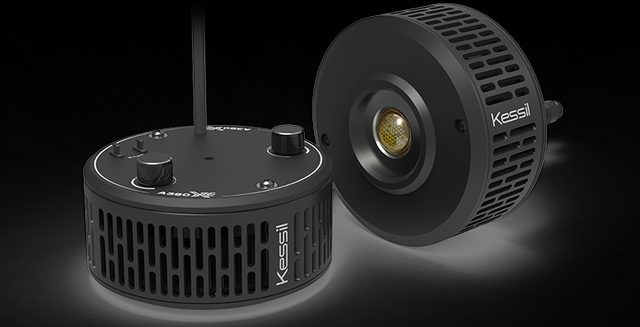
Kessil documents the A360XE Tuna Blue at 90W max AC, with a 24×24 in mixed-reef footprint and a narrower 20×20 in SPS footprint. That distinction matters more than a generic claim that one light 'covers two feet,' because coral demand changes how much of the nominal spread is useful.
The fixture supports manual color/intensity adjustment, Quick Set scheduling and acclimation. K-Link can coordinate compatible Kessil fixtures, but network/app-style control depends on compatible Kessil control hardware rather than being assumed to be built into the lamp. The combination of coral-use-specific coverage, control architecture and strong primary documentation earns a 9/10 PetGearReport research score.
The strongest research fit here when a manufacturer explicitly separates mixed-reef and SPS coverage and backs it with mature control and mounting options.
Check price on Amazon →#2Scalable control pick
AquaIllumination Hydra 32HD
Best for: Reef tanks where wireless control and scalable multi-fixture layout matter more than a single published coverage number
What we like
- 95W power consumption is published in AquaIllumination's technical specifications
- Wireless reef-light control and separate moonlight channel
- Multiple manufacturer mounting systems support flexible placement
- Modular form factor is suited to adding fixtures across longer reef footprints
What we don't
- The current Hydra manufacturer page does not publish one simple model-level coverage footprint comparable with Kessil or Red Sea
- Sizing a multi-light layout still requires tank-geometry and coral-placement planning
- A high feature count does not establish coral suitability without intensity and placement calibration
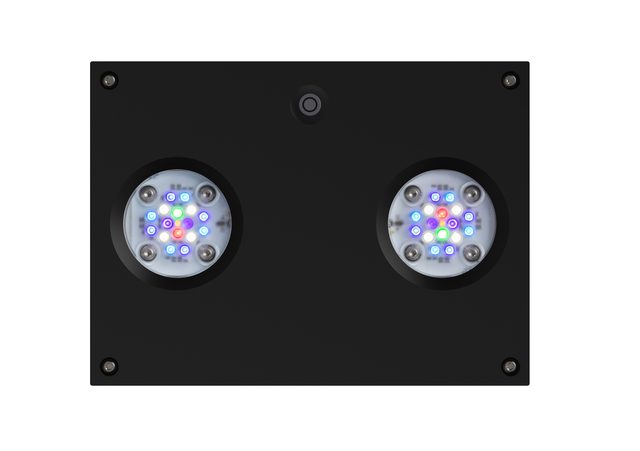
AquaIllumination's current Hydra specifications list the Hydra 32HD at 95W from the wall and document the company's reef-focused control and mounting ecosystem. For a long or irregular aquascape, the ability to position multiple fixtures can be more useful than treating one center-mounted puck as a universal solution.
The trade-off is evidence clarity: unlike Kessil's coral-use footprints or Red Sea's model-specific PAR measurement setup, the current Hydra product page does not give one simple coverage/PAR figure that we can responsibly turn into a sizing rule. That keeps this a 9/10 research score for control, reef fit and scalability, not a claim of measured superiority.
A strong research choice for controllability and modular layouts, with the main evidence limitation being less explicit current footprint/PAR documentation on the manufacturer page.
Check price on Amazon →#3Published PAR evidence pick
Red Sea ReefLED G2 60
Best for: Small reefs where Red Sea's documented 20×20×20 in test geometry closely resembles the intended tank
What we like
- 60W model has a documented 20×20 in coverage footprint
- Red Sea publishes 500 µmol/m²/s at the surface and 100 µmol/m²/s at 20 in
- PAR measurements are tied to a documented saltwater 20×20×20 in test setup
- ReefBeat control and 10,000K–23,000K adjustable color-temperature range
What we don't
- 20×20 in coverage makes it a small-footprint fixture rather than a one-light answer for larger reefs
- Published center/depth PAR evidence should not be converted into universal coral thresholds
- Larger/deeper systems may require a different G2 model or multiple fixtures
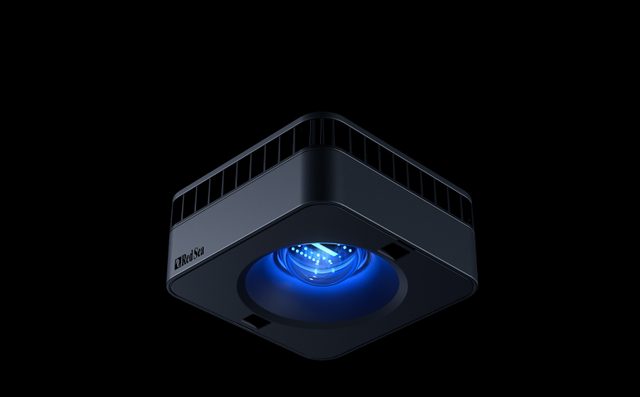
Red Sea documents the ReefLED G2 60 as a 60W fixture with 20×20 in coverage and a 20 in maximum water depth. More importantly, its manufacturer page explains the measurement setup: the light was mounted over a 20×20×20 in saltwater aquarium, with published readings of 500 µmol/m²/s at the surface and 100 µmol/m²/s at 20 in depth.
Those numbers are evidence, not universal coral targets. Aquascape height, mounting, water clarity, neighboring fixtures and coral position can change delivered light. The unusually transparent measurement context, ReefBeat control and clear operating envelope produce a 9/10 PetGearReport research score.
The clearest model-specific PAR evidence in this five-light set, especially useful when the aquarium resembles Red Sea's published measurement geometry.
Check price on Amazon →#4Nano / small reef pick
AquaIllumination Prime 16HD Reef White
Best for: Nano and small-to-medium reefs where compact app-controlled lighting fits the aquascape
What we like
- AquaIllumination publishes a 24×24 in spread
- Manufacturer states peak PAR of 100 µmol/m²/s at 24 in depth
- Compact 4.88×4.88 in fixture with app control
- Multiple mounting options support nano and small-reef placement
What we don't
- A peak PAR number is not a full distribution map and should not be used as a universal coral target
- Manufacturer page copy and technical table show a small power-draw discrepancy, so this guide uses the 59W technical-table value
- Compact puck geometry can require additional fixtures or careful placement as reef footprint and coral demand increase
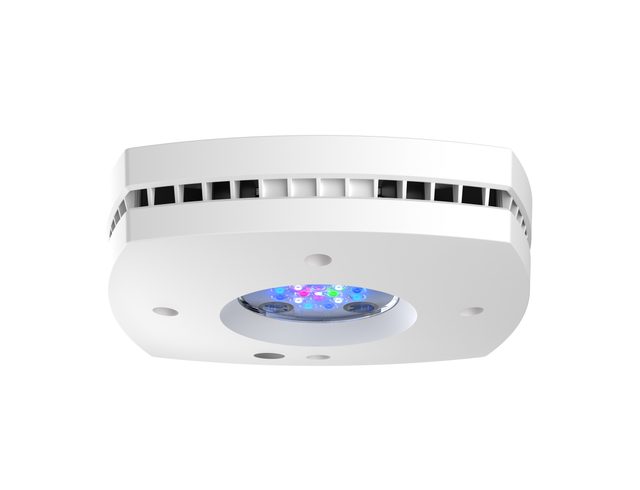
AquaIllumination documents the Prime 16HD Reef with a 24×24 in spread and a peak PAR of 100 µmol/m²/s at 24 in depth. The technical-specification table lists 59W at full power; nearby product copy references 55W, so this guide keeps the technical-table value visible rather than silently merging the two figures.
For a nano or small reef, the compact footprint and app control are useful, but a peak PAR statement does not describe every point in the tank. Coral placement and distribution still need validation. That evidence profile produces an 8/10 PetGearReport research score.
A compact and well-documented reef fixture, ranked below the larger units because its smaller form factor makes coverage validation especially important.
Check price on Amazon →#5Large-footprint output pick
NICREW HyperReef 150 Gen 2
Best for: Larger reef footprints where a documented 150W platform and 30×30 in maximum coverage are useful starting constraints
What we like
- NICREW documents 150W full-power consumption
- Maximum coverage is published at 30×30 in
- Gen 2 redesign includes spectral, lens, control and mounting updates
- Included mount plus optional narrow-angle lens supports spread-versus-penetration choices
What we don't
- Maximum coverage is not the same as uniform coral-use coverage at every depth
- This comparison does not substitute an inferred PAR number where the manufacturer page text does not provide one universal value
- Operating envelope still needs to be matched to coral placement rather than selected by wattage alone
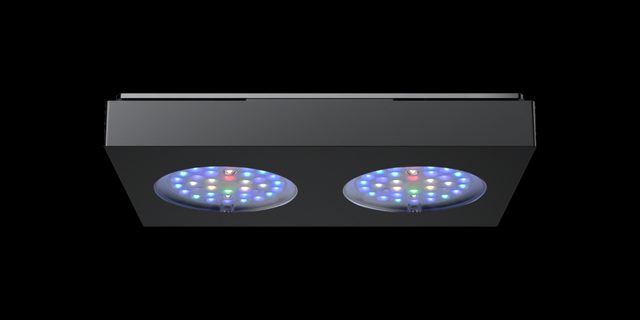
NICREW lists the HyperReef 150 Gen 2 at 150W full power with maximum coverage of 30×30 in. The Gen 2 platform also changes the optics, spectrum/control architecture and mounting system, while an optional narrow-angle lens trades spread for more concentrated penetration.
The important word is 'maximum': a 30×30 in envelope does not prove uniform coral-appropriate intensity across that entire square at every depth. Because the manufacturer provides useful power and coverage constraints but less text-level measurement detail than Red Sea, the fixture receives an 8/10 PetGearReport research score.
A higher-output, wider-footprint option with clear power and maximum-coverage documentation, but less model-specific measurement detail than Red Sea provides.
Check price on Amazon →If your aquarium is freshwater/planted rather than coral-focused, use our best aquarium LED lights guide. That parent page compares planted, nano and simpler freshwater-display fixtures; this page owns the reef/coral intent so the two guides do not compete for the same decision.
For the nutrient-export side of a marine system, the protein skimmer guide compares in-sump, hang-on-back and in-tank options by manufacturer bioload guidance and physical fit rather than by one universal gallon multiplier.
For reef systems where daily evaporation changes sump or display water level, the aquarium auto top-off guide compares level sensors, overflow failsafes, pump/head limits and siphon-control boundaries.\n\n## How we researched and scored
PetGearReport has not physically tested these five reef lights, measured their PAR, or grown coral under them. This is a research-based comparison built from current manufacturer documentation, exact product identity from indexed marketplace/catalog evidence, published specifications, and documented controls. The scores are PetGearReport research scores, not hands-on results and not Amazon/customer ratings. Marketplace price and availability are dynamic and are not scoring inputs.
We score each fixture on five visible criteria:
- Coverage & output evidence — 30%: model-specific footprint, power and PAR/distribution evidence where the manufacturer publishes it.
- Reef spectrum & control documentation — 25%: reef-oriented spectrum, channel control, scheduling, acclimation and app/controller documentation.
- Coral-use & operating envelope — 20%: how clearly documentation distinguishes mixed reef, SPS, depth or other coral-use constraints without relying on generic maximum spread.
- Mounting & scalability — 15%: mounting options, multi-fixture architecture and ability to adapt to longer or more complex reef footprints.
- Documentation & support — 10%: current primary-source clarity plus exact-variant identity confidence.
The weighted result is the sum of each 1–10 category grade multiplied by its weight; the published score is rounded to a whole-number PetGearReport research score.
| Product | Coverage/output 30% | Reef spectrum/control 25% | Coral-use envelope 20% | Mounting/scalability 15% | Docs/support 10% | Weighted result | Published score |
|---|---|---|---|---|---|---|---|
| Kessil A360XE Tuna Blue | 10 | 9 | 9 | 9 | 10 | 9.40 | 9/10 |
| AquaIllumination Hydra 32HD | 8 | 9 | 9 | 9 | 9 | 8.75 | 9/10 |
| Red Sea ReefLED G2 60 | 10 | 9 | 9 | 8 | 10 | 9.25 | 9/10 |
| AquaIllumination Prime 16HD Reef White | 8 | 8 | 8 | 8 | 8 | 8.00 | 8/10 |
| NICREW HyperReef 150 Gen 2 | 8 | 8 | 8 | 9 | 8 | 8.15 | 8/10 |
One-light planning boundaries: what the published specs do—and do not—prove
| Fixture | Manufacturer single-fixture evidence | Useful starting boundary | What it does not prove |
|---|---|---|---|
| Kessil A360XE Tuna Blue | 24×24 in mixed reef / 20×20 in SPS, 90W max AC | One fixture is a documented starting point only when the intended coral use fits the matching published footprint | The mixed-reef number does not prove 24×24 in SPS coverage, and Kessil does not publish one universal depth/PAR target for this comparison |
| AquaIllumination Hydra 32HD | 95W from the wall; No universal current footprint published on the current product page | Use the modular mounting/control architecture to plan around actual tank geometry and coral placement | 95W does not establish fixture count, coverage or coral suitability by itself |
| Red Sea ReefLED G2 60 | 20×20 in coverage; 20 in maximum water depth; manufacturer measurement shows 500 at the surface / 100 at 20 in in its documented 20×20×20 in saltwater setup | Strongest one-light evidence here when the aquarium closely matches Red Sea’s published footprint, depth and mounting geometry | The published center/depth readings are not a universal coral threshold or a full-tank PAR guarantee |
| AquaIllumination Prime 16HD Reef | 24×24 in spread; peak 100 µmol/m²/s at 24 in | Useful starting envelope for nano/small reefs when coral placement can be validated | A peak reading is not a full PAR map and does not prove uniform 100 µmol/m²/s across 24×24 in |
| NICREW HyperReef 150 Gen 2 | 150W; 30×30 in maximum coverage | Useful maximum geometric envelope for larger footprints before mounting and coral-placement validation | Maximum coverage is not coral-use-specific coverage and is not a universal PAR distribution claim |
If the aquarium exceeds a documented one-light envelope, plan multiple fixtures or a larger model instead of extrapolating the published number. For fixtures without a current manufacturer one-light footprint, do not reverse-engineer fixture count from watts alone.
Coverage is a coral-use question, not just a fixture dimension
A reef light can have more than one defensible coverage number. Kessil explicitly separates the A360XE’s 24×24 in mixed-reef footprint from its 20×20 in SPS footprint. That is a useful warning against treating the widest advertised spread as automatically appropriate for high-demand coral across the whole tank.
For fixtures without one current manufacturer-published footprint, do not invent one. The Hydra 32HD ranks highly for reef control and scalable mounting, but its current product page does not give us one simple footprint/PAR value that should be turned into a universal sizing rule.
Published PAR is evidence, not a universal coral prescription
Red Sea provides the clearest measurement context in this set. For the ReefLED G2 60, it documents measurements in a 20×20×20 in saltwater aquarium, with the fixture mounted 7 in above the center. In that setup Red Sea publishes 500 µmol/m²/s at the surface and 100 µmol/m²/s at 20 in.
AquaIllumination states a 24×24 in spread for the Prime 16HD Reef and a peak PAR of 100 µmol/m²/s at 24 in. “Peak” is important: it is not a complete map of every coral position, and it should not be converted into a universal biological threshold.
If you have access to a suitable PAR meter, measurements in the actual aquarium can help validate placement after mounting. PetGearReport did not perform those measurements for this guide.
Controls help repeat a plan; they do not choose the plan for you
App control, acclimation modes and schedule presets are useful because they make intensity and photoperiod changes repeatable. They do not prove that a default schedule is right for a particular coral. Start from manufacturer/coral husbandry guidance, acclimate conservatively when changing fixtures or intensity, and evaluate the actual aquarium rather than copying a high-intensity preset blindly.
Reef lighting works with flow, temperature and water stability
Light is one part of the system. Coral placement also interacts with flow, temperature and water chemistry. Use the aquarium wavemaker guide when circulation and dead spots are part of the layout decision, the aquarium water parameters guide for chemistry context, and the aquarium thermometer guide for temperature monitoring options. If lighting and pump heat are pushing water above the intended range, the aquarium chiller guide explains why system volume, temperature drop, equipment heat and chiller-loop flow belong in the cooling decision. Keep those checks inside the aquarium maintenance schedule rather than treating light output as an isolated specification.
Exact product identity verification
Product identity evidence checked September 25, 2026, without freezing current Amazon price or availability:
- B0DGQS4NBC matched Kessil A360XE / GTIN 00850009623294. Kessil remains the primary source for the current 90W and mixed-reef/SPS coverage boundaries.
- B07Z6R5VR9 matched AquaIllumination Hydra 32HD / model 43119152 / UPC 653341191526. AquaIllumination remains the primary source for the current 95W technical specification and control/mounting ecosystem.
- B0F452JVML matched Red Sea ReefLED G2 60. Red Sea remains the primary source for the 60W, 20×20 in, 20 in depth and documented PAR measurement geometry.
- B0813RRQBD matched AquaIllumination Prime 16HD Reef White / model 43119102 / UPC 653341191021. The current manufacturer page still contains 55W marketing copy alongside a 59W technical-table value; this guide keeps that discrepancy visible rather than normalizing it.
- B0DBHCDPPZ matched NICREW HyperReef 150 Gen 2 / model 86052. NICREW remains the primary source for the current 150W and 30×30 in maximum-coverage boundaries.
No direct Amazon product-page probe was used for this refresh. Public catalog evidence is used only to bind each ASIN to the intended exact product; manufacturer documentation remains authoritative for performance, coverage, PAR, control and mounting claims.
Sources and exact-variant checks
Primary specifications checked for this guide:
- Kessil A360XE Tuna Blue — 90W max AC, Tuna Blue spectrum, 24×24 in mixed-reef coverage, 20×20 in SPS coverage, Quick Set/acclimation and K-Link control architecture. Exact indexed Amazon identity: B0DGQS4NBC.
- AquaIllumination Hydra 32HD — 95W from the wall plus current control and mounting ecosystem. Exact indexed Amazon identity: B07Z6R5VR9.
- Red Sea ReefLED G2 specifications — G2 60 at 60W, 20×20 in coverage, 20 in max depth, and model-specific PAR measurement setup. Exact indexed Amazon identity: B0F452JVML.
- AquaIllumination Prime 16HD Reef — 24×24 in spread, stated peak PAR at 24 in, compact dimensions, control and mounting data. Exact indexed Amazon identity for the Reef White variant: B0813RRQBD.
- NICREW HyperReef Gen 2 — HyperReef 150 Gen 2 at 150W and 30×30 in maximum coverage, with Gen 2 optics/control/mounting documentation. Exact indexed Amazon identity: B0DBHCDPPZ.
- Desertcart — Kessil A360XE — public ASIN B0DGQS4NBC to A360XE / GTIN 00850009623294 identity evidence.
- Desertcart — AquaIllumination Hydra 32HD — public ASIN B07Z6R5VR9 to model 43119152 / UPC 653341191526 identity evidence.
- Desertcart — Red Sea ReefLED G2 60 — public ASIN B0F452JVML to ReefLED G2 60 identity evidence.
- Desertcart — AquaIllumination Prime 16HD Reef White — public ASIN B0813RRQBD to model 43119102 / UPC 653341191021 identity evidence.
- Desertcart — NICREW HyperReef 150 Gen 2 — public ASIN B0DBHCDPPZ to model 86052 identity evidence.
Direct Amazon product-page responses were not used for product validation. Exact ASIN identity was reconciled from manufacturer identifiers plus safe indexed marketplace/catalog evidence. Marketplace listings, price and availability are dynamic; re-check the exact live variant before purchasing.
Frequently asked questions
How much PAR does a reef tank need?
There is no single PAR number that fits every coral, placement, spectrum, photoperiod and tank. Use coral-specific husbandry guidance plus measurements from the actual aquarium when possible. Manufacturer PAR figures are most useful when the test geometry, mounting height and depth resemble your setup; they should not be converted into one universal threshold.
Can I choose a reef light by watts per gallon?
No. Wattage identifies power draw, not the intensity or distribution reaching a coral. Optics, mounting height, spectrum, fixture spacing, tank depth, water clarity and aquascape geometry all affect delivered light. Use documented coverage and PAR evidence where available instead of a watts-per-gallon rule.
Do SPS corals need a different light than a mixed reef?
The same fixture family can sometimes serve both, but the usable footprint may change. Kessil, for example, documents 24×24 in mixed-reef coverage for the A360XE and a narrower 20×20 in SPS footprint. That is why this guide treats coral-use coverage separately from a generic maximum spread.
How many reef lights do I need?
Use the tank footprint, depth, aquascape and the manufacturer's documented coverage as the starting constraints. Long tanks, center braces, tall rockwork and SPS-heavy layouts may need multiple fixtures to reduce shadowing even when one fixture nominally covers the tank's width.