Best Aquarium Chillers: 5 Picks by Tank Size, Temperature Drop & Flow
An aquarium chiller is not sized by gallons alone. We researched five exact US-market variants using current manufacturer documentation for cooling capacity, flow, plumbing and operating limits, then separated those facts from system-level heat-load decisions. PetGearReport has not physically tested these chillers, measured pull-down time, noise, energy use or temperature stability in a live aquarium.
| Rank | Product | Score | Best for | Link |
|---|---|---|---|---|
| #1 | JBJ Arctica DBA-075 1/10 HPBest documented all-round aquarium chiller | 9 | aquarists who want the strongest current manufacturer sizing documentation and can match the 240–960 GPH plumbing envelope | Check price → |
| #2 | Active Aqua AACH10HP 1/10 HPBest compact compressor option with explicit volume range | 9 | 10–40 gallon systems where an explicit manufacturer volume range and lower 132 GPH minimum flow fit the planned loop | Check price → |
| #3 | TECO TK-500Best premium low-flow control architecture | 9 | systems that benefit from a documented 106–211 GPH chiller loop and buyers who value the current TECO control and service architecture | Check price → |
| #4 | Active Aqua AACH25HP 1/4 HPBest for a larger documented heat load | 8 | 40–92 gallon systems with enough loop flow and a measured or documented cooling demand beyond the smaller 1/10 HP class | Check price → |
| #5 | VEVOR CL280 52-Gallon 1/10 HP ChillerBest pump-included value bundle | 7 | buyers who want a current 52-gallon compressor bundle with pump and fittings and whose target temperature stays inside the documented 65–80°F control range | Check price → |
#1 · Our PickBest documented all-round aquarium chiller
JBJ Arctica DBA-075 1/10 HP
Best for: aquarists who want the strongest current manufacturer sizing documentation and can match the 240–960 GPH plumbing envelope
What we like
- Current JBJ DBA-075 uses a titanium heat exchanger and R-134a refrigerant
- Published flow range is 240–960 GPH
- JBJ publishes a system-level chiller calculator that accounts for tank and sump volume plus equipment heat
- Aquarium Series manual publishes 1,270 BTU/h cooling capacity at its stated rating condition
- Indexed US marketplace evidence maps the JBJ Arctica 1/10 HP variant to ASIN B001EM1E8U
What we don't
- JBJ does not reduce DBA-075 sizing to one universal aquarium-gallon ceiling on the current product page
- The 240 GPH minimum flow can be too high for some low-flow displays unless plumbing is designed around it
- Published cooling capacity depends on the manufacturer's stated rating condition
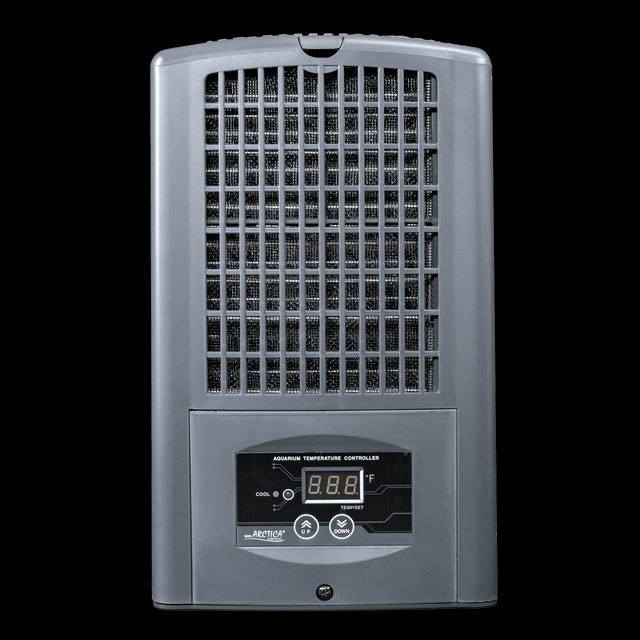
JBJ's current Aquarium Series page identifies model DBA-075 as a 115V, 1/10 HP Arctica chiller with a titanium heat exchanger, 240–960 GPH flow range and 3/4-inch, 5/8-inch and 1/2-inch adapters. The current page directs buyers to JBJ's chiller calculator rather than assigning one simplistic gallon rule.
That calculator asks for display tank volume, sump volume, current temperature, desired temperature, lighting watts, return pump watts and powerhead watts. JBJ's Aquarium Series manual separately lists 1,270 BTU/h cooling capacity for DBA-075 at its stated 95°F dry-bulb / 77°F wet-bulb rating condition. Indexed marketplace/catalog evidence maps the JBJ Arctica 1/10 HP variant to Amazon.com ASIN B001EM1E8U. PetGearReport has not measured its pull-down time, noise or electrical consumption.
The best-documented decision path in this shortlist because JBJ provides both exact DBA-075 flow/spec data and a calculator that explicitly includes system volume, temperature target and equipment heat.
Check price on Amazon →#2Best compact compressor option with explicit volume range
Active Aqua AACH10HP 1/10 HP
Best for: 10–40 gallon systems where an explicit manufacturer volume range and lower 132 GPH minimum flow fit the planned loop
What we like
- Hydrofarm publishes a 10–40 gal recommended volume range
- Published flow range is 132–396 GPH
- Rated cooling capacity is 1,020 BTU/h
- Pure titanium evaporator is documented for fresh and salt water
- Exact AACH10HP identity maps to ASIN B07BHHQLKR in indexed marketplace evidence
What we don't
- Recommended volume is still conditional on ambient temperature and the actual heat load
- Pump selection and plumbing remain separate installation decisions
- Indoor-use-only manufacturer boundary limits placement
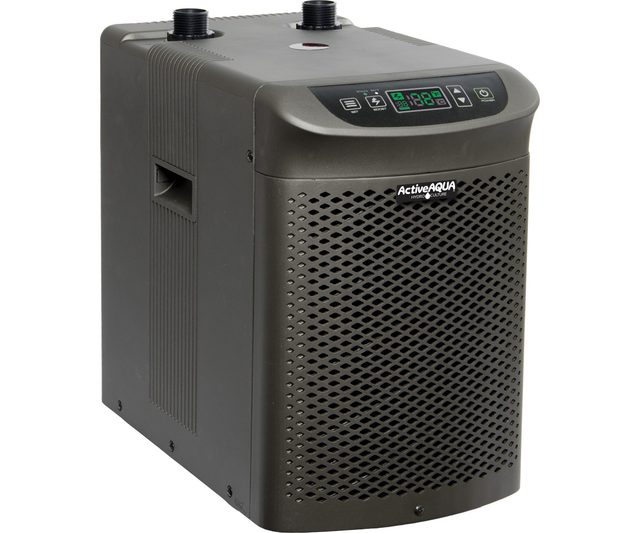
Hydrofarm identifies the Active Aqua AACH10HP as a 1/10 HP chiller for a recommended 10–40 gal / 50–150 L volume, with 132–396 GPH flow, 1,020 BTU/h rated capacity, 190W rated wattage and a pure titanium evaporator. The manufacturer also notes that starting ambient temperature affects initial chilling time and marks the unit for indoor use only.
Those figures are useful screening boundaries, not a promise that every 40-gallon aquarium will reach every target temperature. Heat from lights and pumps, room temperature and the target water temperature still matter. Exact model AACH10HP / UPC 638104022965 reconciles to indexed Amazon.com ASIN B07BHHQLKR.
A compact compressor choice with unusually clear manufacturer boundaries for recommended volume, flow and rated BTU capacity.
Check price on Amazon →#3Best premium low-flow control architecture
TECO TK-500
Best for: systems that benefit from a documented 106–211 GPH chiller loop and buyers who value the current TECO control and service architecture
What we like
- Current TECO line lists TK-500 for systems up to 120 gallons
- Published 106–211 GPH flow range is the narrowest and lowest-flow envelope in this shortlist
- Titanium exchanger, R290 refrigerant and 225W power consumption are currently documented
- Digital controller supports °F/°C display and audible alarms
- Exact TK500 marketplace identity maps to ASIN B091WWDPR8
What we don't
- The up-to-120-gallon headline is not a universal guarantee across heat loads or target temperatures
- Its relatively narrow flow window requires deliberate pump and bypass planning
- Higher acquisition cost should be justified by the control/plumbing fit rather than brand positioning alone
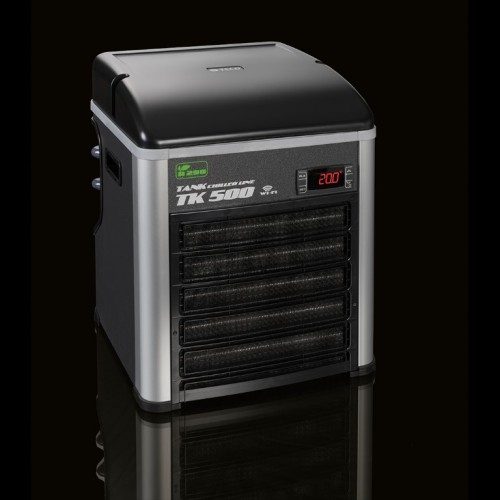
TECO's current TK-500 page lists a 1/6 HP R290 chiller for aquariums up to 120 gallons, with a titanium exchanger, 106–211 GPH flow range, 3/4-inch thread, 5/8-inch barb fitting and 225W power consumption. TECO also publishes a digital thermostat, °F/°C display and audible alarms.
The same page illustrates why the 120-gallon headline needs context: TECO's cooling-performance example is tied to a specific 86°F room, water target and heating load. Treat the gallon figure as a manufacturer screening boundary, then check the installation and heat load. Indexed catalog evidence ties model TK500 to Amazon.com ASIN B091WWDPR8.
The most distinctive premium option here because its low documented flow range and controller architecture solve a different plumbing problem than the higher-flow chillers.
Check price on Amazon →#4Best for a larger documented heat load
Active Aqua AACH25HP 1/4 HP
Best for: 40–92 gallon systems with enough loop flow and a measured or documented cooling demand beyond the smaller 1/10 HP class
What we like
- Hydrofarm publishes a 40–92 gal recommended volume range
- Rated cooling capacity is 3,010 BTU/h
- Published flow range is 396–925 GPH
- Rated electrical input is 460W
- Pure titanium evaporator is documented for fresh and salt water
What we don't
- 396 GPH minimum flow is a significant plumbing requirement
- Pump and hoses are not part of the core chiller specification and must be matched separately
- Larger rated capacity should solve a documented load rather than serve as an automatic upgrade
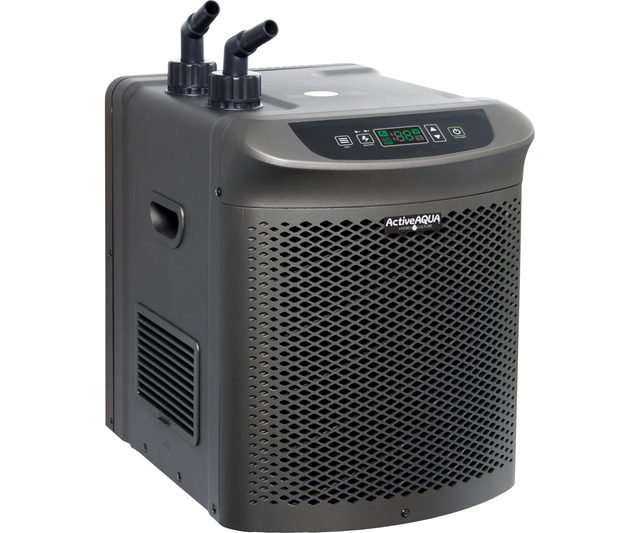
Hydrofarm's current AACH25HP documentation lists a recommended 40–92 gal range, 396–925 GPH flow, 3,010 BTU/h rated cooling capacity, 460W rated input and a pure titanium evaporator for fresh or salt water. The manufacturer again notes that starting ambient temperature affects initial chilling.
Do not treat 1/4 HP as an automatic upgrade for every aquarium. The higher 396 GPH minimum flow and larger capacity need to fit the plumbing and heat load. Exact AACH25HP identity is consistently tied to indexed Amazon.com ASIN B07BHHP71C.
The clearest step-up option when the system needs more published cooling capacity and can support the substantially higher flow requirement.
Check price on Amazon →#5Best pump-included value bundle
VEVOR CL280 52-Gallon 1/10 HP Chiller
Best for: buyers who want a current 52-gallon compressor bundle with pump and fittings and whose target temperature stays inside the documented 65–80°F control range
What we like
- Current VEVOR model CL280 is documented for a recommended maximum cooling-water volume of 52 gallons
- Manufacturer lists a 65–80°F temperature-control range
- Recommended water circulation is at least 1200 L/h
- Pure titanium cooler is documented for freshwater and saltwater use
- Indexed exact-model evidence maps CL280 to ASIN B0FHK638Z7 and includes the SP-2500 pump bundle
What we don't
- The 65°F lower control limit is a hard fit question for colder-target applications
- Manufacturer calls for at least 24 inches / 60 cm of ventilation clearance
- PetGearReport has not verified pump noise, long-term durability or real-world pull-down performance
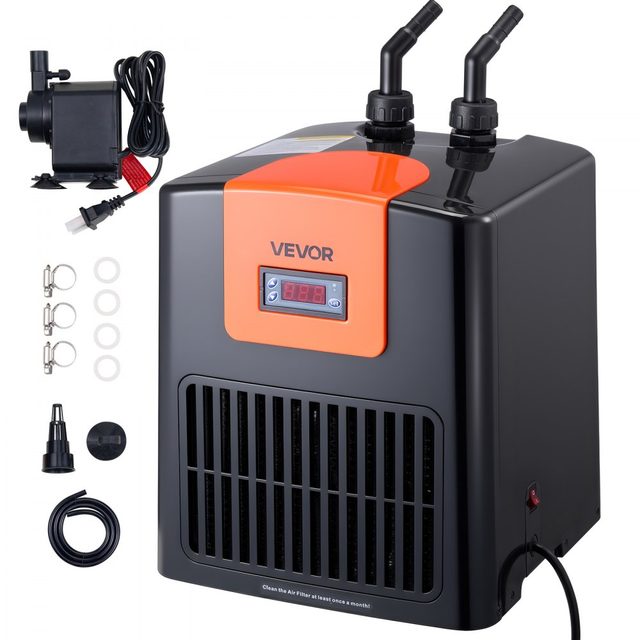
VEVOR's current CL280 page identifies a 1/10 HP R290 compressor chiller with a pure titanium cooler, recommended maximum cooling-water volume of 52 gallons, 65–80°F control range and recommended circulation of at least 1200 L/h. The manufacturer also instructs users to leave at least 24 inches / 60 cm around the chiller for airflow.
Indexed exact-model marketplace evidence maps CL280 to ASIN B0FHK638Z7 and lists a bundle containing the SP-2500 pump, hoses, clamps and fittings. Those package details are useful for identity; PetGearReport does not treat marketplace ratings, price or availability as scoring evidence.
A useful complete-bundle option, but the 65°F lower control limit and ventilation requirement deserve more attention than the headline 52-gallon capacity.
Check price on Amazon →An aquarium chiller is a heat-removal system, not just a box with a horsepower label. The useful question is whether a specific model can remove enough heat from your actual system while staying inside its documented water-flow, plumbing, temperature-control and ventilation boundaries.
That makes chiller selection different from shopping only by nominal tank size. A reef aquarium with high lighting and multiple pumps can add substantial equipment heat. An axolotl tank may need a lower target temperature than a typical tropical community aquarium. A sump adds water volume, and the room itself can be the dominant heat source.
If you do not know the system’s real water volume, start with the aquarium volume calculator. Use an independent aquarium thermometer to verify the water rather than relying only on the chiller’s controller.
How we researched and scored
PetGearReport has not physically tested these chillers, measured aquarium pull-down time, sound level, compressor cycling, long-term reliability, electrical consumption or temperature stability. We compared current manufacturer documentation, exact model identity, published cooling evidence, flow/plumbing requirements, control boundaries, service information and indexed US marketplace identity.
The displayed number is a PetGearReport research score, not a hands-on result, customer rating or laboratory measurement.
- Cooling fit & heat-load evidence — 30% — manufacturer cooling capacity, performance context and whether sizing guidance includes more than tank gallons.
- Flow & plumbing fit — 25% — published minimum/maximum flow, fittings and how clearly the loop can be designed.
- Temperature control & operating boundaries — 20% — set range, controller features, ambient/ventilation limits and other documented constraints.
- Aquarium-use compatibility & serviceability — 15% — heat-exchanger material, fresh/salt support, maintenance access and installation clarity.
- Documentation & exact identity — 10% — current first-party model documentation plus confidence in the exact US Amazon.com variant mapping.
| Chiller | Cooling evidence 30% | Flow/plumbing 25% | Control/boundaries 20% | Aquarium fit 15% | Evidence 10% | Weighted | Score |
|---|---|---|---|---|---|---|---|
| JBJ Arctica DBA-075 | 10 | 9 | 9 | 9 | 9 | 9.35 | 9/10 |
| Active Aqua AACH10HP | 9 | 9 | 8 | 9 | 10 | 8.90 | 9/10 |
| TECO TK-500 | 8 | 9 | 9 | 9 | 9 | 8.70 | 9/10 |
| Active Aqua AACH25HP | 9 | 8 | 8 | 9 | 10 | 8.55 | 8/10 |
| VEVOR CL280 | 7 | 7 | 6 | 8 | 9 | 7.15 | 7/10 |
The weighted decimals make the method auditable; they do not imply laboratory precision. Current Amazon price, stock, ratings and review counts are intentionally excluded.
Quick comparison: choose by the whole cooling loop
| Model | Manufacturer size guidance | Published flow | Cooling/control evidence | Decision boundary |
|---|---|---|---|---|
| JBJ Arctica DBA-075 | Use JBJ chiller calculator | 240–960 GPH | 1,270 BTU/h at manual rating condition | Strong documentation; needs at least 240 GPH |
| Active Aqua AACH10HP | 10–40 gal | 132–396 GPH | 1,020 BTU/h | Compact compressor range; indoor only |
| TECO TK-500 | Up to 120 gallons | 106–211 GPH | 225W input; manufacturer publishes load-specific performance example | Narrow low-flow loop; gallon ceiling needs load context |
| Active Aqua AACH25HP | 40–92 gal | 396–925 GPH | 3,010 BTU/h | Higher heat-removal class with high minimum flow |
| VEVOR CL280 | Up to 52-gallon cooling volume | ≥1200 L/h | 65–80°F control range | Pump bundle; 65°F lower set limit and large ventilation clearance |
The table is a comparison of published boundaries, not a cross-brand performance test. BTU/h numbers should be read with each manufacturer’s conditions rather than treated as perfectly normalized laboratory results.
Why gallons alone are not enough
JBJ’s current chiller calculator makes the missing variables unusually explicit. It asks for display tank volume, sump volume, current temperature, desired temperature, heat from lighting, heat from the return pump and heat from each powerhead.
That is the right mental model. The chiller has to remove heat entering the system, not simply cool a gallon count printed on the aquarium box.
Record at least:
- actual display and sump water volume;
- current peak water temperature without active chilling;
- desired species-appropriate water temperature;
- realistic warm-room temperature;
- lighting wattage and photoperiod;
- return-pump and powerhead heat;
- the candidate chiller’s documented cooling evidence;
- the water flow the plumbing can deliver through the chiller.
Do not convert those inputs into a fake universal horsepower rule. Use the exact manufacturer’s calculator, performance chart or model guidance when available.
Flow rate can eliminate a chiller before cooling capacity does
An inline chiller needs enough water movement through its heat exchanger, but more flow is not automatically better. Each model has a documented operating envelope.
The differences in this shortlist are large: TECO TK-500 publishes 106–211 GPH, Active Aqua AACH10HP 132–396 GPH, JBJ DBA-075 240–960 GPH, and Active Aqua AACH25HP 396–925 GPH. VEVOR specifies at least 1200 L/h for CL280.
That matters for low-flow livestock and quiet systems. You do not have to force the display aquarium itself to experience the chiller’s entire loop flow; a sump, manifold or correctly designed bypass can separate display circulation from equipment-loop requirements. But every added valve, fitting, hose length and vertical lift changes actual pump flow. When the chiller shares a return loop, the return-pump head-loss calculator can estimate the plumbing TDH at a chosen flow without inventing the chiller’s own pressure drop.
If whole-tank circulation is the decision rather than chiller-loop flow, compare the aquarium wavemaker guide. They are different jobs.
Compressor capacity is only useful when the system can reject the heat
A chiller moves heat out of aquarium water and releases it into the surrounding air. Putting a compressor chiller inside a sealed cabinet can make its job harder because the cabinet itself heats up.
Follow each manufacturer’s ventilation instructions. VEVOR currently calls for at least 24 inches / 60 cm of space around CL280. Other models use their own clearance requirements, so do not copy that number across brands.
Think about where the rejected heat goes before choosing the equipment location. A chiller can cool aquarium water while making a small enclosed room warmer.
Axolotl tanks: target temperature comes before product size
Axolotls are one of the strongest reasons people shop for aquarium chillers, but the target temperature must come from husbandry guidance rather than the chiller marketing page.
The MSD Veterinary Manual’s preferred housing table lists 18–20°C / 64–68°F for axolotl (Ambystoma mexicanum). That does not mean every home aquarium must be run at one exact number, and it is not a substitute for veterinary care when an animal is ill.
It does create an important product boundary: VEVOR documents CL280’s control range as 65–80°F, so a desired 64°F set point falls below that published control range. Other chillers need their own exact set-point limits checked before purchase.
For the separate filtration problem, see our best aquarium filters for axolotls. Low-flow livestock requirements and chiller-loop flow should be engineered together rather than treated as competing rules.
Reef tanks: lighting and pump heat belong in the sizing calculation
Reef systems can combine warm rooms with high-output lighting, return pumps, circulation pumps and other equipment. Those heat inputs are exactly why JBJ’s calculator asks about lighting, return-pump and powerhead wattage. If the return pump is still being selected, our aquarium return pump guide keeps delivered flow, head height and plumbing restriction separate from the chiller’s own flow window.
If you are still selecting the lighting system, use the reef aquarium light guide first. The chiller should solve the resulting heat load, not become a substitute for understanding how much equipment heat the system is adding.
A titanium exchanger is common among the chillers in this shortlist and is documented for fresh/salt applications by the relevant manufacturers. That compatibility still does not make the models interchangeable because their flow, control and cooling boundaries differ.
Compressor chiller vs thermoelectric chiller vs evaporative fan
Compressor chillers use a refrigeration cycle and are the main architecture represented in the ranked products above. They can address larger or more persistent cooling loads, but they add plumbing, compressor noise, electrical demand and room heat.
Thermoelectric chillers use solid-state cooling and can be attractive for small systems with modest temperature drops. JBJ’s current Nano E-Chiller line is an example: model DBI-020 is documented for up to 20 gallons with a 9–11°F / 5–6°C cooling-capacity claim and 118 GPH maximum pump output.
DBI-020 is not ranked here because we could not establish a sufficiently strong exact Amazon.com identity for the current model under the same evidence standard as the five ranked variants. We excluded it rather than assign a speculative affiliate ASIN.
Evaporative fans can lower water temperature by increasing evaporation. They avoid a refrigeration loop but consume more top-off water and their effectiveness depends strongly on room humidity, airflow and the required temperature drop.
Operating cost: calculate from published input, not from horsepower
Horsepower labels do not tell you the exact electricity bill. When a manufacturer publishes electrical input, use that value with the actual compressor runtime and your electricity tariff.
A simple estimate is:
monthly energy (kWh) = rated input (kW) × average compressor hours per day × days
For example, TECO currently lists TK-500 at 225W input and Hydrofarm lists AACH25HP at 460W. That does not mean either compressor will run continuously, and PetGearReport has not measured their duty cycles. Room temperature, equipment heat, set point, insulation and ventilation all affect runtime.
This is why we do not publish a fixed monthly-cost claim.
Independent temperature verification still matters
The chiller’s controller is part of the control loop. It should not be the only instrument used to verify the aquarium.
Place a separate thermometer where it can provide a meaningful second reading. A material disagreement between the chiller display and an independent thermometer is a troubleshooting signal, not a reason to average the two numbers automatically.
Our aquarium thermometer guide compares external, probe, strip and in-water formats. If your aquarium also needs active heating during colder periods, use the aquarium heater size calculator for the heating side of the temperature-control problem; chiller and heater sizing should remain separate.
Installation checklist before buying
Before ordering a chiller, record:
- System water volume — display plus sump, adjusted for actual filled volume where practical.
- Peak observed water temperature — preferably measured with an independent thermometer.
- Target temperature — based on reliable species/husbandry guidance.
- Room condition — especially the warmest normal ambient temperature.
- Equipment heat — lighting, return pumps and powerheads.
- Required temperature drop — current/peak water temperature versus target.
- Chiller flow window — minimum and maximum through the exact model.
- Pump curve and head loss — expected delivered flow after plumbing losses.
- Hose/barb size — match the exact chiller fittings.
- Ventilation space — enough room to reject heat without recirculating hot exhaust.
- Maintenance access — filters, condenser surfaces and plumbing should remain serviceable.
- Independent monitoring — a separate thermometer and a routine check plan.
A model that fails any hard boundary should be removed from the shortlist before softer features are compared.
Identity verification notes
We use manufacturer documentation for performance and operating claims, and indexed marketplace/catalog evidence only to reconcile the exact US affiliate identity.
- JBJ Arctica DBA-075 / 1/10 HP — current manufacturer model and 1/10 HP identity reconcile to indexed JBJ Arctica 1/10 HP ASIN B001EM1E8U.
- Active Aqua AACH10HP — exact model / UPC 638104022965 reconcile to ASIN B07BHHQLKR.
- TECO TK-500 — exact model TK500 reconciles to ASIN B091WWDPR8.
- Active Aqua AACH25HP — exact model / UPC 638104022972 reconcile to ASIN B07BHHP71C.
- VEVOR CL280 — exact current model reconciles to ASIN B0FHK638Z7, including the indexed SP-2500 pump bundle.
- JBJ Nano E-Chiller DBI-020 — current manufacturer specifications were found, but exact Amazon.com identity evidence was not strong enough for the affiliate standard used here, so it was excluded from the ranked five.
Direct Amazon product-page probing was not used for this publication pass.
Sources and verification
Technical claims prioritize current manufacturer or authoritative husbandry documentation. Marketplace/catalog sources are used only for exact identity reconciliation, not for performance scoring.
- JBJ Aquariums — Arctica Aquarium Series — current DBA-075 model, flow, fittings, heat exchanger and electrical family data.
- JBJ Aquariums — Chiller Calculator — display/sump volume, current/desired temperature, lighting, return-pump and powerhead heat inputs.
- JBJ Aquariums — Arctica Aquarium Series manual — DBA-075 1,270 BTU/h capacity and stated rating condition.
- Hydrofarm — Active Aqua AACH10HP — 10–40 gal range, 132–396 GPH, 1,020 BTU/h, 190W and UPC.
- Hydrofarm — Active Aqua AACH25HP — 40–92 gal range, 396–925 GPH, 3,010 BTU/h, 460W and UPC.
- TECO — TK-500 — current up-to-120-gallon label, 106–211 GPH, 225W, controller, plumbing and cooling-performance context.
- VEVOR — CL280 52-Gallon Aquarium Chiller — CL280 model, 52-gallon maximum cooling-water volume, ≥1200 L/h circulation, 65–80°F range and ventilation guidance.
- JBJ Aquariums — Arctica Nano E-Chiller — current DBI-020 capacity and pump specification; used to document the excluded nano candidate.
- MSD Veterinary Manual — preferred temperature ranges — axolotl preferred housing range of 18–20°C / 64–68°F.
For a complete temperature-control workflow, pair this guide with the aquarium thermometer guide, aquarium heater size calculator and aquarium volume calculator.
Frequently asked questions
What size aquarium chiller do I need?
Start with actual system water volume, the temperature drop you need and the heat entering the aquarium from the room, lighting, pumps and other equipment. Then use the exact manufacturer's cooling and flow guidance. JBJ's own calculator asks for display and sump volume, current and desired temperature, lighting watts, return-pump watts and powerhead watts, which is why PetGearReport does not publish a universal horsepower shortcut.
Can I use an aquarium chiller for an axolotl tank?
A chiller can be appropriate when room conditions otherwise keep the water above the species-appropriate range, but the exact model still has to fit the target temperature and flow. The MSD Veterinary Manual table lists 18–20°C / 64–68°F as a preferred housing range for axolotls; note that some chillers, including the VEVOR CL280, have a documented lower control limit of 65°F.
Do aquarium chillers need a separate pump?
Many inline chillers require water to be pumped through a documented flow range. Some marketplace packages include a pump, while others do not. Match the actual delivered flow after head height and plumbing losses to the chiller's permitted range rather than choosing a pump from its label alone.
Are compressor chillers better than fans?
They solve different cooling loads. Evaporative fans can reduce temperature without a refrigeration loop but increase evaporation and depend strongly on room humidity and airflow. Compressor chillers provide active refrigeration but add plumbing, electrical draw and rejected heat to the room. Choose based on the required temperature drop and system constraints.
Can a chiller replace an aquarium heater?
Not necessarily. A chiller removes heat when the aquarium is too warm; a heater adds heat when it is too cold. Some systems may need only one direction of control, while rooms with large seasonal swings can require a broader temperature-control plan. Use independent temperature monitoring either way.