Best Aquarium Powerheads & Wavemakers: 3 Freshwater Circulation Picks
A circulation pump or powerhead can help redistribute water when a filter return leaves low-movement zones, but more GPH is not automatically better. We researched three exact US-market fixed-flow variants for freshwater use, focusing on flow direction, livestock fit, mounting, maintenance and identity evidence. PetGearReport has not physically tested these pumps, mapped tank velocity or measured installed flow.
| Rank | Product | Score | Best for | Link |
|---|---|---|---|---|
| #1 | SICCE Voyager Nano 2000Best magnetic-mount broad-flow pick | 9 | freshwater tanks within SICCE's documented 120-200 L range where compact magnetic mounting and broad directional circulation matter | Check price → |
| #2 | Fluval CP3 Circulation Pump (Item 14347)Best documented fixed-flow pick | 9 | freshwater aquariums up to Fluval's documented 50-gallon range where directional fixed flow is enough | Check price → |
| #3 | hygger HG021 Mini Wave Maker 530 GPHBest budget directional pick | 8 | freshwater tanks within hygger's current 5-20 gallon manufacturer range where low cost, magnetic mounting and directional circulation fit the livestock | Check price → |
#1 · Our PickBest magnetic-mount broad-flow pick
SICCE Voyager Nano 2000
Best for: freshwater tanks within SICCE's documented 120-200 L range where compact magnetic mounting and broad directional circulation matter
What we like
- Current SICCE US page explicitly supports freshwater use
- 530 GPH maximum flow and a documented 120-200 L freshwater range
- 360-degree support rotation and magnetic mount simplify repositioning
- 3W draw and self-cleaning impeller architecture are documented
- Indexed US catalog evidence maps Voyager Nano 2000 / model SIC548 to ASIN B01E6DH9RI
What we don't
- Fixed-output architecture lacks electronic speed control
- Magnet guidance must be matched to actual glass thickness
- A broad stream can still be excessive if aimed directly at flow-sensitive livestock
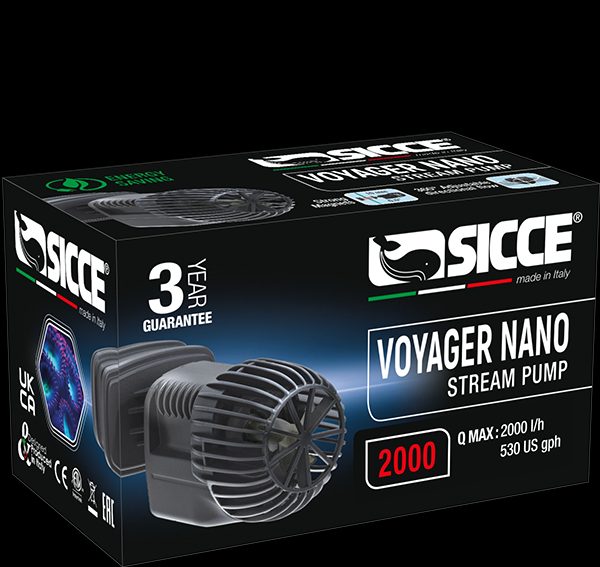
SICCE's current US Voyager Nano page lists the 2000 model at 530 GPH, 3W, 120V/60Hz and 120-200 L for freshwater aquariums, with magnetic support and 360-degree positioning. Indexed catalog evidence maps the US Voyager Nano 2000 / SIC548 family to ASIN B01E6DH9RI. It is still a fixed-output stream pump, so the useful advantage is placement flexibility rather than an assumption that every 35-50 gallon tank needs the full published flow.
The better placement-focused choice when a compact magnetic mount and 360-degree positioning are more useful than higher fixed output.
Check price on Amazon →#2Best documented fixed-flow pick
Fluval CP3 Circulation Pump (Item 14347)
Best for: freshwater aquariums up to Fluval's documented 50-gallon range where directional fixed flow is enough
What we like
- Current Fluval US documentation lists freshwater and saltwater use
- 740 GPH maximum flow with a manufacturer range up to 50 US gallons
- 270-degree directional adjustment helps aim flow around hardscape
- 5W draw and timer compatibility are documented
- Item 14347 and UPC 015561143479 reconcile cleanly to ASIN B009XSGHFW
What we don't
- Fixed-output pump does not provide electronic speed control
- Published tank capacity does not replace livestock-specific current tolerance
- Mounting is less flexible than a strong magnet system
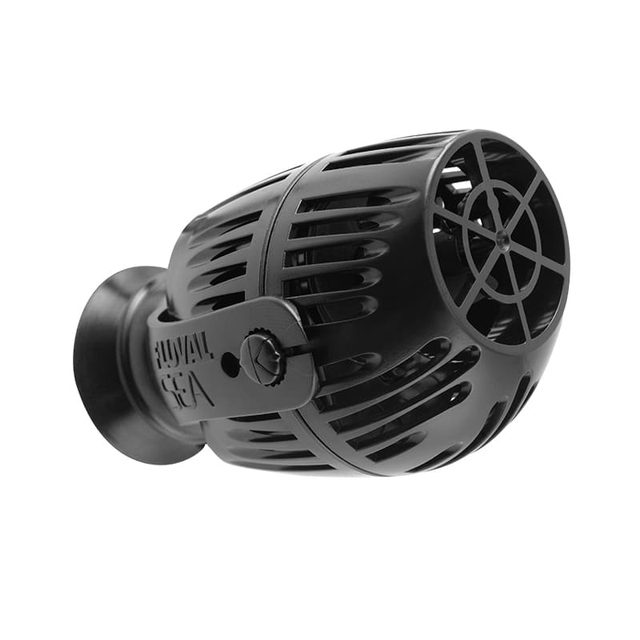
Fluval identifies CP3 as item 14347 / UPC 015561143479, rated up to 50 US gallons with 740 GPH maximum flow, 5W power and 270-degree directional adjustment. Current indexed US catalog evidence maps the same item number and UPC to ASIN B009XSGHFW. The limitation is controllability: this is a fixed-output circulation pump, so placement and livestock tolerance matter more than a headline GPH number.
The strongest evidence-led fixed-flow option here when you want a current Fluval model, clear freshwater documentation and simple directional adjustment.
Check price on Amazon →#3Best budget directional pick
hygger HG021 Mini Wave Maker 530 GPH
Best for: freshwater tanks within hygger's current 5-20 gallon manufacturer range where low cost, magnetic mounting and directional circulation fit the livestock
What we like
- Current hygger documentation identifies HG021 for freshwater and saltwater circulation
- Current 3W model is specified for 5-20 US gallons and 530 GPH
- 360-degree rotatable head and magnetic mount for 4-10 mm tank walls are documented
- Ceramic shaft and disassembly guidance support routine maintenance
- Recent indexed US catalog evidence maps HG021 530 GPH to ASIN B0B51H591W
What we don't
- A second indexed listing exists for the same HG021 family, so identity evidence is less tidy than Fluval's
- No electronic speed controller on this 3W version
- Current indexed marketplace titles may show a broader 15-40 gallon range than hygger's current 5-20 gallon manufacturer table
hygger's current HG021 page documents the 3W / 530 GPH version for 5-20 US gallon tanks, with 360-degree direction, magnetic attachment and freshwater use. Multiple recent indexed US catalog sources map model HG021 to ASIN B0B51H591W, which is the variant used here. Because a second indexed ASIN also appears for the same family, PetGearReport treats the identity evidence as less clean rather than pretending the duplicate does not exist.
A practical lower-cost option, but we score identity evidence more conservatively because duplicate indexed listings exist for the HG021 family.
Check price on Amazon →A wavemaker is useful only when it fixes a real circulation problem. In freshwater aquariums, that usually means helping the filter return move water around wood, rocks, dense plants or long tank dimensions—not recreating a reef-style surge for its own sake.
That distinction matters because filter flow, circulation-pump flow and air delivery are different things. A circulation pump can redistribute water, but it does not replace the mechanical and biological filtration performed by a proper filter. If the system uses a sump, our aquarium return pump guide covers the separate job of moving water through vertical head and return plumbing.
Powerhead, circulation pump or wavemaker: what this guide actually compares
Retail listings use these terms loosely. For this freshwater guide, a powerhead / circulation pump means a submersible pump used to add directional or broad in-tank water movement. A programmable wavemaker adds variable-speed, pulsing, random-flow or similar controller behavior rather than only fixed continuous output.
All three ranked products here are fixed-output circulation pumps / powerheads. The hygger product is marketed as a Wave Maker, but the 3W HG021 version in this shortlist is still a fixed-output 530 GPH pump with directional adjustment rather than a programmable speed controller. SICCE Voyager Nano 2000 and Fluval CP3 are likewise fixed-output circulation/stream pumps. In the scoring, none is scored as if it provides programmable pulse, random-flow or feed-mode control.
If programmable pulsing or variable-speed modes are the requirement, these three are the wrong shortlist. This page is for supplemental freshwater circulation where placement, direction and livestock tolerance matter more than creating a reef-style changing flow pattern.
Quick decision: choose by placement and control, not headline GPH
| Pump | Published flow | Control architecture | Best when | Avoid if |
|---|---|---|---|---|
| SICCE Voyager Nano 2000 | 530 GPH | Fixed output; 360-degree magnetic positioning | You need compact broad-flow placement flexibility inside SICCE’s documented freshwater range | You need electronic speed control or pulse modes rather than placement-based tuning |
| Fluval CP3 | 740 GPH | Fixed output; 270-degree directional adjustment | You want the highest published fixed flow here with current Fluval freshwater documentation and simple aiming | The livestock needs lower output or you need electronic variable-speed control |
| hygger HG021 3W | 530 GPH | Fixed output; magnetic 360-degree aiming | You want a lower-cost magnetic powerhead inside the 5–20 US gallon manufacturer range | You need programmable wavemaker behavior or a manufacturer range beyond the 3W model’s current 5–20 gallons |
The table is not a GPH leaderboard. It separates fixed-flow placement choices from controller-driven wavemaker features that these exact three products do not provide.
How we researched and scored
PetGearReport has not physically tested these pumps, measured installed velocity, mapped dead spots with dye, measured noise or quantified debris transport. We compared current manufacturer documentation, exact US-market identity evidence and the operational trade-offs of each design. The published numbers are PetGearReport research scores—editorial assessments, not hands-on test results, Amazon ratings or laboratory measurements.
- Flow architecture & adjustability — 30% — fixed versus adjustable output, stream shape and directional control.
- Freshwater & use-case fit — 25% — documented freshwater support plus how clearly the product fits realistic supplemental-circulation jobs.
- Placement & mounting flexibility — 20% — aiming range, mount architecture and glass-thickness constraints where documented.
- Maintenance & power architecture — 15% — disassembly, impeller access, power draw and timer/controller compatibility.
- Documentation & exact identity — 10% — quality of current manufacturer material plus confidence in the exact US ASIN mapping.
| Pump | Flow 30% | Freshwater fit 25% | Placement 20% | Maintenance/power 15% | Evidence 10% | Weighted | Published score |
|---|---|---|---|---|---|---|---|
| SICCE Voyager Nano 2000 | 8 | 10 | 10 | 9 | 9 | 9.15 | 9/10 |
| Fluval CP3 | 8 | 10 | 8 | 8 | 10 | 8.70 | 9/10 |
| hygger HG021 530 GPH | 8 | 9 | 9 | 8 | 8 | 8.45 | 8/10 |
The decimals keep the weighting auditable; they do not imply real-world measurement precision. Published rank follows the weighted result, while the rounded scores do not claim measurable superiority in every aquarium.
Start with the filter return, not a turnover formula
Before adding another pump, look at what the existing filter outlet already does. A canister spray bar, HOB waterfall, lily pipe or directional return can create very different circulation patterns even when their published hydraulic numbers look similar.
There is no universal turnover target in this guide. A long planted aquarium with wood and dense stems can need different placement from an open cichlid layout at the same nominal volume. Use the aquarium filter size guide to keep manufacturer tank ranges and hydraulic labels in context, and the best aquarium canister filters guide when the complete filtration system is still the main decision.
A circulation pump should complement the filter outlet, not mask a filter that is undersized, clogged or badly positioned.
Match current to the livestock, not just the tank size
Manufacturer gallon ranges are useful screening tools, not permission to expose every fish to the full stream. Bettas, long-finned fish, shrimp, fry and some discus setups can react very differently to localized current than active riverine fish or many cichlid communities.
For planted displays, the goal is usually circulation through and around the aquascape without pinning leaves sideways or scouring substrate. Our planted-tank filter guide covers the filtration side of that decision. If the aquarium is cichlid-focused, the cichlid filter guide keeps media capacity, maintenance and return control separate from supplemental circulation.
If fish repeatedly avoid one area, struggle against the stream or hold fins abnormally after the pump is added, reposition or reduce the circulation rather than assuming more movement is automatically beneficial.
Placement can matter more than the headline GPH
A fixed-output pump is tuned mostly by where it sits and where it points. Aim across the long dimension or around a hardscape barrier when that helps complete a circulation loop; avoid firing a concentrated stream directly into livestock resting zones or delicate plants.
Fluval CP3 provides 270-degree directional adjustment. SICCE Voyager Nano uses a 360-degree support and magnetic mount, while hygger HG021 combines a magnetic base with a 360-degree rotatable head. Those differences matter because a pump you can place correctly may solve a dead spot with less total output than a poorly aimed higher-flow model.
After installation, observe the whole aquarium over several feeding and maintenance cycles. Debris that still settles in one sheltered pocket can reveal a low-movement zone, but visible debris alone is not proof that the aquarium needs a larger pump.
Circulation is not filtration or aeration
A wavemaker does not replace filter media. Mechanical filtration captures suspended debris, while established biological media supports the nitrogen cycle. A circulation pump can help carry suspended material toward an intake, but it does not remove or biologically process that material by itself.
If the problem is a persistent slick or biofilm specifically at the air-water interface, use the aquarium surface film troubleshooting guide before adding whole-tank flow. It separates filter-return adjustment, aeration, circulation and direct surface-skimming jobs. When direct collection is the actual need, the aquarium surface skimmer guide compares standalone and filter-attached options instead of adding more whole-tank flow.
It is also different from an air pump. An aquarium air pump moves air through airline to devices such as air stones or sponge filters; the bubbles and rising water then contribute to surface agitation and circulation. Choose the hardware based on the actual job instead of treating every GPH or airflow number as interchangeable.
Maintenance and power still matter
Propeller pumps work in the same water that carries algae, biofilm, plant fragments and fine debris. Follow the manufacturer cleaning instructions, inspect the guard and impeller area, and never run a submersible unit dry unless its documentation explicitly permits it.
Low wattage is useful for equipment that may run continuously, but power draw is not a performance score. A 3W pump that is badly aimed can be less useful than a 5W pump placed correctly. Timer compatibility also does not mean rapid on/off cycling is appropriate unless the manufacturer supports that operating pattern.
Identity verification notes
We deliberately stopped at three products. The current TUNZE 6040.005 HUB Edition has strong manufacturer documentation, but the indexed US Amazon identity available in this publication pass was not strong enough for the same exact-variant standard. Hydor’s current Koralia Nano family is active, but its current global SKU structure does not reconcile cleanly enough with the older US P29201 / 425 GPH Amazon mapping for a new evergreen recommendation.
The hygger HG021 family has duplicate indexed US listings. We use B0B51H591W because multiple recent US catalog trackers map that ASIN directly to model HG021 and the 530 GPH configuration. Hygger’s current manufacturer table specifies 5-20 US gallons for the 3W model, while indexed marketplace titles may still say 15-40 gallons; this guide uses the manufacturer range. The conflicting duplicate ASIN is excluded rather than treated as interchangeable.
Direct Amazon product-page responses were not used as identity evidence in this publication pass.
Sources and verification
Technical claims are based primarily on current manufacturer documentation; indexed marketplace/catalog evidence is used only to reconcile the exact US affiliate variant.
- Fluval — CP3 Circulation Pump — item 14347, UPC 015561143479, 740 GPH, 5W, freshwater/saltwater use and 270-degree direction.
- SICCE US — Voyager Nano — Voyager Nano 2000 freshwater range, 530 GPH, 3W, magnetic support and 360-degree positioning.
- hygger — HG021 Mini Wave Maker — current HG021 architecture, 530 GPH 3W version, magnetic mounting and 360-degree direction.
- Current indexed US catalog evidence maps Fluval item 14347 to B009XSGHFW, SICCE Voyager Nano 2000 to B01E6DH9RI and hygger HG021 530 GPH to B0B51H591W.
No Amazon price, stock or availability claim is made here. Those can change independently of product identity.
Frequently asked questions
Does every freshwater aquarium need a wavemaker?
No. Many aquariums get adequate circulation from the filter return alone. Add a circulation pump only when the actual layout leaves persistent low-movement zones or when the livestock benefits from more current.
How many GPH should a freshwater wavemaker have?
There is no universal GPH-per-gallon rule that fits every aquarium. Tank dimensions, filter-return direction, hardscape, plant mass and livestock flow tolerance all change the useful amount and direction of circulation.
Can a wavemaker replace an aquarium filter?
No. A circulation pump moves water but does not provide the mechanical and biological media functions of a complete aquarium filter. Use it as supplemental circulation where the tank actually needs it.
Where should I place a circulation pump in a freshwater tank?
Place it so the stream works with the filter outlet and tank geometry rather than firing directly at fish or delicate plants. Watch the whole tank for persistent debris pockets, excessive plant movement and livestock avoidance, then adjust direction.
Is a wavemaker the same as an air pump?
No. A wavemaker or circulation pump directly moves aquarium water. An air pump moves air through airline and equipment such as an air stone or sponge filter; the rising bubbles then create water movement and surface agitation.