Best Aquarium Filters for Cichlids: 5 Picks for Media Capacity & Maintenance
Medium and large cichlid aquariums can combine substantial feeding, digging and territorial layouts with a wide range of water movement needs. We researched five exact filter variants by mechanical and biological media architecture, documented tank fit, maintenance access, return control and exact Amazon.com identity. PetGearReport has not physically tested these filters, measured installed flow, debris capture, noise or long-term durability.
| Rank | Product | Score | Best for | Link |
|---|---|---|---|---|
| #1 | Fluval FX2 High Performance Canister FilterBest overall for larger cichlid tanks | 9 | larger medium-to-high-bioload cichlid systems where canister media capacity and separate intake/return placement solve a real need | Check price → |
| #2 | Seachem Tidal 110 Power FilterBest HOB for accessible media service | 9 | 55–110 gallon cichlid aquariums that benefit from large open-basket HOB media and quick top-access maintenance | Check price → |
| #3 | Fluval 407 Performance Canister FilterBest documented 55–100 gallon canister | 9 | 55–100 gallon cichlid systems that want a compact canister with clear hydraulic documentation and structured media staging | Check price → |
| #4 | OASE BioMaster 2 600 Canister FilterBest maintenance-first large canister | 9 | larger cichlid displays where frequent mechanical pre-filter service and configurable canister media are high priorities | Check price → |
| #5 | Fluval FX4 High Performance Canister FilterBest high-capacity large-system option | 9 | large cichlid aquariums that genuinely need the FX4 media envelope, multiple return-positioning options and 250-gallon manufacturer capacity | Check price → |
#1 · Our PickBest overall for larger cichlid tanks
Fluval FX2 High Performance Canister Filter
Best for: larger medium-to-high-bioload cichlid systems where canister media capacity and separate intake/return placement solve a real need
What we like
- Fluval documents use up to 175 US gallons
- 10.6 L canister volume and 3.9 L biological volume provide substantial media capacity
- 475 GPH Pump Output and 343 GPH Filter Circulation are published separately
- Multiple media stages suit debris-heavy systems
- Exact Amazon.com identity already verified across current PetGearReport guides
What we don't
- Large footprint and hoses require suitable cabinet space
- More capacity is unnecessary when a smaller filter already fits the tank and waste load
- Pump Output must not be treated as installed Filter Circulation
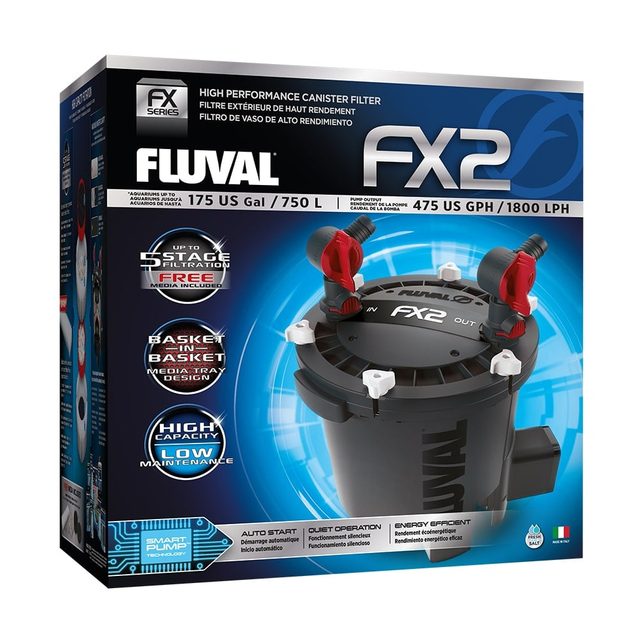
Fluval documents FX2 for aquariums up to 175 US gallons, with 475 GPH Pump Output, 343 GPH Filter Circulation, 10.6 L canister volume and 3.9 L biological volume. For medium and large cichlid tanks, that combination gives useful media headroom for systems where feeding and digging create significant mechanical debris. The value is the media platform and documented hydraulic envelope—not the biggest number by itself.
The strongest all-round larger-system pick when extra media and canister placement are genuinely useful rather than simply oversized.
Check price on Amazon →#2Best HOB for accessible media service
Seachem Tidal 110 Power Filter
Best for: 55–110 gallon cichlid aquariums that benefit from large open-basket HOB media and quick top-access maintenance
What we like
- Seachem documents use for aquariums up to 110 US gallons
- 450 GPH Flow Rate with broad output regulation
- 3.2 L reusable basket accepts configurable media
- Top-access basket makes frequent mechanical service straightforward
- Exact Amazon.com identity already verified in PetGearReport's 90-gallon and discus guides
What we don't
- Not a standalone fit above its 110-gallon manufacturer ceiling
- Rim and rear clearance are required
- 450 GPH Flow Rate is not directly comparable with Fluval Filter Circulation
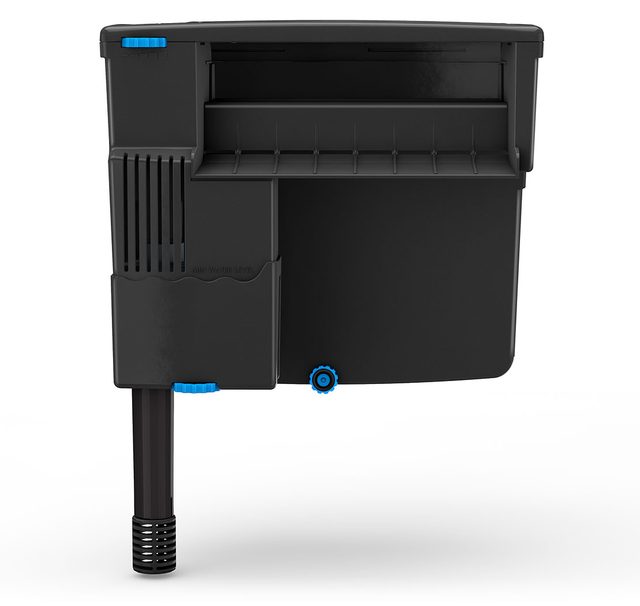
Seachem rates Tidal 110 for aquariums up to 110 US gallons and publishes 450 US GPH as Flow Rate, with a 3.2 L filter basket, flow regulation and intake-flow regulation. That makes it especially useful where frequent mechanical-media inspection matters and a rim-mounted filter physically fits the tank.
The service-first HOB choice when you want substantial reusable media without canister hoses or cabinet access.
Check price on Amazon →#3Best documented 55–100 gallon canister
Fluval 407 Performance Canister Filter
Best for: 55–100 gallon cichlid systems that want a compact canister with clear hydraulic documentation and structured media staging
What we like
- Fluval documents a 50–100 US gallon aquarium range
- 383 GPH Pump Output and 245 GPH Filter Circulation are published separately
- 6.0 L total chamber with 4.2 L basket volume
- Vertical pre-filter adds dedicated mechanical area
- Exact Amazon.com identity already verified in current PetGearReport guides
What we don't
- Not a standalone manufacturer-range fit above 100 gallons
- Less total media volume than the FX platform
- Canister service is more involved than lifting a HOB basket
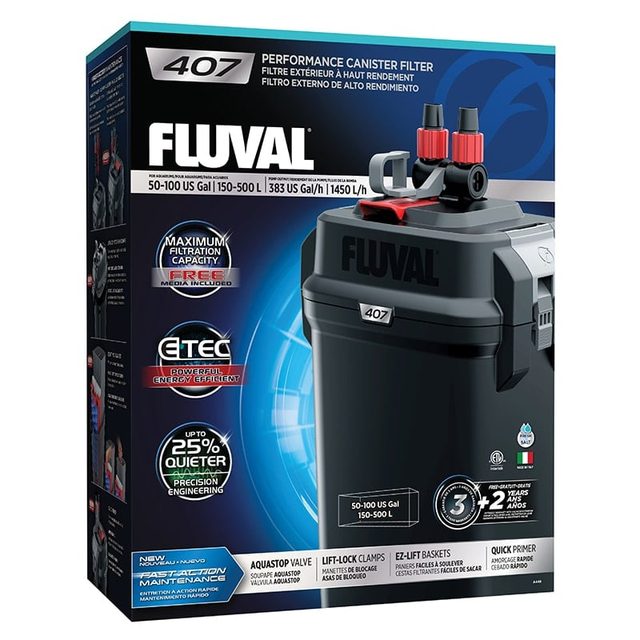
Fluval rates the 407 for 50–100 US gallons and separates 383 GPH Pump Output from 245 GPH Filter Circulation. It lists 4.2 L basket volume, 6.0 L total chamber volume and a 1074 cm² vertical pre-filter. Those specifications make it a clean fit for many 55–90 gallon cichlid setups without pretending it remains a standalone option at 125 gallons.
A strong mid-size canister when the aquarium sits inside its published range and the larger FX footprint is unnecessary.
Check price on Amazon →#4Best maintenance-first large canister
OASE BioMaster 2 600 Canister Filter
Best for: larger cichlid displays where frequent mechanical pre-filter service and configurable canister media are high priorities
What we like
- OASE documents a large-system BioMaster 2 platform with high filter volume
- EasyClean pre-filter can be serviced separately
- 6.8 L filter volume plus a 0.60 L removable pre-filter
- Modular spray bar includes flow-control hardware
- Exact Amazon.com identity already verified in current PetGearReport guides
What we don't
- Larger canister and plumbing require suitable cabinet/service space
- 345 GPH Max. gallons per hour is an OASE-specific label
- The platform is excessive when a smaller model already covers the aquarium and waste load
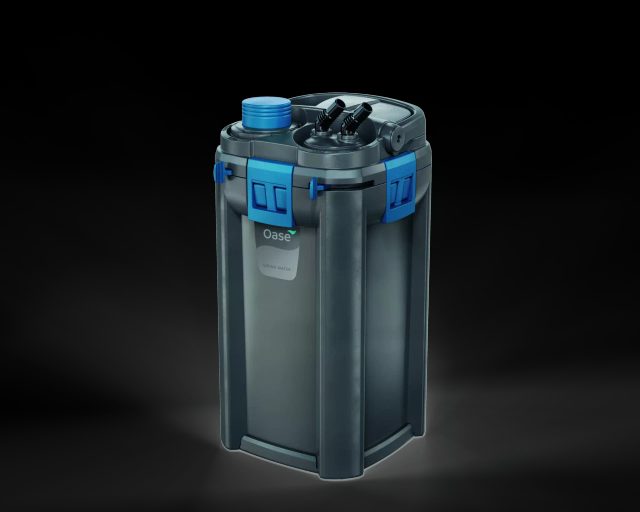
OASE documents BioMaster 2 600 with an EasyClean pre-filter, Hel-X biological media, filter sponges and a modular spray bar with flow-control attachment. Current model documentation lists 6.8 L filter volume and a separate 0.60 L pre-filter, making serviceability—not raw maximum flow—the main reason to choose it for a larger cichlid system.
The maintenance-first large-canister choice when a removable pre-filter meaningfully reduces the friction of frequent debris service.
Check price on Amazon →#5Best high-capacity large-system option
Fluval FX4 High Performance Canister Filter
Best for: large cichlid aquariums that genuinely need the FX4 media envelope, multiple return-positioning options and 250-gallon manufacturer capacity
What we like
- Fluval documents use up to 250 US gallons
- 14 L canister volume provides substantial media capacity
- 700 GPH Pump Output and 450 GPH Filter Circulation are published separately
- 217 in² mechanical foam area supports heavy debris capture
- Exact Amazon.com identity already verified in current PetGearReport guides
What we don't
- Size and capacity are unnecessary for many 55–90 gallon cichlid tanks
- Wide FX footprint and hose routing need cabinet space
- Higher Filter Circulation is not automatically a better livestock fit
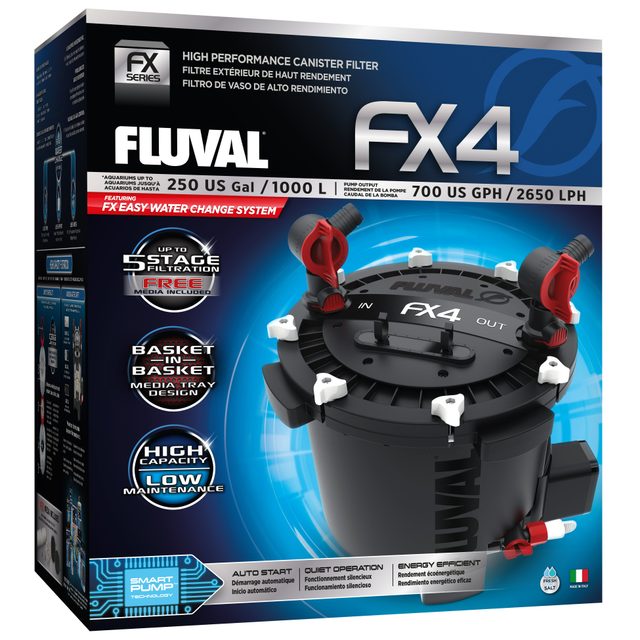
Fluval documents FX4 for aquariums up to 250 US gallons, with 700 GPH Pump Output, 450 GPH Filter Circulation and 14 L canister volume. That makes it relevant where aquarium size, waste load and media requirements justify the larger platform. It should not displace a smaller correctly sized filter solely because its specifications are bigger.
A high-capacity option for genuinely large systems, not an automatic upgrade merely because its gallon and flow figures are larger.
Check price on Amazon →This guide is intentionally narrower than “all cichlids.” It targets medium and large cichlid aquariums, especially African Rift Lake communities and larger New World species where feeding load, digging and territorial hardscape can make debris handling and serviceability important.
Current Aqueon care guidance recommends an aquarium of at least 55 gallons for most Rift Lake cichlids and says to maintain good filtration. Its New World cichlid guide notes that many larger species can be messy eaters and says a high-capacity filter is recommended. That is useful husbandry context, but it does not turn one filter size or one cross-brand GPH multiplier into a rule for every cichlid. Aqueon — African Rift Lake cichlids · Aqueon — New World cichlids
If you have discus, use the discus filter guide instead because gentle localized current materially changes the ranking. Dwarf cichlid setups also fall outside this page’s main scope; their smaller tanks and species-specific habitat needs should not inherit a large-system recommendation by default.
Cichlid filtration workload map: husbandry signal → filter feature
Primary sources rechecked September 23, 2026. A cichlid husbandry signal is not a universal flow target. The useful translation is from the actual fish, feeding/debris pattern and aquarium size to the filter features that make routine waste removal and biofilter maintenance practical.
| System scope | Current husbandry signal | What it changes in the filter decision |
|---|---|---|
| Most Rift Lake cichlids | Aqueon recommends at least 55 gallons for most Rift Lake cichlids and emphasizes good filtration; many species also dig and move substrate | Start with an exact tank-size fit, then value accessible mechanical capture, stable biological media and a return pattern that does not undermine the species/layout |
| Larger New World cichlids | Aqueon notes that many larger species are messy eaters and says a high-capacity filter is recommended | Media capacity and frequent debris service become especially relevant; do not substitute raw motor output for a maintainable media path |
| New World flow context | Aqueon’s habitat summary spans fast-flowing streams through quiet rivers, lakes, backwaters and swamps | There is no family-wide current requirement; output control and return placement matter alongside media capacity |
| Discus | Warm-water and localized gentle-current constraints materially change the shortlist | Discus remain outside this ranking; use the discus filter guide |
| Dwarf cichlids | Smaller species/tanks can have very different habitat and current requirements from the medium/large systems here | Dwarf cichlids remain outside this large-system ranking rather than inheriting an FX/Tidal recommendation by default |
The first two rows explain why this guide focuses on mechanical capture area, pre-filter access, biological-media capacity, realistic service interval, and controllable return placement. A high-capacity system still has to be serviceable enough that the owner actually keeps debris from restricting its media path.
What the five ranked filters document
The numbers below stay attached to each manufacturer’s own terminology. They are evidence for capacity and service architecture, not a cross-brand speed contest.
| Ranked filter | Manufacturer capacity / media evidence | Hydraulic/control evidence | Maintenance implication |
|---|---|---|---|
| Fluval FX2 | 10.6 L canister volume and 3.9 L biological volume | 475 US GPH Pump Output; 343 US GPH Filter Circulation; multi-directional twin output nozzles | Large media platform with adjustable return direction; external canister service |
| Seachem Tidal 110 | 3.2 L filter volume and an open top-access basket | 450 US GPH Flow Rate at full flow; Seachem says the same model can be regulated down to 90 US GPH | Fast basket access is useful when mechanical media needs frequent inspection/cleaning |
| Fluval 407 | 4.2 L basket volume and 6.0 L total chamber volume | 383 US GPH Pump Output; 245 US GPH Filter Circulation | Structured canister stages plus a vertical pre-filter, with more involved below-tank service |
| OASE BioMaster 2 600 | 6.8 L filter volume plus a removable 0.60 L pre-filter | 345 US GPH Max. gallons per hour on the current U.S. model; modular spray bar includes flow-control hardware | EasyClean pre-filter lets coarse debris service happen without opening the full canister each time |
| Fluval FX4 | 14 L canister volume and 3.9 L biological volume | 700 US GPH Pump Output; 450 US GPH Filter Circulation; multi-directional output | More physical/media headroom than FX2, but that extra capacity should solve a real tank/waste requirement |
These specifications are deliberately label-preserving: do not rank unlike hydraulic labels as one GPH leaderboard. Seachem Flow Rate, Fluval Pump Output, Fluval Filter Circulation, and OASE Max. gallons per hour are not one standardized measurement.
Maintenance capacity is not motor capacity
For debris-producing systems, use a maintenance-first sequence:
- Make sure the exact manufacturer aquarium range covers the tank.
- Look at the mechanical path: sponge/pre-filter area, basket layout and how easily trapped solids can be removed.
- Check biological-media capacity without treating more liters as automatically better if the tank does not need the larger platform.
- Decide whether the service interval you can realistically maintain matches the filter architecture and cabinet/rim access.
- Match return placement and controllability to the actual species, rockwork and sheltered areas.
- Use the manufacturer’s hydraulic label only in the context in which it was published.
A larger motor number cannot compensate for clogged mechanical media. A filter that is easier to inspect and clean on the real aquarium can be the stronger system even when another model publishes a larger pump figure.
How we researched and scored
PetGearReport has not physically tested these filters. This is a research-based comparison built from current manufacturer documentation, current cichlid-care guidance and exact product-identity evidence already present in our production affiliate inventory. The scores are PetGearReport research scores—editorial assessments of documented fit and trade-offs, not hands-on measurements, laboratory results, customer ratings or Amazon ratings.
We applied the same five weighted categories to every product:
- Media / waste-handling architecture — 30% — documented mechanical stages, biological-media capacity and ability to manage debris without treating motor size as the whole filter.
- Tank fit — 25% — whether the exact manufacturer aquarium range cleanly covers the intended medium/large cichlid use case.
- Maintenance — 20% — practical access to pre-filters, baskets, valves and other service points likely to matter in debris-producing systems.
- Flow & placement control — 15% — documented output regulation or intake/return placement options that help match the actual species and layout.
- Evidence & exact identity — 10% — quality of current manufacturer documentation plus exact Amazon.com variant evidence already verified by PetGearReport. | Filter | Media / waste (30%) | Tank fit (25%) | Maintenance (20%) | Flow / placement (15%) | Evidence (10%) | Weighted | Published score | | — | —: | —: | —: | —: | —: | —: | —: | | Fluval FX2 | 10 | 9 | 9 | 8 | 10 | 9.25 | 9/10 | | Seachem Tidal 110 | 8 | 9 | 10 | 10 | 10 | 9.15 | 9/10 | | Fluval 407 | 8 | 10 | 9 | 8 | 10 | 8.90 | 9/10 | | OASE BioMaster 2 600 | 10 | 7 | 10 | 7 | 10 | 8.80 | 9/10 | | Fluval FX4 | 10 | 7 | 8 | 8 | 10 | 8.55 | 9/10 |
The decimals make the weighting auditable; they do not imply laboratory precision. Rank order is decision-focused, and pricing, temporary marketplace status and customer-star ratings are excluded.
Media capacity matters more than a bigger motor number
Cichlid filtration is often discussed as if the only goal were maximum flow. For the setups covered here, the more useful question is whether the filter gives mechanical debris enough capture area, preserves useful biological media, and can be serviced often enough to keep that media path open.
Aqueon’s Rift Lake guidance specifically notes that many species dig and stir debris. Its New World guidance separately points out that larger fish can be messy eaters. Those are reasons to value mechanical stages and service access—not reasons to assume the highest published GPH figure is automatically the best filter.
Use the aquarium filter media guide to separate mechanical, biological and optional chemical stages. If biological-media selection itself is the decision, the best biological filter media guide compares current loose-media options by physical fit and maintenance rather than marketing surface-area claims alone.
Keep Flow Rate, Pump Output and Filter Circulation separate
These five products do not publish one standardized hydraulic number. Seachem labels Tidal 110 at 450 US GPH Flow Rate. Fluval publishes both Pump Output and Filter Circulation for the 407, FX2 and FX4. OASE uses its own Max. gallons per hour label for BioMaster models.
Do not flatten those labels into one cross-brand leaderboard. Use the aquarium filter size guide and filter sizing & flow calculator to preserve the manufacturer’s label, tank range and actual setup context while comparing models.
Cichlids themselves also span very different habitats. Aqueon’s New World guide describes environments ranging from fast-flowing streams to quiet rivers, lakes, backwaters and swamps. That diversity is another reason this page does not turn one flow multiplier into a family-wide requirement.
Match architecture to maintenance access
A high-capacity filter only helps if it is serviced often enough to keep water moving through its media. Tidal 110 keeps the basket at the rim, while Fluval and OASE canisters move more of the media below the tank and add hoses, valves and cabinet-access requirements.
That trade-off is why the best aquarium HOB filters and best aquarium canister filters remain useful companion guides. A canister is not automatically superior just because it holds more media, and a HOB is not automatically easier if the tank’s lid, rim or wall clearance makes access awkward.
For routine water-quality checks, use the aquarium water-parameters guide and a suitable aquarium water test kit. The aquarium maintenance schedule gives a repeatable framework for water changes, flow observation and media service without replacing manufacturer-specific instructions.
Start with the aquarium size you actually run
For many Rift Lake setups, 55 gallons is the first relevant general size reference. The 55-gallon filter guide covers the HOB/canister crossover, while the 75-gallon guide and 90-gallon guide cover the next common steps.
At 125 gallons, the shortlist changes because Tidal 110 and Fluval 407 no longer sit inside their standalone manufacturer ranges. Use the 125-gallon filter guide when the tank itself—not species-specific cichlid husbandry—is the primary constraint.
The broader best aquarium filters guide is the right starting point when you have not yet chosen a filter architecture. This page adds the cichlid-specific emphasis on debris handling, media capacity and serviceability.
Which cichlid filter should you choose?
Choose Fluval FX2 when a larger tank genuinely benefits from its 10.6 L canister platform and separate intake/return placement. Choose Tidal 110 when the aquarium is within its 110-gallon ceiling and easy top-access mechanical service matters more than hiding the filter below the tank.
Choose Fluval 407 for a 55–100 gallon system that wants a compact canister and unusually clear separation between Pump Output and Filter Circulation. Choose BioMaster 2 600 when a larger system benefits from a separately serviceable EasyClean pre-filter. Move to FX4 when the aquarium and waste load actually justify the larger 250-gallon platform and 14 L canister volume.
Avoid buying the larger model simply because its package numbers are bigger. A filter outside the tank’s practical size, cabinet geometry or maintenance routine can be a worse system than a smaller correctly matched model.
If filtration is correctly sized but the layout still leaves sheltered low-movement areas, the aquarium wavemaker and circulation pump guide covers supplemental freshwater circulation without treating a higher GPH number as automatically better for cichlids.
Sources and verification notes
Specifications and care claims were checked against current manufacturer documentation before this update. Amazon links use exact variants already marked live with identity verification in PetGearReport’s production inventory; no new Amazon product-page probe was used for this page.
- Cichlid care: Aqueon — African Rift Lake Cichlids and Aqueon — New World Cichlids.
- Seachem Tidal 110: Seachem manufacturer page — up to 110 US gallons, 450 GPH Flow Rate, 3.2 L filter volume, flow regulation and intake-flow regulation.
- Fluval 407: Fluval manufacturer page — 50–100 US gallons, 383 GPH Pump Output, 245 GPH Filter Circulation, 4.2 L basket volume and 6.0 L total chamber volume.
- Fluval FX2 / FX4: Fluval FX2 manufacturer page and Fluval FX4 manufacturer page — manufacturer capacity, Pump Output, Filter Circulation and canister/media specifications.
- OASE BioMaster 2 600: OASE manufacturer page — EasyClean pre-filter architecture, Hel-X media, filter sponges and modular spray bar with flow-control attachment.
Frequently asked questions
What filter is best for a cichlid tank?
There is no one filter for every cichlid. For medium and large setups, start with a model whose manufacturer aquarium range includes the tank, then compare mechanical debris handling, biological-media space, maintenance access and return placement. This guide ranks FX2 first for larger mixed use cases, but a 55–100 gallon system may be better served by Fluval 407 or Tidal 110.
Do cichlids need a high-capacity filter?
Some do. Aqueon's current New World cichlid guidance notes that many larger species are messy eaters and recommends a high-capacity filter. Rift Lake guidance also emphasizes good filtration. That does not make the largest filter automatically correct: manufacturer tank range, species, feeding, layout and maintenance still determine fit.
Is a canister filter better than a HOB for cichlids?
Not automatically. Canisters add external media volume and flexible intake/return placement; a large HOB such as Tidal 110 keeps media easy to reach and avoids cabinet hoses. The better architecture is the one that fits the aquarium, waste load, current needs and maintenance routine.
Is Fluval 407 enough for a 75-gallon cichlid tank?
Fluval documents the 407 for 50–100 US gallons, so 75 gallons sits inside its manufacturer range. Whether it is the best choice still depends on stocking, feeding, debris load, return placement and how often the media is serviced.
Should I use the same filter advice for discus and dwarf cichlids?
No. This page is aimed at medium and large cichlid systems. Discus have their own gentle-current and warm-water constraints, while many dwarf cichlids are kept in much smaller aquariums with different current and habitat needs. Use species-specific guidance instead of treating the family as one filtration use case.