Best Aquarium Filters for Planted Tanks: 5 Picks for Flow, Media & Maintenance
A planted aquarium needs filtration that moves water through useful media without treating one headline GPH number as the whole system. We compared five exact Amazon.com variants already identity-verified in current PetGearReport content, focusing on flow control and distribution, media architecture, maintenance access and how naturally each design fits a planted display. PetGearReport has not physically tested these filters, measured installed circulation, CO₂ retention, nutrient distribution or long-term plant growth with them.
| Rank | Product | Score | Best for | Link |
|---|---|---|---|---|
| #1 | OASE BioMaster 2 350 Canister FilterBest overall | 9 | Medium planted displays where external media capacity, adjustable flow and quick pre-filter servicing matter | Check price → |
| #2 | Fluval 107 Performance Canister FilterBest small planted canister | 9 | Small planted aquariums that want external media and flexible intake/return placement without jumping to a large canister | Check price → |
| #3 | Fluval 307 Performance Canister FilterBest mid-size canister | 9 | Mid-size planted aquariums that need more external media capacity while keeping intake and return placement configurable | Check price → |
| #4 | Fluval AC50 Power FilterBest HOB alternative | 9 | Low-tech planted aquariums where easy top-access maintenance and adjustable HOB flow matter more than hidden plumbing | Check price → |
| #5 | AQUANEAT 3 Pack Bio Sponge Filter (Small)Best nano & shrimp-planted option | 8 | Nano planted shrimp tanks where gentle intake and simple biological filtration matter more than large external media capacity | Check price → |
#1 · Our PickBest overall
OASE BioMaster 2 350 Canister Filter
Best for: Medium planted displays where external media capacity, adjustable flow and quick pre-filter servicing matter
What we like
- Up to 90-gallon manufacturer range
- 5.6 L filter volume plus separate 0.50 L pre-filter
- EasyClean pre-filter can be serviced without opening the main media chamber
- Outlet flow control is documented by OASE
- Exact Amazon.com identity already verified in current PetGearReport content
What we don't
- Large external canister needs cabinet space and hose routing
- 295 GPH is OASE maximum flow, not a Fluval-style Filter Circulation figure
- Premium service architecture is more filter than many nano planted tanks need
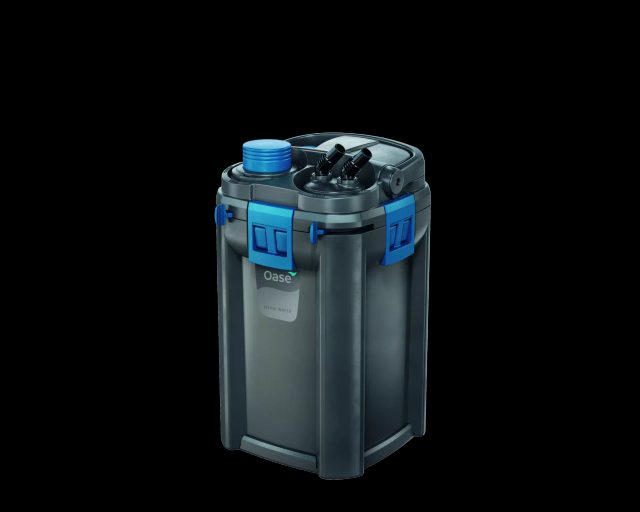
OASE documents the BioMaster 2 350 for aquariums up to 90 gallons, with 295 GPH maximum flow, 5.6 L of filter volume and a separate 0.50 L pre-filter. The EasyClean module lets the pre-filter be removed for routine debris service without dismantling the main filter body.
For a planted display, that separation is useful because leaves, trimmings and fine debris can load the first mechanical stage while the main biological/media chamber remains undisturbed. OASE also documents flow adjustment at multiple locations, including the outlet.
Choose it when cabinet space and external hoses are acceptable and the tank benefits from more media capacity than a compact HOB or sponge filter. Do not compare its 295 GPH maximum-flow label directly with another brand's differently defined complete-filter circulation figure.
The strongest all-round planted-tank fit here because it combines a separate serviceable pre-filter, large configurable media volume and documented outlet flow control.
Check price on Amazon →#2Best small planted canister
Fluval 107 Performance Canister Filter
Best for: Small planted aquariums that want external media and flexible intake/return placement without jumping to a large canister
What we like
- 10–30 US gallon manufacturer range
- 95 GPH Filter Circulation is published separately from 145 GPH Pump Output
- Vertical pre-filter plus removable media baskets
- Compatible with Fluval's planted-display Lily Pipe Set
- Exact Amazon.com identity already verified in current PetGearReport content
What we don't
- Less media capacity than larger 07 Series models
- External hoses and cabinet placement add setup work
- Lily Pipe Set and compatible clear hosing are separate accessories
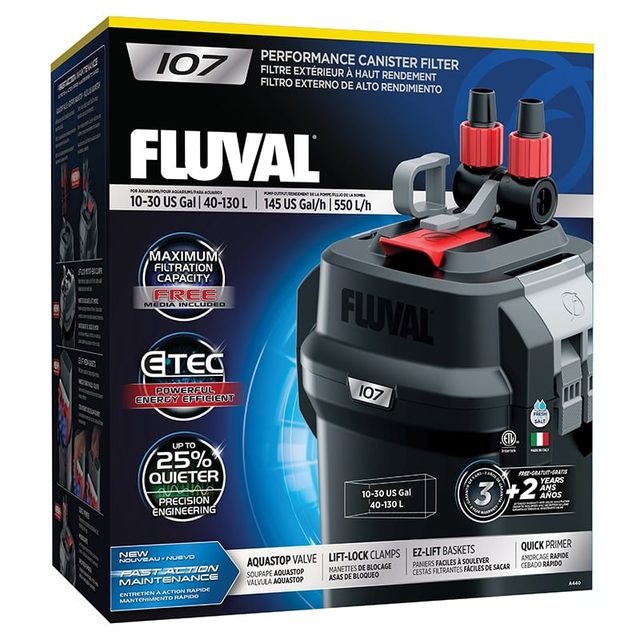
Fluval specifies the 107 for 10–30 US gallons, with 145 GPH Pump Output and 95 GPH Filter Circulation. It also lists a 1.2 L basket volume, a vertical mechanical pre-filter and removable media baskets.
The 107 is compatible with Fluval's Glass Lily Pipe Set. Fluval says the curved outlet diffuses water flow, is ideal for planted environments and promotes nutrient distribution; that accessory is sold separately and requires the compatible clear hosing.
This is the canister to consider when a smaller planted display needs external media and directional return control. Keep Pump Output and Filter Circulation separate rather than converting them into one generic performance number.
The best small canister fit because Fluval publishes clear hydraulic labels and supports planted-display return hardware for the 107/207/307/407 platform.
Check price on Amazon →#3Best mid-size canister
Fluval 307 Performance Canister Filter
Best for: Mid-size planted aquariums that need more external media capacity while keeping intake and return placement configurable
What we like
- 40–70 US gallon manufacturer range
- 206 GPH Filter Circulation is documented separately from 303 GPH Pump Output
- 3.1 L basket volume and vertical pre-filter
- Compatible with Fluval's planted-display Lily Pipe Set
- Exact Amazon.com identity already verified in current PetGearReport content
What we don't
- Larger cabinet footprint than the 107
- More media and plumbing to service than a HOB
- Plant-friendly glass return hardware is optional rather than included
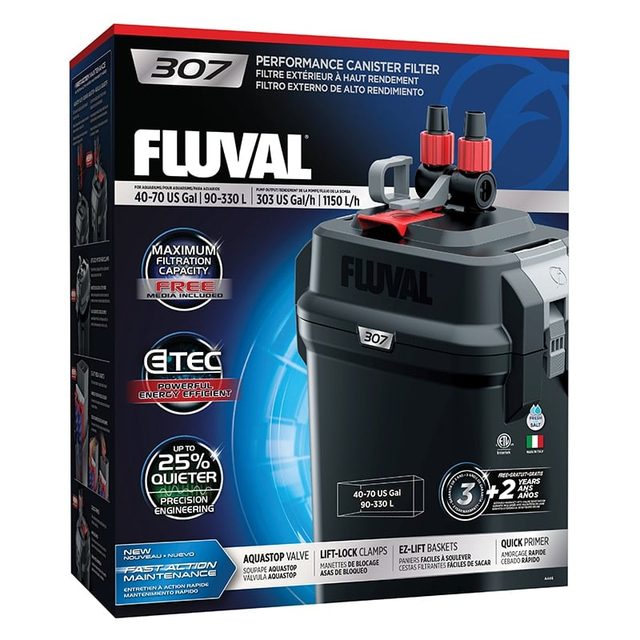
Fluval documents the 307 for 40–70 US gallons, with 303 GPH Pump Output, 206 GPH Filter Circulation and 3.1 L of basket volume. Like the 107, it routes water through a vertical pre-filter before the media trays.
The same Fluval Lily Pipe Set is compatible with the 307 and is specifically described by the manufacturer as diffusing flow for planted environments. That gives the 307 a clear planted-display integration path without pretending the accessory changes the filter's published hydraulic specification.
Choose the 307 when the 40–70 gallon range and larger media stack fit the aquarium. It is not automatically better than the 107 for a smaller tank simply because its Pump Output and Filter Circulation numbers are higher.
The mid-size capacity step for planted displays that have outgrown the 107 class but still benefit from the same 07 Series return-accessory ecosystem.
Check price on Amazon →#4Best HOB alternative
Fluval AC50 Power Filter
Best for: Low-tech planted aquariums where easy top-access maintenance and adjustable HOB flow matter more than hidden plumbing
What we like
- 20–50 US gallon manufacturer range
- Adjustable flow control
- Four-stage filtration with reusable foam and BIOMAX
- Top-access media service is simpler than disconnecting a canister
- Exact Amazon.com identity already verified in current PetGearReport content
What we don't
- Rim-mounted body and waterfall return are more visible than hidden canister plumbing
- Needs rear clearance at the aquarium
- Return geometry is less flexible than an external canister with separate outlet hardware
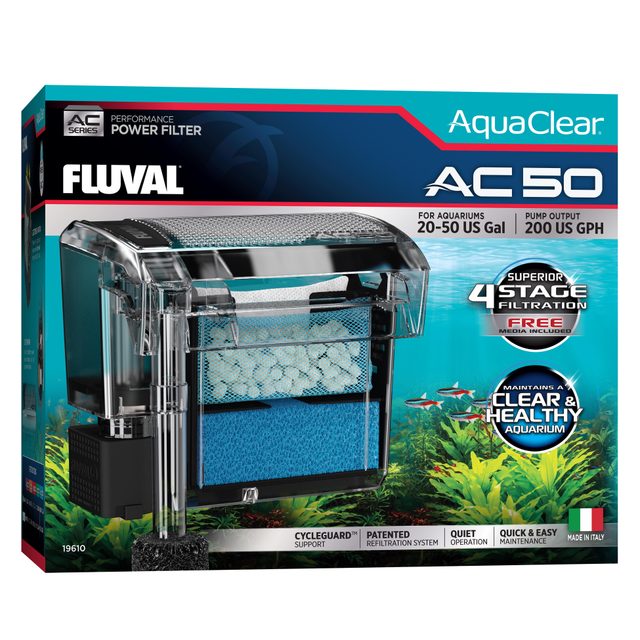
Fluval specifies the current AC50 for 20–50 US gallons and documents four-stage filtration, a pre-filter intake strainer, reusable mechanical foam, BIOMAX and adjustable flow control. The media basket is accessed from the top rather than through external hoses.
That makes the AC50 a practical low-tech planted-tank option when easy service matters. The trade-off is return geometry: a HOB discharge is tied to the rim location, so aquascape, plant mass and water level can influence how evenly water moves through the display.
Use the supported flow control to tune the filter within the aquarium's needs instead of chasing a universal turnover target. If hidden equipment and independently positioned intake/return hardware are priorities, a canister is the cleaner architecture.
The strongest HOB option in this set because the AC50 combines adjustable flow, reusable staged media and straightforward service access in the 20–50 gallon class.
Check price on Amazon →#5Best nano & shrimp-planted option
AQUANEAT 3 Pack Bio Sponge Filter (Small)
Best for: Nano planted shrimp tanks where gentle intake and simple biological filtration matter more than large external media capacity
What we like
- Air-driven sponge intake is gentle for small shrimp and fry
- Three small filters can support multiple nano tanks or a seeded spare
- Each current small unit is listed for aquariums up to 10 gallons
- Simple foam architecture adds biological surface without external hoses
- Exact Amazon.com identity already verified in current PetGearReport content
What we don't
- Requires a separate air pump and airline
- Less configurable media capacity than a canister or open-basket HOB
- Air output is not the same measurement as aquarium water circulation GPH

The exact AQUANEAT small three-pack is already identity-verified in PetGearReport's production inventory, with each small sponge filter positioned for aquariums up to 10 gallons. The design is air-driven and uses foam as both the intake surface and biological medium.
For a nano planted shrimp setup, that simplicity can be an advantage because the intake is spread across sponge rather than concentrated at a powered strainer. It also leaves the filter architecture easy to understand and service.
The limitation is media capacity and flow control. Do not add the three gallon ratings together as if they were one filter specification, and do not compare an air pump's delivery figure directly with a canister or HOB water-flow number.
The niche pick for nano planted shrimp setups, where a broad soft intake and low hardware complexity can be more useful than a larger powered filter.
Check price on Amazon →How we researched and scored
PetGearReport has not physically tested these filters, measured installed circulation, quantified CO₂ loss, measured nutrient distribution or run controlled plant-growth trials. We compared current manufacturer documentation, planted-aquarium guidance, exact-product identity checks and the architecture of each option. The displayed numbers are PetGearReport research scores, not hands-on results, laboratory measurements or customer ratings.
The weighted categories are:
- Flow control & distribution — 30%: documented adjustment plus how naturally the intake/return architecture can distribute water through a planted layout.
- Media architecture — 25%: useful mechanical/biological staging, configurable media space and clarity of the water path.
- Maintenance & serviceability — 20%: access to pre-filters, baskets, foam and other routine service points.
- Planted-display integration — 15%: equipment visibility, return-placement flexibility and documented planted-environment accessories where available.
- Exact identity & evidence quality — 10%: current technical documentation and confidence in the exact Amazon.com variant.
| Product | Flow 30% | Media 25% | Maintenance 20% | Display 15% | Evidence 10% | Weighted | Score |
|---|---|---|---|---|---|---|---|
| OASE BioMaster 2 350 | 9 | 10 | 10 | 8 | 10 | 9.40 | 9/10 |
| Fluval 107 | 9 | 9 | 8 | 10 | 10 | 9.05 | 9/10 |
| Fluval 307 | 9 | 10 | 8 | 10 | 10 | 9.30 | 9/10 |
| Fluval AC50 | 9 | 9 | 10 | 7 | 10 | 9.00 | 9/10 |
| AQUANEAT Small 3-Pack | 8 | 6 | 9 | 7 | 9 | 7.65 | 8/10 |
The decimals make the weighting auditable; they are not claims of real-world measurement precision. Rank also reflects use case, so the 107 remains ahead of the larger 307 for buyers specifically looking for a smaller planted canister.
Flow distribution matters more than one GPH number
A planted display is not an empty box. Hardscape, dense stems, carpeting plants, wood and rocks all change how water moves between intake and return. That is why this guide uses no universal turnover target.
Fluval publishes Pump Output and Filter Circulation separately for the 07 Series. OASE publishes a maximum flow figure for the BioMaster 2 350. Those labels describe different test conditions and should not be sorted into one fake apples-to-apples leaderboard.
Use the aquarium filter size guide to keep manufacturer tank ranges, hydraulic labels, media loading and actual aquarium layout separate. If you are comparing complete filter architectures first, our best aquarium canister filters, best aquarium HOB filters and best aquarium sponge filters guides cover those decisions directly.
Low-tech vs CO₂-injected planted tanks
Tropica describes CO₂ as a major plant nutrient and notes that many Medium and Advanced plants require supplemental CO₂. That does not mean one filter architecture automatically preserves or wastes a fixed percentage of CO₂.
In a low-tech planted aquarium, the main filtration questions are usually water movement, debris handling, biological stability and maintenance access. A HOB such as the AC50 can be attractive when easy top-access service matters, while a canister can keep more hardware away from the rim.
In a CO₂-injected aquarium, first choose the pressurized hardware with the aquarium CO₂ systems guide, then treat return geometry and surface agitation as parts of the full circulation and gas-exchange system. A canister’s separately positioned return can make that geometry easier to manage, but the correct setup still depends on tank shape, plant mass, hardscape and livestock oxygen needs. Do not suppress necessary gas exchange merely to chase a CO₂ number.
Media architecture and plant debris
Planted aquariums create their own maintenance load: trimmed leaves, fine plant fragments, substrate dust and normal livestock waste all reach the filter. The useful question is not how many media types can be stuffed into a chamber, but whether each stage has a defined job and can be serviced without disrupting the rest of the system. If fine trimmings or biofilm repeatedly collect at the air-water interface instead of in the filter, the aquarium surface skimmer guide compares direct-collection options and their intake-safety trade-offs.
The BioMaster separates a removable pre-filter from the main media volume. Fluval’s 07 Series uses a vertical pre-filter before the media baskets. The AC50 keeps reusable foam, biological media and optional chemical media in a top-access basket. Our aquarium filter media guide explains mechanical, biological and optional chemical stages by function rather than by a universal stack order.
If you are choosing the biological stage itself, the best biological filter media for aquariums guide compares reusable loose-media options by physical fit and maintenance guidance. Preserve established biological media instead of replacing the entire mature bed simply because a calendar date arrives.
Maintenance is part of planted-tank performance
A high-capacity filter that is awkward to service can become a poor real-world choice if debris accumulates until circulation falls. Check pre-filters, intake strainers, foam and hoses based on observed loading and the exact manufacturer instructions.
The BioMaster earns its maintenance advantage from the EasyClean pre-filter module. The AC50 is simpler in another way: its media is reached from the aquarium rim without disconnecting hoses. The 07 Series sits between those approaches with external plumbing but removable pre-filter/media components.
Plant growth changes over time, so circulation can change even when the filter hardware does not. After major trimming, replanting or hardscape changes, observe whether dead spots or excessive local current have appeared rather than assuming the original return position remains ideal.
Nano planted and shrimp-planted setups
A large canister is not automatically an upgrade for a small planted aquarium. Nano tanks often have less room for hardware, less water volume to buffer mistakes and livestock that may prefer gentler localized current.
The AQUANEAT small sponge filter is deliberately the niche pick here. It trades configurable media capacity for a broad foam intake and simple air-driven architecture. That can be useful in a planted shrimp tank, where intake safety may matter more than hiding every piece of equipment.
If shrimp are the primary constraint rather than plants, use the dedicated best aquarium filters for shrimp guide, which puts shrimplet intake safety ahead of planted-display aesthetics.
Cycle and verify the aquarium, not just the filter
A new filter is hardware, not an instant mature biofilter. Use the aquarium cycling guide to establish and verify biological filtration rather than assuming the presence of plants or a new canister makes a system immediately ready for livestock.
The aquarium water parameters guide covers the wider testing framework. Plant health, clear water and normal-looking livestock are useful observations, but they do not replace ammonia/nitrite testing when the system is new or unstable.
If the filter return still leaves persistent low-movement zones after it is positioned well, our aquarium wavemaker and circulation pump guide compares supplemental freshwater circulation by direction, mounting and livestock fit rather than a universal turnover target.
Sources
Technical and planted-aquarium claims on this page are based on current manufacturer and specialist plant-care documentation. Exact Amazon.com ASIN identities were already verified in PetGearReport’s production inventory on 2026-09-14; no new Amazon probe was required for this page, and dynamic price or availability is intentionally not stated.
- OASE — BioMaster 2 350 — up-to-90-gallon range, 295 GPH maximum flow, 5.6 L filter volume, 0.50 L pre-filter, EasyClean maintenance and outlet flow control.
- Fluval — 07 Series / 107 and 307 specifications — manufacturer ranges, Pump Output, Filter Circulation, media/pre-filter architecture and basket volumes.
- Fluval — Lily Pipe Set — compatibility with 107/207/307/407 and manufacturer guidance on diffused flow in planted environments.
- Fluval — AC50 Power Filter — 20–50 gallon range, four-stage media architecture and adjustable flow control.
- Tropica — Fertiliser and CO2 — plant nutrient and CO₂ guidance.
- Tropica — Make your aquarium a success — filtration and water-movement context for planted aquariums.
- AQUANEAT — aquarium filtration range — current brand filtration range; exact Amazon child identity is carried from PetGearReport’s existing 2026-09-14 verification.
Frequently asked questions
What type of filter is best for a planted aquarium?
Canisters are attractive when you want configurable media and flexible intake/return placement, while HOB filters can be easier to service from the rim and sponge filters can suit nano or shrimp-planted tanks. Start with the exact manufacturer's aquarium range and the maintenance workflow you can sustain rather than assuming one architecture is universally best.
How much filter flow does a planted tank need?
There is no universal turnover target that PetGearReport can defend for every planted aquarium. Tank dimensions, plant density, hardscape, livestock, media loading and return geometry all change useful circulation. Keep each manufacturer's Pump Output, Filter Circulation or maximum-flow label in its own documented context.
Are canister filters better for CO₂-injected planted tanks?
A canister can make intake and return placement easier to manage, but filter type alone does not determine CO₂ performance. In a CO₂-injected aquarium, evaluate return geometry and surface agitation as part of the whole circulation and gas-exchange setup instead of relying on a fixed percentage-loss claim.
Do planted tanks still need biological filtration?
Plants participate in nutrient uptake, but a planted aquarium still benefits from established filtration and stable water quality. Preserve mature biological media, verify the nitrogen-cycle state with water testing, and do not assume plant growth makes ammonia or nitrite monitoring unnecessary.
Is a sponge filter enough for a planted shrimp tank?
It can be when the exact sponge filter and air source fit the aquarium size and biological load. A sponge filter offers gentle intake and simple biological surface, but it has less configurable media capacity than a canister or HOB and still requires maintenance when debris restricts flow.