Best Reef Calcium Reactors: 3 Picks by CO2 Control, Effluent & Fit
A calcium reactor is a controlled CO2, media and effluent system for replacing calcium and alkalinity demand; it does not decide the aquarium's target or output by itself. We researched three exact marketplace variants using current manufacturer documentation for CO2/effluent control, monitoring, included hardware, maintenance, fit and exact identity. PetGearReport has not physically tested these reactors, measured effluent chemistry, tuned chamber pH, pressure-tested plumbing, measured CO2 use, verified pump life or observed aquarium outcomes.
| Rank | Product | Score | Best for | Link |
|---|---|---|---|---|
| #1 | Reef Octopus OCTO CalReact 220 with VarioS 6Best documented control platform | 9 | high-demand reef systems where published control architecture, media capacity and monitoring integration matter more than compact size | Check price → |
| #2 | ViaAqua AC30 Acro-Cal Calcium ReactorBest compact 200-gallon-class option | 9 | reef keepers who need a narrower reactor body with a built-in circulation pump and current manufacturer service instructions | Check price → |
| #3 | ViaAqua AC10 Acro-Cal Calcium ReactorBest small-system exact-identity pick | 8 | smaller reef systems where a compact true CO2 calcium reactor is justified by measured demand and cabinet space is constrained | Check price → |
#1 · Our PickBest documented control platform
Reef Octopus OCTO CalReact 220 with VarioS 6
Best for: high-demand reef systems where published control architecture, media capacity and monitoring integration matter more than compact size
What we like
- Current Reef Octopus documentation publishes reverse-flow CO2 recirculation, precision effluent control, bubble counter and pH-probe holder
- VarioS 6 variable-speed recirculation pump is included
- 9.3 L / 2.5 US gal media capacity is explicitly documented
- Current manufacturer table publishes 1/4 inch connections and a 132–211 GPH feed-pump suggestion
- Exact EAN 6950291252111 reconciles to marketplace ASIN B073RMSTY3
What we don't
- CO2 cylinder, regulator/solenoid, reactor media, pH probe/controller and feed hardware still form part of the wider system
- Large 16.5 x 11 inch footprint and ~23 inch height need substantial cabinet space
- Manufacturer tank-volume guidance is equipment fit, not a safe universal calcium/alkalinity output
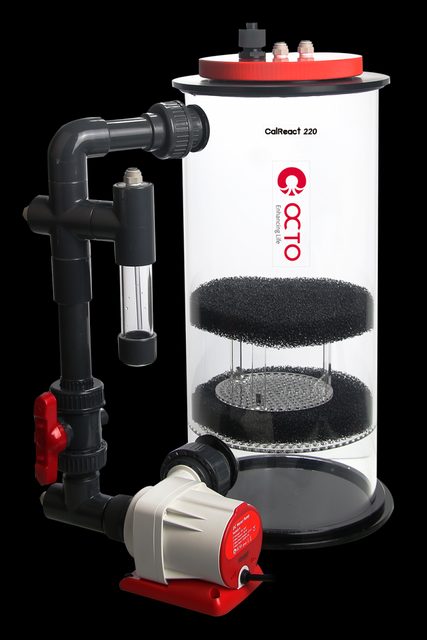
Reef Octopus identifies this exact model as **CalReact 220**. Current technical data list **9.3 L / 2.5 US gal** media capacity, a manufacturer tank-volume reference of **370–554 US gallons**, **1/4 inch** inlet/outlet fittings, a suggested feed-pump range of **132–211 GPH**, a **70W** recirculation system and the included **VarioS 6** pump.
The reactor uses a **reverse flow and CO2 recirculating design**, a built-in bubble counter, a **precision effluent control valve** and a probe holder. The **pH probe is not included**. Exact EAN **6950291252111** reconciles to marketplace ASIN **B073RMSTY3**.
The strongest research pick because the current manufacturer page documents the most complete control stack: variable-speed recirculation, CO2 recovery, effluent valve, bubble counter, probe holder and large media chamber.
Check price on Amazon →#2Best compact 200-gallon-class option
ViaAqua AC30 Acro-Cal Calcium Reactor
Best for: reef keepers who need a narrower reactor body with a built-in circulation pump and current manufacturer service instructions
What we like
- Current ViaAqua page documents exact AC30 model and UPC 006903728041
- Built-in water pump, bleed valve, bubble counter and pH-sensor compression fitting reduce separate reactor-body hardware
- Can be used in-sump or hang-on according to the manufacturer
- Current maintenance guidance publishes monthly impeller cleaning and 3–6 month media/reactor service intervals
- Exact marketplace identity reconciles to ASIN B002440GL8
What we don't
- CO2 source, regulator, check valve, tubing, reactor media and pH control hardware are separate dependencies
- Manufacturer's 50–200 gallon range does not establish the correct output for any specific reef
- The older platform offers less published CO2-recirculation/control detail than the Reef Octopus design
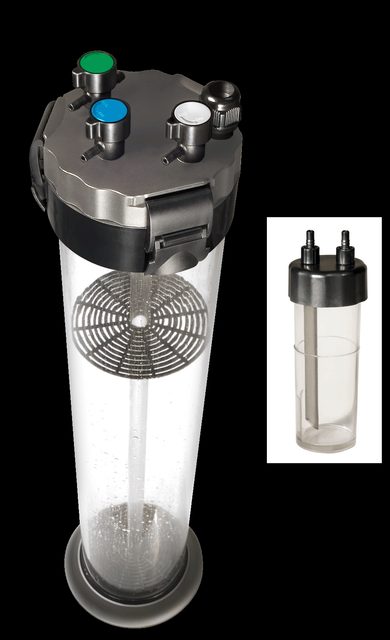
ViaAqua identifies the larger Acro-Cal model as **AC30**, UPC **006903728041**. Current specifications list a **5.5 inch** width, **22.75 inch** height and manufacturer capacity range of **50–200 gallons**. ViaAqua documents a **built-in water pump**, **bleed valve**, bubble counter, hang-on/in-sump installation and a pH-sensor compression fitting.
The current maintenance section says to **clean the impeller monthly**, replace calcium media every **3–6 months** depending on use, and clean the reactor/pump on a similar 3–6 month cycle. The manufacturer lists a **pH controller** as recommended system hardware and separately lists the CO2 source, regulator, check valve, tubing and media as required installation components. Exact AC30 marketplace identity reconciles to ASIN **B002440GL8**.
A practical compact reactor with unusually clear current maintenance guidance, ranked below CR220 because its control and monitoring architecture is less comprehensively documented.
Check price on Amazon →#3Best small-system exact-identity pick
ViaAqua AC10 Acro-Cal Calcium Reactor
Best for: smaller reef systems where a compact true CO2 calcium reactor is justified by measured demand and cabinet space is constrained
What we like
- Current ViaAqua model table documents exact AC10 and UPC 006903729079
- Compact 4 inch x 15 inch form factor
- Built-in water pump, bleed valve and bubble counter reduce reactor-body accessories
- Manufacturer supports in-sump or hang-on installation
- Exact marketplace identity reconciles to ASIN B000UZLQLM
What we don't
- Manufacturer's 10–75 gallon fit range is much narrower than the other two picks
- The complete CO2/regulator/check-valve/media/control system still requires separate hardware
- Small physical capacity means fit should be judged against measured demand rather than nominal tank size alone
ViaAqua identifies the compact model as **AC10**, UPC **006903729079**. Current manufacturer data list a **4 inch** width, **15 inch** height and a **10–75 gallons** equipment-fit range. The Acro-Cal platform includes a **built-in water pump**, bleed valve and **bubble counter**, and ViaAqua documents in-sump or **hang-on** use.
The installation still requires a **CO2 source**, regulator, check valve, tubing and calcium-reactor media; ViaAqua recommends pH monitoring/control. Exact AC10 marketplace identity reconciles to ASIN **B000UZLQLM**.
The cleanest small-system identity in this research set, with the same straightforward Acro-Cal architecture but substantially less physical capacity than the other picks.
Check price on Amazon →A calcium reactor is continuous chemistry-delivery hardware, not an automatic reef target. If low display-tank pH is the concern, diagnose room-air CO2 separately; the reef CO2 scrubber guide covers skimmer-air treatment rather than changing reactor chamber setpoints to solve an air-side problem.
If you are still choosing between two-part, all-in-one, kalkwasser and calcium-reactor supplementation, start with the reef dosing methods guide. If you need to establish current consumption, the reef dosing calculator can normalize measured decline before you decide whether reactor-level complexity is justified.
Keep the feedback loop anchored to separate measurements: reef alkalinity testers, reef calcium testers and reef magnesium testers. If kalkwasser remains a better fit, compare the separate kalkwasser reactor guide.
Tank-size rating is not a dose prescription
Manufacturers publish aquarium-size ranges to help position reactor capacity.
Tank-size rating is not a dose prescription.
A 200-, 500- or 600-gallon equipment statement does not tell you:
- how much alkalinity your corals currently consume;
- how quickly the exact media dissolves;
- the correct CO2 rate;
- the correct effluent rate;
- a safe chamber pH;
- how a water change or salt mix changed demand.
Reactor capacity is not coral demand.
Start from repeatable alkalinity/calcium measurements and actual consumption, not the marketing tank-size number.
No universal reactor pH setpoint
A calcium reactor works by adding CO2 to lower pH inside the chamber so calcium-carbonate media dissolves into the circulating water. The resulting effluent returns calcium/alkalinity-bearing water to the aquarium.
There is no universal reactor pH setpoint that should be copied across every setup. The reef pH monitoring guide explains why chamber-probe calibration, placement and controller failure design are separate from choosing the chemistry setpoint; the reef pH monitor/controller guide compares exact hardware when you need a dedicated probe/controller.
The correct operating window depends on the:
- exact reactor media;
- particle size and composition;
- reactor design;
- CO2 and recirculation behavior;
- effluent flow;
- measured aquarium demand.
Follow the media manufacturer and reactor manufacturer instructions for the exact reactor media in use. A published example for one medium is not a universal recipe.
A recirculation pump is not a complete CO2 system
A reactor that includes a pump is still only part of the installation.
A recirculation pump is not a complete CO2 system.
Depending on the product, the wider system can include:
- CO2 cylinder;
- regulator and often solenoid/control hardware;
- check valve and CO2-safe tubing;
- feed pump or controlled feed path;
- calcium-reactor media;
- probe and/or pH controller;
- alkalinity and calcium testing;
- effluent plumbing.
For the Reef Octopus CR220, the VarioS 6 recirculation pump is included but the pH probe is sold separately. ViaAqua similarly lists multiple CO2 and monitoring components outside the reactor body.
How we researched and scored
PetGearReport has not physically tested these reactors, pressure-tested the chambers, measured CO2 consumption, tuned effluent, verified pump life, measured media dissolution or observed coral response.
The displayed number is a PetGearReport research score, not a hands-on result, Amazon/customer rating or laboratory performance score.
- CO2 / effluent control documentation — 25%
- Demand matching & monitoring — 25%
- Installation & included hardware — 20%
- Maintenance & service access — 15%
- Capacity & fit documentation — 10%
- Exact identity & source quality — 5%
| Reactor | CO2/effluent 25% | Demand/monitoring 25% | Install 20% | Service 15% | Fit 10% | Identity 5% | Weighted | Score |
|---|---|---|---|---|---|---|---|---|
| Reef Octopus CalReact 220 | 9.5 | 9.5 | 9 | 9.5 | 9 | 8.5 | 9.30 | 9/10 |
| ViaAqua AC30 | 8.5 | 8.5 | 9 | 8.5 | 8 | 8.5 | 8.55 | 9/10 |
| ViaAqua AC10 | 8 | 8 | 8.5 | 8.5 | 7.5 | 8.5 | 8.15 | 8/10 |
The decimals make the weighting auditable; they do not imply measured engineering precision.
Reef Octopus CalReact 220: the most complete documented control stack
Current Reef Octopus documentation lists:
- 9.3 L / 2.5 US gal media capacity;
- 370–554 US gallons manufacturer tank-volume reference;
- 132–211 GPH suggested feed-pump range;
- VarioS 6 recirculation pump;
- 70W pump power in the current manufacturer table;
- 1/4 inch inlet/outlet size;
- reverse-flow CO2 recirculation;
- bubble counter;
- pH-probe holder;
- precision effluent control valve.
The reactor can be installed wet or dry according to the current technical table.
What it does not provide is a universal aquarium output. The same hardware can deliver different chemistry depending on CO2, effluent flow, media and aquarium consumption. The pH probe is not included.
ViaAqua AC30: compact body with explicit service intervals
The current ViaAqua Acro-Cal page identifies AC30, UPC 006903728041.
The manufacturer publishes:
- 5.5 inch width;
- 22.75 inch height;
- 50–200 gallons equipment range;
- built-in water pump;
- bleed valve;
- bubble counter;
- pH-sensor compression fitting;
- in-sump or hang-on installation.
ViaAqua also publishes maintenance intervals instead of leaving service undefined: clean the impeller monthly, replace calcium media every 3–6 months depending on use and clean the reactor/pump every 3–6 months.
The wider system still needs the required CO2 hardware and media listed by the manufacturer.
ViaAqua AC10: the small exact-identity option
The AC10, UPC 006903729079, uses the same basic Acro-Cal approach at a smaller scale.
Current model data list:
- 4 inch width;
- 15 inch height;
- 10–75 gallons equipment range;
- built-in water pump;
- bleed valve;
- bubble counter;
- sump or hang-on use.
The small body can make sense where cabinet space and measured demand are both lower, but its 75-gallon manufacturer reference should not be translated into an assumed chemistry output.
CR220 vs AC30 vs AC10: what actually changes?
| Decision factor | Reef Octopus CR220 | ViaAqua AC30 | ViaAqua AC10 |
|---|---|---|---|
| Published media capacity | 9.3 L / 2.5 gal | Not stated on current model table | Not stated on current model table |
| Recirculation pump | VarioS 6 variable-speed | Built-in water pump | Built-in water pump |
| CO2 recirculation documented | Yes | Not emphasized on current manufacturer page | Not emphasized on current manufacturer page |
| Effluent control documentation | Precision valve | Blue effluent valve / Acro-Cal control | Blue effluent valve / Acro-Cal control |
| Bubble counter | Included | Included | Included |
| pH monitoring provision | Probe holder; probe sold separately | Compression fitting; controller recommended | Compression fitting/platform documentation; controller recommended |
| Installation | Wet or dry | Sump or hang-on | Sump or hang-on |
| Published service interval | General easy-maintenance design | Monthly impeller; 3–6 month reactor/media cycle | Same current Acro-Cal maintenance guidance |
| Strongest reason to shortlist | Large capacity + control documentation | Compact 200-gallon-class architecture | Compact small-system architecture |
Control changes should follow measured demand
A calcium reactor can change output when you change:
- CO2 delivery;
- effluent flow;
- feed rate;
- recirculation;
- media condition;
- media type;
- chamber operating conditions.
Avoid changing multiple variables at once if you want the next alkalinity/calcium tests to tell you what happened.
The reef dosing calculator is most useful before reactor tuning or when comparing demand over time. Once a reactor is active, the reactor itself becomes a simultaneous chemistry input, so measured trends and direct testing remain the feedback loop rather than treating the calculator as an automatic reactor controller.
Sources
- Reef Octopus — OCTO Calcium Reactor — current CalReact 220 media capacity, VarioS 6 pump, tank-volume table, feed-pump suggestion, reverse flow/CO2 recirculation, effluent valve, bubble counter and probe-holder documentation.
- ViaAqua — Acro-Cal Calcium Reactor — current AC10/AC30 dimensions, equipment ranges, UPCs, built-in hardware, installation requirements and maintenance intervals.
Exact marketplace ASIN mappings were reconciled from indexed marketplace/catalog evidence against these manufacturer identities. No Amazon price, stock or availability claim is made because those values can change independently of the editorial comparison.
Frequently asked questions
Does a bigger calcium reactor automatically dose more safely?
No. Larger media capacity can support longer service intervals or higher potential output, but the actual aquarium input still depends on CO2, effluent flow, media behavior and measured demand. Tank-size rating is not a dose prescription.
What pH should a calcium reactor run at?
There is no universal reactor pH setpoint for every reactor and media. Follow the exact reactor and reactor-media manufacturer guidance, then tune from measured aquarium demand and effluent behavior. Do not copy a setpoint solely because another aquarium uses it.
Is the included recirculation pump everything I need?
No. A recirculation pump is not a complete CO2 system. Depending on the model, the wider installation can require a CO2 cylinder, regulator/solenoid, check valve, tubing, feed path, reactor media, pH probe/controller and monitoring.
Should I change reactor output after one alkalinity test?
Repeat an unexpected result first. Reactor changes should follow a confirmed alkalinity/calcium trend and measured demand. Make one controlled change at a time and retest so the effect can be interpreted.