Best Reef Calcium Test Kits & Checkers: 4 Picks by Accuracy & Workflow
Reef calcium tests differ less by the parameter they report than by how they control error. A digital colorimeter removes the final color-endpoint judgment but can add dilution and optical-cleanliness sensitivity; syringe titration can provide a sharp endpoint without electronics but leaves technique and endpoint recognition with the user; a simpler drop-count kit trades finer resolution for a straightforward routine. We researched four exact marketplace variants using current manufacturer documentation for range, resolution or endpoint increments, published accuracy where available, reagent/QC traceability, workflow and exact product identity. PetGearReport has not physically tested these kits, compared them against a certified laboratory calcium method, measured inter-user endpoint error, aged reagents or independently verified manufacturer performance claims.
| Rank | Product | Score | Best for | Link |
|---|---|---|---|---|
| #1 | Hanna HI758 Marine Calcium Checker HCBest published measurement evidence | 9 | reef keepers who prioritize explicit published accuracy and a direct numerical result and are willing to control the dilution workflow carefully | Check price → |
| #2 | Red Sea Calcium Pro Reef Test KitBest precision titration workflow | 9 | reef keepers who want a fine-resolution manual titration method without the calcium-free dilution-water requirement of the digital Hanna workflow | Check price → |
| #3 | Salifert Calcium Profi-TestBest compact syringe titration | 8 | reef keepers who want a compact manual syringe titration with a documented conversion formula and no electronic instrument | Check price → |
| #4 | API Calcium Test Kit 69LBest simple drop-count baseline | 7 | reef keepers who want a straightforward calcium trend check and do not need the finer measurement evidence of the premium options | Check price → |
#1 · Our PickBest published measurement evidence
Hanna HI758 Marine Calcium Checker HC
Best for: reef keepers who prioritize explicit published accuracy and a direct numerical result and are willing to control the dilution workflow carefully
What we like
- Dedicated marine calcium colorimeter with direct numerical readout
- Hanna publishes a 200–600 ppm range, 1 ppm resolution and ±6 ppm ±5% of reading accuracy at 25°C / 77°F
- HI758-26 replacement reagents and HI758-11 calibration-check set are explicitly documented
- Digital readout removes the final visual titration endpoint decision
- Exact HI758 marketplace identity maps to ASIN B005FH2OIY
What we don't
- The 1 ppm display resolution is much smaller than the published accuracy and must not be treated as equivalent to accuracy
- The method uses a 100:1 dilution, so calcium contamination in the dilution water can bias results high
- The workflow requires calcium-free deionized or distilled water, a 100 µL marine sample and careful cuvette handling
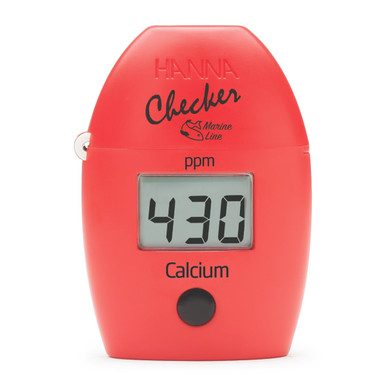
Hanna documents the HI758 Marine Calcium Checker HC with a 200–600 ppm calcium range, 1 ppm resolution and accuracy of ±6 ppm ±5% of reading at 25°C / 77°F. It uses an adaptation of the Zincon method and a 610 nm LED.
The important trade-off is sample preparation. Hanna states that the HI758 uses a 100:1 dilution and warns that calcium in the water used for the C1 phase can create falsely high results. The current troubleshooting guidance calls for 9 mL of calcium-free deionized or distilled water and an exact 100 µL marine sample. HI758-26 is the 25-test reagent set and HI758-11 is the calibration-check set. Exact HI758 marketplace identity reconciles to Amazon.com ASIN B005FH2OIY.
The strongest documented measurement system in this shortlist, but not the simplest: its value depends on controlling dilution water, sample volume and optical cleanliness.
Check price on Amazon →#2Best precision titration workflow
Red Sea Calcium Pro Reef Test Kit
Best for: reef keepers who want a fine-resolution manual titration method without the calcium-free dilution-water requirement of the digital Hanna workflow
What we like
- Current Red Sea documentation describes an advanced calcium titration method with 5 ppm resolution
- Includes a single-hand titrator and analytical-grade glass-vial workflow
- Manufacturer documentation lists 75 tests
- Avoids the HI758's 100:1 dilution-water dependency
- Exact R21405 / UPC 730773214051 identity maps to ASIN B004FUJ5JI
What we don't
- The final endpoint is still visually judged rather than instrument-read
- Current first-party documentation supports 5 ppm resolution; that should not be rewritten as a universal ±5 ppm accuracy guarantee
- Titration repeatability still depends on sample volume, reagent volume and endpoint technique
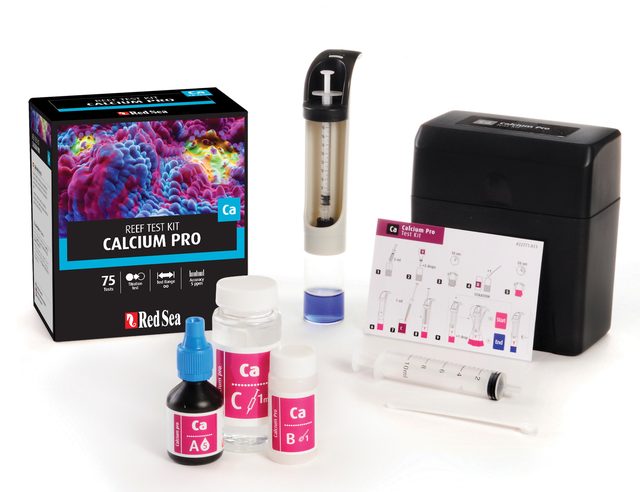
Red Sea's current Foundation documentation describes Calcium Pro as an advanced titration test with 5 ppm resolution. The current system uses analytical-grade glass vials and a single-hand titrator and is documented for 75 tests.
That is a different strength from Hanna's HI758: Red Sea does not require a 100:1 colorimeter dilution, but the user still has to recognize the titration endpoint consistently. We therefore treat 5 ppm as the documented measurement resolution and do not convert it into an invented accuracy claim. Exact product code R21405 / UPC 730773214051 reconciles to Amazon.com ASIN B004FUJ5JI.
A strong manual alternative because Red Sea documents a 5 ppm-resolution titration system with a dedicated titrator and 75-test format.
Check price on Amazon →#3Best compact syringe titration
Salifert Calcium Profi-Test
Best for: reef keepers who want a compact manual syringe titration with a documented conversion formula and no electronic instrument
What we like
- Manufacturer procedure uses a defined syringe titration rather than a loose color-card estimate
- Standard workflow uses a 2 mL sample with a separate 1 mL lower-resolution option
- The 1 mL titration syringe is graduated in 0.01 mL and the manufacturer provides a direct calcium conversion formula/table
- Pink-red to clear-blue endpoint is explicitly documented
- Exact model 8714079130347 maps to ASIN B001EIZT4Y
What we don't
- The endpoint remains visual and operator-dependent
- The low-resolution 1 mL sample mode doubles the calculated result and trades detail for reagent economy
- Salifert does not publish the same numerical ±ppm accuracy specification as Hanna for this kit
Salifert's Calcium Profi-Test instructions use a 2 mL sample in standard mode. A 1 mL sample can be used for a lower-resolution mode, with the result multiplied by two. The method adds Ca-1 and Ca-2, then titrates with Ca-3 from a 1 mL syringe until the color changes from pink-red to clear blue.
The syringe is graduated in 0.01 mL and the manufacturer provides the conversion formula ppm Ca = (1 - syringe reading) × 500 for standard mode, alongside a lookup table. That makes the arithmetic auditable, but it does not eliminate endpoint judgment. Exact model 8714079130347 reconciles to Amazon.com ASIN B001EIZT4Y.
A well-bounded manual method with explicit sample-volume and syringe-reading rules, but its result still depends on consistent visual endpoint recognition.
Check price on Amazon →#4Best simple drop-count baseline
API Calcium Test Kit 69L
Best for: reef keepers who want a straightforward calcium trend check and do not need the finer measurement evidence of the premium options
What we like
- Dedicated reef calcium kit from API with current manufacturer instructions
- Simple 5 mL sample and drop-count endpoint workflow
- API states the kit measures calcium levels as low as 20 mg/L
- Pink-to-blue endpoint and bottle-by-bottle sequence are explicitly documented
- Exact model 69L / UPC 317163120699 maps to ASIN B0006JDWHI
What we don't
- The final endpoint is visual
- A broad drop-count method provides less fine-grained decision detail than the premium titration and colorimeter options
- API does not publish the same numerical ±ppm accuracy specification or separate calibration-check system as Hanna
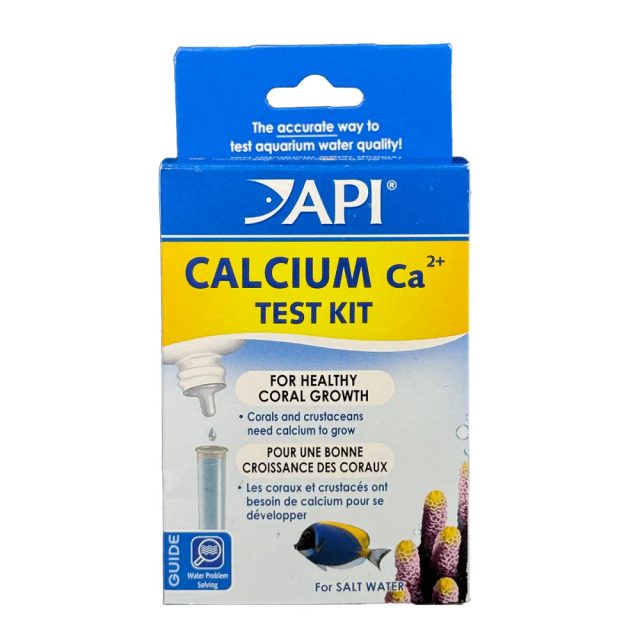
API's current Calcium Test Kit is specifically documented for reef aquariums and states that it measures calcium levels as low as 20 mg/L. The instruction manual uses a 5 mL sample, 10 drops of Calcium Test Solution Bottle #1, then Bottle #2 drop by drop until the sample changes from pink through purple to the blue endpoint.
That is easy to audit as a workflow, but it is still a visual drop-count titration and API does not publish a numerical ±ppm accuracy specification for this kit. Exact model 69L / UPC 317163120699 reconciles to Amazon.com ASIN B0006JDWHI.
The simplest baseline in the shortlist: clean product identity and clear instructions, with a deliberate trade-off in measurement granularity.
Check price on Amazon →Calcium is a foundation-chemistry measurement, but the reading is only useful when the method’s limitations are understood.
For adjacent reef decisions, use the reef magnesium tester guide, reef alkalinity tester guide, reef nitrate tester guide, reef phosphate tester guide, reef salt mix guide, aquarium dosing-pump guide, and aquarium water-parameters guide.
How we researched and scored
PetGearReport has not physically tested these calcium testers, compared them against a certified laboratory calcium method, measured repeatability across users, quantified visual endpoint error, aged reagents or independently verified manufacturer performance claims.
The displayed number is a PetGearReport research score, not a hands-on result, Amazon/customer rating or laboratory certification.
- Measurement evidence & reef-range usefulness — 30% — explicit range, resolution and published accuracy where available, without treating resolution as accuracy.
- Endpoint/readability & operator dependence — 25% — direct digital readout versus syringe/drop-count endpoint and how much judgment remains with the user.
- Reagent/QC traceability — 20% — defined reagent sets, calibration-check support, product-specific titration system and documentation.
- Workflow & repeatability — 15% — sample-volume control, dilution sensitivity, number of manual steps and clarity of the documented method.
- Exact identity & documentation — 10% — model/SKU/UPC evidence reconciled to the exact marketplace ASIN.
| Calcium tester | Measurement 30% | Endpoint 25% | Reagent/QC 20% | Workflow 15% | Identity 10% | Weighted | Score |
|---|---|---|---|---|---|---|---|
| Hanna HI758 | 10 | 10 | 10 | 5 | 10 | 9.25 | 9/10 |
| Red Sea Calcium Pro | 8 | 8 | 9 | 9 | 10 | 8.55 | 9/10 |
| Salifert Calcium | 7 | 8 | 8 | 8 | 10 | 7.90 | 8/10 |
| API Calcium 69L | 5 | 7 | 6 | 8 | 10 | 6.65 | 7/10 |
The decimal makes the weighting auditable. It does not imply laboratory precision.
Quick decision: choose the calcium method before the brand
| Tester | Method | Measurement detail | Best when | Avoid if |
|---|---|---|---|---|
| Hanna HI758 | Digital colorimeter | 200–600 ppm, 1 ppm display resolution, ±6 ppm ±5% of reading published accuracy at 25°C | You want a numerical result with explicit published accuracy and a separate calibration-check path | You do not want the 100:1 dilution, calcium-free water and exact 100 µL sample workflow |
| Red Sea Calcium Pro | Manual precision titration | 5 ppm resolution, 75-test format | You want a fine-step manual titration without the HI758 dilution-water dependency | You want an instrument-read endpoint rather than a visual titration endpoint |
| Salifert Calcium | Syringe titration | 0.01 mL syringe graduations with a documented conversion formula | You want a compact, auditable manual titration with explicit syringe arithmetic | You want a numerical instrument result or a manufacturer-published ±ppm accuracy specification |
| API Calcium 69L | Drop-count titration | 5 mL sample, visual pink-to-blue endpoint; API says the kit measures calcium as low as 20 mg/L | You want a simple trend check with straightforward drop-count technique | You need the finer measurement evidence or calibration path of the premium methods |
A smaller display or titration step is not the same thing as higher accuracy. Choose the method whose documented measurement limits, endpoint style and workflow you can reproduce consistently, then use the result as one point in a calcium trend rather than as an automatic dosing command.
Digital is not automatically better
The HI758 is a colorimeter, so the final result is numerical rather than a human color match. That is useful, but the instrument’s procedure introduces its own controls.
Hanna explicitly warns that calcium in the dilution water can create falsely high results. Its 100:1 dilution means the quality of the blank/dilution water matters much more than many users expect.
A manual titration has a different error model. It avoids that colorimeter dilution dependency, but the user has to control:
- exact sample and reagent volume;
- drop or syringe volume;
- mixing between additions;
- recognition of the endpoint;
- reagent condition and storage.
So digital is not automatically better. It moves the important sources of error rather than eliminating them.
Resolution and accuracy are not interchangeable
Hanna HI758 is the clearest example:
- range: 200–600 ppm calcium;
- resolution: 1 ppm;
- published accuracy at 25°C: ±6 ppm ±5% of reading.
The display changing by 1 ppm does not mean every reading is accurate to ±1 ppm.
Red Sea Calcium Pro documents 5 ppm resolution for its titration method. That is useful measurement detail, but it should not be silently rewritten as a ±5 ppm accuracy guarantee.
Salifert publishes a syringe procedure with 0.01 mL graduations and a conversion formula. API documents that its kit measures calcium as low as 20 mg/L and uses a visual drop-count endpoint.
Hanna HI758: strong measurement evidence, demanding dilution control
Hanna’s HI758 uses a marine calcium colorimetric method and publishes range, resolution and numerical accuracy.
The unusual part is the blank/dilution stage. Hanna’s current guidance states that the method uses a 100:1 dilution and cautions that hobby RO/DI water may still contain enough calcium to affect the result.
The current workflow guidance calls for:
- 9 mL of calcium-free deionized or distilled water for the initial stage;
- an exact 100 µL marine sample;
- clean cuvettes that have not been rinsed with calcium-containing tap water;
- the specified reagent sequence.
The defined support chain includes HI758-26 reagents and the HI758-11 calibration-check set.
This is excellent documentation, but it also explains why the most instrumented option is not necessarily the easiest one to reproduce.
Red Sea Calcium Pro: precision titration without the dilution-water dependency
Red Sea’s Calcium Pro is an advanced manual titration method.
Current first-party Foundation documentation lists:
- 5 ppm resolution;
- 75 tests;
- analytical-grade glass vials;
- a single-hand high-precision titrator.
The benefit is a tightly controlled titration workflow without the 100:1 dilution blank required by HI758.
The remaining uncertainty is the human endpoint. Consistency still depends on sample preparation, reagent addition and recognizing the final color change the same way each time.
Salifert: explicit syringe arithmetic
Salifert’s Calcium Profi-Test uses a 2 mL sample for its standard procedure.
The manufacturer also documents a 1 mL lower-resolution option, which uses less reagent and requires the calculated result to be multiplied by two.
The 1 mL titration syringe is graduated in 0.01 mL, and the standard-mode calculation is:
ppm Ca = (1 - syringe reading) × 500
The endpoint changes from pink-red to clear blue.
That explicit arithmetic makes the result traceable to the syringe reading, but users still need a consistent endpoint judgment.
API 69L: simple drop-count baseline
API’s calcium kit uses a 5 mL sample.
The current instruction manual specifies:
- add 10 drops of Bottle #1;
- shake the sample;
- shake Bottle #2 vigorously;
- add Bottle #2 drop by drop;
- count drops until the sample passes from pink through purple to blue;
- use the supplied chart to convert the drop count to calcium.
API also states that the kit measures calcium levels as low as 20 mg/L.
It is a practical broad baseline, but API does not publish the same numerical accuracy specification or instrument check-standard system as Hanna.
Measurement does not decide the correction
Measurement does not decide the correction.
Before changing calcium dosing after an unexpected result:
- repeat the measurement carefully;
- verify salinity, because concentration changes can move the measured calcium value;
- check alkalinity separately rather than inferring it from calcium;
- compare against the recent calcium trend;
- account for water changes and the incoming salt mix;
- calculate actual consumption before changing an automated dosing schedule.
Our reef salt mix guide documents why replacement-water chemistry can alter the apparent demand, and the aquarium dosing-pump guide keeps automated delivery separate from the chemistry decision. For CO2-driven supplementation, the reef calcium reactor guide compares reactor control architecture without treating nominal tank size as a dosing prescription. For a maintenance estimate based on two comparable measurements, the reef dosing calculator scales measured consumption from the exact product-label potency rather than inventing a universal calcium dose.
Exact product identity verification
Product identity evidence checked September 25, 2026: B005FH2OIY matched Hanna HI758; B004FUJ5JI matched Red Sea Calcium Pro / R21405 / UPC 730773214051; B001EIZT4Y matched Salifert Calcium / model 8714079130347; and B0006JDWHI matched API Calcium 69L / UPC 317163120699. These mappings keep the affiliate destinations tied to the intended products without freezing current Amazon price or availability. Manufacturer documentation remains the source for measurement range, accuracy/resolution, reagent and workflow claims; public marketplace/catalog records are used only to reconcile exact product identity. No Amazon price, stock or availability claim is made because those values can change independently of product identity. No direct Amazon product-page probe was used for this refresh.
Sources
- Hanna Instruments — HI758 Marine Calcium Checker HC — 200–600 ppm range, 1 ppm resolution, ±6 ppm ±5% accuracy, reagent and calibration-check identifiers, dilution-water cautions.
- Hanna Instruments — How to Test Calcium — 100:1 dilution context, 100 µL sample and calcium contamination warning.
- Red Sea — Foundation Pro Test Kit — Calcium Pro 5 ppm measurement resolution and 75-test titration system.
- Salifert — Calcium Profi-Test instructions — 2 mL standard sample, 1 mL low-resolution option, syringe graduations, endpoint and conversion formula.
- API Fishcare — Calcium Test Kit — reef use, 20 mg/L measurement statement and manufacturer instructions.
- Desertcart — Hanna HI758 identity record — public ASIN B005FH2OIY to HI758 identity evidence only.
- Desertcart — Red Sea Calcium Pro identity record — public ASIN B004FUJ5JI to UPC 730773214051 identity evidence only; Red Sea remains authoritative for measurement claims.
- PriceHistory — Salifert Calcium identity record — public ASIN B001EIZT4Y to model 8714079130347 identity evidence only.
- Ubuy — API Calcium 69L identity record — public ASIN B0006JDWHI to model 69L / UPC 317163120699 identity evidence only; API remains authoritative for test performance claims.
Frequently asked questions
Is a digital calcium checker always better than titration?
No. Digital is not automatically better. Hanna HI758 provides a direct result and a published accuracy specification, but its 100:1 dilution makes calcium-free dilution water and exact sample volume unusually important. A careful titration method can be more straightforward for some reef keepers.
What is the difference between calcium resolution and accuracy?
Resolution is the smallest displayed or titration step; accuracy is how close the method is expected to be under stated conditions. Hanna HI758 resolves 1 ppm but publishes ±6 ppm ±5% of reading accuracy at 25°C. Red Sea Calcium Pro documents 5 ppm resolution. Neither statement should be rewritten into a stronger claim.
Why can dilution water affect the Hanna HI758?
Hanna documents a 100:1 dilution for the HI758. Because only 100 µL of marine sample is used, calcium already present in the deionized/RO/distilled water used for the dilution can bias the result high. Hanna specifically recommends calcium-free deionized or pure distilled water for that stage.
Should I increase calcium after one low result?
Measurement does not decide the correction. Repeat an unexpected result carefully, verify salinity and alkalinity, compare the result with the recent trend and calculate actual consumption before changing dosing. Large corrections based on one unexplained reading can create a new imbalance.
Why test alkalinity with calcium?
Calcium and alkalinity are both involved in reef calcification and are commonly consumed together, but they are separate measurements. A calcium number should not be used to infer alkalinity. Use a dedicated alkalinity method and interpret both in the context of salinity and the aquarium's measured demand.