Best Reef pH Monitors & Controllers: 3 Picks by Calibration, Control & Safety
A pH display does not decide what your reef target should be, and a controller does not make CO2 or kalkwasser fail-safe by itself. We researched three exact product identities by measurement/calibration evidence, control architecture, probe serviceability, reef/reactor integration and current public identity evidence. PetGearReport has not physically tested these meters or controllers, measured long-term probe drift, verified published accuracy, forced relay/solenoid failures, compared calibration buffers in a laboratory or controlled reef chemistry with them.
| Rank | Product | Score | Best for | Link |
|---|---|---|---|---|
| #1 | Milwaukee MC122 PRO pH ControllerBest documented controller | 9 | reef keepers who want a well-documented single-output pH controller for a calcium-reactor or other supervised control loop | Check price → |
| #2 | American Marine PINPOINT pH ControllerBest two-device relay architecture | 9 | reef keepers who specifically need bidirectional or two-device control and will build independent safeguards around the relay outputs | Check price → |
| #3 | American Marine PINPOINT pH MonitorBest monitor-only option | 8 | reef keepers who want continuous pH trend visibility without allowing the meter itself to energize chemistry-control hardware | Check price → |
#1 · Our PickBest documented controller
Milwaukee MC122 PRO pH Controller
Best for: reef keepers who want a well-documented single-output pH controller for a calcium-reactor or other supervised control loop
What we like
- Current MC122US / UPC 810666004225 identity is unusually clear
- Manufacturer publishes 0.0–14.0 pH range, 0.1 resolution and ±0.2 pH accuracy
- Manual two-point calibration and MA911B/2 double-junction probe are documented
- One power-control contact supports CO2/dosing control within the published electrical limits
- Current manual publishes probe-care, monthly recalibration guidance and output-contact protection warning
What we don't
- 0.1 display resolution is coarser than the PINPOINT monitor's 0.01 display
- One control outlet is less flexible than PINPOINT's two-device controller architecture
- Controller output still depends on valid probe input and separate solenoid/pump failure controls
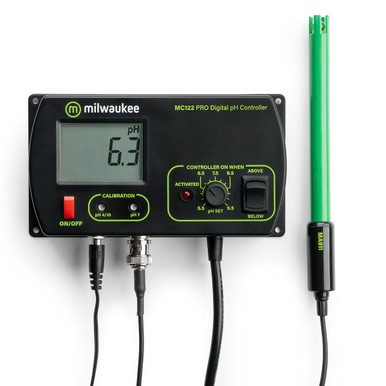
Milwaukee identifies the current North American unit as **MC122US**, UPC **810666004225**. The manufacturer publishes a **0.0–14.0 pH** measurement range, **0.1 pH** resolution, **±0.2 pH** accuracy, a **5.5–9.5 pH** selectable setpoint range, manual **two-point calibration**, and the included **MA911B/2** double-junction probe. The controller has **one power-control contact** rated by the current US product page for 115 VAC, **2A**.
Milwaukee's current manual suggests recalibration **at least once a month**, after prolonged storage and after probe replacement. It also states that the MC122 output contact has **no internal protection fuse** and recommends external protection against failure. Indexed marketplace/catalog evidence reconciles MC122 / model 716690 / UPC 810666004225 to ASIN **B00I47XIX2**.
The strongest documentation-led controller pick because Milwaukee publishes measurement specs, calibration procedure, control range, probe identity and electrical/failure boundaries in one current source set.
Check price on Amazon →#2Best two-device relay architecture
American Marine PINPOINT pH Controller
Best for: reef keepers who specifically need bidirectional or two-device control and will build independent safeguards around the relay outputs
What we like
- Current manufacturer page documents both upward and downward pH control
- Can automate two electrical devices rather than one control contact
- Current 120 VAC version is documented for loads up to 3.0 amps
- Probe and calibration fluids are included
- Manufacturer explicitly positions the controller for calcium-reactor setups
What we don't
- The controller does not publish the same simple measurement accuracy/resolution summary on its current product page as Milwaukee
- Two controllable outputs add more possible relay/connected-device failure paths
- A setpoint still must come from system-specific chemistry and equipment guidance rather than the controller
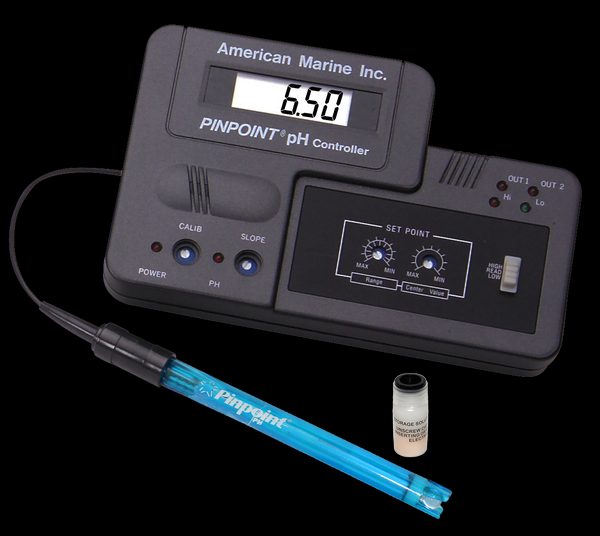
American Marine's current **PINPOINT pH Controller** page says the 120 VAC controller can operate **two electrical devices**, control pH in both an **upward and downward** direction, and handle up to **3.0 amps at 120 VAC**. It is sold with the pH **probe and calibration fluids**, and the manufacturer explicitly lists **calcium reactor** setups among its intended uses.
That flexibility is not a reason to remove fail-safes. Each relay output can only act on the probe reading it receives, while the connected solenoid, pump or other device has its own failure modes. Indexed marketplace evidence for the exact American Marine PINPOINT pH Controller, UPC **660689005057**, reconciles to ASIN **B001EHJO5K**.
The more flexible relay architecture, ranked second because measurement-spec visibility is less direct on the current product page than Milwaukee's.
Check price on Amazon →#3Best monitor-only option
American Marine PINPOINT pH Monitor
Best for: reef keepers who want continuous pH trend visibility without allowing the meter itself to energize chemistry-control hardware
What we like
- Current manufacturer page publishes fine 0.01 resolution
- Monitor-only architecture avoids automatically switching CO2, pumps or dosing hardware
- Sold with probe and calibration fluids
- Probe uses a 10 foot high-suppression cable with BNC connector
- Standard 9-volt battery operation allows monitoring without a controller relay
What we don't
- Does not switch equipment
- Fine display resolution is not a claim of 0.01 accuracy
- Continuous monitoring still depends on calibration, probe care and representative placement
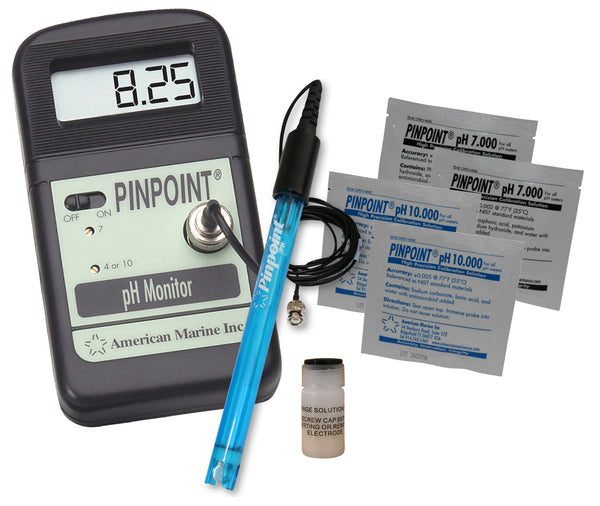
American Marine's current **PINPOINT pH Monitor** page describes a full-time **monitor-only** instrument with **0.01 resolution**, sold with its probe and calibration fluids. The probe uses a **10 foot** high-suppression cable and **BNC connector**, while the meter runs from a standard **9-volt battery** unless the optional AC adapter is used. It **does not switch equipment**.
The fine display is useful for viewing trend shape, but **resolution is not accuracy**. A hundredth-place display does not prove that every hundredth-place change is chemically real. Indexed marketplace evidence reconciles the exact PINPOINT pH Monitor to ASIN **B000255MH4**.
The best fit when observation and alarms/trend interpretation matter more than automatic control; it deliberately leaves the action decision outside the meter.
Check price on Amazon →A reef pH device can do one of two fundamentally different jobs:
- monitor-only: measure and display pH;
- controller: measure pH and energize/de-energize external equipment.
That distinction matters more than the number of decimal places on the display.
Our reef pH monitoring guide explains calibration, day/night trends, probe drift and controller failure design. If the trend points to high indoor CO2, the reef CO2 scrubber guide covers the separate air-treatment decision. This buyer guide focuses on the exact hardware.
For wider chemistry context, use the aquarium water-parameters guide. For CO2 reactor hardware, use the reef calcium reactor guide. For kalkwasser, use the kalkwasser reactor guide. Pressurized planted-tank gas hardware is covered separately in the aquarium CO2 systems guide, and reef alkalinity still needs a direct reef alkalinity tester.
Quick decision: monitor-only, single-output or dual-output control
| Product | Architecture | Published evidence | Best when | Avoid if |
|---|---|---|---|---|
| Milwaukee MC122 PRO | Single-output controller | 0.0–14.0 pH, 0.1 resolution, ±0.2 pH accuracy; one 2A control output on the current 115 VAC model | You need one supervised chemistry-control loop such as a calcium-reactor CO2 solenoid and value explicit measurement/calibration documentation | You need two independent relay actions or only want monitoring with no switched equipment |
| PINPOINT pH Controller | Dual-output controller | two independent 3.0A 120 VAC relay outputs with upward/downward control around the selected range | You genuinely need separate high/low actions or two-device control and can add independent safeguards around both outputs | You only need observation, or a simpler one-output control path reduces failure complexity |
| PINPOINT pH Monitor | Monitor-only | 0.01 display resolution, probe/calibration fluids, 9V operation; does not switch equipment | You want continuous trend visibility while keeping chemistry actions manual or in a separate controller | Automatic relay switching is a hard requirement |
A controller adds an actuator path; it does not make the chemistry safer by itself. Choose the architecture first, then compare calibration, probe care and measurement evidence. Every controller path still needs a system-appropriate setpoint and an independent way to contain probe, relay, solenoid or dosing failures.
Resolution is not accuracy
A monitor that displays 8.12 instead of 8.1 is showing finer resolution.
That does not prove the 8.12 value is closer to the true pH.
Resolution is not accuracy.
Milwaukee publishes both values for the MC122: 0.1 pH resolution and ±0.2 pH accuracy. American Marine’s PINPOINT pH Monitor emphasizes its 0.01 display resolution, but this guide does not convert that into an invented ±0.01 accuracy claim.
For reef decisions, calibration quality, probe condition, placement and trend repeatability can matter more than an extra display digit.
A controller is not automatically safer
A monitor-only device leaves the response to you or to a separate automation system.
A controller can make the response immediate, but it can also automate a bad decision if:
- the probe drifts;
- the probe leaves the water;
- the probe is dirty or miscalibrated;
- a relay fails;
- a stuck solenoid continues CO2 flow;
- a connected pump siphons or keeps delivering;
- the setpoint is wrong for the system.
So a controller is not automatically safer than a monitor.
For critical chemistry control, consider an independent fail-safe outside the same sensor/relay path. Depending on the system, that can mean a mechanical gas-flow limit, supervisory controller, alarm, timer, conservative reservoir, or a bounded maximum delivery volume.
The exact architecture depends on the equipment; this guide does not invent a universal cutoff.
No universal reef pH target
There is no universal reef pH target that applies identically to every aquarium.
pH varies with:
- gas exchange and room CO2;
- alkalinity;
- photosynthesis and respiration;
- day/night timing;
- kalkwasser or CO2 reactor operation;
- livestock and husbandry context.
Use a system-appropriate operating range from reliable guidance and interpret the repeated trend.
Do not buy a controller because it promises to “hold” one copied number.
No universal calcium-reactor pH setpoint
A calcium reactor deliberately lowers chamber pH with CO2 so calcium-carbonate media dissolves.
There is no universal calcium-reactor pH setpoint.
The useful chamber range depends on the exact reactor media, reactor design, CO2 input, effluent flow and measured alkalinity demand. Follow the reactor and media manufacturer rather than copying another aquarium.
A chamber pH controller is therefore a reactor-control instrument, not a substitute for testing aquarium alkalinity and calcium.
How we researched and scored
PetGearReport has not physically tested these meters/controllers, measured long-term probe drift, verified published accuracy, forced relay/solenoid failures, compared calibration buffers in a laboratory or controlled reef chemistry with them.
The displayed number is a PetGearReport research score, not a hands-on result, Amazon/customer rating or laboratory performance score.
- Measurement & calibration evidence — 30%
- Control architecture & failure boundaries — 25%
- Probe care & serviceability — 20%
- Reef / reactor integration — 15%
- Exact identity & source quality — 10%
| Product | Measurement 30% | Control/safety 25% | Probe/service 20% | Integration 15% | Identity 10% | Weighted | Score |
|---|---|---|---|---|---|---|---|
| Milwaukee MC122 PRO | 9.5 | 9 | 9.5 | 9 | 8.5 | 9.20 | 9/10 |
| PINPOINT pH Controller | 8 | 9.5 | 8.5 | 9 | 8.5 | 8.70 | 9/10 |
| PINPOINT pH Monitor | 8.5 | 7 | 8.5 | 8 | 8.5 | 8.10 | 8/10 |
The decimals make the method auditable; they do not imply measured engineering precision.
Milwaukee MC122 PRO: clearest current measurement + control documentation
The current North American identity is MC122US, UPC 810666004225.
Milwaukee publishes:
- range: 0.0–14.0 pH;
- resolution: 0.1 pH;
- accuracy: ±0.2 pH;
- setpoint range: 5.5–9.5 pH;
- manual two-point calibration;
- included MA911B/2 double-junction probe;
- one power-control contact;
- current US power-driver specification: 115 VAC, 2A.
The current manual also exposes operational boundaries that matter in a reef cabinet. It suggests recalibration at least once a month and says the MC122 output contact has no internal protection fuse, recommending external protection against failure.
That documentation quality is why it ranks first—not a claim that PetGearReport measured superior real-world accuracy.
PINPOINT pH Controller: more relay flexibility
American Marine’s current controller page documents a different architecture.
The PINPOINT pH Controller can:
- control pH in both upward and downward directions;
- automate two electrical devices;
- handle up to 3.0 amps at 120 VAC on the current US version;
- ship with the pH probe and calibration fluids;
- integrate with a calcium reactor setup.
Two outputs can be useful when a system needs separate up/down equipment, but they also mean more switched hardware that must fail safely.
If you only need to switch one CO2 solenoid, the extra relay flexibility is not automatically an advantage.
PINPOINT pH Monitor: observation without relay control
The PINPOINT pH Monitor deliberately does less.
American Marine documents:
- full-time monitoring;
- 0.01 resolution;
- included probe and calibration fluids;
- 10 foot high-suppression probe cable;
- BNC connector;
- standard 9-volt battery power, with optional AC adapter.
It is monitor-only and does not switch equipment.
That can be a feature rather than a limitation when you want a continuous graph/reading but prefer chemistry changes to remain manual or handled by another controller with separate safeguards.
What to verify before trusting a controller output
Before allowing any pH device to switch chemistry hardware:
- calibrate using the exact manufacturer’s procedure;
- inspect probe condition and storage history;
- place the probe where it remains submerged in representative water;
- verify the setpoint against the actual reef/reactor plan;
- confirm which direction the relay activates;
- test the connected solenoid or pump while observing the system;
- add an independent failure limit where practical;
- retest alkalinity/pH after meaningful changes.
Probe drift is not the only concern. A healthy probe can still give misleading control input if it is moved to a local dosing plume or if the water level drops below it.
Monitor for trends; test chemistry directly
A pH trend can reveal gas-exchange changes, room-CO2 patterns, day/night cycles and controller behavior.
It cannot replace direct alkalinity measurement.
The reef alkalinity tester guide compares measurement methods separately because pH and alkalinity answer different questions.
For calcium reactors, pair chamber pH monitoring with effluent/system alkalinity trend. For kalkwasser, treat high-pH cutoff logic as backup protection rather than the primary demand signal.
Exact product identity verification
Product identity evidence checked September 25, 2026, without freezing current Amazon price or availability:
- B00I47XIX2 matched Milwaukee MC122 / model 716690 / UPC 810666004225. Milwaukee identifies the current North American unit as MC122US with the same UPC; Milwaukee remains the primary source for measurement, calibration and power-driver specifications.
- B001EHJO5K matched American Marine PINPOINT pH Controller / UPC 660689005057. American Marine remains the primary source for the current two-device, upward/downward, 3.0-amp 120 VAC control architecture.
- B000255MH4 matched American Marine PINPOINT pH Monitor. Current public catalog evidence maps the ASIN to the monitor-only product, while American Marine remains the primary source for 0.01 resolution, probe/cable details and 9V operation.
These checks keep affiliate destinations tied to the intended hardware while separating durable identity and manufacturer specifications from temporary marketplace state. No direct Amazon product-page probe was used for this refresh.
Sources
- Milwaukee Instruments — MC122 PRO pH Controller — current MC122US identity, UPC, range, resolution, accuracy, setpoint, calibration, probe and power-driver specifications.
- Milwaukee Instruments — MC110/MC120/MC122 manual — calibration procedure, monthly recalibration suggestion, output-contact fuse warning and operating instructions.
- American Marine — PINPOINT pH Controller — two-device control, upward/downward control, 120 VAC load limit, probe/calibration inclusion and calcium-reactor positioning.
- American Marine — PINPOINT pH Monitor — 0.01 resolution, probe cable/BNC, 9V power and monitor-only product architecture.
- Desertcart — Milwaukee MC122 — public ASIN B00I47XIX2 to model 716690 / UPC 810666004225 identity evidence.
- Desertcart — PINPOINT pH Controller — public ASIN B001EHJO5K to UPC 660689005057 identity evidence.
- Desertcart — PINPOINT pH Monitor — public ASIN B000255MH4 to PINPOINT pH Monitor identity evidence.
Public catalog records are used only to cross-check exact affiliate-product identity against the manufacturer-defined hardware. No Amazon price, stock or availability claim is made because those values can change independently of the editorial comparison.
Frequently asked questions
Is 0.01 pH resolution automatically more accurate than 0.1?
No. Resolution is the smallest displayed increment; accuracy is a separate specification. A finer display can make trends easier to see, but it does not prove every displayed hundredth is correct.
Is a pH controller safer than a monitor?
Not automatically. A controller can stop or start equipment, but that also means probe drift, bad placement, a relay fault or a stuck solenoid can change chemistry automatically. Independent fail-safes remain important.
Can I use the controller setpoint as my reef pH target?
No. There is no universal reef pH target for every aquarium. Choose an appropriate operating range from reliable system/livestock guidance, then use the monitor/controller as one measurement or safety layer.
What pH should I set for a calcium reactor?
There is no universal calcium-reactor pH setpoint. Follow the exact reactor and media manufacturer, then tune the reactor against effluent behavior and measured alkalinity demand.