Best Reef Kalkwasser Reactors: 3 Picks by Mixing, Safety & Integration
A kalkwasser reactor is hardware for preparing and delivering calcium-hydroxide solution; it does not decide how much alkalinity or calcium your reef needs. We researched three exact marketplace variants using current manufacturer documentation for mixing architecture, delivery safeguards, ATO/dosing integration, maintenance, fit and exact product identity. PetGearReport has not physically tested these reactors, measured saturation, verified delivered concentration, logged pH response, tested failure modes, measured motor life or observed aquarium outcomes.
| Rank | Product | Score | Best for | Link |
|---|---|---|---|---|
| #1 | IceCap Kalk Mixing Reactor KM-120Best documented compact mixer | 9 | reef keepers who want a compact magnetic-mixer reactor with unusually explicit installation and maintenance documentation | Check price → |
| #2 | Reef Octopus OCTO KS-100 Kalk StirrerBest paddle-style duty-cycle documentation | 9 | reef keepers who prefer a slow paddle-style stirrer and can accommodate a tall dry-mounted reactor with separate feed plumbing | Check price → |
| #3 | Two Little Fishies KW Reactor 300Best motorless up-flow architecture | 8 | reef keepers who want a simple up-flow kalk reactor without a dedicated stirrer motor and already understand their top-off/feed plumbing | Check price → |
#1 · Our PickBest documented compact mixer
IceCap Kalk Mixing Reactor KM-120
Best for: reef keepers who want a compact magnetic-mixer reactor with unusually explicit installation and maintenance documentation
What we like
- Current CoralVue documentation identifies exact small SKU IC-KM-120
- Adjustable speed magnetic mixer gives direct mixing control without an internal powerhead
- Manufacturer documents non-submersible installation, timer/controller use and explicit no-continuous-run boundary
- Quick-fill cap, detachable vessel and published maintenance intervals make service expectations unusually clear
- Exact IC-KM-120 marketplace identity reconciles to ASIN B07RJ233WW
What we don't
- ATO system or dosing pump, calcium hydroxide and timer/controller are required separately
- Manufacturer warns the reactor must not be used without intact friction bands
- The 100-gallon manufacturer fit statement is not evidence of a safe chemistry dose for every 100-gallon reef
CoralVue identifies the small IceCap Kalk Mixing Reactor as **SKU IC-KM-120**. Current specifications list use for aquariums up to **100 gallons**, a **5.7 x 5.7 inch** footprint, **5 inch** body diameter, **25 inch** height and **~1 gallon** holding capacity. The reactor uses an **adjustable speed magnetic mixer** and a detachable vessel with a quick-fill cap.
The safety and maintenance boundaries are unusually explicit: the reactor is **not submersible**, the mixer **must not be run continuously**, and CoralVue says not to use it without the magnet's friction bands. The manufacturer recommends inspecting those bands every **4–6 weeks**, replenishing kalkwasser roughly every two weeks and rinsing the vessel about monthly. Exact IC-KM-120 marketplace identity reconciles to ASIN **B07RJ233WW**.
The strongest documentation-led pick because CoralVue publishes exact size, holding capacity, non-submersible boundary, motor-use limit, friction-band inspection and service intervals.
Check price on Amazon →#2Best paddle-style duty-cycle documentation
Reef Octopus OCTO KS-100 Kalk Stirrer
Best for: reef keepers who prefer a slow paddle-style stirrer and can accommodate a tall dry-mounted reactor with separate feed plumbing
What we like
- Current Reef Octopus technical data identifies KS-100 article code 130304
- High-torque low-RPM motor gently stirs calcium hydroxide while leaving clearer liquid above the settled solids
- Current manufacturer page specifies 5 minutes every 2 hours rather than continuous operation
- Published 90–120 g calcium-hydroxide capacity and 26–53 GPH feed-pump suggestion make fit easier to reason about
- Exact KS-100 marketplace identity reconciles to ASIN B073QDSH5J
What we don't
- Feed pump, timer, RO tubing and calcium hydroxide are separate system dependencies
- Tall 27.6-inch body needs cabinet clearance
- Older indexed instructions differ on stir duration, so the current product page/current manual for the shipped unit should be checked before programming
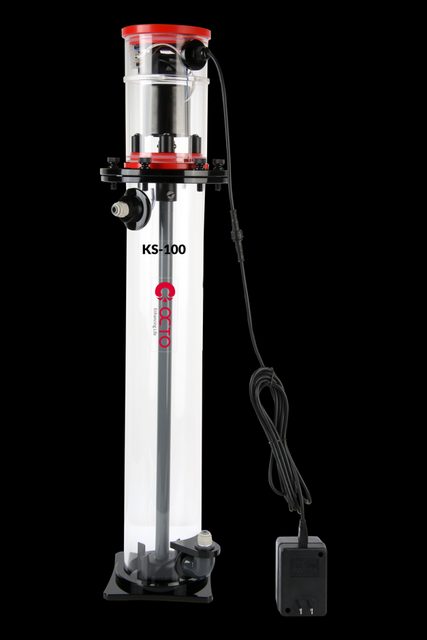
The **KS-100** is Reef Octopus article code **130304**. Current technical data lists **90–120 g** calcium-hydroxide capacity, a manufacturer tank-volume reference of **80–132 US gallons**, and a suggested feed-pump range of **26–53 GPH**. The body is a dry-mounted stirrer using a **high-torque low-RPM motor**.
The **current Reef Octopus product page** says to operate the stirrer for **5 minutes every 2 hours** with a timer. **Do not run the stirrer continuously.** Older indexed instructions have shown a different interval, so this article follows the current manufacturer page/catalog and recommends confirming the current instructions supplied for the exact unit before programming. Exact KS-100 marketplace identity reconciles to ASIN **B073QDSH5J**.
Strong current technical documentation and a clear intermittent-duty rule, with the main trade-off being height and more separate plumbing/control dependencies.
Check price on Amazon →#3Best motorless up-flow architecture
Two Little Fishies KW Reactor 300
Best for: reef keepers who want a simple up-flow kalk reactor without a dedicated stirrer motor and already understand their top-off/feed plumbing
What we like
- Manufacturer's up-flow design uses incoming top-off water rather than a dedicated mixing motor
- Tiny rotating sprinkler is documented to push about 5 gph upward through calcium hydroxide
- Can hang on the aquarium or mount below it, with rotating fittings and included check valve
- Threaded lid simplifies adding calcium hydroxide and routine service
- Exact ATLKWR300 marketplace identity maps directly to ASIN B004A507E0
What we don't
- Still requires a suitable feed/top-off pump and programmable timer
- Manufacturer's up-to-300-gallon statement is equipment positioning, not a chemistry dose limit
- Operational documentation is less detailed on maintenance intervals and failure inspection than IceCap's current page
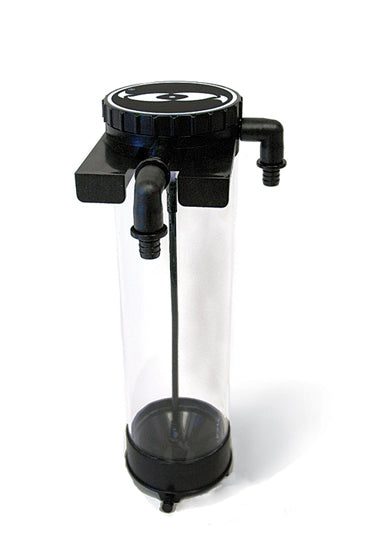
Two Little Fishies identifies this reactor as **ATLKWR300** / KW Reactor 300. The manufacturer says it can be fed by a small powerhead of **about 200 gph** or a high-pressure top-off pump; a tiny **rotating sprinkler** moves **about 5 gph** of top-off water upward through the calcium hydroxide. A **programmable timer** is required to limit on-time.
The manufacturer positions it for aquariums up to **300 gallons** and documents hang-on or below-aquarium mounting, an included **check valve**, rotating flexible fittings and a **threaded lid**. That 300-gallon statement is not a dose prescription. Exact ATLKWR300 maps directly to Amazon marketplace ASIN **B004A507E0**.
A simple, distinctive motorless up-flow design with clean exact identity, ranked lower because current maintenance and failure-boundary documentation is less detailed.
Check price on Amazon →A kalkwasser reactor is a mixing and delivery component, not a chemistry controller.
If you are still choosing between kalkwasser, two-part, an all-in-one supplement or a calcium reactor, start with the reef dosing methods guide. Once two comparable measurements establish consumption, the reef dosing calculator can estimate maintenance replacement from the exact product-label potency you enter.
For automation hardware, compare the aquarium dosing pump guide and ATO guide. For source freshwater, use the RODI systems guide. Keep the feedback loop anchored to a repeatable reef alkalinity test.
The most important boundary: tank-size rating is not a dose prescription
A reactor manufacturer may say that a model is intended for a 100-, 130- or 300-gallon system. That helps with equipment positioning and physical capacity.
It does not mean a reef of that size should receive a fixed amount of kalkwasser.
Tank-size rating is not a dose prescription.
Actual delivery depends on:
- measured calcium/alkalinity demand;
- actual system water volume;
- calcium-hydroxide concentration and preparation;
- freshwater delivery rate;
- whether the reactor is tied to evaporation replacement;
- pH and salinity response;
- the exact reactor and additive instructions.
ATO signal is not chemical demand
An auto top-off replaces evaporated freshwater according to water level.
ATO signal is not chemical demand.
Evaporation can change with room humidity, fans, seasonal HVAC use and open/closed lids even when coral demand has not changed. If kalkwasser delivery is directly tied to ATO activity, the chemical delivery rate can move because evaporation moved.
That does not make ATO-driven kalkwasser inherently wrong. It means the failure model must include both freshwater overdelivery and high-pH kalkwasser overdelivery.
A dosing pump can decouple chemistry delivery from the water-level signal, but the aquarium still cannot accept unlimited freshwater without affecting salinity and water level.
High-pH solution makes failure design part of the purchase
Kalkwasser is calcium hydroxide dissolved in freshwater. The solution is strongly alkaline.
A feed-pump, timer, controller, ATO sensor or plumbing failure can therefore become more than a simple water-level problem. Depending on the system architecture, overdelivery can affect pH, salinity and calcium/alkalinity balance at the same time.
Useful safeguards can include:
- conservative feed rates;
- maximum run-time limits where supported;
- independent high-water or leak detection;
- separating reservoir capacity from worst-case delivery when practical;
- pH monitoring appropriate to the system;
- regular inspection of tubing, check valves, seals and mixer parts;
- retesting alkalinity after programming changes.
The exact safeguards depend on the reactor, pump/controller and aquarium. This guide does not invent one universal kalkwasser rate or pH cutoff. If pH is used as an alarm or cutoff layer, the reef pH monitoring guide covers probe calibration, drift and why controller logic should remain backup protection rather than the primary demand signal. The reef pH monitor/controller guide covers the separate hardware choice.
How we researched and scored
PetGearReport has not physically tested these reactors, measured delivered kalkwasser concentration, logged pH, tested motor endurance, forced ATO failures, measured leak resistance or verified aquarium outcomes.
The displayed number is a PetGearReport research score, not a hands-on result, Amazon/customer rating or laboratory performance score.
- Mixing control & documentation — 25%
- Delivery safety & failure boundaries — 25%
- Installation & integration — 20%
- Maintenance & service access — 15%
- Capacity & fit documentation — 10%
- Exact identity & source quality — 5%
| Reactor | Mixing 25% | Safety 25% | Integration 20% | Service 15% | Fit 10% | Identity 5% | Weighted | Score |
|---|---|---|---|---|---|---|---|---|
| IceCap KM-120 | 9.5 | 9.5 | 9 | 9 | 9 | 9 | 9.25 | 9/10 |
| Reef Octopus KS-100 | 9 | 9 | 8 | 9 | 9 | 8 | 8.75 | 9/10 |
| TLF KW Reactor 300 | 8 | 8 | 9 | 8 | 8 | 8 | 8.20 | 8/10 |
The decimals make the weighting auditable. They do not represent measured engineering precision.
IceCap KM-120: the clearest service and safety documentation
The small IceCap model is IC-KM-120.
Current CoralVue documentation lists:
- up to 100 gallons;
- 5.7 x 5.7 inch footprint;
- 5 inch body diameter;
- 25 inch height;
- ~1 gallon holding capacity;
- adjustable speed magnetic mixer;
- push-fit tubing and a quick-fill cap.
More importantly, the current page makes the operating boundaries explicit.
The mixer is not submersible and must not be run continuously. CoralVue also warns not to use the reactor without the magnet’s friction bands, recommends checking those bands every 4–6 weeks, and publishes routine refill/rinse guidance.
That documentation is why it ranks first here; it is not evidence that PetGearReport measured better saturation or reliability.
Reef Octopus KS-100: intermittent paddle stirring with a current duty cycle
The KS-100 is article code 130304 in current Reef Octopus technical data.
Published data include:
- 90–120 g calcium-hydroxide capacity;
- tank-volume reference 80–132 US gallons;
- suggested feed pump 26–53 GPH;
- dry installation;
- high-torque low-RPM stirring.
The current Reef Octopus product page instructs users to run the mixer 5 minutes every 2 hours with a timer.
Do not run the stirrer continuously.
An older indexed instruction sheet has circulated with a different stir interval. Because of that conflict, this article uses the current Reef Octopus product page/current catalog and treats the current manual supplied for the exact unit as authoritative.
Two Little Fishies KW Reactor 300: motorless up-flow mixing
The ATLKWR300 takes a different approach.
Two Little Fishies says to use a small powerhead of about 200 gph or a high-pressure top-off pump. A tiny rotating sprinkler pushes about 5 gph of top-off water upward through calcium hydroxide, mixing a concentrated kalkwasser solution without a dedicated stirring motor.
The manufacturer also documents:
- a programmable timer to limit pump on-time;
- an included check valve;
- rotating flexible connection fittings;
- hang-on or below-aquarium placement;
- a threaded lid for refill/service;
- an up-to-300 gallons equipment positioning statement.
Again, that 300-gallon statement does not tell you how much kalkwasser to dose.
Which architecture fits which setup?
| If your priority is… | Architecture to examine first | Why |
|---|---|---|
| Explicit maintenance and non-continuous-motor documentation | IceCap KM-120 | Current manufacturer page publishes detailed install, motor, friction-band and service boundaries |
| Slow paddle stirring with published Ca(OH)2/feed-pump ranges | Reef Octopus KS-100 | Current technical table gives powder capacity, tank reference and feed-pump suggestion |
| No dedicated stirrer motor | TLF KW Reactor 300 | Incoming water drives a rotating sprinkler/up-flow mixing design |
| Chemistry delivery independent of evaporation | Dosing-pump-fed reactor | Lets chemistry delivery follow a measured schedule rather than ATO events |
| Simplest water-level automation | ATO-fed reactor | Fewer separate scheduling layers, but chemistry delivery then varies with evaporation |
The final choice still depends on measured demand, available cabinet height, freshwater source, controller/fail-safe design and how much service work you will actually perform.
Sources
- IceCap / CoralVue — Kalkwasser Mixing Reactor — IC-KM-120 identity, dimensions, holding capacity, non-submersible boundary, motor-use warning, friction-band inspection and maintenance guidance.
- Reef Octopus — Kalkwasser Reactor — current KS-100/150/250 technical table and current 5-minutes-every-2-hours stirrer instruction.
- Two Little Fishies — KW Reactor 300 — feed architecture, ~5 gph internal up-flow mixing, timer requirement, mounting and 300-gallon equipment reference.
Exact marketplace ASIN mappings were reconciled from indexed marketplace/catalog evidence against these manufacturer identities. No Amazon price, stock or availability claim is made because those values can change independently of the editorial comparison.
Frequently asked questions
Does a kalkwasser reactor decide how much kalkwasser my reef needs?
No. The reactor mixes or prepares the solution. Measure alkalinity demand, verify system water volume, follow the exact calcium-hydroxide/reactor instructions and retest after changes. A manufacturer tank-size rating is not a dose prescription.
Can I run a kalk stirrer continuously?
Not these motorized models. Current Reef Octopus guidance for the KS-100 says 5 minutes every 2 hours. CoralVue says the IceCap Kalk Mixer motor is unsuitable for continuous use and should be controlled by a timer/controller. Follow the exact current manual for the unit you own.
Should I run kalkwasser through my ATO?
It can be done when the exact hardware and chemistry instructions permit it, but remember that an ATO signal is not chemical demand. Evaporation changes with room conditions, so tying kalkwasser to top-off also ties chemical delivery to evaporation. Use fail-safes and monitor salinity, pH and alkalinity.
Is a kalkwasser reactor the same as a calcium reactor?
No. A kalkwasser reactor mixes calcium hydroxide with freshwater. A calcium reactor uses CO2 to dissolve calcium-carbonate media. The control architecture, failure modes and maintenance are different.