Best Aquarium Dosing Pumps: 5 Picks by Dose Range, Channels & Control
An aquarium dosing pump automates delivery of a dose you have already determined; it does not decide how much calcium, alkalinity, trace solution, liquid fertilizer, kalkwasser or other additive an aquarium needs. We researched five exact marketplace variants by pump architecture, calibration evidence, scheduling, channel count, dose range, failure boundaries, serviceability and exact product identity. PetGearReport has not physically tested these pumps, measured delivered volume, calibration drift, tubing wear, backflow, siphon behavior, missed-dose handling or long-term reliability.
| Rank | Product | Score | Best for | Link |
|---|---|---|---|---|
| #1 | Red Sea ReefDose 4Best documented four-head reef doser | 10 | reef aquariums where four independently scheduled supplement channels, fine documented dose increments and ReefBeat control justify the more sophisticated controller | Check price → |
| #2 | Kamoer X4 WiFi DoserBest scheduling and calibration flexibility | 9 | reef or advanced aquarium setups needing four channels, flexible schedules, calibration controls and explicit delay between chemically incompatible additions | Check price → |
| #3 | Chihiros Dosing Pump System (4 Pump Heads)Best planted-aquarium four-head system | 9 | planted freshwater and aquascape users who want four app-controlled fertilizer channels in a compact system with manufacturer-documented marine compatibility as a secondary use | Check price → |
| #4 | Kamoer X1 PRO-T2Best single-head high-flow / reactor feed option | 8 | single-fluid applications such as controlled kalkwasser delivery, calcium-reactor feed or other higher-flow continuous/extended dosing where one channel is enough | Check price → |
| #5 | Jebao DP-4Budget four-channel pick | 7 | cost-sensitive users who need four independently programmed channels and accept weaker current technical documentation and a simpler control interface | Check price → |
#1 · Our PickBest documented four-head reef doser
Red Sea ReefDose 4
Best for: reef aquariums where four independently scheduled supplement channels, fine documented dose increments and ReefBeat control justify the more sophisticated controller
What we like
- Four independently controlled direct-drive dosing heads
- Red Sea documents ±0.05 ml head accuracy and 0.2–1000 ml daily dose per head
- Three documented flow rates: 15, 30 and 45 ml/min
- ReefBeat scheduling includes single, hourly, timed and customized programs plus missed-dose compensation
- Exact ReefDose 4 / UPC 730773353200 maps to ASIN B0981K2CKZ
What we don't
- Designed specifically around reef supplementation rather than planted-aquarium fertilizer workflows
- App-connected ecosystem adds setup complexity versus a local-button doser
- Tubing and dosing-head condition still require inspection and recalibration despite strong control features
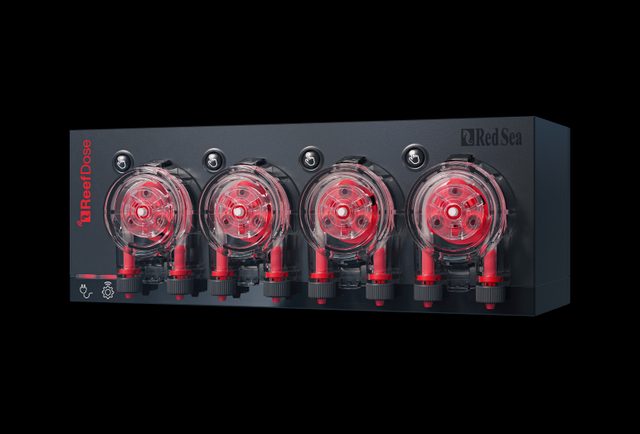
Red Sea documents the ReefDose 4 as a four-head reef dosing system using direct-drive planetary gear motors. The current manufacturer page specifies ±0.05 ml accuracy, a daily dose range of 0.2–1000 ml per head in 0.1 ml increments, and selectable flow rates of 15, 30 or 45 ml/min. ReefBeat supports single daily dosing, up to 24 hourly doses, timer schedules and customized schedules, plus missed-dose compensation after unscheduled interruptions.
Those controls automate delivery; they do not establish the chemically correct dose for the aquarium. Dose selection still belongs to the supplement instructions, current test results and the aquarium's measured demand. Exact ReefDose 4 identity with UPC 730773353200 reconciles to indexed Amazon.com ASIN B0981K2CKZ.
The strongest research pick because the exact current documentation is unusually complete on precision, daily dose range, flow rate, scheduling and missed-dose handling.
Check price on Amazon →#2Best scheduling and calibration flexibility
Kamoer X4 WiFi Doser
Best for: reef or advanced aquarium setups needing four channels, flexible schedules, calibration controls and explicit delay between chemically incompatible additions
What we like
- Four independent dosing channels with Wi-Fi control
- CoralVue documents manual, auto and custom modes plus channel-delay scheduling
- Documented minimum dosing volume is 0.1 ml and calibration resolution is 0.1 ml
- Settings are retained through power loss according to current distributor documentation
- Exact Kamoer X4 / UPC 851220007948 maps to ASIN B06VVH8C8N
What we don't
- The X4 platform is older than newer app-first dosing systems
- Detailed feature set increases setup complexity compared with simple local-button units
- Consumable pump tubing remains a wear item and manufacturer/distributor maintenance guidance still applies
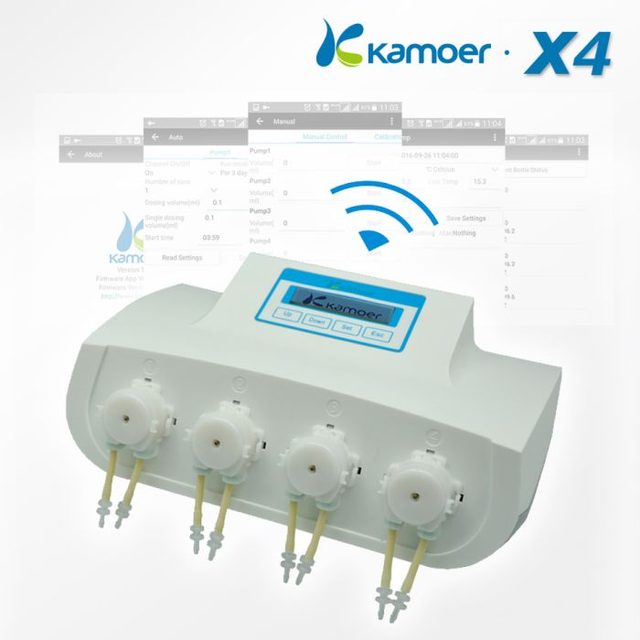
CoralVue's current Kamoer X4 documentation lists four dosing channels, Wi-Fi control, manual/auto/custom operating modes, a minimum 0.1 ml dose, 0.1 ml calibration resolution and scheduling from multiple doses per day to less-frequent intervals. A dedicated delay setting between channels is specifically intended to reduce chemical interaction when different solutions should not enter the system together.
The X4 also documents saved settings after power loss and replaceable PharMed tubing in the pump head. Those are useful failure and maintenance boundaries, not guarantees against stale calibration or worn tubing. Indexed marketplace evidence maps Kamoer X4 with UPC 851220007948 to Amazon.com ASIN B06VVH8C8N.
A feature-rich four-channel option with unusually detailed documentation for calibration, scheduling and channel delay, ranked just behind ReefDose because the platform is older and less streamlined.
Check price on Amazon →#3Best planted-aquarium four-head system
Chihiros Dosing Pump System (4 Pump Heads)
Best for: planted freshwater and aquascape users who want four app-controlled fertilizer channels in a compact system with manufacturer-documented marine compatibility as a secondary use
What we like
- Chihiros positions the system specifically for freshwater aquascapes while also documenting marine use
- Four dosing heads support independent liquid/fertilizer channels
- Manufacturer specifies 50 ml/min nominal dose flow per pump system
- Authorized Chihiros documentation describes app programming down to 0.2 ml daily dose with 0.1 ml adjustment increments
- Exact four-head marketplace variant maps to ASIN B0C38D437T
What we don't
- Manufacturer page publishes fewer precision/accuracy details than Red Sea or Kamoer X4 documentation
- App-based workflow still requires calibration and periodic verification
- Fertilizer demand must be determined from the planted system and product instructions rather than copied from another aquarium
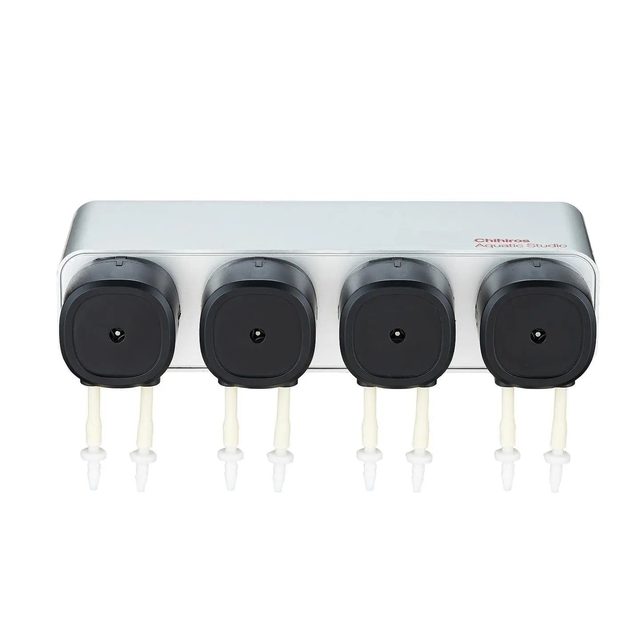
Chihiros describes its four-head dosing system as a professional freshwater aquascape doser that is also suitable for marine aquariums. The manufacturer lists four heads, 50 ml/min dosing flow, a 12V operating system and a documented pump-tube lifetime figure. Authorized Chihiros documentation describes daily dosing down to 0.2 ml, a maximum of 999.9 ml per head and 0.1 ml adjustment increments through the app.
Those programmable values do not tell a planted aquarium how much fertilizer it needs. Use the fertilizer manufacturer's instructions, plant load, water changes and measured nutrient trends to establish the target, then use the pump to repeat that target. The exact four-head marketplace variant reconciles to Amazon.com ASIN B0C38D437T.
The clearest planted-tank specialist in the shortlist, with four channels and small programmable doses but less published accuracy evidence than the top two.
Check price on Amazon →#4Best single-head high-flow / reactor feed option
Kamoer X1 PRO-T2
Best for: single-fluid applications such as controlled kalkwasser delivery, calcium-reactor feed or other higher-flow continuous/extended dosing where one channel is enough
What we like
- Single-head stepper architecture is designed for a different duty envelope than four-channel micro-dosers
- Kamoer technical documentation lists up to 110 ml/min flow and less than ±2% precision under its specified conditions
- Adjustment knob plus 2.4 GHz Wi-Fi control provides local and app control paths
- Manufacturer documentation explicitly supports dosing-pump and calcium-reactor feed use
- Exact X1 PRO T2-US maps to ASIN B0BDDVDQFW
What we don't
- Single-head design does not replace a four-channel system when several independent additives are required
- High flow capability is not evidence that every tiny intermittent dose will outperform a dedicated micro-doser
- Tubing route and outlet position must be set to avoid unintended siphon/backflow behavior
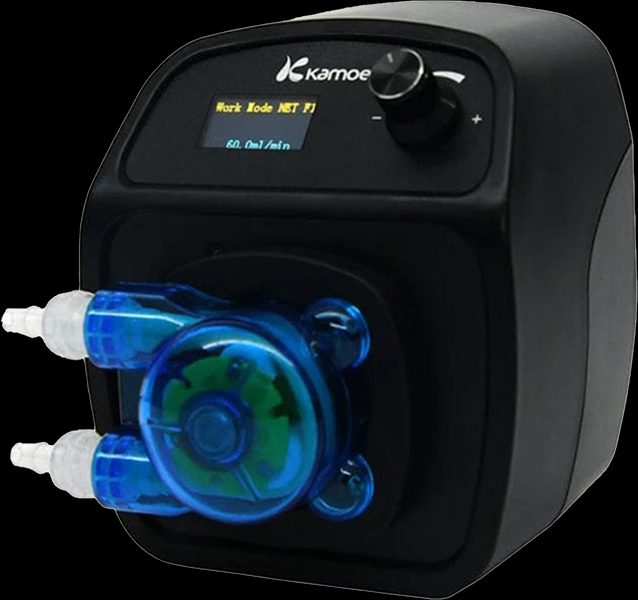
Kamoer identifies this exact platform as X1 PRO T2, with US marketplace model X1 PRO T2-US. Technical documentation lists a three-roller KPAS100 pump head, flow up to 110 ml/min, precision under ±2%, local adjustment knob control and 2.4 GHz Wi-Fi. Kamoer documentation describes use both as a dosing pump and as a calcium-reactor feed pump.
That makes the X1 PRO-T2 a separate use case from ReefDose, X4 or Chihiros. It is a single-head pump for one fluid path, not a four-channel additive organizer. For kalkwasser or reactor work, the chemical concentration and allowed delivery rate still need to come from aquarium testing, equipment instructions and a conservative pH/chemistry plan. Exact X1 PRO T2-US maps to Amazon.com ASIN B0BDDVDQFW.
A different tool rather than a smaller four-channel doser: strong single-head stepper capability for higher-flow or continuous-style applications.
Check price on Amazon →#5Budget four-channel pick
Jebao DP-4
Best for: cost-sensitive users who need four independently programmed channels and accept weaker current technical documentation and a simpler control interface
What we like
- Four-channel DP-4 remains documented in Jecod/Jebao's current dosing-pump family
- Each channel can be used for a different liquid addition schedule
- Local-button programming avoids dependence on a phone app or cloud service
- Exact DP-4 marketplace identity maps to GTIN 00617395384242 and ASIN B014KKCILE
- Long-running product identity makes replacement-head and setup information widely available
What we don't
- Current first-party documentation is substantially thinner on dose accuracy and calibration performance than the higher-ranked products
- Local interface is less flexible than modern app-controlled scheduling
- Marketplace specifications contain inconsistent flow wording, so this guide does not use an unverified flow figure as a ranking advantage
Jecod's current dosing-pump family still lists the DP-4 as a multi-channel automatic dosing model. The manufacturer documentation establishes the DP-series role and four-channel DP-4 identity, while indexed marketplace evidence maps model DP-4 / GTIN 00617395384242 to Amazon.com ASIN B014KKCILE.
We deliberately do not repeat marketplace flow-rate fields that conflict with Jecod's own table formatting, and we do not infer modern app features that the DP-4 does not document. Its value is straightforward four-channel local programming; its lower research score reflects weaker current first-party calibration and precision evidence, not a hands-on failure finding.
A conservative budget choice: four channels and exact product identity are clear, but current precision and calibration evidence is not strong enough to score it alongside the better-documented systems.
Check price on Amazon →A dosing pump is useful only after the dose itself has been justified.
For reef aquariums that can mean maintaining alkalinity, calcium, magnesium or other supplements. For planted freshwater aquariums it can mean repeatable fertilizer delivery. In both cases, the pump’s job is to repeat a programmed delivery, not to decide the chemistry target. If you already have two comparable reef test readings and the exact product-label potency, the reef dosing calculator can translate measured decline into a transparent maintenance-dose estimate before you program the pump.
That distinction is the foundation of this guide: a dosing pump does not decide how much to add. If you are still deciding whether the reef should use two-part, an all-in-one, kalkwasser or a calcium reactor, start with the reef dosing methods guide before choosing the delivery hardware.
Use the aquarium water-parameters guide to interpret chemistry in context and the aquarium water-test-kit guide to choose measurements that actually cover the parameter you are managing.
How we researched and scored
PetGearReport has not physically tested these dosing pumps, measured delivered volume, verified manufacturer accuracy claims, quantified calibration drift, aged tubing, simulated power loss, induced siphons/backflow or run unattended over-dose trials.
The displayed number is a PetGearReport research score, not a hands-on result, customer rating or laboratory measurement.
- Dosing architecture & calibration evidence — 30% — pump/motor design, documented accuracy or precision, calibration workflow and minimum controllable dose evidence.
- Scheduling, channels & control — 25% — number of independent heads, program flexibility, app/local control, channel delay and missed-dose/power-loss behavior.
- Dose range & application fit — 20% — documented dose/flow envelope and how clearly the system fits reef additives, planted fertilizers, reactor feed or other defined jobs.
- Failure boundaries, maintenance & serviceability — 15% — replaceable tubing/heads, routing guidance, calibration maintenance and explicit failure/installation limits.
- Exact identity & documentation — 10% — model/SKU/UPC/GTIN evidence reconciled to the ranked marketplace variant.
| Dosing pump | Architecture 30% | Scheduling/control 25% | Range/fit 20% | Maintenance 15% | Identity 10% | Weighted | Score |
|---|---|---|---|---|---|---|---|
| Red Sea ReefDose 4 | 10 | 10 | 10 | 9 | 10 | 9.85 | 10/10 |
| Kamoer X4 WiFi | 9 | 10 | 9 | 8 | 9 | 9.10 | 9/10 |
| Chihiros 4-head | 8 | 9 | 9 | 9 | 8 | 8.60 | 9/10 |
| Kamoer X1 PRO-T2 | 9 | 7 | 9 | 8 | 9 | 8.35 | 8/10 |
| Jebao DP-4 | 7 | 7 | 7 | 7 | 8 | 7.10 | 7/10 |
The weighted decimals make the method auditable; they do not imply laboratory precision. The published rank follows the same weighted evidence order while still preserving the different use cases: X1 PRO-T2 is a single-head specialist rather than a four-channel additive system.
Pump automation does not replace chemistry decisions
A dosing pump can execute the wrong instruction very consistently.
Before automating an additive:
- identify the parameter or nutrient the additive changes;
- measure the aquarium using an appropriate method;
- establish current consumption or plant demand over a useful interval;
- follow the exact additive manufacturer’s starting and adjustment directions;
- program conservatively;
- retest after automation begins and after meaningful livestock, plant, feeding or water-change changes.
For reef calcium and alkalinity, current Bulk Reef Supply guidance likewise derives dosing from measured consumption rather than from tank volume alone. Our reef alkalinity tester guide compares dedicated measurement methods before that demand is translated into an automated dose. For calcium, the reef calcium tester guide separates measurement accuracy/resolution from the dosing decision. For magnesium, the reef magnesium tester guide applies the same measured-demand boundary to slower-moving foundation chemistry. Water changes can also alter that measured demand; our reef salt mix guide compares replacement-water chemistry profiles so a salt change is not mistaken for a dosing-pump setting problem. For planted aquariums, fertilizer concentration and plant uptake differ by product and system, so a dosing pump cannot convert one aquarium’s schedule into a universal recipe.
ATO is not a dosing pump
An ATO is not a dosing pump.
An ATO follows evaporation-driven water level. A dosing pump should follow measured demand or another intentionally defined fluid-delivery program.
If a supplement is tied directly to evaporation, the chemical dose can change because room humidity, fans, temperature or open-lid evaporation changed — even when biological demand did not.
Use the aquarium auto top-off guide for water-level automation. Keep the two control problems separate unless the exact husbandry method intentionally couples them and you understand the resulting limits.
Calibration: programmed milliliters are not self-verifying
Peristaltic delivery depends on the pump head, tubing, fluid, calibration and installation.
Calibration can drift because:
- flexible tubing compresses and ages;
- pump-head rollers and tubing experience wear;
- tubing is replaced with a different material or dimension;
- the fluid viscosity changes;
- inlet/outlet routing changes;
- deposits form in the fluid path.
Use the manufacturer’s calibration procedure with the actual installed tubing and fluid path where applicable. Recheck after pump-head or tubing service and whenever a measured collection test no longer matches the programmed volume.
A manufacturer accuracy specification is evidence about a defined system and condition. It is not permission to assume that an uncalibrated or worn pump remains within that specification indefinitely.
Siphon and backflow are installation problems, not just pump problems
A stopped peristaltic pump does not make every plumbing layout safe.
Keep reservoirs, tubing and outlets arranged according to the manufacturer instructions. Avoid creating a gravity path that can continue to siphon liquid when the motor is off. Protect against backflow from the aquarium or sump into the dosing line where the exact installation guidance requires it.
For X1 PRO-T2, Kamoer specifically instructs users to keep the inlet line short and the outlet line suspended above the aquarium. That kind of routing boundary matters as much as the app setting.
Keep incompatible additives apart
Multi-channel pumps can deliver several liquids within seconds of one another. That does not mean the liquids should meet each other at full concentration.
Concentrated calcium and alkalinity solutions are a common reef example: adding them together or too close can trigger local precipitation. Follow the additive manufacturer’s compatibility and spacing directions.
Useful safeguards include:
- schedule chemically incompatible additives at different times;
- use separate dosing lines;
- discharge into adequate flow where the supplement manufacturer instructs;
- do not combine concentrates in one reservoir unless the product is explicitly formulated as one solution;
- re-test the aquarium after changing dose timing.
The Kamoer X4’s documented inter-channel delay is valuable for exactly this kind of scheduling problem, but correct chemistry still has to be established outside the pump.
Product-by-product fit
Red Sea ReefDose 4
Exact marketplace identity: ReefDose 4, UPC 730773353200, ASIN B0981K2CKZ.
Red Sea publishes the most complete precision/control specification in this shortlist: four heads, ±0.05 ml documented accuracy, 0.2–1000 ml/day per head, 0.1 ml increments and 15/30/45 ml/min flow modes.
Missed-dose compensation is useful, but it should be configured with judgment. Automatically catching up a benign trace additive is not automatically equivalent to catching up a chemical whose safe rate matters. Follow the exact additive and ReefDose configuration guidance.
Kamoer X4 WiFi Doser
Exact marketplace identity: Kamoer X4, UPC 851220007948, ASIN B06VVH8C8N.
Current CoralVue documentation gives the X4 four channels, Wi-Fi control, manual/auto/custom modes, 0.1 ml minimum dosing, 0.1 ml calibration resolution and a channel-delay setting.
That delay is particularly relevant for two-part chemistry. The controller can separate additions in time, but it cannot know whether the programmed separation, dose or outlet location is chemically appropriate for the exact products in use.
Chihiros Dosing Pump System — 4 heads
Exact marketplace variant: Chihiros Dosing Pump System (4 Pump Heads), ASIN B0C38D437T.
Chihiros is the strongest planted-aquarium fit here. Its current manufacturer page calls it a professional freshwater aquascape system and also documents marine suitability. It uses four heads and lists 50 ml/min dose flow.
Authorized Chihiros documentation publishes daily dose programming down to 0.2 ml with 0.1 ml adjustment increments. Because the manufacturer publishes less explicit delivered-volume accuracy evidence than Red Sea or Kamoer X4, this guide scores the calibration category more conservatively.
Kamoer X1 PRO-T2
Exact US model: X1 PRO T2-US, ASIN B0BDDVDQFW.
This is a single-head stepper pump with a different use case. Kamoer technical documentation lists flow up to 110 ml/min, precision under ±2%, an adjustment knob and Wi-Fi.
The manufacturer describes dosing-pump and calcium-reactor use. That makes it relevant for controlled kalkwasser delivery, calcium-reactor feed or another one-fluid application where a four-head additive system would be unnecessary. If the pump will feed a kalk stirrer rather than a plain reservoir, compare the kalkwasser reactor guide for the reactor-specific mixing and motor-duty boundaries.
Do not interpret high maximum flow as proof of better micro-dosing at every setting. Match the pump to the actual required flow envelope.
Jebao DP-4
Exact model: Jebao DP-4, GTIN 00617395384242, ASIN B014KKCILE.
The DP-4 remains part of Jecod/Jebao’s documented multi-channel dosing family and gives four locally programmed channels without requiring an app.
The reason it ranks fifth is evidence quality. Current first-party documentation does not provide the same clear accuracy/calibration specification available for the higher-ranked products, and marketplace flow fields are inconsistent enough that we do not use them as evidence.
Why Neptune DOS QuietDrive and EcoTech Versa are not ranked
Two technically strong pumps are deliberately unranked in this edition because exact current Amazon.com marketplace identity did not meet the same evidence gate as the five ranked variants.
Neptune DOS QuietDrive is a current two-head dosing/fluid-metering system with industrial stepper motors, a documented variable 0.1–250 ml/min flow range and Apex Fusion control. Neptune’s current page states that the QuietDrive model requires an A2 or A3 Series Apex.
EcoTech Versa is a single peristaltic pump with Mobius control, documented accuracy of 2% or less, a wide flow range and continuous/manual/auto modes. EcoTech explicitly states that Versa does not determine dosing volume; testing and tuning are still required.
Their exclusion is an exact Amazon marketplace identity decision, not a claim that either pump is technically inferior.
Maintenance checklist for any dosing pump
Add the doser to the aquarium maintenance schedule rather than treating it as set-and-forget equipment.
A practical inspection includes:
- verify that each reservoir contains the expected liquid;
- inspect tubing for hardening, flattening, cracking, salt creep or deposits;
- confirm inlet and outlet routing;
- check for siphon or backflow paths;
- measure delivered volume periodically using the manufacturer’s calibration method;
- recalibrate after tubing/head replacement;
- confirm that schedules were not unintentionally changed after app/controller updates or power events;
- compare aquarium test trends with the programmed daily amount.
Automation reduces repetitive manual work. It does not remove the need to verify what the equipment is actually doing.
Sources and verification
- Red Sea — ReefDose — four-head architecture, ±0.05 ml accuracy, daily dose range, flow rates, scheduling and missed-dose compensation.
- Red Sea ReefDose 4 support — current ReefDose 4 support identity.
- Chihiros — Dosing Pump System — four heads, 50 ml/min flow, freshwater-aquascape positioning, marine compatibility and current package specifications.
- CoralVue — Kamoer X4 WiFi Doser — channels, modes, scheduling, calibration, minimum dose, channel delay, power-loss settings and service parts.
- Kamoer X1 PRO-T2 FCC/manual record — manufacturer-submitted model identity and technical manual record.
- Jecod/Jebao — DP dosing pump family — current DP-series/DP-4 manufacturer family identity.
- Neptune Systems — DOS QuietDrive — current flow, lift, Apex requirement and use cases.
- EcoTech Marine — Versa — current peristaltic architecture, accuracy, flow range, Mobius modes and explicit testing/tuning boundary.
- Bulk Reef Supply — dosing and water chemistry FAQ — testing/consumption-first dosing workflow and separation of concentrated calcium/alkalinity additions.
No Amazon price, stock or availability claim is made here. Those are dynamic and are not part of the research score.
Frequently asked questions
What does an aquarium dosing pump actually do?
It meters a programmed amount of liquid on a schedule. The pump automates delivery; it does not determine the correct calcium, alkalinity, fertilizer, trace-element, kalkwasser or other chemical dose. That decision comes from appropriate testing, measured aquarium demand and the exact additive manufacturer's directions.
Is an ATO the same as a dosing pump?
No. An ATO is not a dosing pump. An ATO replaces evaporation according to water level, while a dosing pump should deliver a dose tied to measured demand or another defined process. Evaporation changes with room conditions, so using evaporation as the control signal for a supplement can make chemical delivery vary for the wrong reason.
How often should I calibrate a dosing pump?
Use the exact manufacturer's setup and maintenance instructions. Recalibrate after replacing tubing or a pump head, after changing the tubing route when the manufacturer says it matters, and whenever a measured verification shows delivered volume no longer matches the programmed amount. There is no single calibration interval that fits every pump, fluid and duty cycle.
Can I dose calcium and alkalinity at the same time?
Do not assume two concentrated additives are chemically compatible simply because the pump has multiple channels. Follow the additive manufacturer's instructions. Reef dosing guidance commonly separates concentrated calcium and alkalinity additions because dosing them together or too close can promote local precipitation. Multi-channel scheduling is useful because it lets you separate incompatible additions in time and/or location.
Can a dosing pump siphon liquid into the aquarium when the motor is off?
Plumbing geometry matters. Follow the pump manufacturer's inlet/outlet routing, keep dosing outlets positioned as instructed, and do not create a gravity path that can continue moving liquid after the pump stops. Check valves are not a substitute for correct installation unless the exact manufacturer requires and documents them.