Seachem Tidal 55 vs AquaClear 70: Flow, Media & Maintenance
The Seachem Tidal 55 and Fluval AC70 (AquaClear 70 family) are both configurable hang-on-back filters, but their strongest features are different. This research-based comparison uses current manufacturer documentation and exact product-identity evidence checked September 24, 2026. PetGearReport has not physically tested these filters, measured their real-world flow or noise, or observed long-term durability.
| Rank | Product | Score | Best for | Link |
|---|---|---|---|---|
| #1 | Seachem Tidal 55 Power FilterBest for controls & surface skimming | 9 | Aquariums up to 55 gallons where surface skimming, restart behavior and intake/flow controls matter more than a wider gallon envelope | Check price → |
| #2 | Fluval AC70 Power FilterBest for wider tank range & 4-stage media | 9 | 40–70 gallon aquariums where the wider manufacturer tank envelope and current AC70 four-stage media system are the stronger fit | Check price → |
#1 · Our PickBest for controls & surface skimming
Seachem Tidal 55 Power Filter
Best for: Aquariums up to 55 gallons where surface skimming, restart behavior and intake/flow controls matter more than a wider gallon envelope
What we like
- Seachem rates it for aquariums up to 55 US gallons
- Published Flow Rate is 250 US GPH with 1.2 Liters of filter volume
- Built-in surface skimmer plus adjustable submerged-intake split
- Self-priming pump and maintenance alert are documented features
- Open basket ships with foam and Matrix biomedia
What we don't
- Manufacturer tank envelope stops at 55 gallons
- Requires 3 inches of wall clearance behind the aquarium
- Surface-skimmer and intake-split controls add setup choices

Seachem specifies the Tidal 55 for aquariums up to 55 US gallons / 200 L, with a 250 US GPH / 1000 L/h Flow Rate, 1.2 Liters of filter volume and 6W draw at 120V. Those are manufacturer specifications, not PetGearReport measurements.
Its main differences are functional rather than numerical. Seachem documents a surface skimmer, adjustable split between surface and submerged intake, front flow regulation, bottom-to-top media flow, a self-priming pump and a maintenance alert. The open basket ships with foam and Matrix biomedia rather than requiring a proprietary cartridge.
Product identity evidence checked September 24, 2026: B01M6Z59E9 matched Seachem Tidal 55, without freezing current Amazon price or availability. Choose it because those controls and the up-to-55-gallon envelope fit your aquarium, not because 250 GPH is assumed to be a standardized real-world benchmark.
Choose the Tidal 55 when you want the more feature-rich intake and restart system: surface skimming, self-priming startup, a maintenance alert and an open media basket in one documented design.
Check price on Amazon →#2Best for wider tank range & 4-stage media
Fluval AC70 Power Filter
Best for: 40–70 gallon aquariums where the wider manufacturer tank envelope and current AC70 four-stage media system are the stronger fit
What we like
- Fluval documents a 40–70 US Gal aquarium range
- Published Max. Flow Rate is 300 US GPH / 1136 LPH
- Current AC70 uses 4-stage filtration with pre-filter, chemical, biological and mechanical stages
- CycleGuard and patented refiltration are documented current-generation features
- Current manufacturer listing includes pre-filter sponge, Bio-Foam, BIOMAX and activated carbon
What we don't
- No built-in surface skimmer is documented on the current AC70 page
- 300 GPH is a Max. Flow Rate label, not a PetGearReport measurement
- Current-generation media layout is more prescribed than the Tidal's open single basket
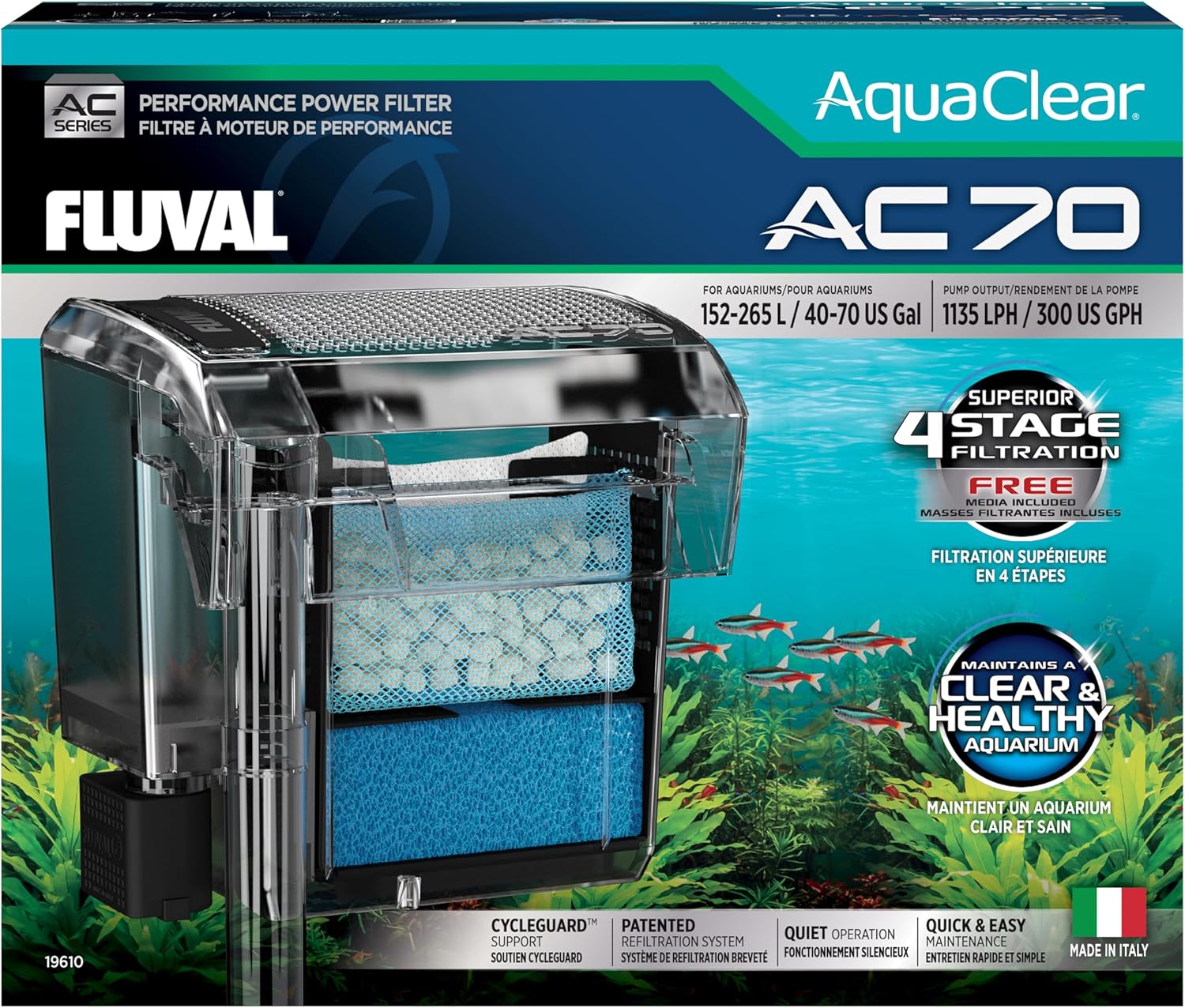
Fluval's current AC Series documentation identifies model 19615 / UPC 015561196154 as the AC70 for 40–70 US Gal / 152–265 L aquariums. It publishes a Max. Flow Rate of 300 US GPH / 1136 LPH, 7W draw at 120V and an 8.5 x 6.1 x 8.6 inch body.
The current generation uses a 4-stage path with an intake pre-filter, chemical stage, biological stage and mechanical stage. Fluval also documents CycleGuard, adjustable flow, a dedicated chemical-media access point and a patented refiltration system that increases media contact when flow is reduced.
Product identity evidence checked September 24, 2026: B0DCGB5T4Y matched Fluval AC70 item 19615 / UPC 015561196154, without freezing current Amazon price or availability. This page uses that exact current AC70 identity rather than the older B000260FUW affiliate target. Treat 300 GPH as Fluval's Max. Flow Rate label rather than a directly equivalent measurement to Seachem's Flow Rate.
Choose the current AC70 when its 40–70-gallon envelope, 4-stage media path, CycleGuard and 300-GPH Max. Flow Rate specification better match the aquarium than the Tidal's extra intake controls.
Check price on Amazon →How we researched and scored
PetGearReport has not physically tested the Tidal 55 or AC70, measured their installed flow, noise, priming reliability, debris capture or long-term durability. We compared current manufacturer documentation, exact model identity, aquarium-capacity guidance, hydraulic labels, media architecture, controls, installation requirements, maintenance workflow and current public product-identity evidence. Amazon pricing, temporary availability and customer-star ratings were not scoring inputs.
The displayed 1–10 number is a PetGearReport research score, rounded to the nearest whole number from the same five weighted categories for both filters:
- Tank fit & hydraulic documentation — 25%: exact aquarium range and clarity of the published hydraulic label.
- Media architecture & flexibility — 25%: reusable media stages, basket freedom and documented media path.
- Flow control & use-case fit — 20%: output control, intake options and features relevant to different tank layouts.
- Maintenance & restart workflow — 15%: service access, clog indication and documented restart behavior.
- Documentation & parts support — 15%: current official specifications, model traceability and replacement-media support.
| Filter | Tank fit / hydraulics 25% | Media architecture 25% | Flow / use-case fit 20% | Maintenance / restart 15% | Documentation / parts 15% | Weighted result | Published score |
|---|---|---|---|---|---|---|---|
| Seachem Tidal 55 | 9 | 9 | 10 | 9 | 9 | 9.20 | 9/10 |
| Fluval AC70 | 9 | 10 | 8 | 8 | 9 | 8.90 | 9/10 |
Both round to 9/10. The Tidal ranks first here because its integrated surface-skimmer, intake-split, self-priming and maintenance-alert features give it broader documented control for this particular head-to-head comparison. That is an editorial research judgment, not evidence that it performs better in every aquarium.
Quick verdict
Choose the Tidal 55 when you want built-in surface skimming, adjustable intake split, self-priming restart, a maintenance alert and one large configurable media basket. Its manufacturer envelope tops out at 55 gallons.
Choose the current Fluval AC70 when the 40–70 gallon manufacturer envelope, 4-stage media layout, CycleGuard and refiltration system fit the aquarium better. Its current US specification is 300 US GPH Max. Flow Rate, not an independently measured installed-flow result.
Tidal 55 vs AquaClear 70 at a glance
| Decision point | Seachem Tidal 55 | Fluval AC70 / AquaClear 70 |
|---|---|---|
| Manufacturer aquarium range | Up to 55 US gallons / 200 L | 40–70 US Gal / 152–265 L |
| Published hydraulic label | Flow Rate: 250 US GPH / 1000 L/h | Max. Flow Rate: 300 US GPH / 1136 LPH |
| 120V wattage | 6W | 7W |
| Media design | One large removable open basket; foam + Matrix included | 4-stage path; pre-filter sponge, Bio-Foam, BIOMAX and carbon included |
| Surface skimmer | Built in, with adjustable surface/submerged intake split | No built-in surface skimmer documented on the current AC70 page |
| Flow adjustment | Front pump-flow control plus intake-split control | Adjustable flow with patented refiltration at reduced output |
| Restart feature | Manufacturer explicitly documents self-priming pump | Follow current AC70 startup/manual procedure; this comparison does not assume identical priming behavior |
| Maintenance cue | Mechanical maintenance alert rises when media restriction diverts flow | CycleGuard and dedicated media-stage access; no equivalent pop-up alert documented |
| Body / clearance | 8 1/16 x 6 1/8 x 8 3/8 in; 3 in wall clearance | 8.5 x 6.1 x 8.6 in body; verify rear/rim fit for the exact tank |
The table is a specification comparison, not a performance test. The hydraulic labels come from different manufacturers and are not interchangeable as standardized real-world flow measurements.
At exactly 55 gallons: what actually changes
Both manufacturer envelopes include 55 US gallons. At that exact tank size, the useful decision is therefore not “which one is rated for the tank?” but which documented architecture and headroom fit the setup.
| 55-gallon decision | Tidal 55 | Fluval AC70 | What changes |
|---|---|---|---|
| Manufacturer ceiling | 55 US gal | 70 US gal | AC70 extends the published ceiling by 15 US gallons |
| Published hydraulic label | Tidal 55: Flow Rate — 250 US GPH | AC70: Max. Flow Rate — 300 US GPH | The 50 GPH label difference is not a standardized performance margin because the manufacturers use different labels |
| 120V power | Tidal 55: 6W | AC70: 7W | AC70 adds 1W on the published 120V specification |
| Control / restart emphasis | Built-in surface skimmer, intake-flow split, self-priming pump and maintenance alert | Adjustable flow; follow current startup/manual procedure | Tidal adds more integrated intake/restart controls |
| Media-system emphasis | One configurable open basket with foam + Matrix | 4-stage filtration, CycleGuard and refiltration | AC70 uses a more structured current-generation media path |
At 55 gallons, AC70’s extra 15 gallons of published capacity headroom can matter if future stocking, media workflow or system layout makes that useful. Tidal 55 instead keeps its built-in surface-skimming and intake/restart features. Neither difference establishes a universal performance winner.
Flow: 250 GPH vs 300 GPH does not decide the winner
Seachem publishes 250 US GPH for the Tidal 55 under the label Flow Rate. Fluval publishes 300 US GPH for the current AC70 under Max. Flow Rate. The extra 50 GPH on paper does not prove that the AC70 will deliver a proportionally stronger installed circulation pattern after media loading, flow adjustment and tank-specific restrictions.
Use those numbers inside each manufacturer’s documented operating envelope. If the aquarium is above 55 gallons, the AC70’s 40–70 gallon range is the more relevant specification. If the aquarium is within both ranges, livestock current tolerance, intake behavior, media workflow and physical fit become more useful decision criteria.
Our aquarium filter size guide explains why manufacturer ranges and hydraulic labels should come before a generic turnover formula.
Media architecture: open basket vs structured 4-stage path
The Tidal 55 gives you one large basket and explicitly does not require filter cartridges. Seachem includes foam and Matrix, but the basket can be configured around the mechanical, biological and optional chemical media your aquarium actually needs. Bottom-to-top flow is designed to push water through the basket rather than around the media.
The current AC70 is also reusable-media friendly, but its architecture is more structured. Fluval documents 4-stage filtration with a pre-filter, chemical stage, biological stage and mechanical stage. The current package includes a pre-filter sponge, Bio-Foam, BIOMAX and activated carbon, and CycleGuard is designed around changing media independently rather than replacing the whole biological system at once.
Neither approach is universally better. Choose the Tidal if open-basket freedom matters most; choose the AC70 if you prefer a defined staged layout. Our aquarium filter media guide explains the function of each media type without assuming every filter should use the same order.
Surface skimming, intake control and livestock fit
The Tidal 55 has the clearer advantage when surface-film management is part of the buying decision. Seachem documents a built-in surface skimmer plus an adjustable split between the surface intake and telescoping underwater intake. That lets you change where the filter draws water without adding a separate skimmer device.
The current AC70 page documents an intake pre-filter strainer and adjustable flow, but not a built-in surface skimmer. For fry or very small shrimp, neither bare powered intake should automatically be assumed safe. Use a compatible intake guard only when it fits the exact filter and keep it clean enough that it does not starve the pump of water.
If gentle intake is the primary constraint, compare the sponge filter vs HOB guide before forcing either powered HOB into the setup.
Restart and maintenance workflow
Seachem explicitly calls the Tidal 55 self-priming. Its submerged pump does not require the basket to be manually filled before startup, and the filter also has a mechanical maintenance alert that rises when clogged media redirects water around the basket.
The AC70 takes a different approach. Its current generation emphasizes direct media access, a redesigned rotor, a pre-filter strainer, separate media stages and CycleGuard. Fluval also documents a patented refiltration system: reducing flow increases media contact rather than simply bypassing the filtration path.
PetGearReport has not power-cycled either unit or timed service procedures. Treat these as documented design differences, not hands-on reliability findings.
Physical fit and clearance
Both filters occupy similar rear-rim territory, but check the exact aquarium before ordering. Seachem publishes the Tidal 55 at 8 1/16 inches long, 6 1/8 inches wide and 8 3/8 inches high, with 3 inches of wall clearance, 1 inch of tank-trim clearance and 1 11/16 inches of internal-tank clearance.
Fluval publishes the current AC70 body at 8.5 x 6.1 x 8.6 inches. Lid hinges, lighting mounts, braces and the distance to the wall can matter as much as nominal tank gallons. A filter that fits the capacity range but conflicts with the lid or cannot be reached for service is a poor practical choice.
Which one should you buy?
Choose the Tidal 55 if:
- the aquarium is within Seachem’s up-to-55-gallon range;
- built-in surface skimming is useful;
- you want to adjust the split between surface and submerged intake;
- self-priming restart and a visible maintenance alert are priorities;
- one large configurable basket matches how you prefer to manage media.
Choose the AC70 if:
- the aquarium falls in Fluval’s 40–70-gallon range, especially above the Tidal 55’s 55-gallon ceiling;
- you prefer a defined 4-stage media system with separate reusable components;
- CycleGuard and the current AC refiltration design fit your maintenance approach;
- the 7W current-generation unit and its physical dimensions fit the setup;
- a built-in surface skimmer is not a requirement.
If you are comparing more than these two models, use our best aquarium HOB filters roundup. For the smaller cross-brand decision, compare Tidal 55 vs AquaClear 50. For the same-family size decision, use Tidal 55 vs 75; for the next cross-brand step, continue to Tidal 75 vs AquaClear 70; for the larger 110-gallon-class HOB decision, use Tidal 110 vs AquaClear 110. If you are deciding whether to size up within Fluval’s own AC line, use AquaClear 70 vs 110. If you are not yet committed to a rim-mounted filter, our best aquarium filters and canister filter vs HOB comparison cover the broader architecture decision.
Exact product identity verification
Product identity evidence checked September 24, 2026: B01M6Z59E9 matched Seachem Tidal 55, and B0DCGB5T4Y matched Fluval AC70 item 19615 / UPC 015561196154, without freezing current Amazon price or availability. Current manufacturer documentation independently matches the AC70 item/UPC and the Tidal 55 model/specification set. No direct Amazon product-page probe was used for this refresh.
Sources
- Seachem — Tidal 55 — current aquarium range, Flow Rate, wattage, filter volume, dimensions, surface skimmer, intake controls, self-priming pump, maintenance alert and included media.
- Seachem — Compare Tidal Filters — current Tidal 55 technical specifications and clearance dimensions.
- Fluval — AC Series Aquarium Filters — current AC70 item/UPC, aquarium range, Max. Flow Rate, wattage, dimensions, 4-stage filtration and included media.
- Fluval — AC70 Power Filter — current model identity, CycleGuard, refiltration, media layout and freshwater/saltwater compatibility.
Frequently asked questions
Is the AquaClear 70 more powerful than the Tidal 55 because it says 300 GPH?
That conclusion is not supported by the labels alone. Fluval publishes 300 US GPH as the AC70's Max. Flow Rate, while Seachem publishes 250 US GPH as the Tidal 55's Flow Rate. These are manufacturer-specific hydraulic labels, not PetGearReport measurements made under one standardized test. Use tank range, media layout, controls and livestock needs alongside the numbers.
Which filter is better for a 55-gallon aquarium?
Both manufacturers include 55 gallons within their documented envelope: Tidal 55 is rated up to 55 US gallons, while AC70 is rated for 40–70 US gallons. The better fit depends on the aquarium's livestock, desired current, media workflow, clearance and whether features such as surface skimming or the AC70's 4-stage layout matter to you.
Which one has more flexible media?
The Tidal 55 uses one large open basket and explicitly avoids required cartridges, which favors custom media arrangement. The current AC70 also separates reusable media stages, but its 4-stage layout provides dedicated locations for pre-filter, mechanical, chemical and biological media. Flexibility therefore means different things: open-basket freedom versus a more structured staged path.
Does either filter restart itself after a power interruption?
Seachem explicitly documents the Tidal 55 as self-priming. The current Fluval AC70 product page emphasizes its redesigned media and pump system but should be installed and restarted according to the current manual. Do not assume identical restart behavior just because both are hang-on-back filters.