Best Aquarium Filters for Axolotls: 5 Low-Flow Picks for Waste & Maintenance
Axolotls need effective biological and mechanical filtration without being forced to live in a strong current. We researched five exact filter variants with an emphasis on controllable or diffused return flow, intake safety, debris handling, maintenance and manufacturer documentation. PetGearReport has not physically tested these filters, measured installed current or evaluated them as veterinary equipment; the recommendations are research-based and should be matched to the individual aquarium and animal.
| Rank | Product | Score | Best for | Link |
|---|---|---|---|---|
| #1 | Fluval 207 Performance Canister FilterBest overall balance | 9 | Axolotl aquariums within the 20–45 gallon manufacturer range where configurable media and controlled return placement justify a canister | Check price → |
| #2 | hygger HG256 Double Biochemical Sponge Filter (Small)Best gentle sponge option | 9 | Calmer axolotl setups where gentle intake behavior matters more than a powered return and the documented HG256 size class fits | Check price → |
| #3 | OASE BioMaster 2 350 Canister FilterBest premium service workflow | 9 | Larger axolotl systems where separate pre-filter cleaning, included spray-bar return and outlet flow control justify the larger canister | Check price → |
| #4 | Fluval 107 Performance Canister FilterBest lower-circulation canister | 9 | Axolotl setups inside the 10–30 gallon product envelope where the smaller 07 Series hydraulic and media class is a better fit than the 207 | Check price → |
| #5 | Seachem Tidal 35 Power FilterBest conditional HOB | 8 | Axolotl tanks within the manufacturer's ceiling where rim-mounted service access matters and the return can be adjusted and observed carefully | Check price → |
#1 · Our PickBest overall balance
Fluval 207 Performance Canister Filter
Best for: Axolotl aquariums within the 20–45 gallon manufacturer range where configurable media and controlled return placement justify a canister
What we like
- Fluval documents a 20–45 US gal range
- 121 US GPH Filter Circulation is published separately from 206 GPH Pump Output
- 07 Series output can be reduced by up to 50% using the AquaStop control
- Compatible Fluval spray bar can distribute the return more evenly
- Exact Amazon.com identity already verified in current PetGearReport content
What we don't
- Spray bar is a separate accessory rather than standard equipment
- External hoses and canister servicing add complexity
- Even reduced or diffused flow still has to be checked in the actual axolotl tank

Fluval specifies the 207 for 20–45 US gal / 60–220 L and publishes 206 US GPH Pump Output separately from 121 US GPH Filter Circulation. Fluval's 07 Series support documentation also states that output can be safely reduced by up to 50% with the AquaStop valve. That does not create a guaranteed axolotl-safe setting, but it gives the owner a manufacturer-supported way to reduce return strength.
Fluval also sells a spray-bar kit compatible with the 107/207/307/407 series. The manufacturer describes it as distributing water evenly, which can be useful when a concentrated nozzle return is too localized. The spray bar is sold separately, so its cost and installation should be considered part of the setup rather than treated as included hardware.
Choose the 207 when its exact tank range, media capacity and cabinet requirements fit the aquarium. Observe the animal and the actual water movement after installation; a published hydraulic number is not a welfare guarantee.
Our strongest overall researched fit because the 207 combines a defined tank range, a lower documented complete-filter circulation figure and manufacturer-supported output reduction, with an optional spray bar for broader return distribution.
Check price on Amazon →#2Best gentle sponge option
hygger HG256 Double Biochemical Sponge Filter (Small)
Best for: Calmer axolotl setups where gentle intake behavior matters more than a powered return and the documented HG256 size class fits
What we like
- Air-driven sponge architecture avoids a narrow powered intake
- Small HG256 is positioned in the 10–40 gallon class
- Dual sponges provide mechanical and biological surface area
- Separate media chambers add flexibility beyond a plain foam block
- Exact Amazon.com identity already verified in current PetGearReport content
What we don't
- Requires a separate air pump and airline
- Air-pump output is not aquarium water-flow GPH
- Large axolotl setups may need a different or supplemental filtration plan depending on waste load
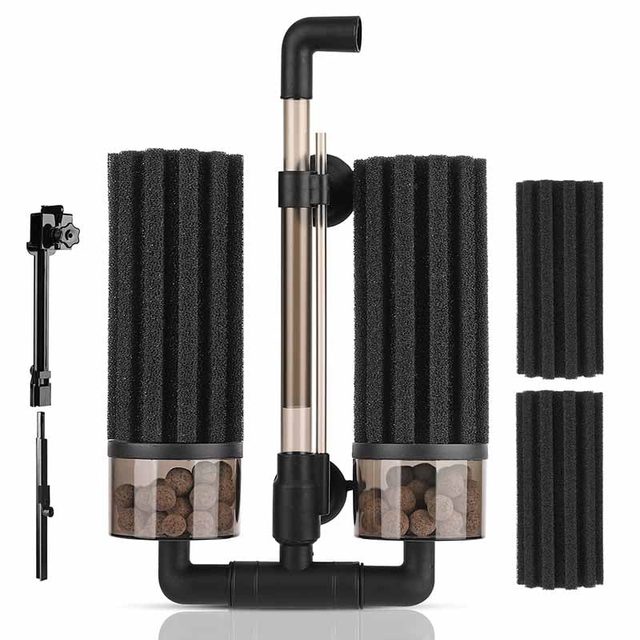
The Small HG256 uses two sponge intakes with separate biomedia chambers and an air-driven uplift rather than a powered water pump. That architecture can make the intake and return less concentrated than many powered filters, but it does not eliminate the need to size the system for real waste production and maintain the sponges before they clog.
Because it is air-driven, this page does not invent a water-circulation GPH number from the air pump. Air-pump output is a different measurement. Use an appropriately sized adjustable air source and verify water quality rather than comparing the pump's air rating with a canister's Filter Circulation figure.
The HG256 is ranked above other sponge products here because its current exact identity is already verified, its media layout is documented, and its gentle architecture is directly relevant to the axolotl-flow constraint.
The gentlest architecture in the shortlist: useful when avoiding concentrated intake and return flow is the primary design constraint, provided the tank's actual waste load and water tests support the setup.
Check price on Amazon →#3Best premium service workflow
OASE BioMaster 2 350 Canister Filter
Best for: Larger axolotl systems where separate pre-filter cleaning, included spray-bar return and outlet flow control justify the larger canister
What we like
- Outlet flow is adjustable
- Current US package includes a spray bar
- EasyClean pre-filter can be removed separately for debris service
- 5.6 L filter volume plus 0.50 L pre-filter volume
- Exact non-Thermo Amazon.com identity already verified in current PetGearReport content
What we don't
- 295 GPH is OASE's Max. gallons per hour label, not a target for axolotls
- OASE publishes an upper 90-gallon ceiling rather than a lower tank-size boundary
- Optional heater integration is not an axolotl advantage
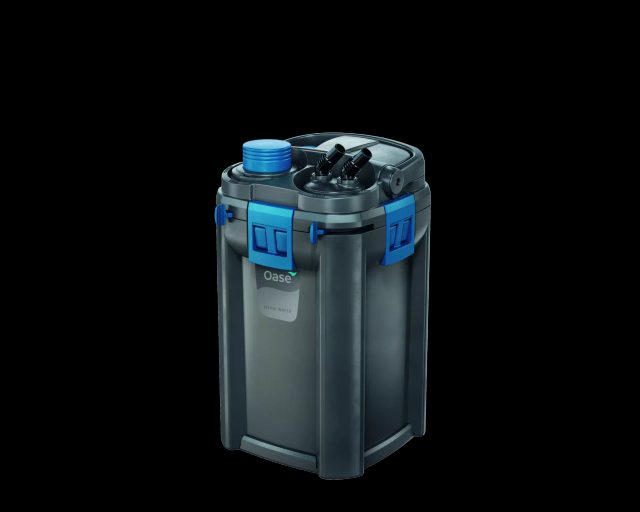
OASE documents the BioMaster 2 350 for aquariums up to 90 gallons / 350 L, with 295 GPH published under Max. gallons per hour, 5.6 L filter volume and a 0.50 L pre-filter. Its US package contents include a spray bar, and OASE documents flow control on the outlet. Those are useful features when the objective is to spread and reduce localized return energy.
The EasyClean pre-filter is the other relevant difference for an animal that can generate substantial solid waste: the pre-filter can be removed separately from the main canister for routine debris service. That may reduce how often the biological-media chamber has to be disturbed.
OASE also markets optional HeatUp heater integration. For this species, heater compatibility is not an axolotl advantage. The Royal Veterinary College gives 16–18°C as the optimum environmental range and says temperature should never exceed 24°C, so this page does not score heater integration as a benefit or recommend adding an in-filter heater.
The maintenance-focused premium option because OASE combines separate pre-filter service with an included spray bar and outlet flow control, while its raw maximum-flow figure remains a constraint to manage rather than a goal.
Check price on Amazon →#4Best lower-circulation canister
Fluval 107 Performance Canister Filter
Best for: Axolotl setups inside the 10–30 gallon product envelope where the smaller 07 Series hydraulic and media class is a better fit than the 207
What we like
- Fluval documents a 10–30 US gal range
- 95 US GPH Filter Circulation is published separately from 145 GPH Pump Output
- 07 Series output can be reduced by up to 50%
- Compatible Fluval spray bar is available separately
- Exact Amazon.com identity already verified in current PetGearReport content
What we don't
- 30 gallons is the top of its manufacturer range
- Smaller media capacity than the 207
- External plumbing and servicing remain more involved than sponge filtration
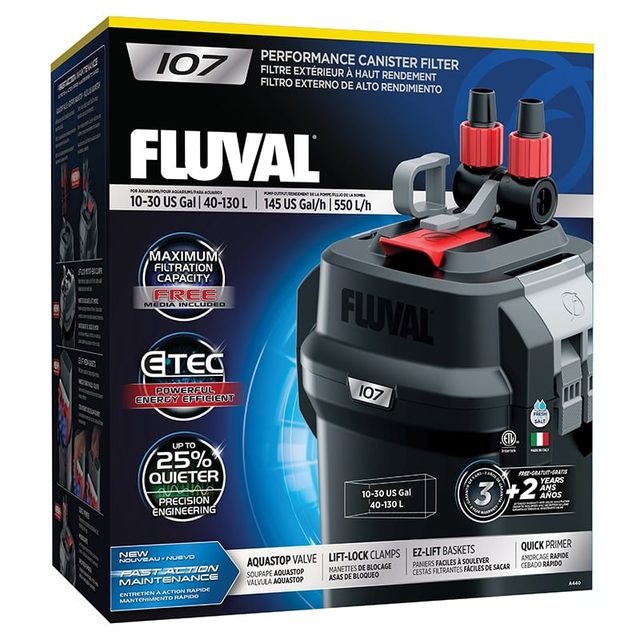
Fluval specifies the 107 for 10–30 US gal / 40–130 L and separates 145 US GPH Pump Output from 95 US GPH Filter Circulation. As with the 207, Fluval allows the 07 Series output to be reduced by up to 50%, and the same 07 Series spray-bar kit is compatible with the 107.
The reason to choose the 107 is not that less flow is automatically better. It is that the exact manufacturer tank range, 95 GPH complete-filter circulation label and compact canister body may fit a smaller setup without buying unnecessary hydraulic or media headroom.
At the upper edge of its 30-gallon range, compare the media and maintenance plan carefully. A filter can be gentle enough in current and still be undersized for the system's debris or biological load.
The lower-circulation 07 Series choice when the 107's exact range is sufficient and the same manufacturer-supported output reduction and spray-bar options are useful.
Check price on Amazon →#5Best conditional HOB
Seachem Tidal 35 Power Filter
Best for: Axolotl tanks within the manufacturer's ceiling where rim-mounted service access matters and the return can be adjusted and observed carefully
What we like
- Seachem documents filtration for aquariums up to 35 US gallons
- 130 US GPH Flow Rate
- Front dial provides pump flow regulation
- Open media basket and removable basket simplify media access
- Exact Amazon.com identity already verified in current PetGearReport content
What we don't
- HOB return is more localized than a well-positioned spray bar or air-driven sponge
- Seachem does not publish a lower gallon boundary
- Minimum dial position still needs real-tank observation rather than being assumed safe
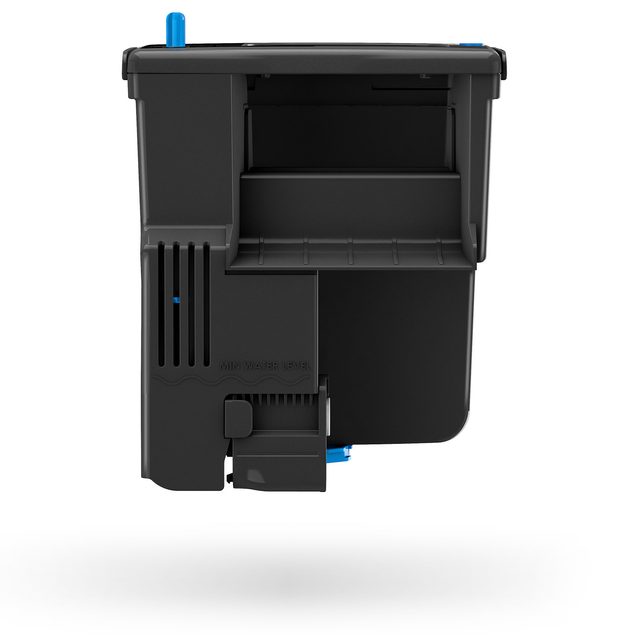
Seachem publishes the Tidal 35 for aquariums up to 35 US gallons / 130 L with a 130 US GPH Flow Rate. The manufacturer documents a front flow-regulation dial, open media basket, surface skimmer and removable basket. Those features make it more adjustable and serviceable than a fixed-output cartridge HOB.
The limitation is return geometry. A rim-mounted HOB sends water back from one concentrated location, so a low dial setting should not be treated as automatic proof of suitable axolotl current. Hardscape, water depth and placement can change what the animal experiences near the bottom.
Choose the Tidal 35 only when the exact setup lets you keep the current gentle throughout the occupied area. If that cannot be achieved, a sponge filter or a canister with a diffused spray-bar return is the more defensible architecture.
A conditional HOB choice rather than a default axolotl recommendation: useful for easy media access and adjustable flow, but only when the real return current remains calm enough in the animal's living area.
Check price on Amazon →If an installed filter is pushing an axolotl around or concentrating too much return flow into the occupied area, use the aquarium strong-flow troubleshooting guide for manufacturer-supported adjustment, output redirection and spray-bar/diffusion options before changing filter size.
How we researched and scored
PetGearReport has not physically tested these filters, measured installed current, monitored axolotl behavior with them or independently verified manufacturer flow figures. We compared current veterinary husbandry guidance, manufacturer documentation, exact model identities and already-verified Amazon.com variants. The displayed numbers are PetGearReport research scores, not hands-on or veterinary ratings.
The weighted categories are the same for all five picks:
- Flow management & intake safety — 30%: ability to reduce, diffuse or avoid concentrated current and how exposed the intake is.
- Filtration architecture & debris handling — 25%: mechanical/biological layout, pre-filtration and suitability for routine solid-waste capture.
- Maintenance & serviceability — 20%: how easily debris-loaded stages can be accessed without unnecessarily disturbing established biological media.
- Tank fit & hydraulic documentation — 15%: exact manufacturer aquarium range and clarity of the published hydraulic label.
- Exact identity & evidence quality — 10%: strength of current manufacturer documentation and exact variant verification.
| Product | Flow & intake 30% | Architecture 25% | Maintenance 20% | Tank/docs 15% | Identity 10% | Weighted result | Published score |
|---|---|---|---|---|---|---|---|
| Fluval 207 | 9 | 9 | 8 | 10 | 10 | 9.05 | 9/10 |
| hygger HG256 Small | 10 | 8 | 8 | 8 | 10 | 8.80 | 9/10 |
| OASE BioMaster 2 350 | 9 | 9 | 10 | 8 | 10 | 9.15 | 9/10 |
| Fluval 107 | 9 | 8 | 8 | 10 | 10 | 8.80 | 9/10 |
| Seachem Tidal 35 | 7 | 8 | 9 | 9 | 10 | 8.25 | 8/10 |
The ranking is editorial, not a raw-score sort. OASE has the highest arithmetic result because its service architecture is unusually strong, but Fluval 207 remains the overall pick because its 20–45 gallon range and lower complete-filter circulation metric make the initial fit easier to bound for a common axolotl-sized setup. The HG256 remains the strongest gentle-flow architecture when its air-driven capacity is sufficient.
Why flow matters more here than in a generic filter roundup
The Royal Veterinary College axolotl care sheet warns that strong filter flow can cause severe stress and that over-filtration also needs to be controlled. PetMD’s axolotl care guidance similarly calls for a good filter with gentle water flow and adjustable flow because high, rapid current can damage or stress the external gills.
That makes this a different buying problem from the broad best aquarium filters guide. A filter can have excellent media capacity and still be a poor axolotl fit if its intake or return creates a persistent high-current zone. Conversely, a very gentle filter can be inadequate if it cannot keep up with the aquarium’s actual debris and biological load. If room conditions make active cooling necessary, compare the separate aquarium chiller guide; chiller-loop flow and the gentle current experienced by the axolotl are related plumbing decisions, not the same metric.
There is no universal turnover value on this page. A gallons-per-hour ratio can describe one aspect of circulation, but it does not capture return shape, intake exposure, media loading, head pressure or manufacturer test conditions.
Keep unlike GPH labels separate
The five products demonstrate why one GPH leaderboard would be misleading:
- Fluval publishes Filter Circulation and Pump Output separately for the 107 and 207.
- OASE publishes Max. gallons per hour for the BioMaster 2 350.
- Seachem publishes Flow Rate for the Tidal 35.
- An air-driven sponge filter does not publish aquarium water flow from its air pump under the same metric at all.
Use our aquarium filter size guide if you want the wider explanation of manufacturer tank ranges, hydraulic labels and why turnover is context rather than a universal sizing rule.
Sponge vs canister vs HOB for an axolotl
A sponge filter is the cleanest low-current architecture in this shortlist. The intake is spread across foam and the water movement is driven by rising air. The trade-off is finite mechanical capacity and the need for a separate air pump. Our best aquarium sponge filters covers the architecture in more detail.
A canister filter moves most media outside the display and gives more control over intake/return placement. Fluval’s 07 Series allows output reduction, while OASE supplies a spray bar with the BioMaster 2 350. The trade-off is more hoses, cabinet space and service hardware. See our best aquarium canister filters for the generic architecture decision.
A HOB filter such as the Tidal 35 is easier to access from the rim, but its return is concentrated in one place. Flow regulation helps, yet the actual current still needs to be checked at the axolotl’s level rather than assumed from the dial position alone.
Intake safety and pre-filter sponges
Powered canister and HOB filters use concentrated intakes. If the exact intake design leaves exposed suction that you want to soften or keep debris away from, a correctly fitted pre-filter sponge can add a sacrificial mechanical layer. Our pre-filter sponge guide explains how to measure fit and why a clogged pre-filter can reduce system flow.
Do not improvise an intake cover that can collapse, detach or block the filter beyond its intended operating limits. Inspect any added pre-filter frequently and service it before flow falls substantially.
Flow reduction without guessing
For the Fluval 107 and 207, use the manufacturer’s supported AquaStop method rather than kinking hoses: Fluval says the 07 Series output can be safely reduced by up to 50%. If a concentrated nozzle return remains too localized, Fluval’s compatible spray bar can distribute the outlet across a longer section of the aquarium.
For the OASE BioMaster 2 350, the US package includes a spray bar and OASE documents flow control at the outlet. The published 295 GPH remains a Max. gallons per hour specification, not a recommended axolotl target.
For the Tidal 35, Seachem provides a pump flow-regulation dial. Treat that control as a tuning tool, not as proof that any particular dial position is safe. Observe the real return pattern after hardscape, water level and media loading are in place.
Water quality still decides whether filtration is working
A calm tank is not automatically a clean tank. Before adding an axolotl, establish the biological filter and verify it with testing; our aquarium cycling guide explains the ammonia → nitrite → nitrate process. During operation, use the aquarium water parameters guide and a suitable aquarium water test kit to follow water quality rather than judging filtration from visible clarity alone.
Mechanical debris also needs routine removal. If replacement tap water contains chlorine or chloramine, use the aquarium water conditioner guide to select by the source-water disinfectant and exact label rather than species branding; axolotl-specific temperature and water parameters remain separate husbandry constraints. Use the aquarium maintenance schedule to plan recurring checks, then inspect intake screens, sponge surfaces and pre-filter stages and service them when loading begins to restrict flow. A larger motor does not substitute for removing accumulated waste.
Temperature is a separate husbandry constraint
The Royal Veterinary College gives 16–18°C as the optimum environmental temperature for axolotls and says it should never exceed 24°C. That matters when evaluating the BioMaster platform: OASE promotes optional HeatUp heater integration, but heater compatibility is not an axolotl advantage and receives no score credit here.
This guide is about filtration selection, not treatment of heat stress or illness. If an axolotl is showing abnormal behavior, gill changes, persistent appetite loss or other health concerns, consult a veterinarian experienced with aquatic or exotic species.
Why Hikari Bacto-Surge is not ranked here
The Hikari Bacto-Surge is a well-documented air-driven sponge filter and appears in PetGearReport’s generic sponge-filter guide. However, Hikari’s own current precaution states that the product is for ornamental fish and should not be used for another purpose. Because an axolotl is an amphibian, we do not rank Bacto-Surge on this species-specific page even though the architecture looks attractive on flow alone.
That is exactly the kind of product-fit boundary this page is intended to preserve: species compatibility comes before a convenient product category match.
Sources
- Royal Veterinary College — Axolotl care sheet
- PetMD — Axolotl (Ambystoma mexicanum) care
- Fluval — 07 Series FAQ
- Fluval — 07 Series specifications
- Fluval — 06/07 Series spray bar
- OASE — BioMaster 2 350
- Seachem — Tidal 35
- hygger — HG256 Double Biochemical Sponge Filter
- Hikari — Bacto-Surge Sponge Filters
Frequently asked questions
Do axolotls need a filter?
A good filter is strongly advisable for maintaining water quality, but the current must remain gentle. PetMD recommends a good filter with adjustable flow, and the Royal Veterinary College warns that strong filter flow and over-filtration can cause stress. Filtration does not replace cycling, water testing or regular maintenance.
What filter flow is best for an axolotl?
There is no universal turnover target that PetGearReport can defend for every axolotl tank. Use the exact filter's manufacturer range, keep return flow gentle and controllable, diffuse concentrated output where appropriate, and watch the animal's response. Manufacturer GPH labels are not interchangeable across brands or test methods.
Is a sponge filter enough for an axolotl?
It can be part of an appropriate setup when the exact sponge filter, air supply, tank size and waste load fit, but do not assume that gentle flow automatically means enough mechanical capacity. Monitor ammonia, nitrite, nitrate trends, visible debris and sponge loading, and add or change filtration if the system cannot maintain water quality.
Can I use a canister filter for an axolotl?
Yes, if the exact model fits the aquarium and its intake and return can be managed so current remains gentle. Fluval's 07 Series permits output reduction and supports a separate spray bar; OASE BioMaster 2 350 includes a spray bar and outlet control. Those features help with flow management but do not replace observation in the actual tank.
Should I use a heater with an axolotl filter?
Do not treat heater integration as a filtration benefit for axolotls. The Royal Veterinary College lists 16–18°C as the optimum environmental temperature and says the water should never exceed 24°C. Temperature problems should be addressed according to qualified husbandry or veterinary guidance rather than by assuming an aquarium heater is needed.